How to Find Competitors Keywords
Your competitors have already proven which keywords work. Every page ranking in their top twenty is a data point: that topic gets searched, that intent drives traffic, that search can convert. Finding competitors keywords is not about copying anyone. It is about shortcutting months of guesswork by looking at what has already been validated in your market.
Most businesses approach website keyword analysis in a vacuum. They use suggestion tools, brainstorm topics, pick terms that sound right. Then they spend six months building content and wonder why nothing ranks. Checking what competitors already rank for takes maybe two hours and tells you more than a week of tool-based guessing.
I have been doing competitive analysis for clients in Calgary and across Canada since 2007. Here is what actually works.

Why Competitor Keyword Research Matters
Competitors who have been doing SEO for a few years have spent real money finding out what works. Their organic traffic is built on keywords that survived the test of Google’s algorithm and actual searcher behavior. You can either spend the same time and money running your own experiments, or you can look at what they have already figured out.
That is the practical case for starting here in your keyword research. Proven demand. Reduced guesswork. Faster prioritization.
There is also a defensive side. A competitor gains ground on a term you considered stable. By the time it shows in Search Console, the drop started three months back. Regular competitive keyword checks are not optional maintenance. Done quarterly, they catch movement before it turns into lost ground. For service businesses, pair that habit with a walkthrough for doing local keyword research.

How to Find Competitors Keywords Using Paid Tools
Three tools cover this well: Ahrefs, SEMrush, SpyFu. Different data models, different strengths. Running two gives a more reliable read than relying on either alone.
Ahrefs Site Explorer is the starting point for most clients. Drop in a competitor’s domain. Click Organic Keywords. Full list: position, estimated monthly traffic, difficulty score. Filter by positions 1 through 20 to see where they actually get traffic, not the terms buried on page five. Export the list and sort by traffic contribution descending.
Ahrefs also has a Content Gap tool that runs this comparison automatically. Enter your domain and up to ten competitor domains. The tool returns keywords where competitors rank in the top ten and your domain has no ranking at all. These gap keywords are your fastest opportunities, particularly the ones with low difficulty and commercial intent. A gap keyword your competitor ranks third for with a difficulty of 25 is a realistic target within three to six months for a site with some authority.
SEMrush Keyword Gap runs the same analysis from a different angle. The data models differ from Ahrefs, so terms that show up in both are usually the most reliable signals. SEMrush adds a competitive density score reflecting how many of the domains you entered rank for each term. Low density plus decent volume is the combination worth chasing.
SpyFu is the one I keep coming back to for clients running paid search alongside SEO. Google Ads spend sits next to organic rankings. A competitor bidding on a keyword is paying per click. That spend is a conversion signal organic tools alone do not give you. Worth checking separately from the other two.
As a Calgary SEO expert, I lean on the location filters these tools offer for local markets. National keyword data is not the same as local search data. A dental clinic in Calgary does not need to rank against Toronto-based clinics. Filter to Canada or specifically to Alberta search data and the list gets much more relevant.
How to Find Competitors Keywords for Free
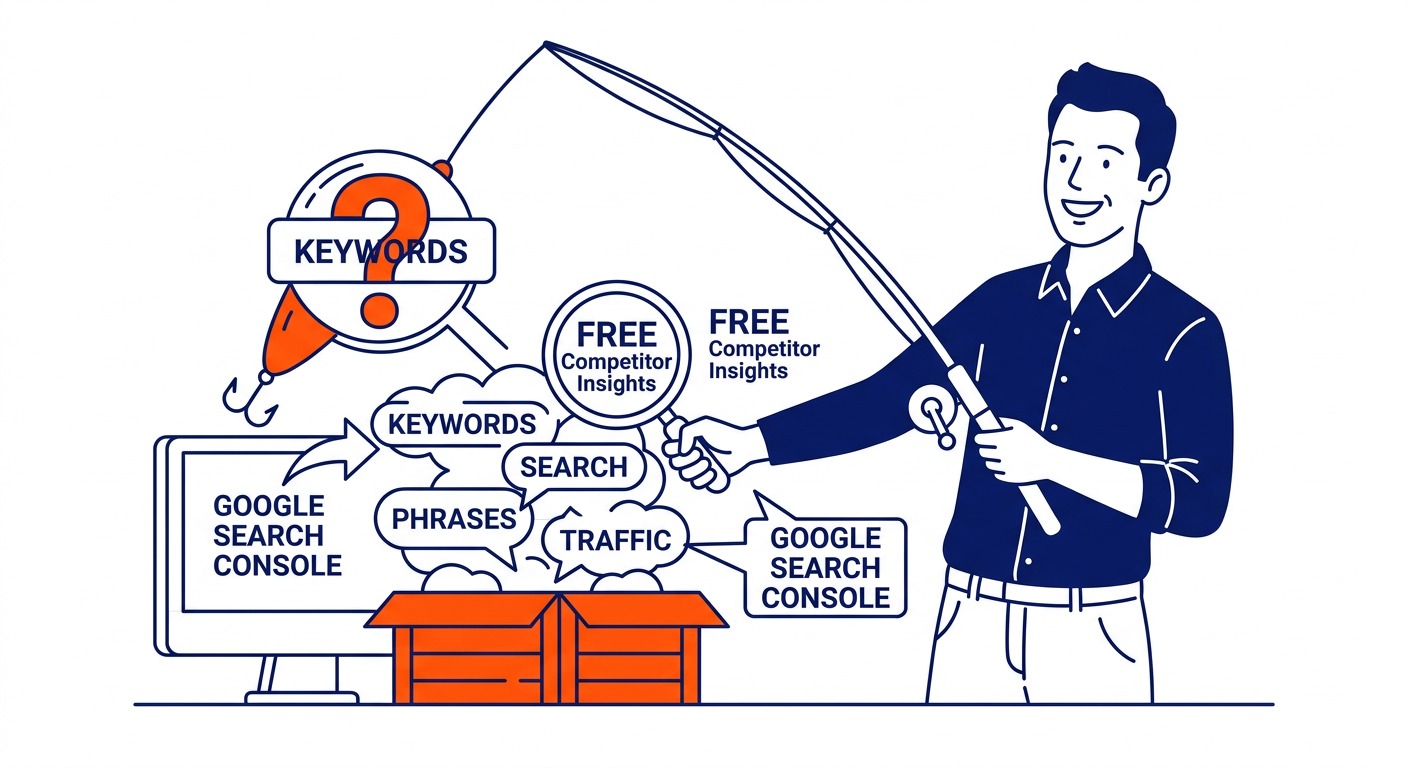
No budget for paid tools does not mean no access to competitive keyword data. The free methods are slower but legitimate.
Google Search Console is the starting point most businesses already have access to and underuse. It shows you the search queries bringing traffic to your own site. That is useful, but the more interesting use is watching for queries where you rank positions 11 to 20. Your competitor almost certainly ranks above you for those terms. Closing that gap is often faster and less competitive than trying to break into a keyword where you have no presence at all.
You cannot see a competitor’s full keyword list through Search Console, but you can compare manually. Check whether you rank anywhere for it in Search Console. No ranking at all means it is a gap.
Manual SERP analysis is slower but free and sometimes more revealing than a tool. Type your target keyword into Google. Look at who ranks in positions one through five. Open each of those pages. Read what they cover: the subheadings, the questions they answer, the related topics they link out to. That content structure is Google’s current definition of what belongs on a page targeting that keyword. Your job is to build something more useful.
Google autocomplete and People Also Ask surface related queries without any tool at all. Type a broad term and let Google suggest completions based on real search patterns. People Also Ask surfaces the questions Google associates with a search. When a competitor’s page ranks for the main term and shows up in that section, Google has confirmed they cover those questions. Match that coverage.
Site search operators let you audit a specific competitor at no cost. The search “site:theirdomainname.com your keyword” in Google shows which of their pages targets a term you care about. Check their published sitemap if one is available. Title tags in search results reflect the primary keyword each page was built around. Manual, but free. All of it points at one question, whether you can take competitors traffic on organic keywords.

What Is Keyword Gap Analysis
Keyword gap analysis is the process of identifying keywords your competitors rank for that you currently do not. That list of opportunities becomes your content roadmap.
The process is straightforward. Pick two or three competitors targeting the same customers. Run their domains through Ahrefs or SEMrush and export organic keyword rankings for each. Compare against your own site’s rankings. Anything they rank for in positions one through twenty where you have no ranking at all is a gap. Whatever they hold in the top five while you sit at positions eleven through thirty is a competitive weakness worth closing.
The interesting part is what you do with the list. Not every gap is worth filling. A competitor holding position two for a keyword with difficulty of 85 is a multi-year project. Skip it for now. Gap keywords with difficulty below 30, clear purchase or comparison intent, and 200 to 800 monthly searches are the ones that can actually rank within a reasonable timeframe.
Keyword gap analysis is also worth running defensively. If a competitor has recently moved up on terms where you had no competition a year ago, that is an early warning. Address those pages before you lose significant ground. Run a keyword gap analysis quarterly and those surprises stop happening.
How to Prioritize Competitor Keywords
The gap list from a keyword gap analysis run is long. Most people either freeze at the volume of it or grab the wrong ones.
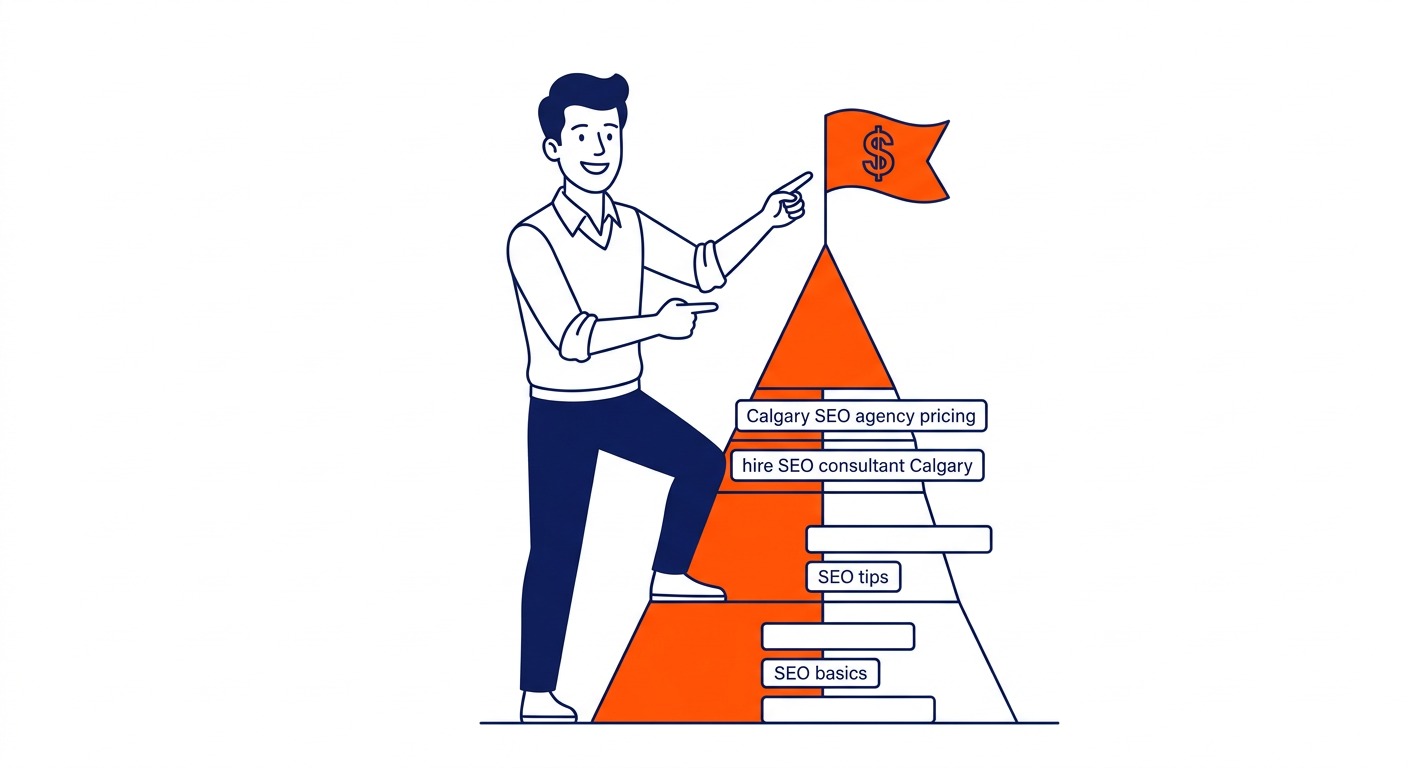
Start with intent. Commercial and transactional keywords come first. If a competitor ranks for “Calgary SEO agency pricing” or “hire SEO consultant Calgary,” those terms are close to a conversion. They matter more than “what is SEO” even if the informational term gets ten times the monthly searches.
Then look at difficulty. Keywords where every page in the top ten has thousands of referring domains pointing to it are not where newer sites win. Look at the median difficulty in your gap list. Work from the lower half toward the upper half as your domain authority builds.
Volume matters less than most people think. A keyword with 80 monthly searches in a service business with a high average transaction value is often more useful than 4,000 monthly searches on a term that attracts students and journalists. Match each competitor keyword back to your actual business. If a searcher using that term would never logically become a client, cut it.
All of the SEO work we do in Calgary, Edmonton, and Vancouver gets built around this kind of filtered competitor keyword list. Consistent organic rankings come from mapping the competitive landscape specifically, knowing where the gaps are winnable and where they are not.

How to Use Competitor Keywords in Your Content
Finding the keywords is research. Using them is where results happen.
For keywords where a competitor ranks on page one and you have no page at all: build one. The benchmark is whatever ranks in positions one through three. Read those pages carefully. Every question they do not answer, every angle they do not cover, every section they mention briefly without depth: those are your additions. Write something more complete and more useful, and use the same internal linking approach to pass authority to the new page.
For keywords where you rank positions 11 through 30 while a competitor holds the top five: update the existing page. Compare theirs to yours. Four things typically explain the gap: internal link volume to that page from the rest of their site, external backlinks, broader topic coverage, or tighter alignment with searcher intent. Find which one applies. Fix it.
There is a second use for competitor keyword data in the Google Ads management Calgary businesses often run alongside organic SEO. Active paid spend on a term means it converts. Running Google Ads on those terms while your organic pages build authority keeps that search intent from going entirely to competitors during the gap period.
A running competitive keyword document updated every quarter is how this stays useful past the initial research pass. Rankings shift. Competitors publish content. Your own site’s authority changes as links build. This is ongoing, not a one-time project.
FAQ
How many keywords does my competitor have?
Site age matters here. So does content volume and how aggressively they have pursued SEO. A local service business a few years in typically sits somewhere between 500 and 2,000 keywords. Sites publishing regularly and building links for a decade sometimes rank for 20,000 or more. The number matters less than which ones. A competitor ranking for 300 high-intent commercial keywords is often more of a threat than one ranking for 15,000 informational terms that attract no buyers.
Can I copy my competitors keywords?
Targeting the same keywords is completely legitimate. That is the point of this exercise. What you cannot do is copy their content. The page needs to earn its ranking on its own merits. Google ranks pages, not domains. Your page goes head to head with their page on the same search. More useful and more complete wins more often than not.
How do I find local competitor keywords?
Location filters in both Ahrefs and SEMrush narrow keyword data to country level. Ahrefs goes further, filtering to specific cities for some markets. Calgary, Edmonton, Vancouver: check whether competing pages include geographic terms in the URL, title tag, or main heading. That is your local competitor keyword structure. Manual searching works too: type your service category and city name into Google. Those ranking in the top five are your direct local competitors.
What is the best tool to find competitor keywords?
Ahrefs or SEMrush are both solid starting points. Ahrefs tends to have a larger keyword index for Canadian markets. SEMrush has better competitive density data. SpyFu earns its place if paid search is part of the mix. Google Ads spending shows up alongside organic rankings. For a business just starting out, Google Search Console plus manual SERP analysis costs nothing and gives you enough to start prioritizing. Add paid tools when you need to analyze multiple competitors efficiently at scale.
How often should I check competitors keywords?
Quarterly at minimum. Local markets move faster than most people expect. One or two active competitors building links and publishing content can shift rankings meaningfully within a quarter. Quarterly competitive keyword reviews catch that movement before it becomes a gap that takes a year to recover. For competitive markets with several active businesses, monthly spot-checks on the ten most important commercial keywords are worth the time.
Contact Calgary SEO Company To-The-TOP!
Questions about anything in this article, or about your own rankings? Talk to a Calgary SEO specialist directly.
Phone: (403) 308-5949
Address: 1509 14 Ave SW, Calgary, AB T3C 0W4
Hours:
Monday to Friday: 10:00 am – 7:00 pm
Saturday: 12:00 pm – 4:00 pm
Sunday: closed
