
How Many Monthly Searches Should a Keyword Have?
People want a threshold. Fifty monthly searches. Maybe five hundred. Some number to type into the filter box so the keyword list gets shorter and the work gets smaller.
No such number exists. Not one that holds up across two different businesses. Most guides answer with it depends, then move along quickly.
That dodge is half right. Still, it leaves out the more useful half.
The Short Answer About Monthly Searches Is Not a Number

Ranges do get quoted. A Calgary plumber often works with phrases sitting between ten and seventy monthly searches. An ecommerce brand selling nationally would ignore anything under a thousand. Both are reading the same column. Each is correct inside its own market.
What moves the threshold is customer value. A keyword attached to a four thousand dollar job survives at eight searches a month. Our keyword research work covers that arithmetic in detail. None of it gets repeated here.
Something else about the threshold rarely gets said out loud. The question is not really about a number. It is about timing.
A Search Volume Floor Is a Deletion, Not a Ranking

Watch what happens to a floor once you pick one. You open the tool. Four thousand rows come back. Then you type fifty into the minimum volume box.
Three thousand two hundred rows vanish.
Nothing warned you first. No dialogue box asked whether you felt sure. The row count at the bottom of the screen changed, and that is the only record anything happened at all.
Notice what that filter did. It did not order the list. A difficulty score orders a list. An intent label orders a list. A volume minimum removes rows from the file entirely. Then most people export whatever is left.
So the deleted rows leave no trace. Nothing in the export says which phrases got dropped. Nobody opens a spreadsheet and wonders about the keywords that are not in it.
The Cut Happens When You Know the Least

Follow the sequence of a normal keyword research session. Volume filtering comes first. Minute two, maybe minute three.
At that point you have not looked at a single search result. You do not know who ranks. Nothing tells you whether the top result is a competitor’s thin page or an entrenched national directory. Nor do you know which phrases your own site already collects impressions for.
All of that arrives later. Hours later, sometimes days.
So the irreversible decision runs first. The informative decisions run afterwards, on a list already cut. Every judgement from that point sits inside a boundary drawn before you understood the market.
Picture a Calgary electrician filtering at fifty. Emergency panel replacement sits at thirty monthly searches, so it disappears with everything else. Nobody checks the result page for that phrase. Impossible now, because the row is gone. It happens to hold two directory listings and a forum thread from 2019. Winnable inside a fortnight. The filter never offered anyone a chance to notice.
Every Other Keyword Filter Gets Revisited. This One Does Not.
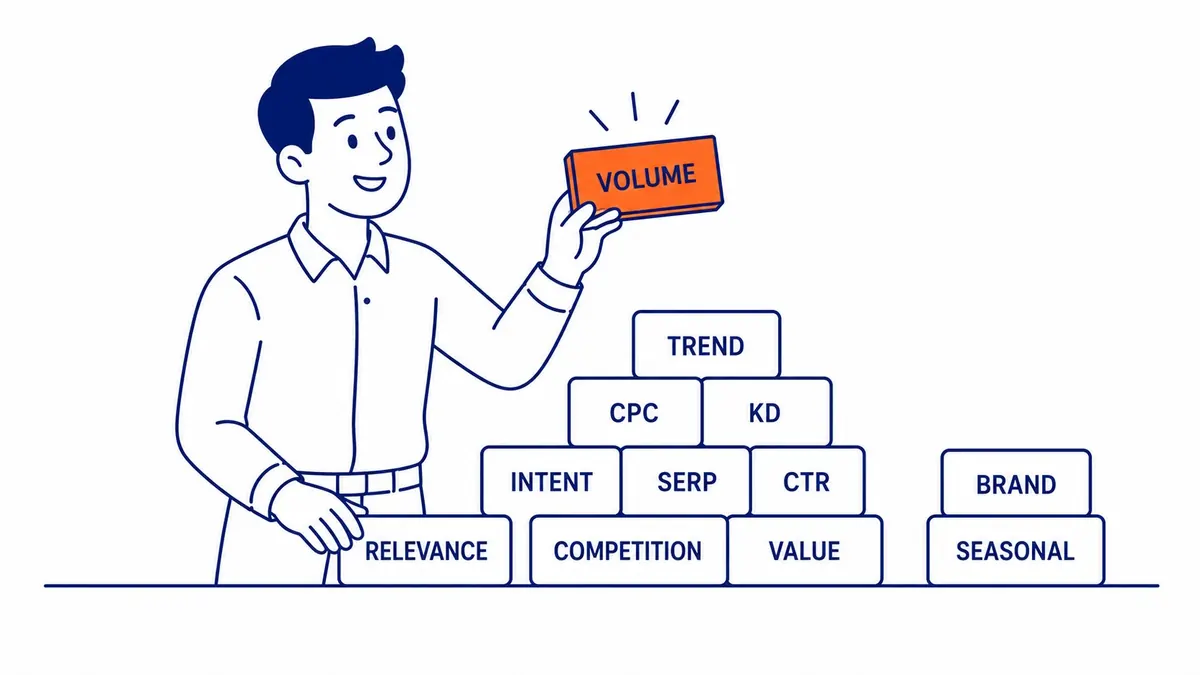
Think about how the other criteria behave across a campaign. A difficulty score gets argued with constantly. You see a weak page ranking third, so you override the number. Intent labels get corrected once the traffic lands and converts strangely.
Those filters stay open to evidence. Every row is still in front of you.
The volume floor closes instead. Nothing later can reopen it, since the candidates are no longer in the file. Google Search Console will eventually report which low-volume phrases already bring people in. Yet it only knows about pages you built. You never built those.
Compare that with a bad difficulty call. You misjudge a score and publish anyway. Then the page stalls at position eleven. The keyword is still sitting in your tracker. That mistake announces itself. A volume cut never makes any noise at all.
Any filter that deletes its own counter-evidence is difficult to correct.
Somebody Will Say the Keyword List Is Too Long

Fair objection. Four thousand rows cannot be read by hand. Some cut has to happen early. Volume sits right there in a sortable column, ready to go.
Now look at why that column got the job. Not because it predicts revenue best. It won because it needed no reading. Difficulty needs interpretation. Intent needs judgement. Fit with your business needs you to think about your business.
Volume needs a keystroke.
So the criterion doing the permanent work was picked for convenience. That objection does not weaken the argument. It explains the whole mechanism.
Somebody Will Say They Went Back and Checked

Some people genuinely do. Then this holds for them, and the file is still open.
Ask where that original export lives. Those files get overwritten easily. The unfiltered version rarely gets saved at all, because nobody archives a list they already decided was junk.
Try it as a test. Open the keyword research folder from your last project. Look for the export made before any minimum was applied.
Still there? Then your options are intact. Missing? Then a floor you set in minute two is quietly governing what you publish two years later.
Paid Search Has a Real Volume Floor. Organic Has None.

One place a minimum genuinely bites. Run a paid campaign long enough and you meet the low search volume status inside Google Ads. Those keywords sit inactive. They will not serve until the query picks up again.
The platform enforces that floor for you. No judgement required.
Organic search has no equivalent switch. Nothing goes inactive. A page built around a phrase searched nine times a month still ranks. Google still indexes it. Somebody types the phrase and finds it.
People carry the paid rule across without noticing. Our Google Ads management work treats those statuses as account housekeeping. Organic keyword selection runs on different rules entirely.
Where a Monthly Searches Minimum Earns Its Keep

The argument has a limit. Production capacity is real. Publishing four pages a quarter means most of that list never gets written, whatever you keep in the file.
A floor is a reasonable way to schedule that work. Rank the queue and take the top of it. The rest waits.
Still, scheduling and deleting are different acts. One says later. The other says never, quietly, without ever putting it in writing.
Budget pressure makes the same case. A first year of SEO has to show something to whoever signed off on the spend. Bigger phrases carry that argument more easily in a boardroom. Fine. Just log what the floor removed, so year two can revisit the question with better information.
A floor also does useful work against garbage. Misspellings. Autocomplete fragments no human typed twice. Those rows deserve to go, though volume is a crude instrument for finding them.
Sort the Volume Column. Do Not Delete the Row.

The practical version fits into one habit. Sort by monthly search volume as much as you like. Just never use it as a delete key.
Keep the raw export. Name it something you will still recognize in a year.
Then add a column of your own. Mark each row now or later. Put the reason in the next cell along.
Six months on, those reasons read differently. Some phrase dismissed at twenty monthly searches turns out to be exactly how customers describe the thing you sell. Then the row is still sitting there, waiting.
None of this costs anything. One saved file. Plus an extra column. The habit runs to about a minute per project.
That is the whole method. Reversibility, applied to the one filter that usually is not.
Keyword Research for Calgary Businesses

SEO Company To-The-TOP! has run keyword research for Alberta and British Columbia businesses since 2007. Nineteen years of it. Solo throughout, so whoever reads your keyword export at To-The-TOP! is also the person writing the plan.
Local markets punish volume floors harder than most. A Calgary trade might own four commercial phrases worth real money. None of them clear fifty monthly searches. Our SEO services work out what a customer is worth before any minimum gets set.
Everything starts from that figure rather than from the volume column. Calgary SEO at To-The-TOP! has run that way for years. Monthly position reporting follows. Timelines get stated plainly, since ranking takes months in a competitive market. White Hat SEO only, which is the slower road. The SEO portfolio shows which keywords that approach has moved.
Plenty of that work means reopening a keyword list somebody else filtered years earlier.
Worth asking any agency what volume threshold they used, and what it removed on the way past.
Common Questions About Monthly Search Volume
Is 100 monthly searches enough for a keyword?
Often yes, for a local service business. A phrase at 100 monthly searches with clear buying intent can carry more revenue than a 5,000 search informational term. What matters is what one customer is worth. Ranking first on a 100 search phrase might send thirty visitors a month. A handful of them calling makes a good month for a trade.
Should I ignore keywords with zero search volume?
Not automatically. Tools stop reporting below a threshold, so a zero often means unmeasured rather than unsearched. Does the phrase describe exactly what you sell? Then keep the row in the file, even without a page of its own yet.
What is a good monthly search volume for local SEO?
No fixed figure exists. Calgary service keywords frequently sit between ten and seventy monthly searches. Those are often the phrases that convert best. National markets run into the thousands for the same kind of term. Compare against your own market, never against a published benchmark.
Do higher search volume keywords take longer to rank?
Usually, yes. Volume correlates with competition, since more businesses chase the phrases that look big inside a tool. A higher volume target normally means more established pages to displace. Expect a longer timeline rather than a different method.
Contact Calgary SEO Company To-The-TOP!
Questions about anything in this article, or about your own rankings? Talk to a Calgary SEO specialist directly.
Phone: (403) 308-5949
Address: 1509 14 Ave SW, Calgary, AB T3C 0W4
Hours:
Monday to Friday: 10:00 am – 7:00 pm
Saturday: 12:00 pm – 4:00 pm
Sunday: closed