
Can Lionbridge Work With My Local SEO Agency?
Yes, Lionbridge can work with your local SEO agency, and the arrangement runs well when each one owns different markets rather than different tasks on the same pages. Lionbridge is a translation and localization company that also sells multilingual SEO for the markets your translated pages serve. A local SEO agency works on how you rank in your home market, including Google Business Profile and the map results. The trouble starts when both touch the same pages, titles or hreflang tags without a shared plan.
What Lionbridge sells, including SEO
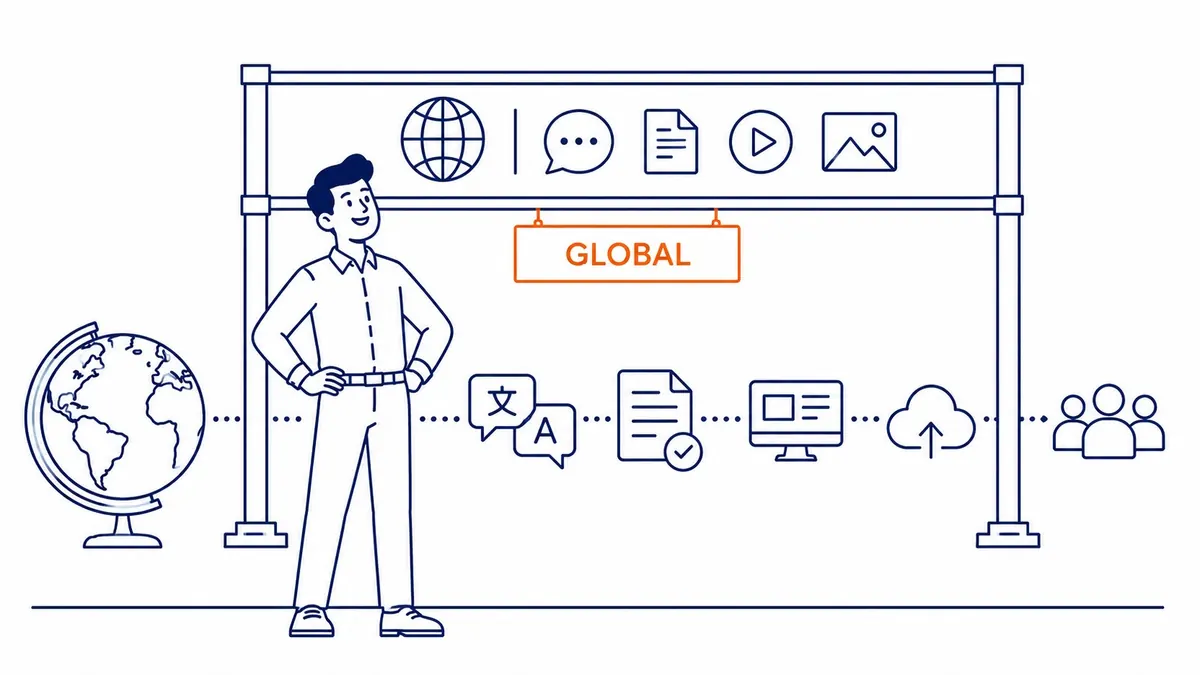
Lionbridge describes itself as a global communications platform that is “fluent in 350+ languages” and has been operating for “over 25 years”, according to its About Us page (checked 31 October 2026). Most of what it sells is language work: website and software localization, translation for regulated industries, interpretation, testing, and AI data services. Its website localization page says it combines AI with “19,000+ qualified translators in over 150 countries”, which gives a sense of the scale it is built for.
What surprises many business owners is that Lionbridge also sells SEO. Its “Global SEO Services and Website Content Optimization” page lists several offerings: content optimization so translated pages perform in search, in-market keyword and question research, transcreation for high-value pages, assessments that look for technical barriers to performing in global search results, and a performance monitoring service with “weekly reports of your keyword performance in target markets”. In other words, Lionbridge does keyword research and reporting, but for the languages and countries it is localizing into. Nothing on that page mentions Google Business Profile, local citations or ranking in a single city’s map results, which is the core of a local agency’s work.
That is why the question has a clean answer once you look at it market by market. Lionbridge is strong where the job is making one site work in many languages, and a local agency is strong where the job is winning searches from people near your business. SEO Company To-The-TOP!, for example, is a Calgary practice that has done search work since 2007 and serves Calgary, Edmonton, Vancouver and the rest of Alberta and British Columbia, which is a very different footprint from a vendor working across hundreds of languages.

What a local SEO agency does that Lionbridge does not
A local agency’s work centres on the searches that happen close to your customers. That means optimizing your Google Business Profile, keeping your name, address and phone number consistent across directories, earning reviews, and making the pages for your home market match what people in your city actually type. Google’s Business Profile help page says local results are “mainly based on relevance, distance, and popularity”, and most of the effort in local SEO work goes into those three things for one area at a time.
The local agency also tends to own the day-to-day health of the main site, because the home market is usually where most of the revenue sits. Title tags and meta descriptions for the English pages, internal linking, page speed and the monthly ranking report for your city all live on that side. None of this overlaps with translation, although it does overlap with anything a second vendor changes on the same English pages.
If you are still deciding whether a local firm is the right fit at all, or whether a national or global provider would serve you better, that is a separate question from how to make two vendors cooperate. This page assumes you already have, or want, both.

The rule that makes it work: one owner per market
The simplest arrangement is to give each vendor whole markets, with a written list of which language and country versions of the site belong to whom. The local agency owns your home market, which for a Calgary business is usually English for Canada. Lionbridge owns the markets it localizes into, such as French for Canada, Spanish for the US or German for Germany, including the keyword research for those markets, where that service is part of the contract. This treats the translated side as what it is, a piece of international SEO, rather than something the local agency has to supervise word by word.
A common piece of older advice says the local agency should own all keyword strategy and Lionbridge should simply translate against it. That would make sense if Lionbridge only translated, but its own SEO page shows it researches keywords in each target market, and in-market research is usually better than translating English keywords, because people in another language often search with different terms. A clearer split gives each vendor full responsibility for its own markets and keeps a short list of shared items that nobody changes alone.
| Area | Local SEO agency | Lionbridge | Shared, agreed in writing |
|---|---|---|---|
| Home market pages (for example en-CA) | Keywords, titles, meta descriptions, content updates | Nothing, unless asked | |
| Translated market pages (for example fr-CA, es-US) | Nothing, unless asked | In-market keywords, translated titles and metadata, transcreation | |
| Google Business Profile, citations, reviews | Owns | Not offered on its SEO page | |
| hreflang tags and x-default | One owner signs off on every change | ||
| Site templates, structured data, redirects | One owner signs off on every change | ||
| Reporting | Home market rankings | Weekly keyword reports for target markets | One combined view each month |
Where two vendors collide on the same site
Most conflicts come from changes that look local but affect every language version at once. hreflang is the clearest case. Google’s documentation on localized versions says “each language version must list itself as well as all other language versions”, so the safest setup is a complete, matching set across the whole site. Where two versions do not point to each other, Google ignores that pairing. If Lionbridge adds a new French page and the local agency later rebuilds the English template without that page in its tags, Google may ignore the pairing between that French page and the English pages. Anyone who has to work out how hreflang tags are set up on a site with two vendors should treat them as one shared file, not two separate jobs.
Language detection is the second trap. Google says it does not use hreflang or the HTML lang attribute to detect a page’s language, and its multilingual guidance says it uses “the visible content of your page” instead, recommending one language for content and navigation on each page. A page with English navigation wrapped around French body copy, which is what you get when one vendor localizes the content and the other controls a template that was never localized, sends a mixed signal. The same guidance warns against side-by-side translations on one page.
The third is redirection. Google’s guidance says “don’t use IP analysis to adapt your content” and asks site owners to avoid automatically redirecting people from one language version to another, partly because most of Google’s crawling comes from the US. A localization vendor and a local agency can easily disagree on this, with one wanting visitors sent to their language automatically and the other wanting the English Canadian page to stay reachable from Calgary. Settle it once, in writing, before either side builds it. Google suggests a visible language selector and an x-default page for visitors whose language you do not serve.
Titles and structured data are the everyday version of the same problem. If both vendors have access to the same content management system, a template change pushed by one can overwrite page titles or schema the other set, and neither may notice until rankings move. That is a process gap rather than anyone’s fault, and the fix is a sign-off step, not a change of vendor.

A coordination checklist for both vendors
A one-page agreement prevents most of the problems above, and it is worth writing before either vendor starts work rather than after something breaks. These are the points to put on it:
- A list of every language and country version of the site, the URL pattern for each, and which vendor owns it.
- One named person, usually on your side or the local agency’s, who approves any change to hreflang tags, x-default, canonical tags, redirects, site templates and structured data before it goes live.
- A rule that neither vendor edits pages in the other’s markets without a written request.
- A shared keyword sheet with one tab per market, so the local agency’s English Canadian targets and Lionbridge’s in-market targets sit side by side and duplicate pages are easy to spot.
- An agreed answer on language redirects and the language selector, based on Google’s guidance.
- A monthly Search Console check of indexing and the canonical Google selected, plus a crawl with an hreflang checking tool, shared with both vendors.

An illustrative Calgary example
Consider a hypothetical Calgary equipment supplier that sells to customers across Alberta and has started taking orders from Quebec and the US. This is an illustration, not a client story. Its English Canadian pages, its Google Business Profile and its Calgary rankings stay with the local agency. Lionbridge translates the product pages into Canadian French and adapts them for US buyers, researching the terms customers in each market actually use and writing the translated titles and descriptions to match.
The shared pieces are where the plan matters. The supplier’s site now needs an hreflang set covering en-CA, fr-CA and en-US, and an x-default page is worth adding for visitors from other markets. Every one of those versions should list all the others. One person approves changes to that set and to the templates that carry it. When the local agency updates the English product template, the change goes through that person, who checks that the French and US versions still match. Each vendor reports on its own markets, and the supplier sees one combined summary each month.
The result is two vendors whose routine work rarely overlaps, because the boundaries are on paper, with one sign-off step for the shared pieces. That is usually a better outcome than one vendor stretched into work it does not normally do.

When you do not need both
If your business serves one market in one language, such as a Calgary contractor working within a fixed service area, Lionbridge is not the right vendor, because there is nothing to localize. A local agency covers that case on its own. If you mainly sell across many countries online and have no physical location that people visit, the reverse can be true, and a localization company with SEO services may cover more of what you need than a local agency would.
The two-vendor setup earns its cost when you have a real home market with local search demand and also sell into other languages or countries. Even then, check what each vendor has actually agreed to do before assuming they will coordinate by themselves, because neither has any reason to manage the other unless you ask.
If you already run both and want someone to check whether the hreflang set, titles and templates still agree with each other, a site audit is a sensible place to start. If you would like a second opinion on your site, call (403) 308-5949.
Contact Calgary SEO Company To-The-TOP!
Questions about anything in this article, or about your own rankings? Talk to a Calgary SEO specialist directly.
Phone: (403) 308-5949
Address: 1509 14 Ave SW, Calgary, AB T3C 0W4
Hours:
Monday to Friday: 10:00 am – 7:00 pm
Saturday: 12:00 pm – 4:00 pm
Sunday: closed