
Do Nofollow Links Help SEO?
Nofollow links can help SEO, but usually not in the way people hope. Since September 2019, Google has treated nofollow as a hint rather than a strict rule, yet its own announcement says that in most cases it will still “not consider them for ranking purposes.” So a nofollow link rarely passes ranking credit directly. Its value is indirect: the visitors it sends, the people who find you through it and link to you later with a normal followed link, and the trust that comes from appearing in the right places. This guide explains what Google has said, what each kind of nofollow link is worth to a business, and what to do with the links on your own site.
What a nofollow link is
A nofollow link is an ordinary HTML link with a rel=”nofollow” attribute added to its anchor tag. A visitor cannot tell the difference, because both kinds of link look the same and both take you to the page when you click. The attribute is a message to search engines: the site that published the link does not want to vouch for the page it points to, or pass any ranking credit to it. A link with no rel attribute at all is what SEOs call a followed or “dofollow” link, and it is the default on the web; there is no actual “dofollow” attribute in HTML. If you want the other side of the comparison, the guide to followed links and how they pass authority covers it in more detail.
Google introduced nofollow in 2005 to fight comment spam. Blogs with open comment sections were being flooded with links posted purely to manipulate rankings, and nofollow gave site owners a way to say “these links are not mine.” Google later asked site owners to use it on paid links as well, and it still accepts it for them. Many large sites now add it automatically to links they do not control or cannot review: Wikipedia, for example, adds rel=”nofollow” to its external links (checked on its Nofollow article on 6 November 2026), and many forums, comment systems and social platforms do something similar. That is why so much of a normal backlink profile is nofollow without anyone having chosen it.
What changed in 2019, in Google’s own words
On 10 September 2019 Google’s Search Central blog announced two new values alongside nofollow: rel=”sponsored” for advertising, sponsorship and other paid links, and rel=”ugc” for links inside user-generated content such as comments and forum posts. The bigger change was in how all three are read. Before, Google said it would not count a nofollow link “as a signal to use within our search algorithms.” From that day, all three became “hints about which links to consider or exclude within Search” for ranking purposes, and from 1 March 2020 nofollow also became a hint for crawling and indexing. Some articles get that order backwards, so it is worth stating plainly: the ranking change came first, in 2019, and the crawling change followed in 2020.
The sentence most people skip comes later in the same announcement. Google wrote that “in most cases, the move to a hint model won’t change the nature of how we treat such links. We’ll generally treat them as we did with nofollow before and not consider them for ranking purposes.” Google’s reason for the change was information, not generosity: link text tells it what a page is about, and seeing every link helps it spot unnatural linking patterns. So the accurate reading is that Google may count a nofollow link when it judges the link useful, it does not say when that happens, and its default remains to leave such links out of ranking.
Google’s current documentation, “Qualify your outbound links to Google” (last updated 10 December 2025), adds a practical point that many pages miss. Links with these attributes “will generally not be followed”, but the linked page can still be found and crawled through sitemaps or links from other sites. Nofollow was never a way to keep a page out of Google, and Google has said that relying on it for that “was never recommended.”
Where nofollow links still earn their keep
If nofollow links usually pass no ranking credit, why does anyone want them? Because a link is a doorway for people as well as for crawlers. A nofollow mention in a Calgary news story, a busy industry forum thread or a well-read association newsletter can send real visitors, and some of those visitors are the people who write about and link to businesses: journalists, bloggers, partners and buyers who later reference you on their own sites with a normal followed link. That chain, from a visible nofollow mention to the followed links it can lead to, is the most dependable way a nofollow link adds SEO value, although it is rarely possible to trace a later link back to the original mention.
Nofollow links also put your name in front of an audience that already trusts the source. That can lead to more people searching for your business by name and more enquiries, which matters to the business whatever Google does with the link itself. It is fair to describe those as business results rather than ranking signals, because Google has not documented that it uses them that way.
You will often read that a profile with only followed links “looks unnatural” and that nofollow links protect you by adding diversity. That is a common theory rather than something Google has documented. The more useful version of the same idea is this: a business that earns links in the normal ways will collect plenty of nofollow links without trying. The goal is not a ratio. It is to earn links the way real businesses do, as the overview of how backlinks build rankings explains.
Case studies deserve a careful read. One frequently cited example, from the digital agency Teknicks (first published in 2015 and updated in 2024), reports page-one rankings and 288% organic traffic growth over about a year and a half from a campaign in which 89% of the links acquired were nofollow. It is one agency’s report on its own client, and it cannot separate the effect of those links from the content, the followed links and everything else that happened during the campaign. It shows that a nofollow-heavy outreach campaign can coincide with growth; it does not show that the nofollow links caused it.
What a nofollow link is worth, by source
The attribute tells you less than the source does. A practical way to judge a link opportunity is to ask whether you would still want it if search engines did not exist. The table below is a practitioner’s guide to the sources a Calgary or Alberta business usually comes across, not a Google rule.
| Source | Attribute you will usually see | What it is worth |
|---|---|---|
| Local or national news coverage | Often nofollow, depending on the publisher; sponsored only if the placement was paid | High: visitors, credibility and journalists who may cite you again |
| Wikipedia | Nofollow on all external links | Low for rankings; some referral traffic if the citation is genuinely useful, and editors remove promotional additions |
| Industry forums, Reddit, blog comments | Nofollow or ugc, usually added automatically | Worth it only when you are answering a real question; posting links for SEO is the comment spam nofollow was created to stop |
| Event, charity or team sponsorships | Should be sponsored or nofollow | Community visibility; the attribute is required, so it is not a reason to decline |
| Paid placements, advertorials, affiliate links | Must be sponsored or nofollow | Traffic and sales; a paid link that passes credit breaks Google’s spam policies |
| Business directories and associations | Varies | Worth having where customers actually look; Google lists low-quality directory links among its examples of link spam |
The sponsorship row is the one that causes real trouble. If a Calgary business sponsors a community run or a minor hockey team and the thank-you page links to it with rel=”sponsored”, that is exactly what Google asks for. Google’s spam policies treat exchanging money, goods or services for links that pass ranking credit as link spam, and they say paid and sponsorship links are fine “as long as they are qualified with a rel=”nofollow” or rel=”sponsored” attribute.” Asking the organiser to remove the attribute turns a harmless sponsorship into a link scheme. The same logic applies to affiliate links and how they affect SEO.
Which attribute to use on your own site
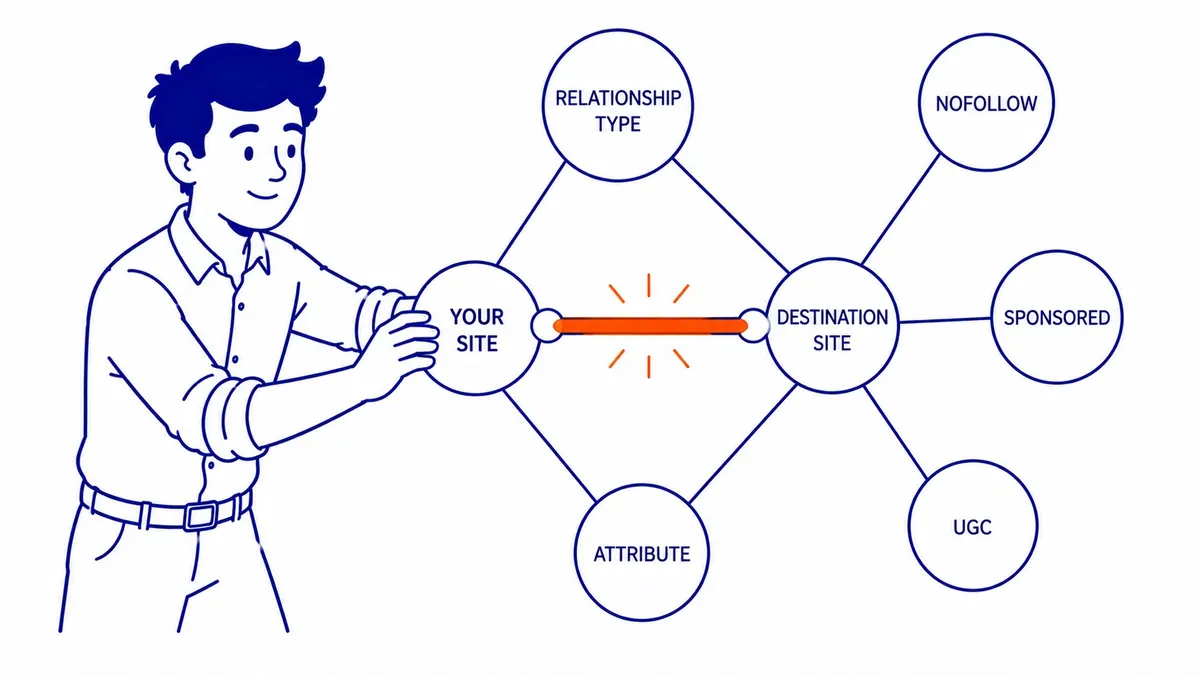
On the links your own site publishes, Google’s guidance is simple. Leave a normal editorial link to a source you trust without any rel attribute. Mark ads, sponsorships and other paid links with rel=”sponsored” (nofollow is still accepted, but Google prefers sponsored). Mark links in comments, reviews and forum posts with rel=”ugc”, which many platforms, including WordPress comments, do for you, and read more about the ugc attribute for user-generated content if you run a community or reviews section. Use nofollow when none of those fits and you would rather Google did not associate your site with the page or crawl it from your site. Google also notes that you can remove the ugc value from links posted by members who have made high-quality contributions over time, as a way to recognise trusted contributors. You can combine values, such as rel=”nofollow ugc”.
Internal links are different, and this is where older advice goes wrong. Adding nofollow to links between your own pages is not the tool Google recommends: for a page on your own site you do not want crawled, it points to the robots.txt disallow rule, and for a page you do not want indexed it points to the noindex rule, with crawling allowed so Google can see it. On large online stores with filter and sort URLs, Google’s faceted navigation guidance says nofollow on those links “may be beneficial”, but only if every link to the filtered URL carries it, and that it is generally less effective in the long term than robots.txt or URL fragments. For a typical small business site, internal nofollow is usually unnecessary, and it is not the method Google recommends for controlling crawling.
How to check whether a link is nofollow
You do not need a paid tool to check a single link. In Chrome, Edge or Firefox, right-click the link, choose Inspect, and look at the highlighted anchor tag. If you see rel=”nofollow”, rel=”sponsored” or rel=”ugc” (alone or combined), it is qualified; if there is no rel attribute, or only values such as noopener or noreferrer, it is a normal followed link, because those two values control browser behaviour and say nothing to search engines. Remember that a page can also apply nofollow to every link on it with a robots meta tag in its head section, so a link with no rel attribute can still be nofollowed at page level. Backlink tools such as Ahrefs or Semrush show the attribute for links across your whole profile, which is easier once you are reviewing more than a handful.
The short answer for a business owner
Do nofollow links help SEO? Rarely by passing ranking credit, sometimes through Google’s hint model in ways it does not disclose, and often through the people they send to you. Judge every opportunity by the source and its audience, accept a nofollow or sponsored attribute where it belongs, and spend your effort on the kind of coverage that earns followed links as a result. If you would like a second opinion on your own backlink profile or a link-building plan, SEO Company To-The-TOP! has provided White Hat SEO in Calgary since 2007, and the SEO services page explains how that work is done. To talk it through, call (403) 308-5949.
Contact Calgary SEO Company To-The-TOP!
Questions about anything in this article, or about your own rankings? Talk to a Calgary SEO specialist directly.
Phone: (403) 308-5949
Address: 1509 14 Ave SW, Calgary, AB T3C 0W4
Hours:
Monday to Friday: 10:00 am – 7:00 pm
Saturday: 12:00 pm – 4:00 pm
Sunday: closed