
How Long to See ROI From SEO? How to Work Out Your Payback Month
You see ROI from SEO in the month when the extra gross profit organic search has brought in since the work began, added up from the start, passes everything you have spent on SEO over the same period. No reliable published study puts one number on that month, because it depends on how competitive your searches are, what a customer is worth to you and how long your sales take to close. What the data does show is that the ranking part alone takes months for most pages, and that the payback usually comes well after rankings and traffic first move. The useful question is how to estimate your own payback month and what to watch while you wait.
Three different things “seeing ROI” can mean
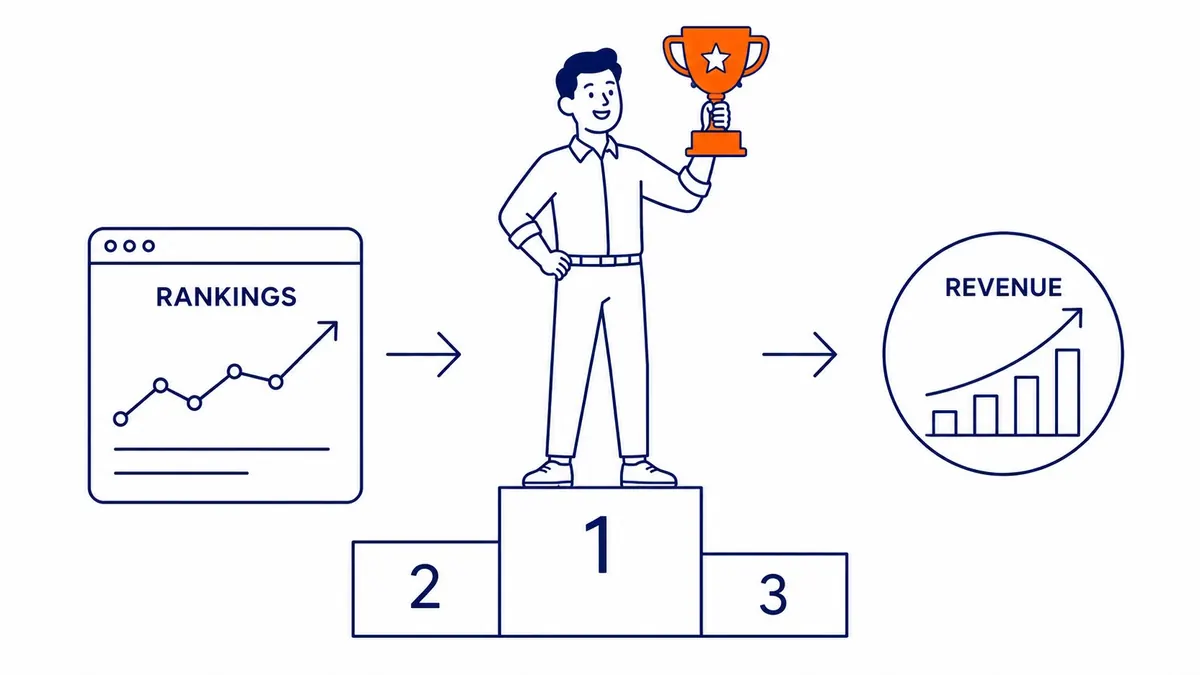
When owners ask how long SEO takes to pay off, they are often asking about three separate milestones without realising it. The first is the first enquiry that came from organic search. The second is the first month or quarter in which the profit from organic customers covers what SEO cost in that same period. The third is cumulative payback, the point at which everything SEO has returned since the start covers everything it has cost. It is easy to report the first or second milestone as “ROI”, and both are real progress, but only the third means the investment has paid for itself.
| Milestone | What it tells you | Where you see it |
|---|---|---|
| First organic lead | The pages are being found and are persuading someone to act | A form or call recorded as a key event in GA4, or a customer who says they found you on Google |
| Period break-even | SEO now earns more each month or quarter than it costs | Your own sales records, matched to organic leads |
| Cumulative payback | The money spent from day one has come back as gross profit | A running total of SEO cost against organic gross profit |
The gap between the second and third milestones can be large. By the time SEO first covers its own monthly cost, every earlier month has been a loss that the later months still have to repay, so the cumulative line keeps climbing for a while after the business starts to feel the benefit.

What the data says about the ranking part of the wait
For a page that Google does not show yet, nothing pays back until it ranks well enough to be clicked, so the ranking time sets a floor under the payback time. Google does not publish a timeline for SEO results or ROI. What its SEO Starter Guide does say is that every change takes time to be reflected on Google’s end, and that “some changes might take effect in a few hours, others could take several months.” It adds that you will likely want to wait a few weeks before judging whether a change has helped. That describes how long Google takes to process a change, not how long a business waits for customers, which is a separate and longer question covered in the guide to how long SEO takes to show results.
One of the larger public studies of ranking time comes from Ahrefs, an SEO software company. It followed a random sample of URLs its crawler first saw in September 2023 and found that only 1.74% of them reached Google’s top 10 within a year. When it looked instead at non-empty English pages created in October 2023, the figure was 6.11%. These are random pages across the web, not pages from planned SEO campaigns, so they describe how hard page one is to reach rather than the odds for any one business. In the same study, the average page ranking first was five years old, and about 73% of the pages in the top 10 were more than three years old. Ahrefs also suggests that if a page is still outside the top 10 after about six months, it is time to look at updating it.
Two practical points follow from that. A plan that depends entirely on brand-new pages reaching page one is a plan with a long and uncertain payback, so treat any promised date for that with caution. As a rule of thumb rather than a finding of the study, pages that already rank somewhere on page two for searches that bring customers, or that already earn impressions without clicks, are usually the faster route to a return, because they have a much shorter distance to travel than a page Google has never shown.
An illustrative payback table
The figures below are invented for illustration. They are not a quote from any provider, SEO Company To-The-TOP! included, and they are not a client result. They follow a service business that spends $6,000 a quarter on SEO in total (outside fees, staff time and content) and makes $900 of gross profit on each new customer, with organic customers growing as rankings improve. The business had no organic customers before the work began, so every organic customer here counts as a return; a business that already had some should count only the increase above that starting level.
| Quarter | Organic customers | Organic gross profit | SEO cost to date | Gross profit to date |
|---|---|---|---|---|
| 1 | 0 | $0 | $6,000 | $0 |
| 2 | 1 | $900 | $12,000 | $900 |
| 3 | 4 | $3,600 | $18,000 | $4,500 |
| 4 | 7 | $6,300 | $24,000 | $10,800 |
| 5 | 9 | $8,100 | $30,000 | $18,900 |
| 6 | 10 | $9,000 | $36,000 | $27,900 |
| 7 | 12 | $10,800 | $42,000 | $38,700 |
| 8 | 13 | $11,700 | $48,000 | $50,400 |
In this example the first organic customer arrives in the second quarter, and the fourth quarter is the first in which SEO earns more than it costs ($6,300 against $6,000). Cumulative payback does not arrive until the eighth quarter, when the running total of gross profit finally passes the running total of cost. Judged at the end of year one, this business would see a loss of $13,200 and might stop, just as the channel was starting to pay. The same arithmetic is why the full method for how to measure SEO ROI uses gross profit rather than revenue and measures over a rolling twelve months or longer.
The table also leaves out a delay that matters for many businesses. Analytics records the enquiry, not the day the customer pays. If your jobs are quoted, scheduled and invoiced over two or three months, or your clients take a quarter to sign, each row’s gross profit really lands one or more quarters later than the lead, and the payback month moves out by the length of that cycle. Canadian businesses should also set the cost line on the right basis: a GST/HST registrant can generally claim back the GST it pays on SEO used in its commercial activities as input tax credits, according to the Canada Revenue Agency, so the pre-tax fee is the real cost, while a business that has not registered carries the 5% GST in Alberta as part of the cost.
What moves your payback month earlier or later
Several of the things that decide the payback month are set before any SEO work starts, and the rest depend on choices made along the way, so it pays to look at all of them plainly rather than hoping for a fast result.
| Factor | Pushes payback earlier | Pushes payback later |
|---|---|---|
| Starting point | Existing pages already ranking on page two or earning impressions | A new site or a new topic with no pages Google shows yet |
| Competition on the target searches | Specific searches that few strong sites target | Broad “service plus city” terms that large or long-established sites hold |
| Gross profit per customer | High-margin work or repeat customers | Low-margin, one-off sales |
| How well the page converts | A page that answers the question and makes calling easy | A page that ranks but gives the visitor no clear next step |
| Sales cycle | Same-week jobs | Quotes, approvals and long contracts |
| Tracking | Calls and forms recorded as key events from day one | No tracking, so payback cannot be shown even when it happens |
A bigger budget helps only up to a point. Spending more can speed up content and technical work, but it cannot make Google rank a page faster than the competition and the page’s quality allow, and in the table above doubling the quarterly cost would also double what has to be paid back. Conversion is the factor most often overlooked. A page that ranks and draws visitors but loses most of them adds to traffic reports without adding customers, and fixing that page can bring the payback month forward without any change in rankings at all.

Signals to watch before the money shows up
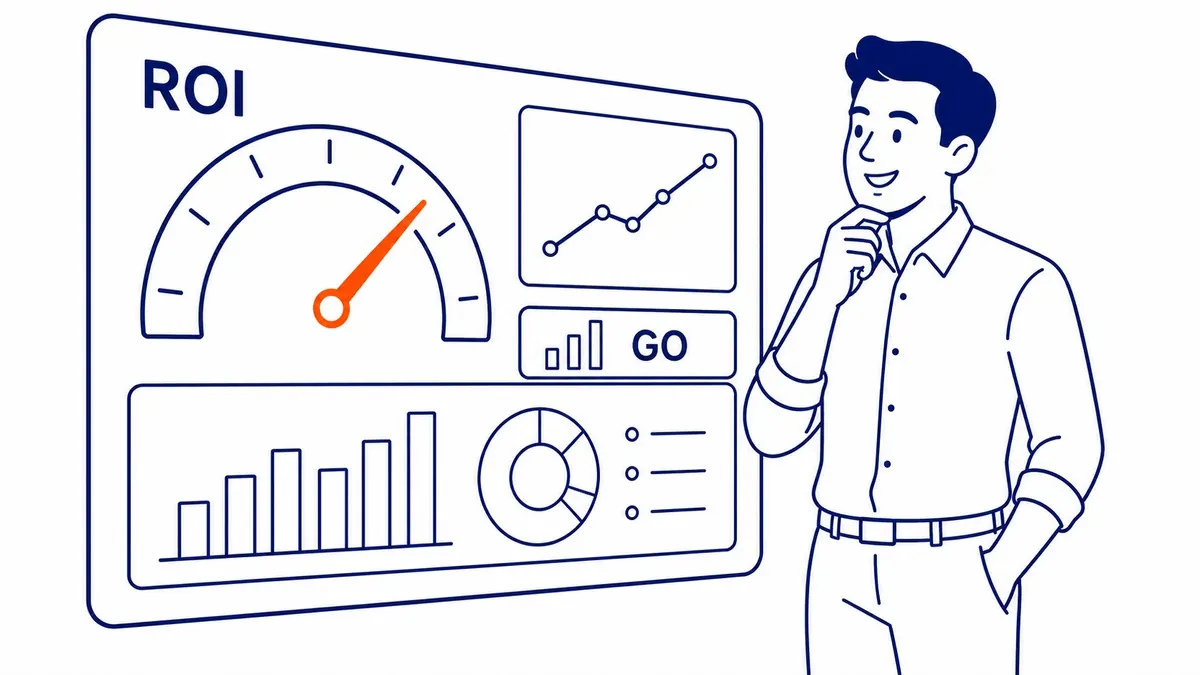
You do not have to wait for the payback month to know whether SEO is on track, because the steps that lead to it show up in a predictable order. In Search Console, impressions on non-branded searches (the ones that do not include your business name) usually move first, then average positions on those searches, then clicks. In GA4, organic key events such as calls and form submissions follow, and in your own records, closed sales from those leads come last. Branded searches deserve to be watched separately, because people who already knew your name would probably have found you anyway.
Check indexing, the searches being targeted and impressions every month, so that a technical or targeting problem is caught early. A reasonable rule of thumb, and it is a rule of thumb rather than a published standard, is to review the plan if non-branded impressions have not grown after two quarters of steady work, and to review the pages themselves if traffic has grown but organic leads have not. The first usually points to keyword targeting or competition, and the second to the page. Monthly position reports are only useful if they cover the searches that bring paying customers, so it is worth checking which terms a provider tracks, and a public keyword portfolio is one way to see what a provider has actually ranked.
Covering the wait, and when SEO is the wrong tool
Because SEO pays back slowly, many businesses run paid search while organic rankings build. Ads can start appearing quickly once approved, since Google says most ads are reviewed within one business day, though complex reviews can take longer, so Google Ads can bring enquiries during the months when SEO is still a cost. The trade-off is that paid traffic stops when the budget stops, while pages that rank can keep producing leads after the work that built them has been paid for. With any provider, To-The-TOP! included, ask for the management fee and the ad spend as two separate numbers before you compare offers.
SEO is also the wrong tool for some situations. If the business needs customers within the next quarter and cannot carry several quarters of cost before a return, or the offer is a one-off event or a short season, the payback month may simply arrive too late to matter. In those cases paid search, or a smaller SEO effort aimed only at pages that already rank, is usually the better use of the money.
SEO Company To-The-TOP! is a Calgary-based solo practice founded in 2007, so one expert does the client work with no junior handoffs. If you would like to talk through your own starting point and what a realistic payback picture looks like for your searches, the SEO services page explains how the work is done, the To-The-TOP! home page has the contact details, or you can call (403) 308-5949.
Contact Calgary SEO Company To-The-TOP!
Questions about anything in this article, or about your own rankings? Talk to a Calgary SEO specialist directly.
Phone: (403) 308-5949
Address: 1509 14 Ave SW, Calgary, AB T3C 0W4
Hours:
Monday to Friday: 10:00 am – 7:00 pm
Saturday: 12:00 pm – 4:00 pm
Sunday: closed