
What Are LSI Keywords?
“LSI keywords” is the name many SEO tools and writers give to words and phrases related to the main topic of a page, such as “espresso”, “roast” and “grind” on a page about coffee. The label is borrowed from latent semantic indexing, an information-retrieval method patented in 1989, but Google does not treat it as a real thing: in July 2019 Google’s John Mueller wrote that “there’s no such thing as LSI keywords”. The useful idea behind the label is real, though, because a page that covers its subject in the vocabulary an expert would use is easier for Google and for readers to understand. This guide explains where the term came from, what Google actually documents, and how to find and use related terms without falling into keyword stuffing.

Where the term LSI comes from
Latent semantic indexing is a real technique with a paper trail. US patent 4,839,853, “Computer information retrieval using latent semantic structure”, was filed on 15 September 1988 by Bell Communications Research and granted on 13 June 1989; its inventors include Scott Deerwester and Susan Dumais, and the patent has long since expired. The abstract describes treating text “in the statistical domain by presuming that there is an underlying, latent semantic structure in the usage of words”. In practice that means the method looks at which words tend to appear together across a set of documents, so that a search can return a relevant document even when it does not contain the exact word the person typed.
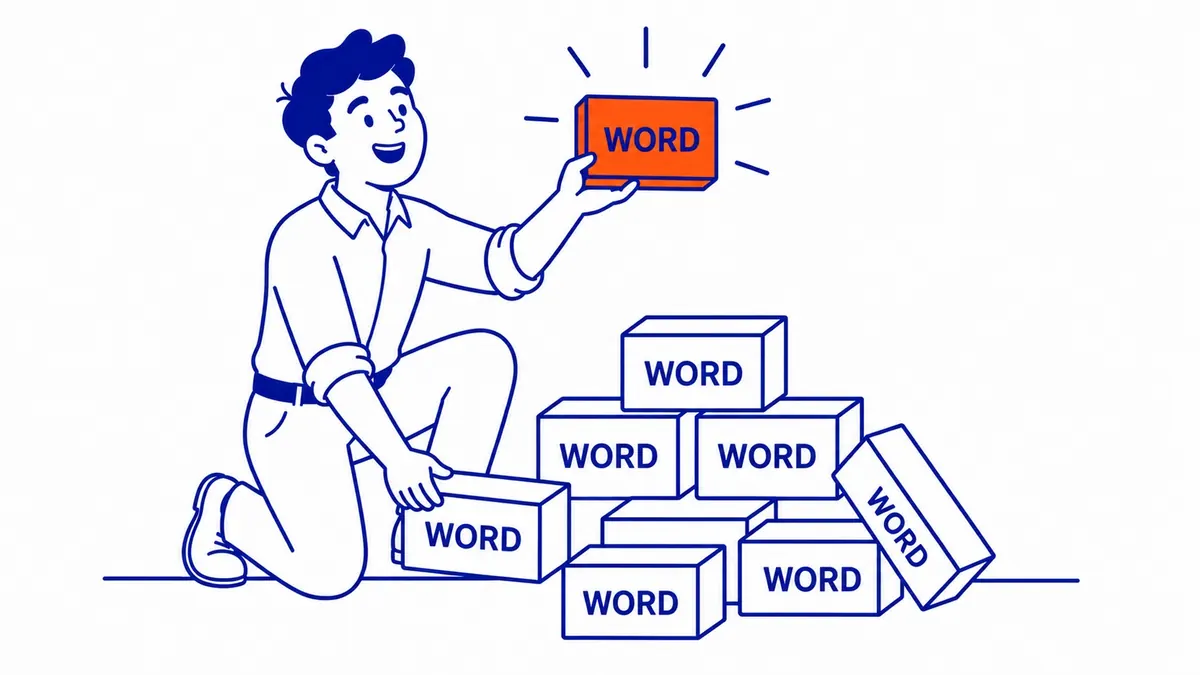
Somewhere in the early SEO industry, the phrase was shortened to “LSI” and attached to a much simpler idea, which is that pages should include words related to their main keyword. Tools sold as “LSI keyword generators” followed, and the label stuck, although those tools have no access to Google’s index and the “LSI” name tells you nothing about how Google ranks pages. Google has never said it uses the patented method. So when someone says “add some LSI keywords”, what they usually mean is “add the related terms and subtopics a thorough page would cover”. The advice can be reasonable even though the name is wrong, and it helps to keep the two apart.
Does Google use LSI keywords?
No. The clearest statement is John Mueller’s reply on X (then Twitter) on 30 July 2019: “There’s no such thing as LSI keywords”, adding in the same reply that anyone telling you otherwise is mistaken. That post is the source most articles on this topic paraphrase, often without a date.

What Google does document is a set of systems built for meaning. Its guide to Google Search ranking systems describes BERT as an AI system that helps Google “understand how combinations of words express different meanings and intent”, and neural matching as a system that matches representations of concepts in queries and pages. Google’s How Search Works pages give a plain example: when you search for “dogs”, you probably do not want a page that repeats the word hundreds of times, so its systems look for other relevant content, such as pictures, videos or a list of breeds. That is the sound part of the LSI idea, described by Google in its own words, and it has nothing to do with a 1980s patent or a list of terms from a generator.
The practical difference matters. Google is not checking your page against a list of “LSI keywords” and awarding points for each one found. It is trying to work out what the page is about and whether it answers the search. A thorough answer will usually contain the relevant terminology anyway, but Google publishes no checklist of related words that a page must include.
LSI keywords, synonyms and secondary keywords
These three get mixed up often, and they do different jobs on a page. A synonym is a different word for the same thing, such as “car” and “automobile”, or “jogging” and “running”, and it mainly helps readability. A related term (what people mean by an LSI keyword) shares the topic without meaning the same thing: on a page about cold brew coffee, “grind”, “filter”, “steep time” and “ice” all belong, but none of them means cold brew.

A secondary keyword is different again, because it is a search phrase with its own demand that you deliberately want the page to rank for, usually a close variant or subtopic of the primary keyword. This page, for example, targets “what are LSI keywords” as its primary keyword and answers “does Google use LSI keywords” and “how to find LSI keywords” as secondary ones. If the distinction is new to you, there is a fuller explanation of secondary keywords with examples.
| Type | What it is | Example for “cold brew coffee” | Its job on the page |
|---|---|---|---|
| Synonym | Same meaning, different word | “cold-brewed coffee” | Readability and variety |
| Related term (“LSI keyword”) | Shares the topic, different meaning | grind, filter, steep time, ice | Shows the subject is covered fully |
| Secondary keyword | A searched phrase you also target | “how long to steep cold brew” | Wins a second set of searches |
How to find related terms without an LSI generator
The most reliable sources of related terms are free and come straight from searchers. Type your main keyword into Google and read the autocomplete suggestions, then look at the “People also ask” questions and the related searches at the bottom of the results page. Google’s own guide to these search features says it can be helpful to pay attention to these related queries when you are thinking about topics to write about, and it explains that related searches are generated from the original query and other things people have searched for. They are not a complete or local measure of demand, though, so check the terms that matter in Search Console or Keyword Planner before building a page around them.

Next, read the three or four pages that already rank and note the subtopics they all cover. If every one of them explains steep time and your page does not, that gap is worth a closer look. Treat it as a research clue rather than a ranking checklist, though. Google weighs many factors beyond the subtopics on a page, so add only what helps your reader, and look for something useful that the existing results leave out. Your own customers are the third source, and often the best: the questions people ask on the phone, in emails and in reviews are the related terms of your topic in the words your buyers actually use. Paid tools can speed this up by grouping terms and showing search volume, and that is where proper keyword research earns its time, because it connects the vocabulary to real search demand instead of guessing.
Keep, merge or drop: deciding which terms belong
Finding terms is the easy part. The skill is deciding which ones deserve a place, and a simple rule works well: keep a term when a reader would expect that subtopic to be answered, merge it when it is just a synonym of something you already cover, and drop it when it belongs to a different search intent, names a competitor, or would only fit if you forced it in.
The example below is illustrative, not a client case. Imagine a Calgary furnace repair page and the kind of list a term tool might return for it.
| Suggested term | Decision | Reason |
|---|---|---|
| furnace not igniting | Keep | A symptom the page should explain, so it deserves its own paragraph |
| flame sensor | Keep | A part worth explaining if the page covers why a furnace shuts off |
| high-efficiency furnace | Keep | Changes the repair and replacement advice |
| furnace fixing | Merge | A synonym of “furnace repair”; covered already |
| furnace installation cost | Drop | A different intent, better served by its own page |
| a competitor’s brand name | Drop | Not the reader’s question, and it would read as filler |
In practice, a page built this way often ends up containing most of the “LSI keywords” a tool would suggest, because answering the customer’s questions tends to require them. Google’s guidance on people-first content points the same way, since it asks creators to write primarily for people and treats content made mainly to gain search engine rankings as a warning sign.
Where the LSI habit turns into keyword stuffing
The wrong way to use related terms is to take a generated list and insert every term somewhere on the page, whether or not the sentence needs it. Google’s spam policies define keyword stuffing as filling a page with keywords or numbers in an attempt to manipulate rankings, often in a list or group, unnaturally or out of context, so a pasted list of “LSI keywords” is simply a newer route to the same problem.

One of Google’s own examples is especially relevant in Calgary: “blocks of text that list cities and regions that a web page is trying to rank for”. Many local service pages end with a long run of community names, from Beltline and Kensington to Airdrie and Okotoks, added in the belief that it helps the page rank in each one. That is the LSI habit in its most common local form, and it fits Google’s description closely. A short, true statement of the areas you serve is useful to a reader, while a block of place names is not, and if you suspect a page has crossed that line, it is worth reading about how much keyword stuffing can hurt a page before adding anything else to it.
Related terms also cannot rescue a thin page. If the content has little to say, extra vocabulary does not change that, so depth comes first and the vocabulary follows.
A note on Google Ads
Paid search is the one place where you still choose keywords one by one, but even there the related-terms idea is handled differently. Google Ads Help explains that broad match, the default match type, lets ads show on searches related to your keyword, including searches that do not contain the direct meaning of your keyword. So in a paid account the work is choosing the right match types and adding negative keywords for the searches you do not want to pay for, rather than collecting synonyms. As Google’s help page on negative keywords notes, they do not match close variants, so a plural or misspelling of an unwanted term may need its own entry. It is a different discipline from on-page writing, and it is a large part of running Google Ads campaigns well.
What to do instead
Stop looking for LSI keywords and write the page a knowledgeable person would write for a customer. Start with the question behind the search, answer it near the top, cover the subtopics the ranking pages and your own customers raise, and then reread the draft to see whether an obvious question is still missing. If it is, add a sentence or a section that answers it, and leave out any term that is there only for the search engine.
That approach has a proper name, and it is the subject of a separate guide on semantic SEO, which covers how topics, entities and intent fit together. The LSI label belongs to a 1980s patent; the habit of covering a subject fully belongs on every page you publish.
If you want a second opinion on whether your pages cover their topics well, or whether a tool is pushing you toward stuffing, SEO Company To-The-TOP! is a Calgary practice that has worked on search since 2007, and one expert does all the client work. Call (403) 308-5949 to talk it through.
Contact Calgary SEO Company To-The-TOP!
Questions about anything in this article, or about your own rankings? Talk to a Calgary SEO specialist directly.
Phone: (403) 308-5949
Address: 1509 14 Ave SW, Calgary, AB T3C 0W4
Hours:
Monday to Friday: 10:00 am – 7:00 pm
Saturday: 12:00 pm – 4:00 pm
Sunday: closed