
What’s the Best SEO Agency for Local Map Ranking Signals?
No single agency wins that title. Local map ranking signals come from three separate mechanisms. Relevance, distance, prominence. Most agencies only work one or two of them well. The right agency for your business is the one actively managing all three, not the one with the flashiest case study page.
That answer disappoints people looking for a shortlist. Fair enough. Here’s the more useful version. Google’s local algorithm doesn’t reward reputation or agency size. It rewards specific, measurable inputs on your Google Business Profile, your website, your citation footprint. An agency worth paying either touches all of those or it doesn’t. Whether someone finds you through Google Maps or a plain search bar, the same three mechanisms decide what shows up. An SEO agency chasing rankings without touching all three is chasing the wrong thing.
The Three Mechanisms Behind Local Map Ranking Signals

Relevance comes first. Google reads your primary category, your business description, your website content, then decides what you actually do. Pick the wrong primary category and nothing else on this list matters much. Keyword stuffing your business name to force relevance backfires too. Google suspends profiles for that, and an agency that suggests it doesn’t understand the risk.
Distance is the one nobody controls. Google calculates proximity between the searcher and your listed address. A downtown location beats a suburban one for downtown searches, full stop. Service-area businesses without a storefront face a real disadvantage here. Strong reviews and citations can partially offset it. They can’t erase it. The searches that trigger this factor matter too. A generic search pulls from a wider radius than a search that already names a neighbourhood. That’s why the wording on your service pages matters almost as much as the address on file. Google Maps calculates this the same way for a coffee shop and a plumber working the whole city. The practical impact still lands differently for each.
Prominence is where agency work actually shows up. Review volume, review recency, backlink quality, citation consistency, all feed the same score. A business with steady five-star reviews and clean directory listings can outrank a closer competitor with a stale profile. This is the signal that separates agencies doing real work from agencies collecting a retainer. Local backlinks in particular move that prominence score more than a generic high-authority link ever will. Google weighs geographic relevance over raw domain size.
What a Competent Local SEO Agency Does With Your Google Business Profile

Profile work sounds simple. Most agencies still get it wrong. Every field matters, not just the obvious ones. Business hours, service areas, attributes all matter. A description matters too. It should read like someone who understands the business wrote it, not a template filled in overnight.
Photos matter more than most owners expect. Fresh photos signal an active, maintained business. Stale photos from three years ago signal the opposite, even if the business is thriving. Posting cadence matters too. Two or three updates a week, with actual service information, keeps the profile looking alive to Google’s crawlers.
Category selection deserves more attention than it gets. The primary category is arguably the single heaviest lever on this entire list. Secondary categories fill in the gaps around services that don’t fit neatly under the primary one. An agency that picks categories once and never revisits them is leaving relevance on the table.
Calgary SEO clients ask about this constantly, and the answer’s always the same. Profile completeness isn’t a one-time setup task. It’s ongoing maintenance, the same way a website needs updates. Local map work rewards the business that treats the profile like a living page, not a form filled out once and forgotten.
How Reviews Build Local Map Ranking Signals

Reviews carry weight nothing else on this list replicates. Volume matters. Recency matters more. A business with two hundred reviews from three years ago loses to a competitor with forty reviews arriving steadily this month. Google reads velocity as a proxy for whether a business is still active and still serving customers well.
Response time counts too. Replying within a day signals engagement. Waiting weeks, or never replying at all, signals the opposite. Keyword-rich reviews help more than generic five-star ratings with no text. A customer who mentions the specific service they received hands Google a relevance signal wrapped inside a trust signal.
Do reviews or backlinks matter more here. Reviews move faster. Slower to build, but backlinks compound over time in a way reviews don’t. A serious agency runs both simultaneously instead of picking one and calling it a strategy.
Citations, Backlinks, and NAP Consistency

NAP consistency sounds boring until it breaks. Name, address, phone number need to match, letter for letter, across every directory your business appears on. One old address on a forgotten directory listing can quietly suppress rankings for months before anyone notices. A single wrong NAP entry on a low-traffic directory rarely matters alone. Dozens of them scattered across the web add up to a trust problem Google can’t ignore.
Local backlinks work differently than backlinks built for a national push. Not every link carries the same weight across that gap. A link from a chamber of commerce page carries more local weight than a generic high-authority blog with no geographic connection. Sponsorships, local press coverage, industry directories, all count. Generic directory spam does not. A local SEO specialist worth paying, the way To-The-TOP! runs every account, treats citation cleanup as ongoing work, not a one-time task.
An SEO audit catches most of this before it becomes a problem. Old NAP variants, broken citation listings, duplicate profiles that shouldn’t exist. Cleanup work isn’t glamorous. It’s foundational.
Website and Location Page Signals
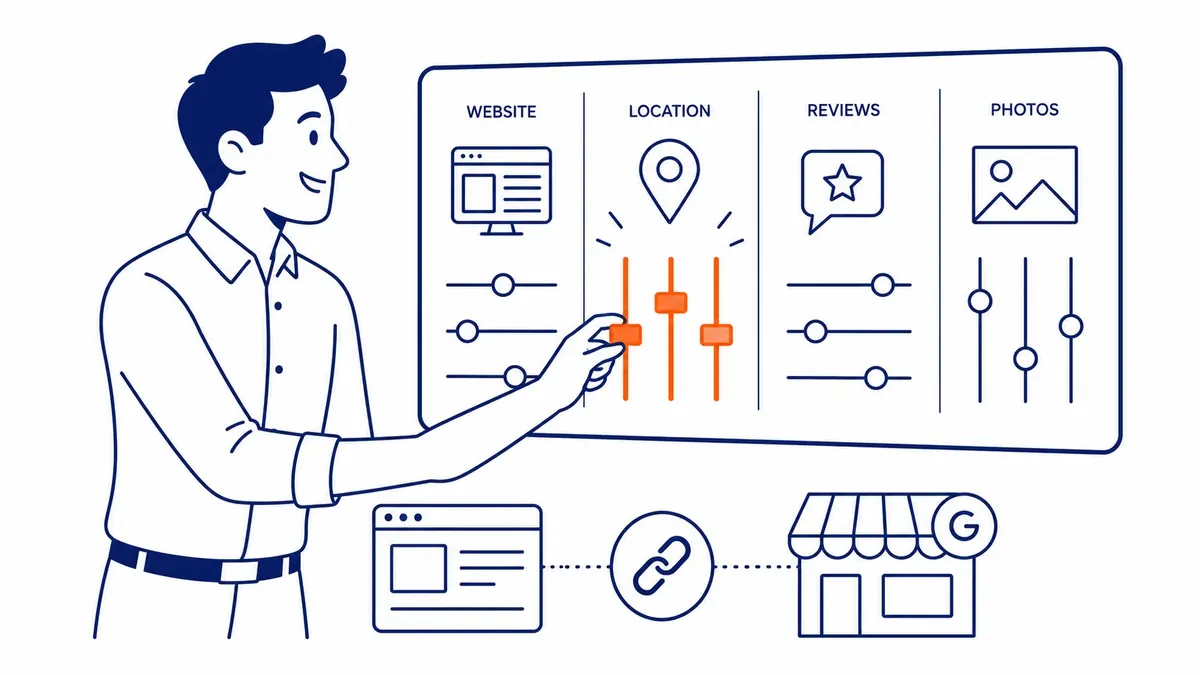
Your website reinforces whatever your Google Business Profile claims. Multi-location businesses need genuinely unique location pages, not the same five hundred words swapped with a different city name. Google spots thin duplicate content fast, and it doesn’t help rankings when it does. Location pages built for Google Maps traffic need the same care as the homepage. They’re not an afterthought bolted on once the main site launches. An SEO agency that treats location pages as a checkbox is leaving half the ranking signal on the table.
This is where schema markup helps. LocalBusiness schema tells Google your NAP, your hours, your coordinates, no ambiguity left for the crawler. Mobile page speed matters too. A slow site on a phone search drives the exact bounce-back behaviour that signals a poor result to Google. It won’t rescue a thin business profile on its own, but schema markup removes guesswork Google would otherwise have to fill in.
Service-area businesses without a physical office benefit from a hub-and-spoke structure, a main services page linking out to shorter city-specific pages. Each of those pages needs real local detail, not a copy-paste template with the city name swapped. Five hundred real words about one service area beats two thousand padded words that could describe any city in the province.
Common Mistakes That Cost Local Rankings

An incomplete profile is the most common mistake. A shaky NAP record runs a close second, and both are easy fixes. Missing categories, a blank description, a handful of photos from opening day, none of it screams active business. Wrong categories rank close behind. Some agencies pick the closest match and move on instead of testing what actually pulls in the right searches.
Inconsistent NAP data quietly undoes otherwise solid work. An old suite number sits on one directory. A missing area code sits on another. Small variations pile up, and each one chips away at the trust signal Google is trying to build around your business.
Ignoring reviews rounds out the list. A profile with dozens of reviews and zero responses reads as abandoned, even with a strong star rating. Google notices engagement. So do customers reading the reviews before they pick up the phone.
Questions Before Hiring for Local Map Ranking Signals
Ask who touches the Google Business Profile day to day. Find out how review requests get sent, and how fast responses go out. Ask what the citation cleanup process actually looks like, specifically, not in vague marketing language. Request a sample of the reporting a client actually receives, not a mockup built for the sales call.
A specialist worth hiring explains category selection in plain terms. Walks through why proximity can’t be fixed with a bigger budget. Points out that reviews take months to build meaningfully, not weeks. Vague answers on any of these questions are a signal. It usually means the work is generic, run the same way for every client regardless of category or city.
SEO Company To-The-TOP! runs local map work the same way it runs everything else. One person handling the account, no reseller layer, no junior handoff partway through the engagement. Nineteen years doing SEO services Calgary businesses actually use, since 2007. Monthly reporting shows real position movement, not vanity metrics. Clients running Google Ads management alongside organic work get both handled by the same person. That keeps the local signals and the paid signals pointed in the same direction, instead of fighting each other.
Three to six months before meaningful map pack movement shows up. That’s the realistic range for most competitive categories. Anyone promising faster results on a signal this dependent on review velocity and citation age is skipping a step somewhere.
Local SEO rankings move together, not in isolation. A Google Maps profile with strong prominence and steady local backlinks still loses ground if proximity works against it. Nobody adjusts the location pages to compensate, and the gap just sits there. Location details end up stale while everything else gets fresh attention. The agencies worth hiring treat all of this as one system, not a checklist run once and left alone. That’s the pattern behind most local SEO wins that last. An SEO agency that only chases reviews, or only chases backlinks, tends to stall out around month four. Local SEO results compound once every signal moves in the same direction.
Frequently Asked Questions
How long does it take to rank in the map pack?
Most competitive categories need three to six months of consistent work across the profile, reviews, citations, before real movement shows up. Newer or unclaimed listings on Google Maps sit closer to the longer end of that range.
Can a service-area business without a storefront rank in the map pack?
Yes, though proximity works against it by default. Strong reviews, clean citations, a central service-area address, all partially offset the distance disadvantage without eliminating it.
Does keyword stuffing in a business name still cause problems?
Yes. Google suspends profiles for it. The short-term relevance boost isn’t worth the risk of losing the listing entirely.
Do reviews or backlinks matter more for map pack ranking?
Both feed prominence, but reviews move the needle faster. Authority from backlinks takes longer to build, compounding once local sources start linking consistently.
Contact Calgary SEO Company To-The-TOP!
Questions about anything in this article, or about your own rankings? Talk to a Calgary SEO specialist directly.
Phone: (403) 308-5949
Address: 1509 14 Ave SW, Calgary, AB T3C 0W4
Hours:
Monday to Friday: 10:00 am – 7:00 pm
Saturday: 12:00 pm – 4:00 pm
Sunday: closed