How Does Google Ads Provide Control Over Your Advertising?
Control is the question we get most from businesses thinking about Google Ads. Not clicks, not cost, not competition. Control. Does an advertiser decide what happens, or does Google?
More than most expect. Spend caps are hard limits. Keywords are chosen by the advertiser. Your ad copy is written by your team. Pausing your ads takes seconds. There is no lock-in, no contract, no minimum spend requirement.
Some control has already shifted toward Google with smart bidding. Worth knowing, though, exactly which dials you still hold.
You Set the Budget. Google Cannot Exceed It.
Hard limit, not a soft cap.
Your daily budget in Google Ads is a ceiling. Google averages no more than that amount per day across a billing cycle. A single day might run up to twice the daily limit when search volume spikes. The monthly total stays within 30.4 times your daily budget, however. That ceiling is yours to set and change.

No Minimum Daily Spend
$5 a day is a valid Google Ads budget. There is no floor. For a service business in Calgary testing a tight keyword list, modest daily spend generates real data without large up-front commitment.
Is $20 a day good for Google Ads? For a focused search campaign targeting specific keywords in Calgary, it is enough to gather signal. Not volume. Signal. Two weeks at $20 shows which searches pull clicks and which ones waste spend with nothing to show.
Smart Bidding vs. Manual Bidding
Smart bidding moves bid-level decisions into Google’s algorithm. Target CPA and Target ROAS adjust your bids automatically based on predicted performance. They work well when conversion tracking is solid. Without conversions recorded, the algorithm has nothing to optimize. Manual bidding, however, holds your bids exactly where you set them.
Keywords Are Chosen by Advertisers
The advertiser decides which searches trigger their ads.
Match Types and How Tight the Control Gets
Broad match expands your keyword to related searches Google considers relevant. Phrase match requires the search to contain your phrase. Exact match holds the search close to your specific keyword. Most accounts we audit have too many broad match keywords in campaigns that needed tighter control. Irrelevant clicks follow. That spend goes to people who will not convert.

Negative Keywords Are the Sharpest Tool
Negative keywords stop your ad from running on searches you do not want. A plumber advertising on Google Ads adds “DIY” and “free” as negatives. Otherwise their campaigns attract people with no intention of calling anyone.
Neglecting negative keywords is still the most common waste we see in Google Ads accounts. Someone, however, has to look at the search terms report regularly. That is still not a set-and-forget task.
Location Targeting Keeps Ads in Your Market
Calgary only, or specific postal codes only.
Advertisers choose the geographic areas where their Google Ads run. City level, radius around an address, or a custom drawn region. Service businesses with a tight delivery zone exclude everything outside it. Your ad shows only where your customers actually are.

Demographic and Audience Layers
Audience filters also sit at the campaign or ad group level. Bid adjustments go up for segments that convert well. They still go down for audiences that historically underperform.
Remarketing adds another layer. People who visited your website without completing an action see your ad again across the Google Display Network, apps, YouTube, and Gmail. One Google Ads account handles all of it.
Your Ad Copy Stays Under Your Control
Reviewed for policy, then yours to run.
Headlines and descriptions come from the advertiser. Google also reviews your ad copy for policy compliance before anything goes live. Certain ad categories do not run regardless of bid level. Beyond compliance, what your ad says is your call.
Responsive Search Ads
Responsive search ads let you submit multiple headlines and descriptions. Google tests the combinations and serves whichever version performs best. Advertisers write every headline. Google selects which combination appears in your ad space. Consistency matters? Pin specific headlines to specific positions.

How Quality Score Shapes Ad Position
Bids alone do not determine position.
Ad Rank combines your bid with Quality Score (1 to 10). Keyword-to-ad relevance matters. Landing page experience matters. Historical click-through rate matters. All three feed into the score.
With a strong Quality Score, your ad reaches a higher position at a lower CPC than a competitor bidding more but scoring lower. Highest bid is not automatically the winner, however.
This metric responds to effort. Better ad copy lifts it. Tighter keyword groups also lift it. A faster landing page lifts it. We have watched Google Ads accounts drop CPC by 30 to 40 percent after cleaning up ad groups and improving page load time. That drop was real.
Conversion Tracking Shows What Actually Worked
The layer that changes everything.
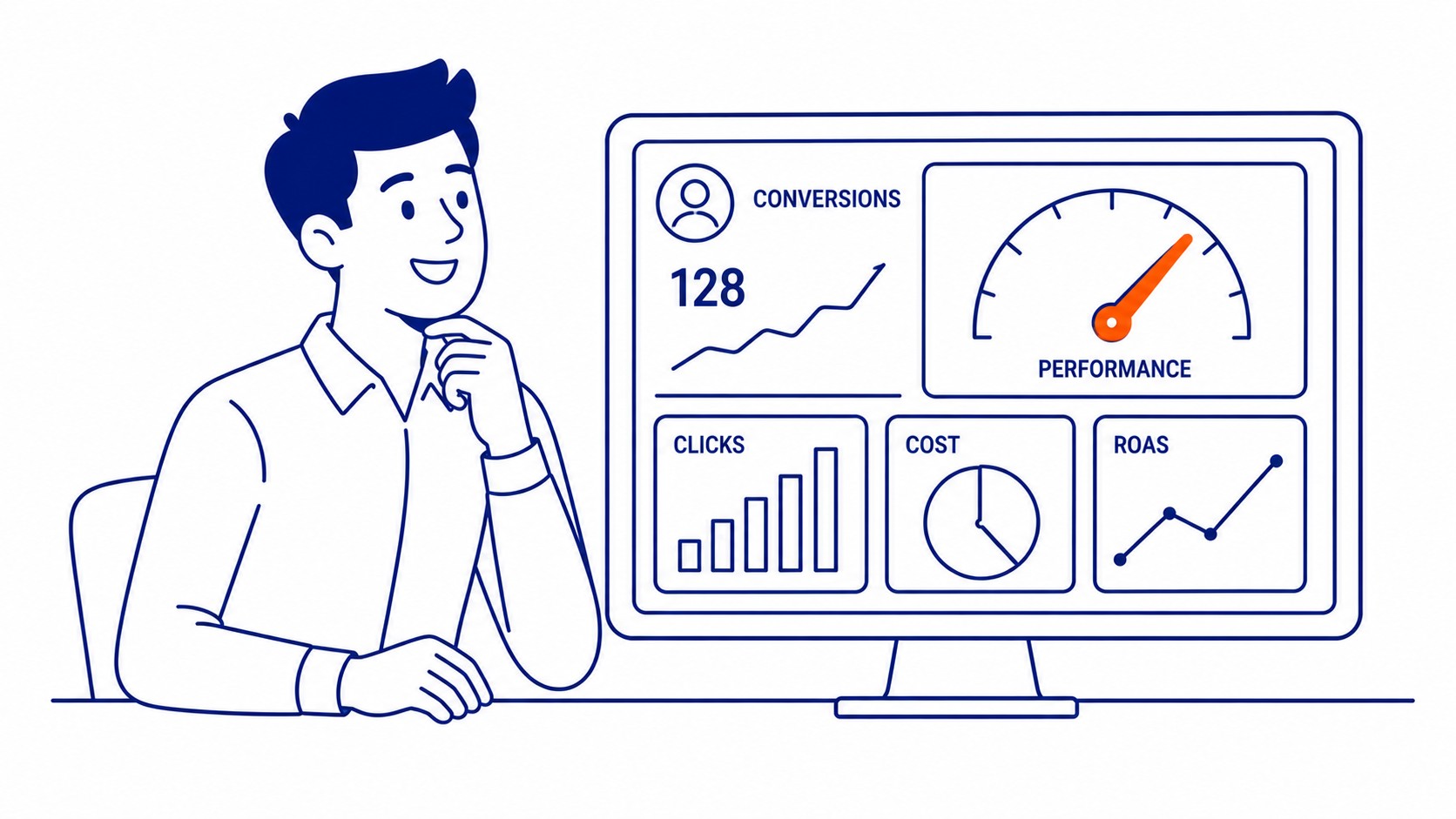
Tracking records what happens after someone clicks your ad. Phone calls. Form submissions. A purchase. These tie back to specific keywords and ads inside your Google Ads account. Without tracking set up, the account runs on click data alone. Clicks still look like results, even when nothing is converting.
Google Analytics and Google’s built-in conversion tools also feed back into your account. The data, then, shapes bidding decisions and shows which keywords deserve more spend and which ones to pause.
Pause and Adjust Your Google Ads Any Time
No contracts, no notice period.
Google Ads campaigns pause from the dashboard immediately. Spend stops the same day. Keywords go negative in minutes. No minimum required to keep the account active. Stopping takes one click.
For businesses running their first Google Ads campaign, this flexibility matters. Test your ad copy. Read the data. Adjust your keywords. The feedback loop is fast, and the account still gives you that space. Switching a keyword match type in Google Ads takes about the same effort.
What Do Google Ads Provide? FAQ
What do Google Ads provide for a business?
Targeted visibility when it counts. Your ad reaches people actively searching for what your business sells, in your service area, at the moment the search happens. Impressions cost nothing. Businesses pay per click. Only the traffic that actually clicks your ad hits your spend.
Is $20 a day enough for Google Ads?
Enough to gather data. Not enough for volume. A Calgary service business with a focused keyword list and solid negative keyword coverage can generate three weeks of real signal from $20 daily. That data tells you, specifically, whether the campaign earns more spend.
How much does a 30 second YouTube ad cost?
YouTube video ads run through Google Ads accounts. Skippable in-stream ads charge only when someone watches 30 seconds or clicks the ad. Cost per view ranges from a few cents to well over a dollar, depending on audience targeting and competition for that audience. No flat rate applies across all advertisers.
Why did Google Ads charge me $500?
Google Ads bills against payment thresholds. The account charges when spend crosses a threshold set in your billing settings, or at the end of a billing cycle. A $500 charge usually means the account hit a payment threshold. Check your Google account billing page for the threshold level and payment schedule.
To-The-TOP! has managed Google Ads campaigns for Calgary businesses since 2007. One specialist handles every account. The Google ad management service covers keyword research, negative keyword development, and monthly reporting.
For businesses weighing Google Ads against hiring a Calgary SEO company: both matter. Google Ads management generates traffic the day a campaign launches. An SEO services agency in Calgary builds organic authority that compounds over months and does not stop when a campaign pauses. Cost is the other half of that comparison, so check how Google Ads billing works first. Most new accounts start with promotional ad credit, so the first month’s math looks off.
Running a website keyword analysis first usually clarifies the starting point. It shows which terms already rank organically and which need paid search to cover the gap. That analysis shapes what your Google Ads campaign targets and what it can leave to SEO.
Contact Calgary SEO Company To-The-TOP!
Questions about anything in this article, or about your own rankings? Talk to a Calgary SEO specialist directly.
Phone: (403) 308-5949
Address: 1509 14 Ave SW, Calgary, AB T3C 0W4
Hours:
Monday to Friday: 10:00 am – 7:00 pm
Saturday: 12:00 pm – 4:00 pm
Sunday: closed
