
How Much Are My Competitors Spending on PPC?
No public number exists for that. Google does not publish it. Your competitor is not emailing over their Google Ads invoice. What exists instead is a set of signals that get you close. Sometimes within a reasonable range. Never exact.
Site owners asking this question usually want one figure. A dollar amount to react to. That number is not available anywhere, not through a free tool, not through a paid one either. What is available is a way to estimate PPC spend well enough to make a real decision.

Why the Exact PPC Number Stays Hidden
Google Ads accounts are private. Bid data belongs to the advertiser, not the public. A competitor’s actual daily budget lives inside their own dashboard. Nobody outside that account sees it directly, not a rival, not a random visitor running a search.
Third-party tools guess at spend. They do not read it off Google’s servers. Every estimate you see online gets reconstructed from visible ads and assumed cost-per-click ranges. Useful for a rough picture. Not the same thing as truth. Estimates still beat nothing, and the practical ways to see what competitors spend on Google Ads are worth knowing.

Auction Insights Shows Position, Not Dollars
Google Ads Auction Insights reports impression share against named PPC competitors. It reports overlap rate too. Position above rate rounds out the picture. None of that is a dollar figure, and none of it converts cleanly into one either.
High impression share on your core keywords means one thing. That advertiser is spending enough to stay visible most of the time. The actual budget behind that visibility stays hidden. Two advertisers can post similar impression share numbers on very different budgets, depending on Quality Score and how aggressively each one bids.
Overlap rate deserves a second look too. A high overlap rate against one specific competitor means your ad and theirs keep landing in the same auction, over and over. That pattern usually points to a direct rival targeting near-identical terms, not a loosely related business that happens to bid nearby. Position above rate then tells you who wins that shared auction more often. That is a different question from who spends more overall.

Third-Party PPC Spend Estimators Get You in the Range
SEMrush and SpyFu scrape visible ad copy across a metro area. So do similar tools. Each one multiplies that by an assumed CPC and estimated click volume. The output looks precise. A specific monthly dollar figure, right down to the hundreds. Treat that precision as decoration.
The underlying CPC assumption often misses local auction swings badly. Calgary CPCs for competitive service terms swing week to week based on who else is bidding. A tool built on national averages will not catch that. Use these numbers as a directional range, never a budget line to plan against.
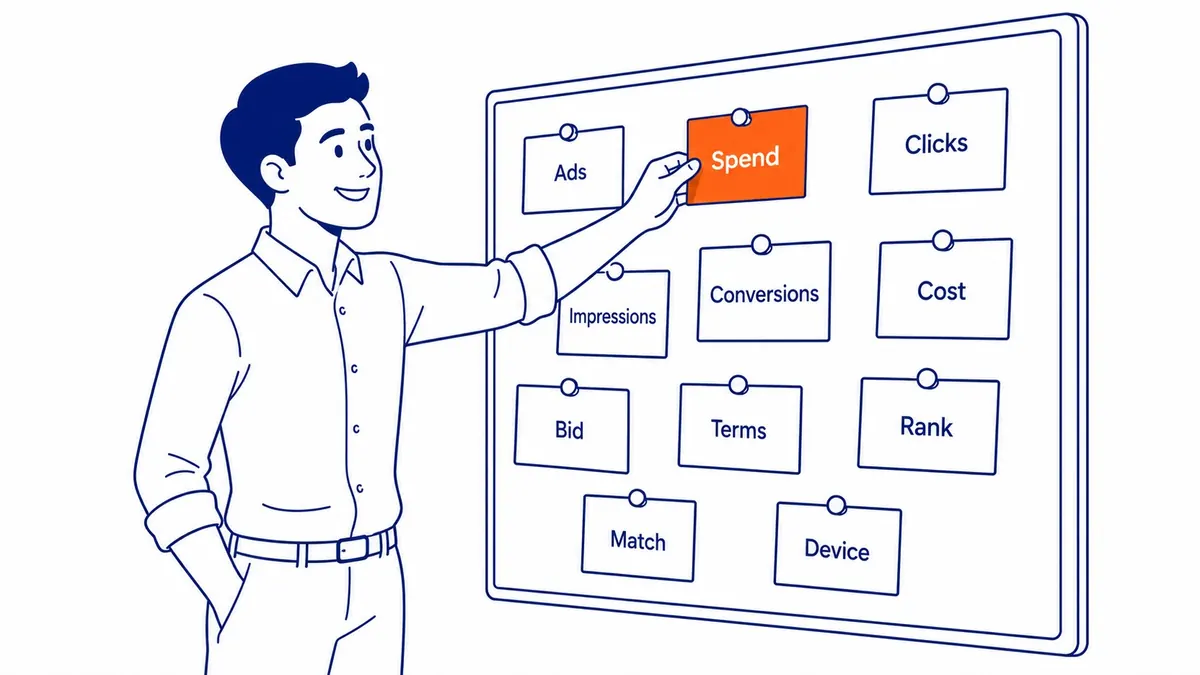
Reverse-Engineering Spend From What You Can Actually See
Run the same search on a Tuesday morning and again Saturday afternoon. Note who is still showing up both times. An advertiser present at both moments has budget that survives the whole week, not just peak hours.
Count the keyword variations triggering their ad. More variations covered usually means a bigger account, backed by real keyword research, not a guess at three obvious terms. It also points to more granular ad groups, and a budget built to match. Check how many ad copy variations rotate too. An account testing three or four headline sets is actively managed, not set-and-forget.
Landing pages matter here as well. A competitor sending traffic to a dedicated, conversion-built page is treating PPC as a real channel. One sending clicks to a generic homepage usually runs a smaller, less serious budget behind it.
Seasonality reveals plenty too. Check the same search again in January, then again in July. A roofing competitor pulling ads in the dead of winter is not out of budget. They are pausing campaigns on purpose, because the seasonal demand curve does not justify spend that time of year. A competitor running ads year-round, regardless of season, usually has a bigger, steadier budget behind the account.

Where This SEO Company Sits Differently
SEO Company To-The-TOP! runs client Google Ads management accounts directly. Real bid and spend data sits in front of the account manager every week. Auction Insights gets checked weekly for every active campaign, not pulled once at kickoff and forgotten.
Competitor spend estimates from third-party scraping tools get cross-checked first. Real numbers from the client’s own auction data come before any budget recommendation goes out. Guessing a figure from a spy tool and calling it strategy is not how this works here.
Nineteen years of Calgary SEO and PPC work since 2007 built that habit. One practitioner handles every account personally. That same person runs SEO services for that same client. So the paid and organic picture never sits in two disconnected reports.

What This Means for Your PPC Budget
Chasing a phantom exact figure wastes time better spent elsewhere. Impression share tells you more about a competitor’s seriousness. Ad presence consistency does too. So does landing page quality, more than any dollar estimate ever will.
A competitor showing up consistently is a real threat. Testing ad copy on top of that raises the stakes further. Sending traffic to a built landing page seals it, regardless of the exact number behind it. One appearing sporadically with a generic destination page usually is not. No matter what a spy tool claims their monthly spend runs. Spy-tool numbers aside, budget ranges tell you where PPC actually lands for a business your size. Software promises to close that gap; AI PPC optimization still needs someone reading the account.
Frequently Asked Questions
What is Auction Insights in Google Ads?
A report inside Google Ads showing how your ads perform against specific competitors bidding the same keywords. Impression share appears there. Overlap rate and position above rate too. Spend does not.
Are third-party PPC spend estimators accurate?
Directionally, sometimes. As an exact dollar figure, rarely. They reconstruct spend from visible ads and assumed CPC ranges, and local auction swings regularly break that assumption.
How can I tell how many keywords a competitor is bidding on?
Search enough variations of your core terms over a few days and track which ads keep appearing. A wider spread of triggering keywords usually points to a larger, better-structured account.
Does higher ad spend always mean better rankings?
No. PPC spend has no direct effect on organic rankings. Google keeps paid and organic ranking systems separate, even though both can appear on the same results page.
Should I match a competitor’s PPC budget dollar for dollar?
Not automatically. A budget set from a guessed competitor number ignores your own conversion data and margins. Set the budget from what your business can actually support, then let Auction Insights guide adjustments from there.
Contact Calgary SEO Company To-The-TOP!
Questions about anything in this article, or about your own rankings? Talk to a Calgary SEO specialist directly.
Phone: (403) 308-5949
Address: 1509 14 Ave SW, Calgary, AB T3C 0W4
Hours:
Monday to Friday: 10:00 am – 7:00 pm
Saturday: 12:00 pm – 4:00 pm
Sunday: closed