What Are Secondary Keywords in SEO? (With Examples)
A primary keyword is the main term a page is built around. A secondary keyword backs it up. It never steals the spotlight.
Confusing the two creates pages that try to rank for everything. They end up ranking well for nothing.

Primary vs Secondary Keywords, the Real Difference
A primary keyword usually pulls the highest search volume on a page’s core topic. It gets the title tag. The H1 too. Most of the early body copy as well.
Secondary keywords sit underneath it. Related phrases. Lower-volume variations. Terms someone might type instead of, or alongside, the primary one.
They are not filler. A secondary keyword earns its place through real search intent. Word-count padding does not count.

A Worked Example
Take a plumbing company page built around emergency plumber Calgary as the primary keyword.
24 hour plumber Calgary works as a secondary option. Burst pipe repair works too. So does emergency plumbing cost. Each shares the same intent. Someone needs a plumber right now.
A different example works for content. A blog post on keyword research might target “keyword research” as the primary term. “Keyword tools” support it. So does “search volume.” “Keyword difficulty” too.

A Second Example, This Time a Service Business
A dental clinic page might target “dentist Calgary” as the primary keyword.
Secondary keywords could cover emergency dental Calgary. Teeth cleaning cost Calgary is another option. So is family dentist near me. All three still point at the same patient looking for dental care nearby.
Notice none of these secondary terms compete with the primary keyword for the same click. They each catch a slightly different phrasing of the same underlying need.

Secondary Keywords vs LSI Keywords
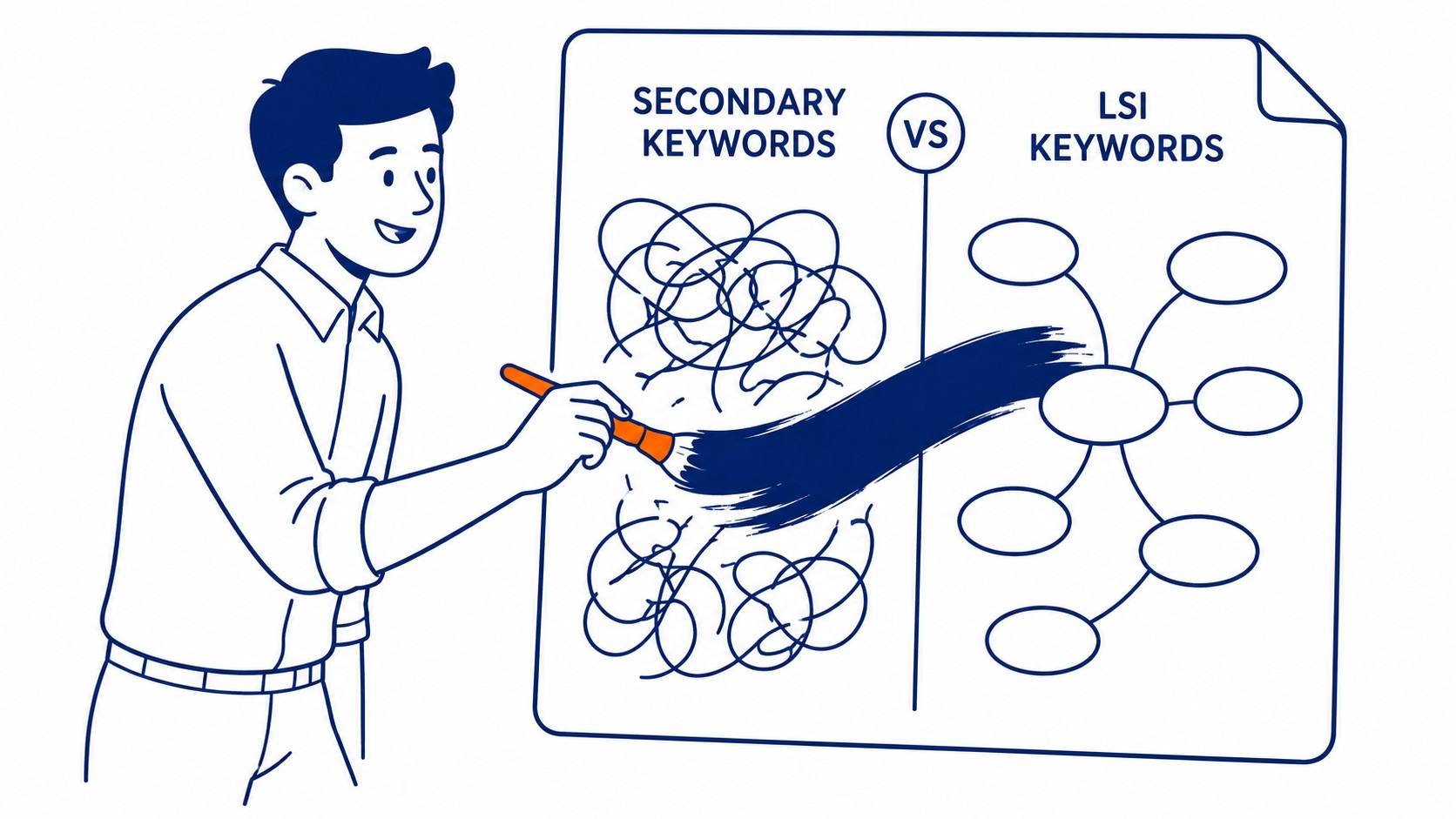
The two get confused constantly. A secondary keyword is a target in its own right, something a page deliberately tries to rank for.
An LSI keyword is supporting vocabulary. Related terms that give a page’s content texture without being a ranking target themselves. The overlap between the two categories is real, which is exactly why they blur together in practice.
How Search Intent Ties Them Together
Good secondary keywords share intent with the primary term. A mismatch signals the wrong keyword, not a missing one.
“Emergency plumber Calgary” and “how to become a plumber” look related. They are not. One signals someone hiring today. The other signals someone researching a career change entirely.
Grouping keywords by intent first, then by topic, keeps a page focused. That matters more than hitting an arbitrary keyword count.

Where Secondary Keywords Belong on the Page
Subheadings carry secondary keywords well. So does the surrounding content, woven naturally rather than forced.
Image alt text works too, when the image is actually relevant to that secondary term.
Meta descriptions can hold one secondary keyword, space permitting. Cramming several in reads as spam, to a person and to Google both.

How Many Secondary Keywords Is Too Many
Four to ten secondary keywords per page is a reasonable range for most service pages and blog posts.
Fewer than that, and a page misses easy ranking opportunities sitting right beside the primary term.
More than that, and the page starts drifting. Each additional keyword pulls a little further from the original topic.
A website audit often catches this drift before it costs real rankings. Pages accumulate keywords over years of edits. Nobody notices the page quietly stopped answering its own original question.
Older pages built before proper keyword mapping existed tend to have the worst drift. Five years of edits later, a page often reads like three separate topics stitched together. Drift like that usually traces back to a fuzzy grasp of what SEO keywords mean. Drift like that says something about the ongoing value of keywords as a planning tool.

Tracking Which Secondary Keywords Actually Work
A secondary keyword earns its spot by bringing in real traffic. Appearing in the content alone does not count.
Search Console shows which queries actually drive clicks to a page. Some of those terms were never deliberately targeted at all.
Some secondary keywords quietly outperform the primary one over time. Worth noticing when that happens, since it sometimes signals the page should be rebuilt around a different primary term entirely.
Monthly position reporting catches this shift early. A specialist watching rankings closely notices when a secondary term starts climbing faster than expected.

Finding Secondary Keywords Without Guesswork
Google’s People Also Ask boxes surface real secondary terms. Straight from actual searches, not guesswork.
Related searches at the bottom of a results page do the same job.
Google Keyword Planner adds search volume numbers on top of that. Paid campaigns through Google Ads management often surface secondary terms too. That data shows exactly which variations bring in clicks.
Competitor pages ranking for the same primary keyword are worth reading closely too. Their subheadings and FAQ sections often reveal secondary terms a fresh keyword list would miss entirely.
SEO Company To-The-TOP! has been mapping primary and secondary keyword sets for Calgary SEO clients since 2007. The process rarely changes much. Search intent still matters more than volume alone.
Frequently Asked Questions
Can a page have more than one primary keyword?
Technically, yes. Usually it means the page needs to split into two. One page chasing two primary keywords tends to rank weakly for both.
Do secondary keywords need their own dedicated page?
Not usually. That is the whole point of a secondary keyword. It rides along on a page built for something bigger.
What happens if secondary keywords do not match the primary keyword’s intent?
The page confuses Google and confuses readers both. Rankings for the primary term often suffer as a result.
How long does it take to see results from better keyword targeting?
Three to six months for meaningful movement, similar to most SEO changes. Longer for highly competitive terms.
Should secondary keywords match the exact wording people search for?
Close wording matters more than exact wording. Google understands phrasing variations well enough that forcing an exact match usually reads awkward for no ranking benefit.
Contact Calgary SEO Company To-The-TOP!
Questions about anything in this article, or about your own rankings? Talk to a Calgary SEO specialist directly.
Phone: (403) 308-5949
Address: 1509 14 Ave SW, Calgary, AB T3C 0W4
Hours:
Monday to Friday: 10:00 am – 7:00 pm
Saturday: 12:00 pm – 4:00 pm
Sunday: closed
