How to Sell SEO
Selling SEO is harder than selling most professional services for one reason: what you are selling is invisible at the point of sale. Clients cannot see the keyword research, the technical audit, or the content plan you are proposing. What they can see is a promise that their website will rank higher on Google — something that has been promised to them before by sellers who did not deliver. That history is in the room every time you pitch SEO services.
The fix is not a better pitch deck. It is a sales process that demonstrates competence before asking for money, addresses the previous-failure history directly, and proposes a scope narrow enough to be believable. What follows is a practical breakdown of how to sell SEO services from the first contact through to a signed agreement.
Who to Sell SEO Services To
Not every business is a good SEO client. The most receptive clients for SEO services share three characteristics: they have an existing web presence (something to improve rather than build from zero), their customers search for their type of business online, and they have enough budget and patience for a six-to-twelve-month engagement. Businesses that need customers fast are better served by Google Ads. Businesses that need customers forever, at a lower cost-per-acquisition over time, are the right fit for SEO.
Local service businesses are often the best starting point for new SEO sellers. Plumbers, electricians, lawyers, dentists, chiropractors, contractors — businesses with a physical location serving a defined geographic area, competing for local search terms. The competition is usually concentrated enough that results are achievable in a reasonable timeframe, and the business owners understand that customers search Google for services like theirs. What them different from e-commerce clients: the conversion is a phone call or form submission, not a product sale, which means the SEO goal is simpler to define and measure.
Beyond local businesses: marketing agencies without an SEO offering often white-label SEO services. Businesses in a specific niche you have experience in — roofing, medical, legal, SaaS — are more likely to trust a practitioner with documented vertical expertise than a generalist. Specialisation narrows your market but increases close rates.
How to Find SEO Clients
Referrals are the highest-converting source of SEO clients, particularly at the beginning. One satisfied client who recommends you to a business associate produces prospects with much lower skepticism than any cold outreach. The implication: early clients who get results should be followed up with regularly, not just to retain them but to ask who they know who might benefit from the same work.
Cold outreach to local businesses works with the right approach. Searching Google for your target service category in a specific city — “Calgary plumber,” “Calgary family lawyer,” “Edmonton landscaping” — shows you exactly which businesses are and are not showing up. A business that does not appear on the first page for its own category name is a prospect. What gives outreach credibility: a specific observation about their current situation, not a generic offer. “I noticed your business does not appear in Google search results when people search ‘roofing companies in [city]’ even though you have been in business for ten years. There is a specific reason for this and it is fixable.” That opens a conversation. A generic “I offer SEO services” email does not.
LinkedIn is a channel for reaching business owners and marketing managers at companies with in-house digital marketing budgets but no SEO expertise. Content marketing — publishing what you know about SEO publicly — builds inbound leads over time. Webinars, speaking at local business events, and partnerships with web designers (who build sites but do not do SEO) are other channels that produce SEO leads with reasonable quality.

The SEO Audit as a Sales Tool
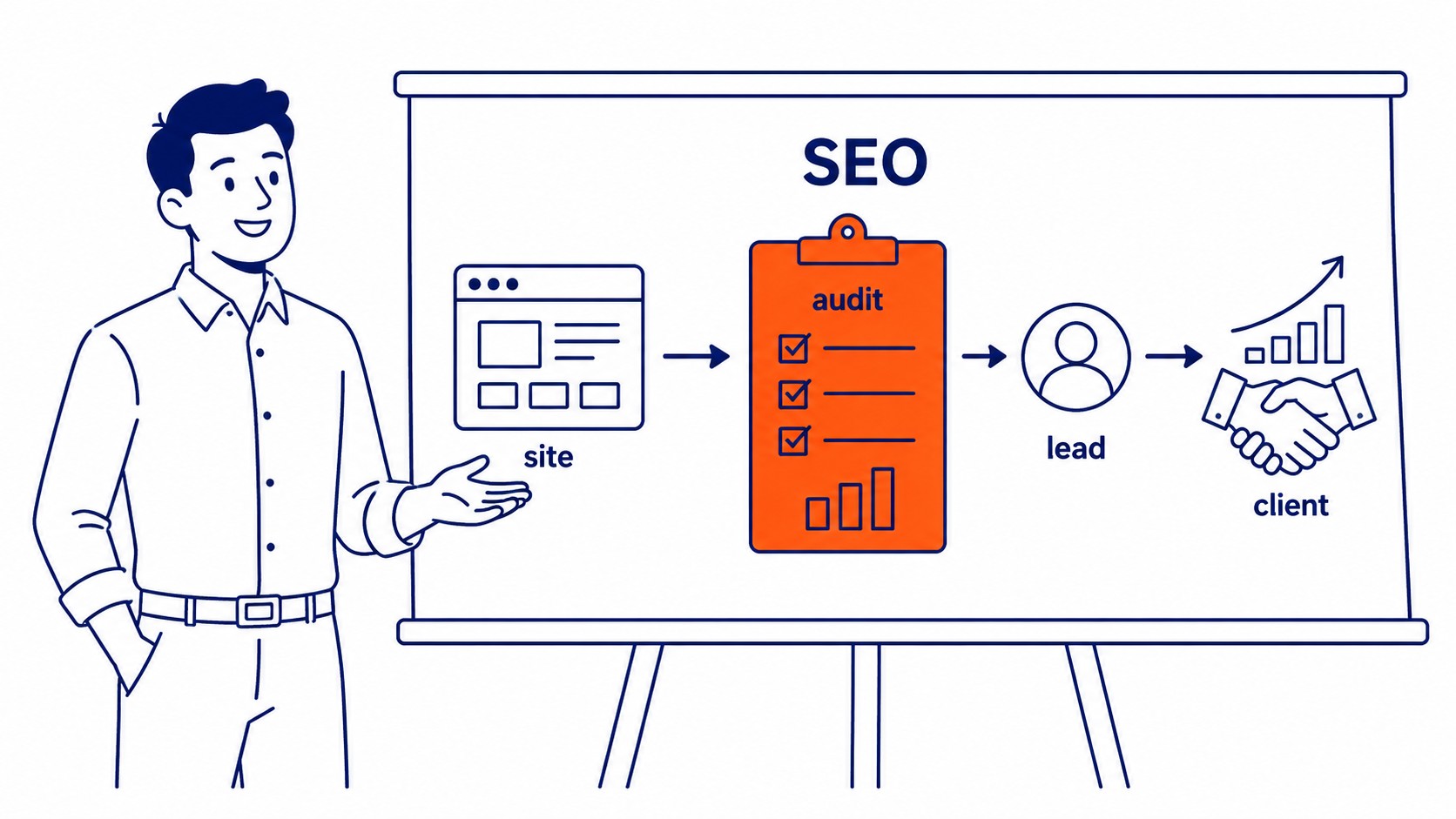
The most effective thing you can do before proposing SEO services is show the prospect what is actually wrong with their current search presence. A free or low-cost SEO audit performed on their website, presented in plain language, accomplishes several things: it demonstrates that you know how to evaluate a site, it makes the problem concrete rather than abstract, and it gives the prospect something tangible before they have committed any money.
What to include in a sales audit: current keyword rankings for their primary service terms, comparison against two or three local competitors who are outranking them, a summary of technical issues preventing search engines from properly indexing the site, and a gap analysis showing what pages and content they are missing. The gap between where they are and where their competitors are is the visual argument for why they need SEO services. Numbers are more persuasive than abstractions: “Your main competitor has 47 pages indexed by Google and you have 12” is more compelling than “your website has less content.”
Keep the audit readable. A 40-page technical report impresses other SEO practitioners. Business owners want to know: why am I not showing up, who is ahead of me, and what would fix it. Answer those three questions clearly and the conversation about SEO services becomes much easier. Our approach to SEO auditing is structured around those same questions because they are what clients actually care about regardless of how technically comprehensive the work behind them is.
Handling SEO Sales Objections
“I tried SEO before and it didn’t work” is the most common objection when selling SEO services. What it usually means: a previous SEO provider took money, produced reports, and delivered no measurable improvement in rankings or traffic. That experience is common enough that many small business owners have had it. The right response is not to defend the industry. It is to acknowledge the experience, ask what they were promised and what they received, and then explain specifically what you do differently and why. Concrete differences — deliverables, reporting, what you will not do — are more credible than general reassurances.
“SEO takes too long” is an objection about the timeline, which is legitimate. The straight answer is that competitive keywords in many industries take six to twelve months to move significantly. What you can point to: local or long-tail keywords that move faster, Google Business Profile work that produces map pack results in weeks, and technical fixes that improve crawlability quickly even if organic ranking shifts take longer to show. Staging the early deliverables around faster wins maintains momentum in the first few months of an engagement while longer-term rankings develop.
“It’s too expensive” usually means the prospect does not yet see the return, not that the price is objectively too high. The reframe: what is a new customer worth to this business? A law firm where a new client generates $5,000 in fees needs only two new clients per month to justify a $1,500/month SEO retainer. Making that math explicit — in their industry, with their numbers — shifts the conversation from cost to investment. Clients who understand the return model for their specific situation are far more likely to sign than clients who see SEO as a line-item expense without a clear payoff.
Pricing SEO Services
SEO retainers for local businesses typically range from $500 to $3,000/month in the Canadian market. What determines where a client falls in that range: the competitiveness of their industry and geography, the scope of work required (technical issues, content needs, link building requirements), and the number of keywords and service pages you will be actively managing. A dentist in a medium-sized Alberta city competing for three or four primary service keywords is a different scope than a personal injury law firm in Calgary competing for dozens of high-competition terms.
The project-based model works for one-time deliverables: a full technical audit and recommendations, a keyword strategy document, a local SEO setup package. Monthly retainers are the more sustainable revenue model for both parties — the client has ongoing work done on their behalf, and you have predictable income. Most experienced SEO sellers eventually move away from one-off projects toward retainer-dominant practices because the results compound over time in a way that project-based work does not.
Pricing for Google Ads management alongside SEO services often makes the total package more valuable to clients. A business running both organic SEO and paid search benefits from keyword data flowing between both channels — the top-converting paid keywords inform the organic content strategy, and the organic traffic data shapes where the paid budget is focused. Clients with both services also retain more readily because changing SEO providers disrupts the integrated strategy rather than just the SEO piece.

Writing an SEO Proposal That Closes
An effective SEO proposal follows a simple structure: what we found (audit summary), what we will do (scope of work), what we expect to happen (realistic outcomes), and what it costs (pricing and terms). Proposals that lead with deliverables and price without first establishing the problem — and demonstrating that you understand it — close at much lower rates than proposals that flow from diagnosis to solution.
The audit summary should reference the specific things you found about their site, not generic SEO issues. “Your title tags are not optimised” is less compelling than “your homepage title tag says ‘Home | [Business Name]’ rather than the service category and city where you want to rank.” Specific findings from their actual website prove you did the work; generic statements do not. What them remember about you after reading the proposal is whether it felt relevant to their actual situation or like a template sent to fifty other businesses.
Scope should be specific without being overwhelming. Monthly deliverables listed clearly: keyword position reports, content additions, technical fixes completed this period, link building activity. What you will not do is also worth including — ruling out black hat tactics, guaranteed rankings claims, or anything else the prospect may have been promised before builds credibility. Specificity about what SEO services are and are not disarms skepticism better than generic reassurances.
Pricing should appear after the value case is made, not at the beginning. Lead with what the client gets and why it matters. Follow with what it costs and how payment works. Monthly invoicing with a three-to-six-month minimum term is standard in the Canadian SEO market — this gives enough time to demonstrate results before the client can exit, and is long enough for the practitioner to do meaningful work.
What Happens After the Sale
Onboarding sets the tone for the entire engagement. A structured first-month process — access to Google Search Console and Analytics, a keyword strategy review call, a site audit walkthrough, an agreement on how reporting will work — gives the client confidence that they made the right decision. Clients who feel abandoned after signing churn early; clients who feel informed and included stay.
Reporting is where SEO services retention is won or lost. Monthly reports should show what work was done, what rankings changed, and what traffic changed. The connection between the work and the outcomes should be explicit, not assumed. When rankings do not move as expected — which happens, especially in the early months — the report should explain why, what was learned, and what the next phase of work addresses. Clients who understand the process tolerate plateaus. Clients who only see a monthly price with no clear outcome connection do not.
The best SEO clients are long-term clients. Selling SEO services to the same client for three, five, or seven years is possible when the results compound and the relationship is built on transparent reporting. As a Calgary SEO agency, To-The-TOP! has clients who have been on retainer for over five years, which is possible because the work is managed by one practitioner, the communication is direct, and the reporting is candid about timelines. The sales approach described in this guide is the same one that produces long-term engagements — it starts with a realistic promise and backs it up with consistent SEO keyword analysis and execution.
Frequently Asked Questions
How do you sell SEO?
The most effective process: identify businesses whose customers search for their services online, run a free or low-cost audit showing the gap between their current search presence and their competitors, present the audit findings in plain language with specific observations about their site, handle the “I tried it before” objection with specifics about what you do differently, and propose a realistic scope with a three-to-six-month term. The close comes from demonstrating competence before asking for money, not from pitching SEO services as a concept.
Is SEO dead or evolving in 2026?
Evolving. The AI overview in Google search results is changing how much organic traffic flows from some informational queries. But intent-based local and commercial searches — the queries that produce phone calls and contact form submissions — are still delivered through organic results to a significant degree. Selling SEO services in 2026 means understanding where organic traffic still converts for the client’s category, and being upfront that the landscape is different than it was in 2019. Clients who understand this are more realistic about expectations, which produces better long-term relationships.
What is the 80/20 rule for SEO?
Roughly 80% of a site’s organic traffic comes from 20% of its pages. In sales terms: the same principle applies to SEO clients. Twenty percent of your clients will generate eighty percent of your referrals, long-term retention, and satisfaction. Identifying which clients are in that group and investing in those relationships disproportionately is how most experienced SEO practitioners build sustainable businesses rather than constantly chasing new clients to replace ones that churn. Selling SEO services well is partly about identifying good clients before signing them.
Will SEO be replaced by AI?
SEO as a discipline will not be replaced, but selling SEO requires adapting the pitch for what AI has changed. AI tools have made generic content cheaper to produce, which means the commodity end of content SEO is worth less than it was. Strategic SEO — what keywords to target, how to structure a site for topical authority, what links matter, how to optimise for local — remains a human-intensive service. Selling SEO services in 2026 should position around strategy and results rather than deliverable volume. Clients who care about page count are buying the wrong thing; clients who care about ranking and phone calls are the ones worth closing.
