
Does Optimizing Content for SEO Work? What the Statistics Actually Measure
It Works. The Statistics Still Cannot Show You That
Yes. Anybody who has rewritten a thin service page properly has watched the impressions climb afterward.
Now try proving that with a statistic. There the trouble starts.

You went looking for numbers before committing money to content. Sensible thing to do. Only the numbers waiting for you got built to answer somebody else’s question.
What a Content Optimization Statistic Is Made Of
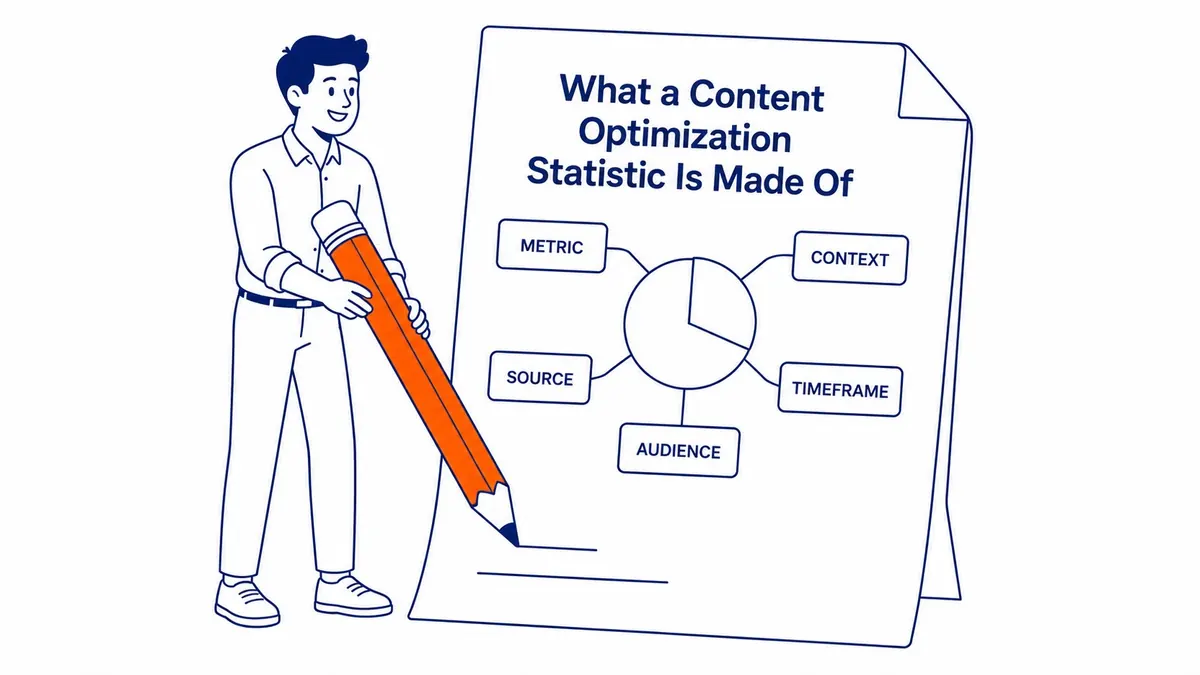
Pick any of them. Optimized pages earn some multiple of the traffic. Longer articles rank higher on average. Refreshing an old post lifts sessions by a headline percentage.
Each of those came out of a dataset. Somebody gathered a pile of URLs, measured a feature across the pile, then compared how those pages performed.
So the useful question is never whether the number is real. Usually it is. Ask instead which URLs went into the pile.
The Pile Starts With Pages That Already Won

Here sits the part that never makes the headline.
Ranking data comes from ranking pages. A study of the top ten results samples the top ten results. Crawler-based tools report on URLs their crawler could reach, which means indexed and linked and alive.
Now think about what is absent. The optimized page sitting on result forty. A rewritten service page that moved nothing at all. Somebody’s blog, updated every month for a year, phone still quiet.
Those pages exist in enormous numbers. None of them entered the dataset.
Nobody hid them either. They simply have no traffic worth measuring, which is the exact property that keeps a page out of a traffic study. The sample excludes failure by definition rather than by choice.
So your statistic describes what winners have in common. Then you read it as your odds of winning. Different claim entirely.
Both readings fit the same number without contradiction. That is why it survives so much repetition. Quote it at a skeptical business owner sometime and watch how little it lands.
Somebody Will Say a Bigger Sample Fixes This

Fair, and it is the strongest objection available. Millions of URLs went into some of these studies. Surely that volume washes the problem out.
Volume was never the issue. Ten million ranking pages are still ten million ranking pages. Widening the sample widens it in the direction it already leaned.
Actually the large study does more damage. It arrives with charts. A methodology section too. Authority, applied to a population that excluded every failure by construction.
There the objection turns into the argument. Scale cannot repair a sample that only admits survivors.
What Would Actually Prove Optimizing Content Works

In principle the statistic you want does exist. Take your page. Optimize it. Then run the same eight weeks twice over, once per version, so the comparison holds everything else still.
Nobody can do that. One page, one timeline, one Google. Whichever version you left unpublished generated no data at all.
So every study on offer substitutes something for that missing half. Other people’s pages stand in for the draft you never shipped. That swap is the entire method, and it does far more work than the charts admit.
Closest anyone gets is a split test across a group of near-identical pages. Large ecommerce sites can run those, since they own hundreds of product templates built from one pattern. Your seven-page service website cannot.
The Survey Numbers Break a Different Way

Then there is the other family of statistics. Marketers reporting what content optimization did for them.
Nobody enjoys filling in a survey about the quarter they wasted. So the respondent answers about the campaign that worked instead. Memory handles the rest. Self-report, collected from people with a reason to look competent.
Vendor case studies land in the same place. A tool company publishes the client who improved. Their other clients still exist.
A Statistic Your Own Site Can Produce

Open Search Console. Twenty minutes of work sits between you and a number that actually covers your site.
List five pages you optimized. Write down the date each change went live. Set the performance report to its sixteen-month window. Filter to one page. Then compare the eight weeks before that date against the eight weeks after. Note the impressions. Average position too.
Now repeat all of that for five pages you never touched.
That second group is your control. No published study will hand you one.
Most people skip the control and stop after the first list. Then a rise gets credited to the rewrite automatically. Half a measurement, read as a whole one.
Both groups climbing together means something else moved them. A seasonal swing. An algorithm update. Your rewrite earns no credit there. The optimized five pulling away from the untouched five is as close to proof as this work gets.
Compare that to the statistic you arrived looking for. Yours carries a control group. It samples exactly the site you care about.
What Your Own Number Still Will Not Settle

Real limits apply here.
Google shipped changes during your window. A competitor may have gone quiet. Another may have gone aggressive. Five pages are five pages, so one lucky post can carry the whole comparison.
Your keyword research shapes the result as much as the writing does. Content optimized for a term nobody searches will sit there, beautifully optimized and unread. That failure looks identical to a writing failure in the data.
Nobody can hand you certainty in advance, including me. Quote a precise lift for a site before the work happens and you are quoting somebody else’s sample.
Content Optimization Work at SEO Company To-The-TOP! in Calgary

To-The-TOP! has been running Calgary SEO campaigns since 2007. Solo practitioner. You work with the person doing the work rather than a junior.
Content optimization at To-The-TOP! starts with a website audit, since the pages worth rewriting are rarely the ones a client expects. Then comes the keyword research. Next, the writing itself. Then monthly position reporting, so your before-and-after comparison lives on paper instead of in memory.
Plenty of businesses run Google Ads alongside that, because paid traffic arrives while the organic side is still compounding. Paid search reports its numbers weekly. Organic takes months. Both facts belong in the same conversation, stated plainly, before anybody signs anything.
Nothing in the SEO portfolio gets expressed as a percentage lift. It names ranked keywords instead. Different kind of evidence, and you can go and search those terms yourself.
Common Questions About SEO Content Statistics
What percentage of pages improve after content optimization?
Nobody knows, and the published statistics cannot tell you. Those samples were drawn from pages that already ranked. Your own before-and-after measurement is the only number scoped to your site.
Are SEO case study statistics trustworthy?
Trustworthy about the case, yes. Somebody’s page really did gain that traffic. The gap opens when one client result gets read as a rate you should expect.
How long before optimizing content shows a measurable change?
Give it three to six months on a competitive keyword. Impressions usually move before average position does. Watch that column in Search Console first.
Does word count correlate with rankings?
Correlate, often. Cause, no. Longer pages tend to cover more of the question, and thorough coverage is the thing getting rewarded.
How many pages should I optimize before judging the result?
Ten pages give you something to read. Five optimized, five left alone. Fewer than that and a single outlier decides your verdict.
Contact Calgary SEO Company To-The-TOP!
Questions about anything in this article, or about your own rankings? Talk to a Calgary SEO specialist directly.
Phone: (403) 308-5949
Address: 1509 14 Ave SW, Calgary, AB T3C 0W4
Hours:
Monday to Friday: 10:00 am – 7:00 pm
Saturday: 12:00 pm – 4:00 pm
Sunday: closed