
Does TLD Matter in SEO?
Not for ranking. Your TLD decides something else though. Who gets to stand beside your name in the results.
Most guides answer the ranking half and stop there. Google does not score extensions. True enough. That answer is also the easy half. Nobody bills you for it.
The Ranking Answer Is Short. The Ownership Answer Is Not.
Generic top-level domains receive equal treatment in Google’s ranking systems. A .com holds no built-in advantage over a .net. Newer TLDs like .agency or .online carry no penalty either. Google has said this repeatedly and the search results back it up.
So pick whichever one you like. That is where the standard advice ends.
Registering a TLD quietly does one more thing. It leaves every other extension of that same name sitting on a shelf, available to a stranger. Your TLD choice doubles as a decision about a neighbour you have not met yet.
The damage shows up at that neighbour. Never inside the algorithm.
A ccTLD Is a Country Signal and Not Much More
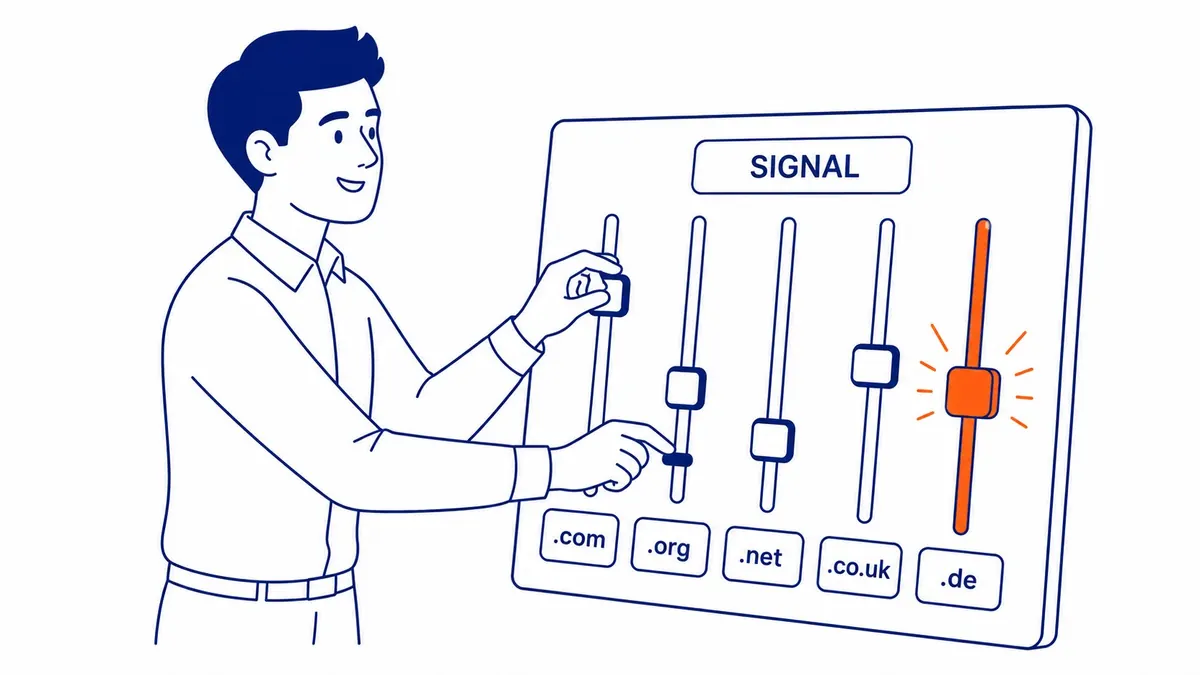
Country-code TLDs behave differently from the generic ones. A .ca points Google at Canada. The .co.uk equivalent points at Britain. That is geo-targeting rather than authority.
Useful inside the country. Limiting outside it. A .ca is a poor fit for a business chasing American customers later on. Most Calgary trades never chase them anyway.
Notice how small that claim is. A country hint. One signal among hundreds, and one you can also set through other means entirely.
Fine. Now the part that costs money.
Somebody Will Say Every TLD Is Treated Equally

They are right. Follow the objection out to its end, though, because it turns into the argument.
Equal treatment means Google holds nothing that marks the .com version of your name as an impostor. That site is simply another site. Same starting line as yours.
Picture the ordinary version of this. A stranger registered yourname.com years ago. He sells industrial fasteners. Nothing to do with you. Search your own brand name now and two sites hold a claim to that word.
Google separates the pair using links and behaviour. Age helps too. The TLD contributes nothing whatsoever, which is exactly what everybody was cheering about a paragraph ago.
If TLDs did carry weight, the weight would at least act as a tiebreaker. They do not. So the tie gets broken by everything else. A stranger with an older site can beat you on your own name, and no amount of on-page SEO changes his extension.
The Result You Do Not Control Is Your Own Name

Brand searches are the ones people run immediately before phoning you. Highest intent traffic on the whole site. Also the traffic every owner assumes is safe.
Habit routes a share of those people past Google entirely. They type the business name into the address bar. Then .com, because that is what fingers do without asking permission.
Your .ca never enters the transaction.
Compare that against fighting for position four instead of five on a service keyword. Not close. One of those visitors already decided to buy.
Two Companies, One Name, Two Extensions
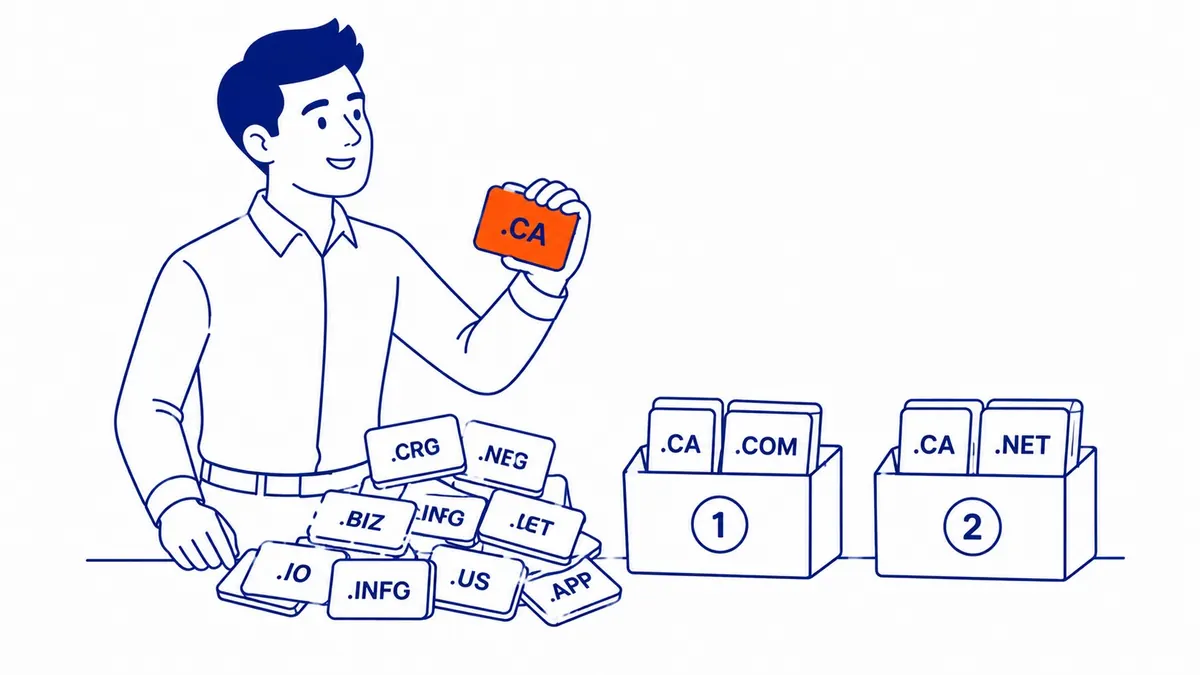
Here is the shape it takes in practice. Two businesses, neither of them doing anything wrong.
The first sits on a .ca registered in 2019. Clean site. Decent content. Ranks well for its service keywords across Alberta.
The second holds the .com of the same name. Registered in 2003 for an unrelated trade in Ontario. Barely maintained. Half the pages have not been touched in a decade.
Search the shared brand name and the older domain still tends to sit above the newer one. Age counts. Accumulated links count. Neither business chose that outcome. Better pages will not fix it either, since the competing result was never competing on quality.
Now flip the roles. Put the older domain on the .ca and the newer one on the .com. Same result, reversed. The extension never touched it.
That is the whole demonstration. TLDs do not decide the winner. They decide whether a second contestant exists at all.
What the Twin Domain Costs You After You Rank
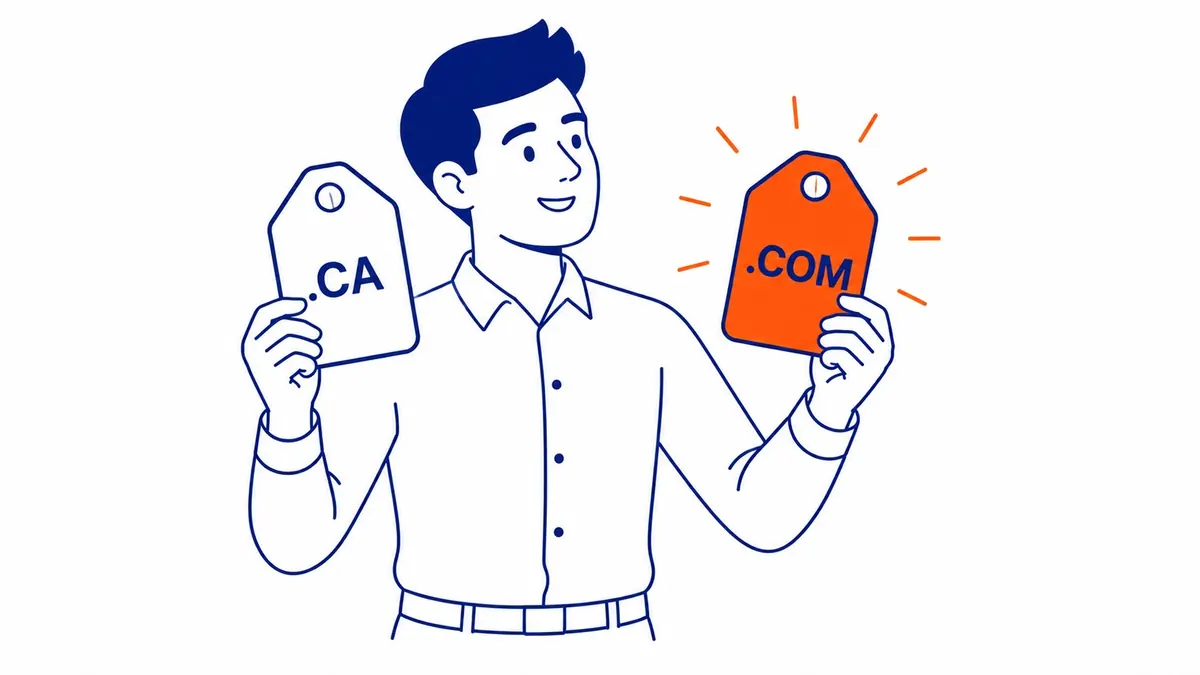
Links arrive at the wrong address first. A directory editor writes up your business and reaches for the .com out of reflex. Local news does the same. Those links land on somebody else’s server. Your site never sees them.
Email drifts along the same path. Documents go to name@the-other-extension. You rarely find out, because the sender assumes you got it.
Then the genuinely ugly case. A twin domain expires and somebody in the expired-domain trade picks it up. Brand searches afterward return your business next to a page you would not want your name near. Nothing on your own website fixes that.
Directory listings drift as well. Most citations carry a website field, and plenty of those listings were built by somebody else years ago. A data aggregator guessed at your address. It guessed .com, naturally.
None of this registers in a rank tracker. Which is precisely why it runs for years without anyone naming it.
Somebody Will Say Just Register Both

Do exactly that, where you can. Pull up a registrar and price the twin. Weigh it against one lost enquiry. The arithmetic takes about nine seconds.
The advice only holds while the twin is still free. Often it is long gone. Somebody registered that name in 2004 and still trades under it.
The domain question converts into a naming question at that moment. Pick a business name whose twin you can hold. Or accept sharing your brand results permanently. Both are defensible positions. Only one of them stays available to you later.
Buy the extensions people actually type, though. That means .com and your own country code. Nobody guesses at your .xyz while standing in a driveway with a phone in one hand.
Registrars will happily sell you fourteen more. Decline politely.
Parking the spare extension on a redirect protects the name and adds nothing to rankings. Defensive registration. Nothing more than that.
Four Checks Before You Register Anything

Type the intended name into a registrar search. Note which extensions are taken, then actually visit each one. A parked page is harmless. An operating business is not.
Google the bare brand name second. Count the first-page results that are not you. That number is the fight you are signing up for.
Third, run any registered twin through the Wayback Machine. Read what used to live at that address. A domain with an unpleasant history sitting beside your name in the results is worth knowing about before you commit to anything.
Last one. Open Search Console. Filter the query report down to your brand name. Compare those impressions against your service keywords. The ratio surprises most owners.
Four checks. Maybe twenty minutes of work. All of them cost far less before you register than after.
TLD Questions and the Work at SEO Company To-The-TOP!
Calgary owners raise TLDs at two moments. Naming a new business, or weighing a change to an existing one. Same answer both times. Choose for the name, not for the algorithm.
To-The-TOP! has run SEO in Calgary since 2007. One specialist handles an account from first audit to monthly report. No junior handoffs anywhere in it. White Hat methods only.
Your domain extension is a small piece of a much larger picture. A proper website audit covers what no domain choice can fix. Then comes keyword research pointed at searches you can realistically win. The portfolio on our site shows which ones we have won already.
Paid search covers the brand gap meanwhile. A Google Ads campaign can hold your own name in the top slot while the organic side sorts itself out. Cost per click on your own name usually runs low, unless a competitor is bidding against you there.
Ring (403) 308-5949 if a twin domain is already sitting on your results.
Common Questions About TLDs and SEO
Does a .ca domain rank better in Canada?
A .ca acts as a geo-targeting signal that tells Google your site serves Canada. It concentrates you inside Canadian results rather than adding authority everywhere. For a Calgary or Edmonton business serving local customers, .ca is a sound choice.
Do new TLDs like .online or .agency hurt SEO?
Not in Google’s ranking systems. Newer generic TLDs receive the same treatment as .com. User recognition is the real gap, since people still trust and remember .com more readily, which affects click-through rather than ranking.
Is a .com still worth paying more for?
Usually yes, for reasons that sit outside the algorithm. People type .com by habit, link to .com by reflex, and remember it more easily. Those behaviours feed traffic and links, which do move rankings.
Should I change my TLD to improve rankings?
No. Moving domains carries real risk and delivers no ranking gain from the extension itself. Change domains for naming or ownership reasons, then handle the migration carefully with 301 redirects.
Contact Calgary SEO Company To-The-TOP!
Questions about anything in this article, or about your own rankings? Talk to a Calgary SEO specialist directly.
Phone: (403) 308-5949
Address: 1509 14 Ave SW, Calgary, AB T3C 0W4
Hours:
Monday to Friday: 10:00 am – 7:00 pm
Saturday: 12:00 pm – 4:00 pm
Sunday: closed