
How Google Algorithm Updates Affect SEO Strategy
Keep the fundamentals. Stop chasing announcements. Wait out the volatility, then look at what actually dropped.
That is the standard answer to this question. It is also correct, and this site argues it properly on other pages, so none of it gets repeated here.
Something inside the question is worth taking apart though. It assumes the Google algorithm update happens first. Then the SEO strategy reacts to it. Read the question that way and the arrow only ever points one direction.
Turn the arrow around. Your SEO strategy decides how much of any algorithm update can reach you at all. That gets settled months before Google ships anything.
The Answer Everybody Reaches For First
Ask around and the same posture comes back. Ride it out. Build quality. Do not panic.
Fine advice. Useless as a forecast, though. It tells a business owner nothing about the next core update. Whether it costs them a quarter. Or passes straight over the site without touching a page.
Prediction is the part people actually want. And prediction is available, just not from the direction everybody looks.
An Algorithm Update Arrives at Queries, Not at Websites
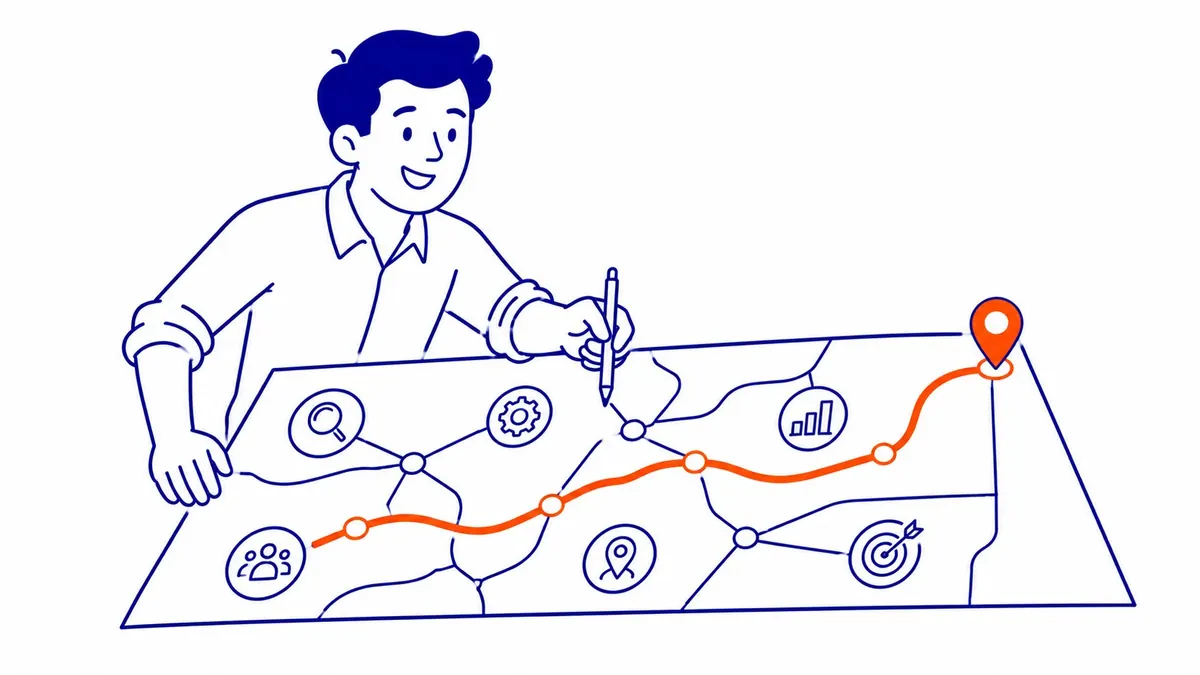
Google does not rank websites. It answers one query, for one person, in one place, then does it again for the next person.
So an update changes how some class of queries gets scored. Not how your domain gets scored. That distinction sounds academic right up until you open a Search Console report during a rollout.
Picture two pages on one site. One climbs through the same core update that sinks the other. Same domain. One author wrote both. Identical fortnight.
Nobody sabotaged anything. Those two pages simply live in different query neighbourhoods, and the change only reached one of them.
That happens constantly. Then site owners average everything into a single traffic line and go hunting for a single cause.
Two Sites, One Update, Opposite Week
Easiest to see as a comparison. Two Calgary contractors, invented for the point. Both publish regularly. Sites are tidy, fast, well built on either side.
The first has forty pages of general advice. How to choose a contractor. What a basement costs. Why permits matter. None of it is wrong. All of it exists in nine hundred other places, written slightly better.
The second has twelve pages. Every one is tied to a job the crew has actually finished. A neighbourhood the truck really drives to. Photos taken at that address.
A core update lands. The first site loses a third of its sessions inside a week. Its neighbour barely registers the thing.
Neither owner touched anything. The difference got decided at a planning table months earlier, when somebody chose what to publish.
Your SEO Strategy Already Set the Blast Radius
Every page you own ranks for a reason. Sometimes that reason is strong. You are the only place answering a specific question about a specific service in a specific city. No algorithm has much room to disagree.
Sometimes the reason is weak. The page ranks because it overlaps with the query and nothing better has crowded it out yet.
Weak reasons are exactly what an update re-scores. Strong reasons are boring to a ranking system. There is very little to recalculate about being the only real answer on the results page.
So exposure is a proportion question. How much of your traffic currently sits on pages held up by weak reasons?
Answer that and you have forecast your next core update, roughly, while knowing nothing whatsoever about it.
Count Your Exposure Before the Next Algorithm Update

Do not estimate this. Measure it.
Open Search Console. Set the range to the last six months. Sort pages by clicks, then take the top twenty.
Now work down the list one at a time. For each page, write a single sentence naming why it deserves to outrank the result sitting below it. Ban yourself from the words quality and comprehensive. Those two words are how a weak reason disguises itself.
Some pages take four seconds. Others stall you completely.
Total the clicks on the ones that stalled you. That figure is your exposure to the next algorithm update. It is also the only forecast on the subject worth anything. Twenty minutes of work. Not a word of SEO news required.
The Rollout Window Is Not a Verdict

Google announces its core updates and gives a rollout window with them. Usually one to two weeks.
Rankings wobble the entire time. Day three looks like a catastrophe. By day eleven it often looks fine again.
So the first read is nearly always wrong. Let the rollout complete before diagnosing anything, then compare like with like.
Plenty of businesses have rewritten perfectly good pages during week one of a rollout. Then the rollout finished. Rankings came back on their own. The rewrite took the credit. Now everybody in that office believes something untrue.
But I Never Chose Anything Risky
Fair objection. Almost nobody sits down and deliberately picks a fragile SEO strategy.
That is the argument, though. Exposure does not get chosen. It accumulates out of defaults.
Somebody said publish twice a month. So twice a month a topic got picked because it was easy to write. A template got reused. Somebody skimmed a competitor’s blog for ideas on a Thursday afternoon.
None of that felt like a decision. All of it was a strategy anyway, because it determined what you ended up owning.
The strongest version of the objection confirms the point rather than denting it. You never chose, and that is precisely why the exposure is high. Pages built for no particular reason are the pages an algorithm update has the most room to re-rate.
What Actually Changes in the Plan After a Core Update

Less than most people expect.
Your targets should not move. The city you serve did not change last Tuesday. Neither did the service that pays your bills.
What moves is order. An update names which of your weak-reason pages just got called on. That page was already somewhere on the list. Now it carries a date.
So the useful thing an update hands an SEO strategy is priority, not direction. Priority delivered by an outside party with no opinion about your internal politics, which is worth more than it sounds.
Where the Algorithm Update Argument Stops
This does not explain everything, and pretending otherwise would be silly.
Some updates change the results page itself. A feature appears above the organic listings and absorbs the clicks. No page-level reason protects you from that. It is a demand problem wearing a ranking costume.
Manual actions are a separate matter entirely. Those come from people rather than algorithms. Search Console reports them under Manual actions, and nothing on this page applies.
Then there is the plainest limit of all. A genuinely strong page can still lose to a stronger one. Being the best answer in 2019 does not renew itself automatically.
Algorithm Updates and SEO Strategy Work in Calgary
SEO Company To-The-TOP! has watched this pattern since 2007. Panda onward. Every core update since then, on real client sites, in real Calgary industries.
The work barely changes between them. A website audit finds the pages holding traffic for weak reasons. Then keyword research settles which queries are worth owning properly. Writing comes last. Slow work, until the reasons get strong enough to be dull.
To-The-TOP! is a solo practice. No junior handoffs. Monthly position reporting, so you can see which pages moved and which sat still through a rollout.
Businesses comparing SEO in Calgary usually call To-The-TOP! during a drop. Earlier is better. The audit only produces a useful baseline while the traffic is still there to measure.
Paid search covers the wait. A campaign under Google Ads management keeps enquiries arriving while the organic side rebuilds. Paid placement does not care what shipped last Tuesday. To-The-TOP! runs both sides for plenty of clients on that basis. Call (403) 308-5949.
Three to six months before organic movement means anything. Longer in a crowded market. That has held true through every algorithm update so far.
Common Questions About Google Algorithm Updates
How often does Google update its algorithm?
Constantly, in small ways. The announced core updates land several times a year. Most days nothing happened that is worth acting on.
Should I change my SEO strategy after an algorithm update?
Rarely the targets. Sometimes the order of the work. An update tells you which pages were resting on weak reasons. Genuinely useful. Yet it says nothing at all about which customers to chase.
How long does recovery from a core update take?
Google’s own guidance points at months rather than weeks, and sometimes at the next core update. The work in between is content work, not a fix. Anybody quoting a fast turnaround is guessing.
Can a site be protected from future algorithm updates?
Not entirely. You can lower the share of traffic sitting on pages that rank for weak reasons. That is the whole of the protection available.
Did an update hit my site, or did something else break?
Check the dates first. Then look at whether the drop spreads across every page or clusters into a few. A site-wide same-day fall is usually technical. Damage concentrated in one topic looks far more like an algorithm update.
Contact Calgary SEO Company To-The-TOP!
Questions about anything in this article, or about your own rankings? Talk to a Calgary SEO specialist directly.
Phone: (403) 308-5949
Address: 1509 14 Ave SW, Calgary, AB T3C 0W4
Hours:
Monday to Friday: 10:00 am – 7:00 pm
Saturday: 12:00 pm – 4:00 pm
Sunday: closed