How to Scale an SEO Agency
Ten clients feels manageable. Fifty clients on the same reporting spreadsheet does not. Most SEO agency owners hit that wall somewhere between year two and year four, right when growth should feel like a win.
Process first. Then people. Client selection comes last. That is the order scaling an SEO agency actually breaks in. Skip ahead and revenue grows while the actual work quietly gets worse.

Why Agencies Break Before They Scale
An agency with three good clients and one founder doing all the work looks healthy on paper. Add fifteen more clients without changing anything else and the founder becomes the bottleneck for every strategy call, every report, every fire. Quality slips first. Client complaints follow six months later, once the damage already shows up in rankings.
The instinct is to hire fast when the pipeline fills up. Hiring fast without documented process just multiplies the founder’s undocumented habits into someone else’s undocumented habits, at double the payroll cost. Client-side buyers hit the same wall, so the steps to outsource SEO start with process.

Systems Before Staff
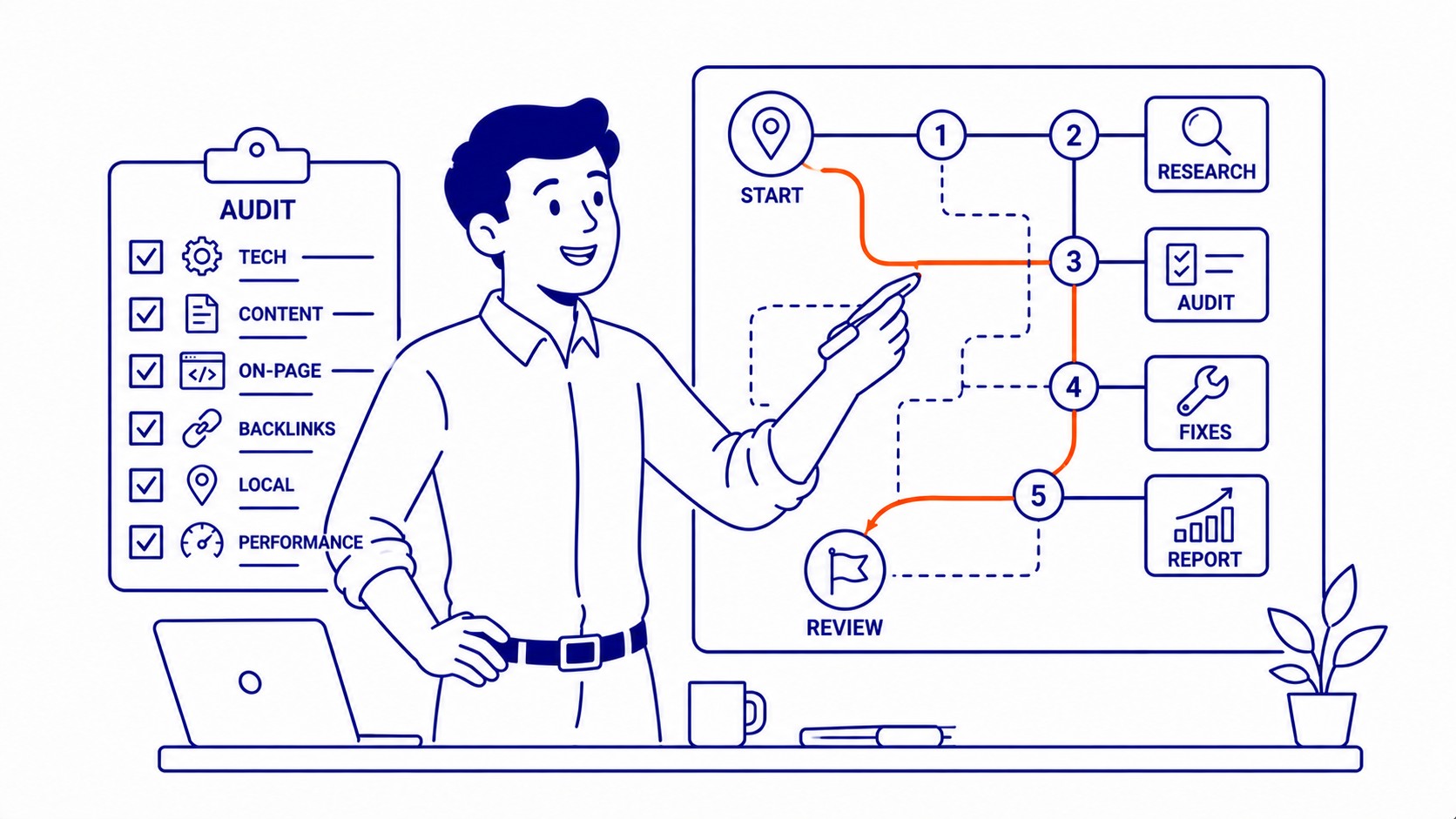
A repeatable audit checklist. A standard onboarding sequence. Add a documented reporting template. All three need to run smoothly before a second employee ever touches a client account. Skip that step and every new hire reinvents the workflow their own way. Client experience turns inconsistent across the roster within a quarter.
Documentation does not need to be a big production. A shared doc with the exact steps for a technical audit works. Screen recordings of how a specific report gets built work too. What matters is that the process lives somewhere other than the founder’s head. An agency that only functions when one specific person is available is not actually scalable. It is just one person working harder, with extra overhead attached.
Client work should be able to survive a two-week vacation without the founder checking Slack from a beach. That test tells the real story about whether systems exist yet.
Hiring the First Few People Right
The first hire after “founder does everything” usually needs to be a generalist, not a narrow specialist. Someone who can take deliverables off the founder’s plate across the board. Specialists earn their keep once there is enough volume to keep a link builder or a technical auditor busy full time. Specialization too early just creates idle hours the agency still pays for.
Client-facing work and production work split cleanly at a certain size, and most agencies wait too long to make that split. The founder handling every client call already caps growth. Writing every audit report on top caps it further. Growth stops at whatever one person’s calendar can hold in a week.
A wrong early hire costs more than the salary. It costs client trust. That new hire is often the first face a client sees who is not the founder they signed with.

Client Concentration Is the Quiet Risk
Growth from three or four large retainers looks great on a revenue chart. Lose one of those clients and thirty percent of monthly revenue disappears in a single call. That kind of concentration turns every renewal conversation into a moment that can sink the whole agency, not just one account.
A healthier growth pattern spreads revenue across more clients at a lower average retainer, so no single loss threatens payroll. Diversification costs something in efficiency; managing twenty accounts takes more coordination than managing five. The tradeoff still favours diversification once an agency has survived one big client walking away mid-contract.

Not Every Agency Should Scale
SEO Company To-The-TOP! has run as a solo practice since 2007, on purpose. Adding staff was never the plan. Direct access to the person actually doing the strategy work is what Calgary SEO clients here pay for. Not a rotating account team relearning the file every eighteen months.
Scaling makes sense for an owner who wants to build something sellable. It also makes sense for an owner who wants to serve more clients than one person physically can. Neither of those goals is wrong. None of it is mandatory either. An agency that stays small on purpose is a legitimate business model. The same person handling every client relationship for nineteen years is not a failure to grow. It is a choice.
Does scaling solve a real constraint, or does it just look like progress on a slide deck? That question is worth asking before chasing headcount. Size comes up again when picking an SEO agency in Bend, or any small market. Agencies that chased it anyway are worth studying, and what hyper dog media means is one example.

What to Check Before Adding Headcount
Full client roster review comes first. Which accounts are profitable at current pricing, and which ones only look busy. An agency scaling on unprofitable retainers just scales the losses.
Process audit comes next. Can a new hire follow the current SOPs and produce work that matches founder quality? Or does everything still route back through one inbox for review? The second answer means hiring adds headcount without adding capacity.
Cash runway matters more than most owners plan for. New hires cost money for months before they generate margin. Agencies that hire against optimistic pipeline forecasts run out of runway before the new team member becomes profitable.
Lead flow often needs to grow before headcount does. Plenty of agencies scaling their client roster lean on paid search to fill that new capacity while organic pipeline catches up. Running Google Ads management alongside the SEO side keeps that lead flow from competing against the agency’s own keyword strategy.
Growing a client roster the right way starts with real keyword research. A proper website audit matters too, on every new account before signing, not after. Skipping that step to close deals faster is exactly the shortcut that causes quality problems. Scaling agencies run into it six months later.
Frequently Asked Questions
How many clients can one SEO specialist manage alone?
Account complexity changes the math. Somewhere between eight and fifteen active accounts is the realistic range for one person. Strategy calls. Reporting. Client communication. One person can hold all three without corners getting cut.
Is it better to hire specialists or generalists first when scaling an SEO agency?
Generalists first, in almost every case. Specialists only pay for themselves once there is enough volume in that specific skill area to keep them busy full time.
What is the biggest mistake agencies make when scaling?
Hiring ahead of documented process. A new employee without clear systems to follow just recreates the founder’s habits inconsistently. Clients notice the quality drop within a few months.
Does a solo SEO practice have a growth ceiling?
Yes, a practical one tied to hours in a week. Some practices choose to stay at that ceiling deliberately, rather than trade direct client relationships for a bigger team. That is a valid long-term choice, not a limitation to fix.
Contact SEO Company To-The-TOP! in Calgary
Questions about anything in this article, or about your own rankings? Talk to a Calgary SEO specialist directly.
Phone: (403) 308-5949
Address: 1509 14 Ave SW, Calgary, AB T3C 0W4
Hours:
Monday to Friday: 10:00 am – 7:00 pm
Saturday: 12:00 pm – 4:00 pm
Sunday: closed
