
Is AI Content Bad for SEO? What Google Actually Says
AI content is not bad for SEO by itself. Google’s position, published in February 2023 and still current, is that its ranking systems reward “original, high-quality content” however it is produced, and that “appropriate use of AI or automation is not against our guidelines.” It becomes a problem when it is used to publish many pages for the primary purpose of manipulating rankings, which Google treats as spam, or when nobody checks the drafts and the pages end up thin, generic or wrong. So the useful question is not whether a tool touched the text, but whether the finished page deserves to rank.

What Google’s policy says, in its own words
The starting point is a Search Central blog post from 8 February 2023, “Google Search’s guidance about AI-generated content”. It says Google’s focus is “on the quality of content, rather than how content is produced”, and it compares the situation with a wave of mass-produced human writing about ten years earlier, when banning human-written content would have made no sense either. The same post answers the ranking question plainly: “Using AI doesn’t give content any special gains. It’s just content.” If a page is useful, original and helpful, it might do well, and if it is not, it might not.
The line Google draws is about purpose. The blog post says that using automation, AI included, to generate content “with the primary purpose of manipulating ranking in search results is a violation of our spam policies.” In March 2024 Google built on that rule with the scaled content abuse policy, and it explained that the policy now applies “whether automation or humans are involved.” A business that pays writers to churn out hundreds of near-identical pages is in the same position as one that uses a language model to do it.
Google’s more recent page on generative AI, last updated on 1 October 2026, adds practical detail. It says generative AI “can be particularly useful when researching a topic, and to add structure to original content”, and it reminds site owners that their pages still have to meet Search Essentials and the spam policies. The underlying test is the one Google uses for any content, described on its helpful content page through E-E-A-T: experience, expertise, authoritativeness and trustworthiness, where Google says “trust is most important.”
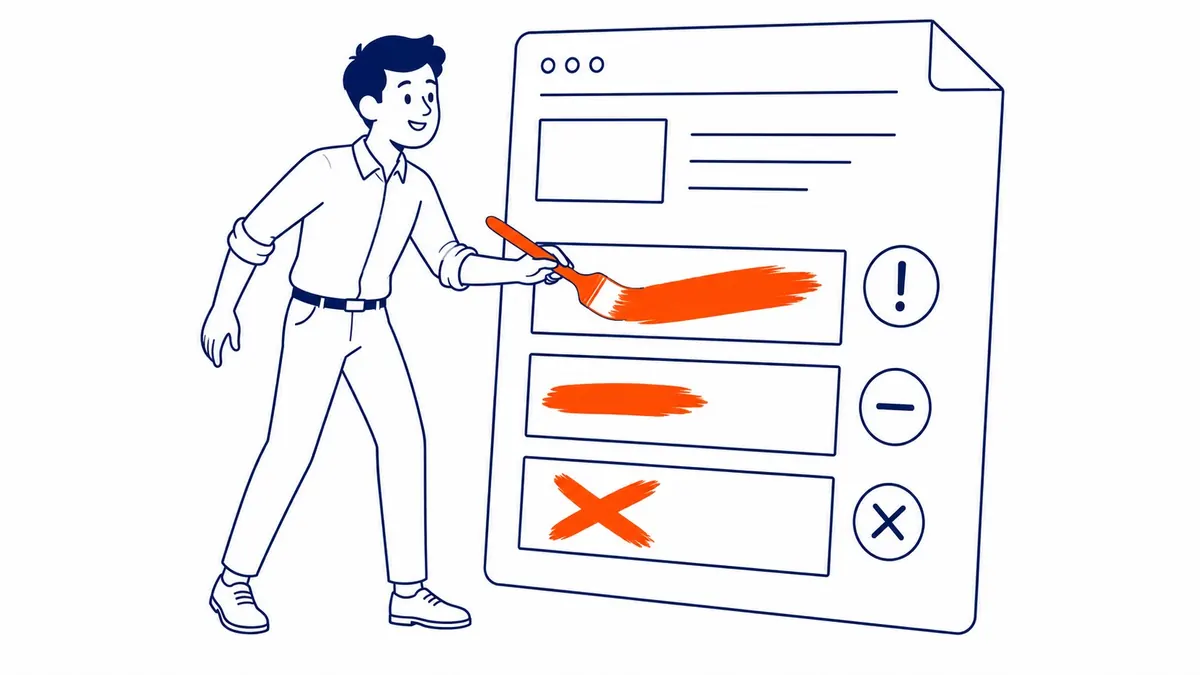
When AI content does hurt: scaled content abuse
Google’s spam policies define scaled content abuse as “when many pages are generated for the primary purpose of manipulating search rankings and not helping users”, and they say it applies “no matter how it’s created.” The examples Google lists are specific enough to check a site against:
- using generative AI tools or similar tools to generate many pages without adding value for users
- scraping feeds, search results or other content to generate many pages, including through automated synonym swapping, translation or other obfuscation
- stitching or combining content from different web pages without adding value
- creating multiple sites to hide the scaled nature of the content
- creating many pages that make little or no sense to a reader but contain search keywords
When a site breaks this policy, Google can lower its rankings through its automated systems or apply a manual action, which is reported in Search Console with a route to request reconsideration. Either way, the cause is the pattern of many low-value pages, not the presence of AI in the workflow.
Here is an illustrative example of how a small business can drift into this territory. A Calgary renovation company asks an AI tool for a “basement development” page for each of forty communities and nearby towns, from Airdrie and Cochrane to Okotoks, and publishes them all in an afternoon. Each page swaps the place name and a few phrases, but the services, prices, photos and advice are identical, and none of the pages says anything a homeowner in that area would not find on the main service page. That is close to Google’s first scaled content example, and pages built for each city with near-identical text also match its separate doorway abuse examples. The same company writing one solid service page, plus a handful of area pages that show real projects, local permit notes and the crew that actually works there, is ordinary marketing, whether or not AI helped with the first drafts.

Where AI drafts go wrong even without a penalty
Most AI-assisted pages never come near a spam policy, yet many of them still fail to rank because they are generic. A language model produces the most likely answer to a prompt, which tends to be the same answer every competing page already gives. Google’s generative AI page puts the risk directly: “generative models don’t retrieve facts, but predict a likely sequence of words based on their training data”, so the output “may contain inaccuracies (also known as hallucinations).” It calls it “critical to manually factcheck and review all AI-generated content for accuracy and trustworthiness before publishing.”
That review is easy to apply too narrowly. Google says it “also applies to metadata like title elements, meta description elements, structured data, and alternate texts for images”, which are the parts most often generated in bulk and never read by a person. An invented statistic in a meta description, or FAQ schema that answers questions the page never covers, is the kind of error that slips through when only the body text gets checked.
Authorship is the other common mistake. Google’s helpful content page says that “fabricating creator profiles (such as by using AI-generated headshots, made-up names, or false credentials to make content appear as if it was written by human experts) is a form of deception”, and that deception makes a page untrustworthy to readers and to its automated quality systems. Google’s 2023 guidance also suggests disclosing how content was made where a reader would reasonably wonder “How was this created?”, and says giving AI an author byline is probably not the best way to do that. For online stores, Google Merchant Center has its own rules: AI-generated product titles and descriptions must be labelled as AI-generated, and AI-generated images must carry the IPTC metadata that marks them as algorithmic media.
What the ranking studies show
One of the most cited studies of the question is from Ahrefs, an SEO software company, published on 7 July 2025. It took 100,000 random keywords, collected the top 20 ranking URLs for each, and analysed the roughly 600,000 of those pages it had in its database, running them through Ahrefs’ own AI content detector. The detector classed 4.6% of the pages as pure AI, 13.5% as pure human and 81.9% as a mix, so 86.5% of the top-ranking pages contained some AI-generated text. The correlation between a page’s share of AI content and its ranking position was 0.011, which Ahrefs describes as effectively zero.
Ahrefs returned to the question in July 2026 with a study of about 331,000 pages, and the picture was less tidy. Pages with more detected AI content tended to rank slightly lower, were indexed less often (about 49% of low-AI pages against about 40% of very-high-AI pages in its sample) and earned fewer impressions, with low and moderate AI pages receiving two to three times the impressions of heavily AI-generated ones. Fully AI-generated pages still reached the top three positions, though, and Ahrefs reads the gap as a sign that heavy AI use often comes with weaker content rather than as evidence that Google suppresses AI text automatically.
Two cautions apply to both studies. First, every figure depends on Ahrefs’ own detector, and Ahrefs itself notes that detectors deal in probabilities and can produce false positives. Second, the near-zero correlation in the 2025 study does not mean AI pages rank well on their own; Ahrefs also found that pure AI pages rarely reached position 1. The fair reading is that Google does not appear to reward or punish AI use as such, which matches what Google says, but that pages built mostly from unedited AI text tend to perform worse, most likely because of what is on the page rather than how it was made. If you are wondering whether Google can detect AI writing at all, that is a separate question, and it matters less than whether the page is worth reading.
Safe and risky uses at a glance
The same tool can support useful editorial work or be used in ways Google’s policies describe as spam. The risk levels below are a practical judgement based on those policies, not a Google classification. The difference usually comes down to how many pages are produced, how much original information goes into them and whether a knowledgeable person checks them before they go live.
| Use of AI | Risk | Why |
|---|---|---|
| Researching a topic, outlining, suggesting headings | Low | Google names research and structure as useful uses |
| First draft that an expert rewrites, fact-checks and adds experience to | Low | Reviewed and, with real experience added, original, which is what Google’s helpful content guidance asks for |
| Titles, meta descriptions and alt text drafted by AI and checked by a person | Low | Google asks for the same review on metadata as on body text |
| Publishing drafts without a fact-check | Medium | Hallucinated facts damage trust and can mislead readers on money or health topics |
| Adding an invented “expert” byline or AI headshot to AI drafts | High | Google calls fabricated creator profiles deception |
| Dozens of near-identical city or service pages generated at once | High | Matches Google’s scaled content abuse examples |
| Rewriting competitors’ pages with a paraphrasing tool | High | Matches Google’s scraping and stitching examples |
None of this changes if the tool is ChatGPT, Gemini, Claude or any other model, because Google’s policies are written about the content and its purpose, not the brand of software. There is a separate article on ChatGPT in particular for anyone working mainly in that tool.
A review routine before anything AI-assisted goes live
A short, consistent review catches most of the problems described above, and it works the same way whether a draft came from a person, a tool or both. The routine below is a practical habit rather than a Google requirement, but every step ties back to something Google’s documentation asks for.
- Check every fact, number, date, price and quotation against a primary source, and delete anything that cannot be traced.
- Add what only your business knows: real projects, local conditions, the questions your customers actually ask and the reasons you recommend one option over another.
- Read the title, meta description, image alt text and any structured data as carefully as the body, because Google applies the same review to them.
- Keep authorship accurate. Use a real person or the company name, and never an invented expert.
- Before publishing a set of similar pages, ask whether each one would still be worth reading if search engines did not exist. If the answer is no for most of them, publish fewer and make them better.
- Watch Search Console after publishing, including the Manual actions report, and treat a drop in impressions on a newly published batch as a reason to review it.
The short answer for business owners
AI is a writing tool, and Google judges the result, not the tool. Used to research, structure and speed up drafts that a knowledgeable person then corrects and fills with real experience, it is not a ranking problem in itself, although the finished page still has to be accurate, useful and better than what already ranks. Used to mass-produce pages nobody needed, it can cause those pages, and potentially the site, to rank lower or drop out of results, which is the same outcome a human content mill would get. SEO results still take months either way, because AI makes drafts faster but it does not make Google trust a site any sooner.
If you are unsure whether pages already on your site would pass that test, a website audit is a sensible place to start. SEO Company To-The-TOP! has worked on White Hat SEO in Calgary since 2007, and you can reach the practice at (403) 308-5949.
Contact Calgary SEO Company To-The-TOP!
Questions about anything in this article, or about your own rankings? Talk to a Calgary SEO specialist directly.
Phone: (403) 308-5949
Address: 1509 14 Ave SW, Calgary, AB T3C 0W4
Hours:
Monday to Friday: 10:00 am – 7:00 pm
Saturday: 12:00 pm – 4:00 pm
Sunday: closed