
Is Google Ads Better Than SEO?
Google Ads is better than SEO when you need enquiries soon, want to test which searches turn into customers, or have a short window such as a launch or a season. SEO is better when you can wait months for results and want visits that do not cost you anything per click once your pages rank. Neither one is better in general, because they buy different things: Google Ads rents a place on the results page for as long as you pay, while SEO builds pages that Google chooses to show on their merits. The useful question is which one fits your timeline, your margin and the results page your customers actually see.

Two channels on one results page
Search for a service in Calgary and you will usually see three kinds of results. Paid ads are labelled “Sponsored” (or “Ad”) and sit at the top or bottom of the page. The map with business profiles, often called the local pack, appears on many local searches. The organic results are the ordinary listings of web pages. Google Ads buys a place in the first group, and SEO works on the third, while the map has its own ranking system that responds to your Google Business Profile, your website and your reputation.
These systems do not trade with each other. Google states on its ranking-results page that the results you see “are not influenced by whether a business, individual, or organization buys ads”, and its Business Profile help adds that “There’s no way to request or pay for a better local ranking on Google.” So Google Ads is not a form of SEO, and spending on ads will not lift your organic position. There are indirect links between the two, which the separate question of whether running ads changes your organic rankings covers in more detail, but the budget decision starts from the fact that each channel has to earn its own place.
| Google Ads | SEO | |
|---|---|---|
| Where you appear | Sponsored ad positions | Organic listings (and, with local work, the map) |
| Speed | Ads can show once reviewed; Google says most ads are reviewed within one business day | Usually months for a competitive term; Google’s SEO Starter Guide notes that some changes show within hours and others take several months |
| What you pay for | Each click, set by the auction | The work on your site and content, not the clicks |
| When spending stops | Ads stop showing | Pages keep ranking for a time, though rankings can slip without upkeep |
| Control | Keywords, locations, schedule, budget and the ad text | Indirect: Google decides what ranks |
| Best at | Speed, testing, short windows, high-margin services | Durable traffic on searches people make every month |
What Google Ads gives you
The main thing Google Ads offers is speed with control. You choose the keywords and match types that decide which searches can show your ads, the area you serve, the hours your ads run and the daily budget, and Google’s ad review page says most ads are reviewed within one business day. That makes it the natural choice for a new business with no rankings yet, a seasonal service such as furnace repair or snow removal, or a new location that needs calls this month rather than next year.
The second thing it gives you is evidence. Once conversion tracking is set up, the search terms report shows which of the searches it reports led to calls and form fills (Google leaves out some low-volume searches for privacy), and Google defines conversion rate as conversions divided by ad interactions. A few months of that data tells you which searches are worth the long investment of ranking organically, which is information SEO alone takes much longer to produce.
The cost is that every visit is paid for. Where your ad appears depends on Ad Rank, which Google says is calculated in each auction from your bid, the quality of your ad and landing page at that moment, Ad Rank thresholds, the competition, the context of the search and your ad assets. When the budget runs out or the campaign is paused, the ads stop, and nothing you paid for keeps working afterwards.

What SEO gives you
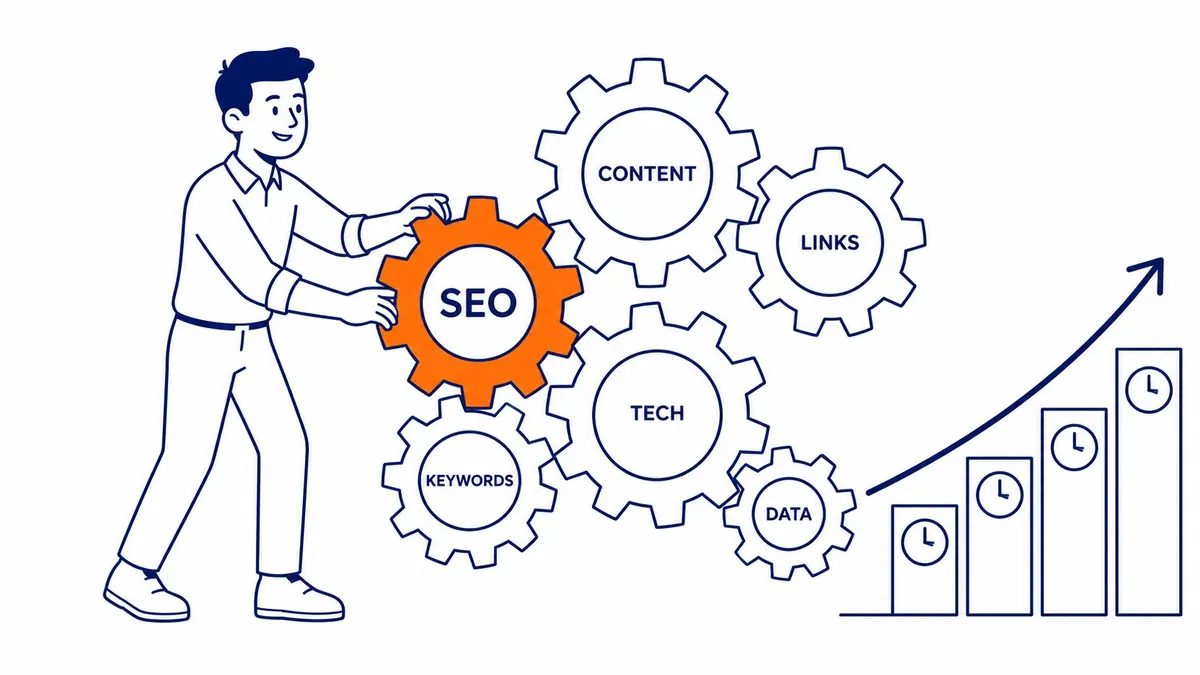
SEO is slower to start and slower to stop. The work covers the content of your pages, the technical health of the site, the links other sites give you and, for local businesses, your Business Profile. Google’s SEO Starter Guide says some changes take effect in a few hours and others could take several months, and suggests waiting a few weeks before judging whether a change helped. In practice, a new page aiming at a competitive Calgary term usually needs months before it brings steady visits, and a site with little history needs longer.
What you get for that patience is traffic without a cost per click. A page that ranks keeps bringing visitors while it holds its position, so the cost of the work is spread over every visit it earns rather than charged per click. Rankings are not permanent, because competitors improve their pages and Google keeps refining its systems, but they do not switch off when an invoice goes unpaid.
The limitation is control. You can make a page better and more relevant, and you can build the reputation that helps it rank, but Google decides what appears, and some searches are dominated by directories, large brands or the map. Good search engine optimization starts by checking whether the searches you care about can realistically be won before money goes into them.
The replacement-cost test
A simple way to compare the two is to ask what your organic traffic would cost if you had to buy it. Search Console shows the clicks your pages receive from the searches it reports (it withholds some rare queries for privacy), and Keyword Planner shows an estimate of the average cost for an ad to show on a keyword. Use Keyword Planner’s cost estimate for the same location as the traffic. Multiply the first by the second and you have a rough monthly figure for the paid equivalent of your organic visits.
Here is an illustrative example, not real data, with all figures in Canadian dollars. Suppose a Calgary service page receives about 120 organic clicks a month from searches whose Keyword Planner cost estimate averages $6. Buying the same 120 visits through ads would cost roughly $720 a month in clicks alone, before any management fee, and the figure repeats every month. If the SEO work that keeps that page ranking costs less than that over a year or two, SEO is the better buy for those searches; if the searches are rare or the page cannot realistically rank, the arithmetic favours ads. The estimate is rough, because ad clicks and organic clicks do not convert identically and actual costs vary by auction, but it turns a vague comparison into a number you can check.

Sizing a Google Ads test before you start
Many owners decide that Google Ads “did not work” after a test that was too small to tell them anything. Google’s budget help explains that if you work with a monthly budget you divide it by 30.4 to get the average daily budget, that a campaign may spend up to twice that daily amount on a given day, and that over a month it will not spend more than 30.4 times the daily figure. Dividing the monthly budget by your expected cost per click gives the number of clicks you are paying for.
Continuing the illustrative numbers, a $600 monthly test is an average daily budget of about $19.74. If the campaign spends the full budget at an average of $6 a click, that is roughly 100 clicks a month, and if 5% of those clicks became enquiries you would see about five leads. That might be plenty for a renovation company with a high average job value and far too few for a business that needs dozens of small orders, which is why the decision depends on your margin as much as your budget. A deeper look at how costs, bids and budgets fit together helps set a realistic figure.
Running both, and in what order
For many local businesses the answer to “Google Ads or SEO?” is both, in sequence. Ads cover the months while organic rankings build, and the search terms report shows most of the phrases that bring enquiries, so the SEO work can concentrate on pages that matter. As organic positions improve for those searches, you can test lowering ad spend on them and move budget to searches that are still hard to rank for.
The two channels also share one lever. Landing page experience is part of the quality Google measures in each ad auction, and the same clear, fast, relevant page is what organic visitors need as well, so improving the page helps your ads in the auction and helps organic visitors once they arrive, although Ads quality measures are not used in organic ranking. There is more on what paid search data can tell your SEO in a separate guide.
One thing should come first in either case: tracking. If calls and form fills are not being measured, you cannot tell whether ads are paying for themselves or whether rankings are bringing customers, and every later decision becomes a guess.
Which one should you start with?
The table below sums up the decision rules a practitioner would apply. They are guidance for typical local businesses rather than rules Google publishes, and a business that fits rows in both columns is usually a candidate for running both.
| Start with Google Ads if | Start with SEO if |
|---|---|
| You need enquiries within weeks | You can wait several months for results |
| You are launching, seasonal or opening in a new area | Your customers search for the same services all year |
| Your margin per sale can absorb the cost of each click | Clicks on your terms are expensive and your margin is thin |
| You want to learn which searches convert before investing in content | You already know which searches bring customers |
| Your target searches are crowded with directories and large brands | Your target searches show local businesses ranking organically and in the map |
Either way, keep an eye on what each channel actually returns. Ads that lose money after a fair test should be changed or stopped, and SEO that shows no movement in rankings or enquiries after a reasonable period deserves a hard look at what is being done.
If you would like a second opinion on which channel suits your business, SEO Company To-The-TOP! has worked on SEO in Calgary since 2007 and is Google Ads certified, with one specialist handling both. You can read about Google Ads management or call (403) 308-5949 to talk it through.
Contact Calgary SEO Company To-The-TOP!
Questions about anything in this article, or about your own rankings? Talk to a Calgary SEO specialist directly.
Phone: (403) 308-5949
Address: 1509 14 Ave SW, Calgary, AB T3C 0W4
Hours:
Monday to Friday: 10:00 am – 7:00 pm
Saturday: 12:00 pm – 4:00 pm
Sunday: closed