How Much Are Google Ads? Costs, Bids, and Budgets Explained
Between $2 and $5 per click for most local service businesses in Canada. Legal and finance keywords push that to $50 or even $200 per click in competitive markets. The question that comes up on every first call about paid search: “just tell me what I am going to spend.” The answer depends on industry, keyword competition, and how tightly the campaign is set up.
Google Ads runs on a pay-per-click auction. No flat rate, no monthly access fee to the ad inventory. Each search query fires a real-time auction. Position and cost per click depend on how your bid, Quality Score, and landing page compare to everyone else bidding on the same keyword at that moment. Put another way, what it costs to buy keywords on Google is never a sticker price. It is whatever that auction settles at.

What You Actually Pay Per Click
Average cost per click on the Google search network runs from $1 to $2 for retail and e-commerce, $2 to $5 for local services like plumbing and landscaping, and $10 to $50-plus for legal, accounting, and finance. Display network clicks (banner ads across partner websites) come in well below search network rates, often under $0.50 each, but conversion intent is much lower. Search ads match to active queries. Display ads interrupt browsing. Different purposes, very different numbers.
Pay-per-click means no charge until someone clicks. Impressions accumulate without cost. SEO courses charge on a different model, and Stupid Simple SEO explained shows how.

What Drives Your Google Ads Cost
Quality Score is the lever most new advertisers underestimate. Google rates each keyword from 1 to 10 based on expected click-through rate, ad relevance, and landing page experience. A score of 8 reduces cost per click significantly compared to a competitor bidding the same amount at a score of 4. Better ads beat bigger budgets at this mechanic. If the auction itself feels fuzzy, it is worth seeing how Google Ads works step by step before reading another cost chart.
Keyword competition is the other major driver. More advertisers bidding on the same phrase pushes the auction price up. Broad match keywords generate more impressions but also spend budget on searches that are not relevant, and those irrelevant clicks cost the same as targeted ones. Time of day matters too. Peak hours cost more. Lower-traffic time slots cost less but reach a smaller audience.
Geographic targeting affects price as well. Calgary search auctions for competitive service terms look different from smaller-market auctions. A campaign scoped to a specific neighbourhood or secondary city often pays less per click because fewer advertisers compete at that level of specificity.
How to Set a Google Ads Budget
Google Ads runs on a daily budget. The platform can spend up to double that on high-traffic days, capped so the monthly total stays within daily budget multiplied by 30.4. Setting $40 a day means a monthly ceiling of roughly $1,220.
For a first Google Ads campaign, $30 to $60 a day is where most local service businesses start generating usable data. That is $900 to $1,800 a month. Enough volume to see which keywords and ad variations convert. Not so much that a structurally weak campaign burns through the budget before the problem shows up in reporting. Budget is only half the setup. The other half is how to advertise on Google Ads in a way that does not waste it.
An Okotoks-area business targeting a narrow set of local keywords can often run a productive campaign at the lower end of that range. Smaller markets mean fewer competing bids on local terms. The trade-off is lower total search volume, so data accumulates more slowly. Budget caps the spend; Google Ads charges still land click by click underneath it.
Industry Cost Benchmarks
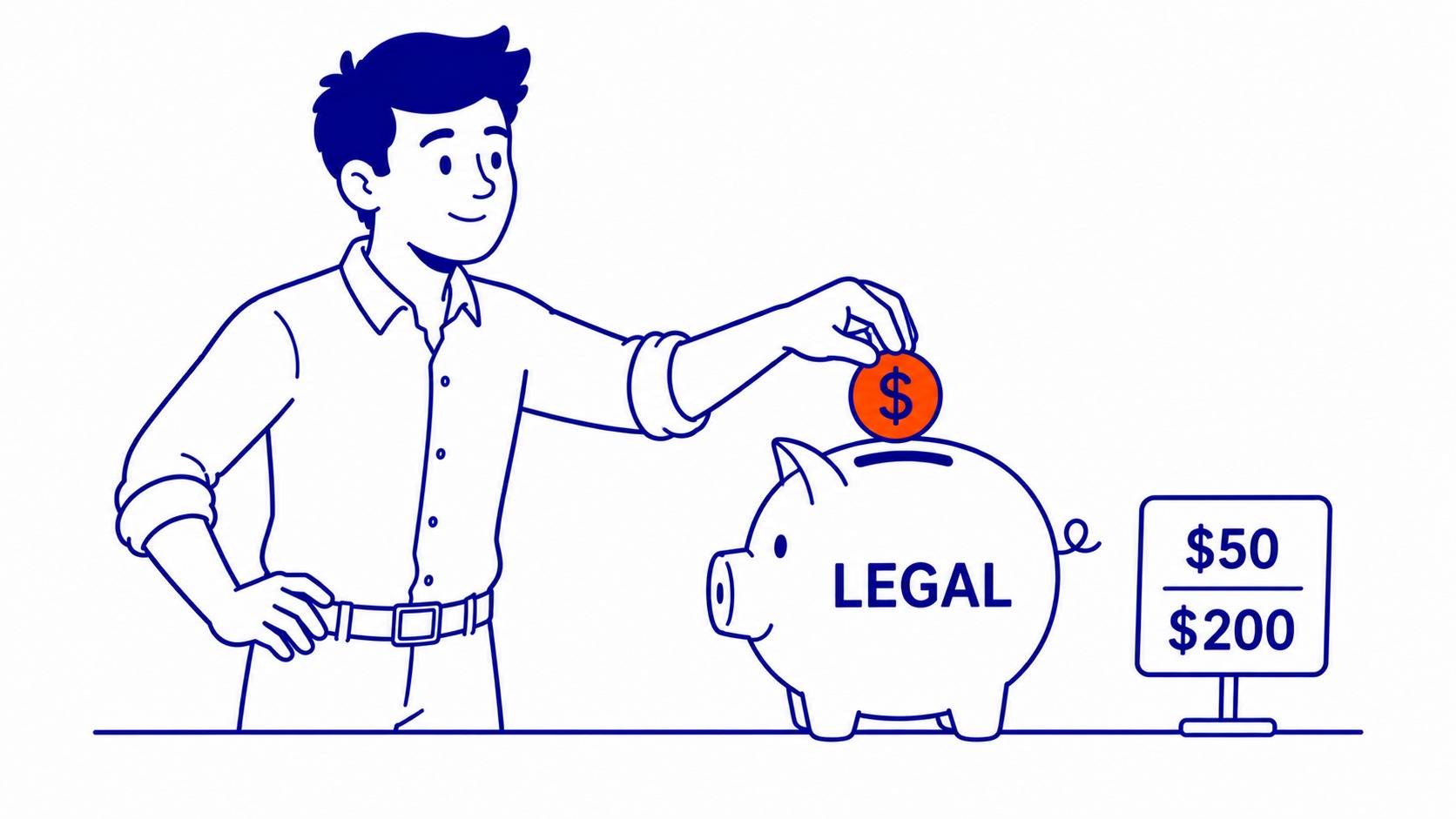
Legal services: $50 to $200 per click in some practice areas. Finance and insurance: $15 to $80. Home services such as HVAC, plumbing, and landscaping: $5 to $30. Retail and e-commerce: $1 to $10. These are ranges drawn from published industry benchmarks and direct campaign data. Actual cost for any specific business depends on exact keywords, match types, and local competition density.
Burnaby businesses competing in Metro Vancouver auctions on regional service terms face higher per-click costs than those targeting specific services or tight geographic phrases. Competition density shapes cost more than geography alone. Narrowing the keyword scope is often the faster path to a lower cost per click than increasing the bid.
Keyword selection matters more than budget at the early stage of any Google Ads campaign. Longer, more specific phrases almost always cost less per click than short broad terms. The trade-off is lower search volume. Businesses watching spend closely usually find that trade-off makes sense. A professional keyword selection and research review is part of how campaigns are structured before any budget is committed.
Frequently Asked Questions
Is $20 a day good for Google Ads?
Twenty dollars a day is roughly $608 a month. Workable for very narrow targeting: one service, one city, a short keyword list. In competitive industries like legal or finance, $20 a day does not generate enough clicks to optimize anything. Target at least 30 to 50 clicks a month to have meaningful data. Below that, adjustments are based on guesswork rather than performance.
Is $10 a day enough for Google Ads?
Rarely enough. At $10 a day in a competitive market, three to five clicks a day is a realistic ceiling. Not enough volume to test ad copy, compare keyword performance, or assess conversion rate patterns. Some businesses run Google Ads at $10 a day strictly for branded search protection, bidding on their own business name to prevent competitors from capturing that placement. That specific use case can work at low spend. Acquisition campaigns need more room.
Why did Google Ads charge me $500?
Two reasons come up most often. Automatic payments: Google sets a billing threshold, typically $500 on newer accounts. Reaching that threshold triggers a charge mid-month regardless of the billing cycle. The second reason is that Google can spend up to double the daily budget on a single high-traffic day. Check billing settings for the current threshold and review the transaction log to see which days hit the ceiling and by how much.
Is $100 a day good for Google Ads?
$100 a day is $3,000 a month. A functional starting point for most local service businesses. Enough volume to assess keyword performance, test two or three ad variations, and begin making informed bid adjustments. Results in leads depend on campaign structure, landing page quality, and how competitive the target keywords are. Budget alone does not determine outcome. Campaign structure and Quality Score improvement carry equal or greater weight.
Knowing what clicks actually cost in a specific industry before committing to a monthly spend is worth the research time. That number changes the conversation about whether $1,000 or $5,000 a month is the right starting point. SEO Company To-The-TOP! has managed Google Ads accounts since 2007, handling bid strategy, Quality Score improvement, and match-type management as part of a complete Google Ads management service. For businesses running paid search alongside a PPC strategy, both channels working together consistently outperforms either in isolation.
Contact Calgary SEO Company To-The-TOP!
Questions about anything in this article, or about your own rankings? Talk to a Calgary SEO specialist directly.
Phone: (403) 308-5949
Address: 1509 14 Ave SW, Calgary, AB T3C 0W4
Hours:
Monday to Friday: 10:00 am – 7:00 pm
Saturday: 12:00 pm – 4:00 pm
Sunday: closed
