
Is SEO Part of Digital Marketing?

Yes, SEO is part of digital marketing. Digital marketing is the umbrella term for promoting a business through online channels, and search engine optimization is the channel concerned with the unpaid, organic results in search engines such as Google. Google’s own SEO Starter Guide describes SEO as “helping search engines understand your content, and helping users find your site and make a decision about whether they should visit your site through a search engine.” What makes SEO unusual among the marketing channels is that nobody can pay Google for an organic position, so it is earned through the site itself and through what other people say and link to. The rest of this article explains where SEO sits, what the other channels can and cannot do for your rankings, and how to decide whether SEO deserves its own place in your plan.
Where SEO sits inside digital marketing
Most descriptions of digital marketing list a similar set of channels: search, social media, email, content, display and video advertising, and affiliate or influencer programs. Search is split into two halves that appear on the same results page but work in completely different ways. Paid search covers the clearly labelled ads shown with some results, usually paid for per click, and organic search covers the regular listings, which Google calls its “non-advertising search results” on its page about hiring an SEO. SEO is the work on that organic half, and the term search engine marketing (SEM) is used in two ways in the industry, sometimes for paid search alone and sometimes for paid and organic together.
That last point causes more confusion than it should. When an agency proposal says “SEM”, it is worth asking which meaning it uses, because a quote for SEM can describe a Google Ads budget with no SEO work in it at all. The page on how paid and organic search work together covers the combined approach in more detail. For the question in the title, the short version is that SEO is one channel within search marketing, and search marketing is one part of digital marketing.
What other channels can and cannot do for your rankings

Because SEO sits next to the other channels, owners often assume that activity in one channel feeds rankings in another. Some of it does, and some of it does not, and Google has published enough to separate the two. The table below sets out the common channels against what Google’s documentation says, and the third column is where the useful distinction lies.
| Channel | What Google documents | Effect on organic rankings |
|---|---|---|
| Google Ads and other paid search | Google says it only sells ad space, so “no one can buy better placement in organic Search results”, and advertisers get no ranking boosts (Ads on Search) | None directly; useful for keyword and conversion data |
| Sponsored posts, paid placements and influencer links | Links that are advertisements or paid placements should be marked rel="sponsored" (Qualify your outbound links), and buying links for ranking purposes is link spam (spam policies) |
Not a legitimate route to rankings; can create a spam problem if links are bought for that purpose |
| Social media, community and PR | The SEO Starter Guide lists social media promotion, community engagement and offline and online advertising as ways to help people and search engines discover new content | Indirect: discovery, mentions and links that other sites choose to give |
| Nothing in Google’s search documentation treats email activity as a ranking input | Indirect only, by bringing readers to content that may then be shared or linked | |
| Content marketing | The same pages can serve as SEO content when they answer what people search for | Direct contribution possible: pages on your site that match a search can be indexed and shown, though publishing does not guarantee a ranking |
The pattern in that table is worth noticing, because the channels that touch organic rankings directly are the ones that change your own website, its content and the links other people choose to give it. Spending in other channels can make those things more likely, but it does not purchase them, which is why a business can run a large advertising budget and still have weak organic visibility.
Why SEO still depends on the rest of the plan
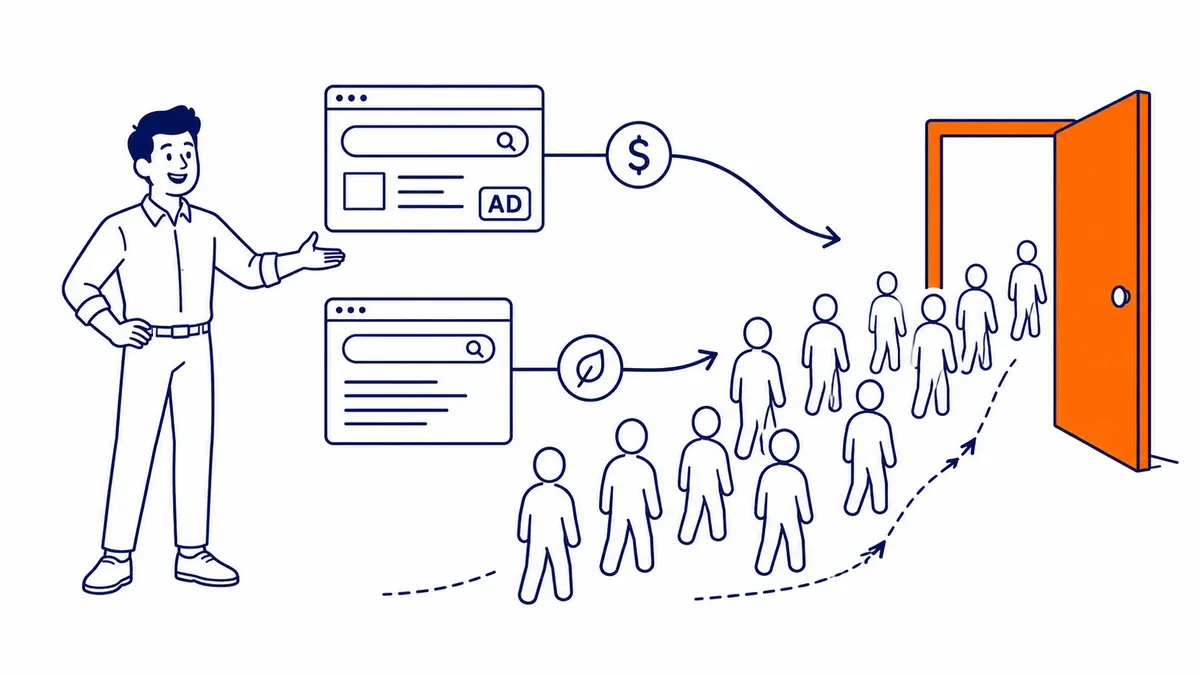
None of that means SEO can be run in isolation. Google’s starter guide is direct about it, saying that “effectively promoting your new content will lead to faster discovery by those who are interested in the same subject, and also by search engines.” It names word of mouth as one of the most effective and lasting methods, and it adds a warning that is easy to miss: you can overdo promotion, and search engines may perceive some practices as manipulation of search results. In practice, that means promotion is welcome when it is aimed at people rather than at Google’s ranking systems.
The practical link between SEO and the other channels usually runs through three things. Content that is worth sharing gives social media and email something to send people to. Coverage and mentions in the press or industry publications can lead to links from sites that choose to reference you. And a brand that people already know tends to be searched for by name, which shows up in Search Console as branded queries.
Paid search is the closest partner, even though it does not move organic rankings. A Google Ads campaign can start showing which search terms lead to enquiries and sales soon after launch, while SEO usually takes months to show clear results, so the paid data can guide which pages the organic work should build first. Google Ads also covers a gap: a new site with little organic visibility can still appear for the searches that matter while the SEO work builds. The two are judged differently, though, so it helps to keep their reports separate rather than blending them into one traffic figure.
Email and social media sit a step further away. They reach people who already know the business, which is valuable in its own right, and that audience is often the first to read, share or link to a useful new page. The page on how email can support search looks at that relationship in more detail.
What makes SEO different from the other channels

SEO shares the goals of every other digital channel, which are visibility, visits and enquiries, but it differs in three ways that affect how a business should plan for it. The first is that the work builds an asset you own. Technical fixes, clearer pages and content that answers real searches stay on your site, whereas an ad stops showing the moment the budget does. That does not make SEO free, because the work costs time or money, but it changes what remains when spending pauses.
The second difference is control, because Google decides what ranks, and its page on hiring an SEO warns owners to beware of anyone who claims to guarantee rankings or a “special relationship” with Google. A paid campaign can be switched on, targeted and capped, while SEO can only make a site more useful and easier for search engines to understand. That is why Google’s own description of SEO talks about helping search engines understand content and helping users decide whether to visit, not about forcing a position.
The third difference is timing. Google’s starter guide says some changes take effect in a few hours while others could take several months, and it suggests waiting a few weeks before judging whether a change helped. Most businesses should plan in months, not weeks, which is why paid search often carries the early load in a new plan.

Within SEO itself, the work usually falls into three areas. Technical SEO makes sure search engines can crawl and index the site and that it works well on phones. On-page SEO matches each page’s content, headings and titles to what people actually search for, starting with keyword research. Off-page SEO covers the reputation a site earns elsewhere, mainly links from other sites and, for local businesses, reviews and a complete Google Business Profile. Google summarizes local results as based mainly on relevance, distance and popularity, which is a reminder that local SEO overlaps heavily with how well-known and well-reviewed a business is.
Canadian rules that apply to the other channels

For a Canadian business, one practical difference between SEO and some of its neighbouring channels is the law that applies to them. Canada’s anti-spam legislation, CASL, requires businesses to have consent, express or in some cases implied, before sending commercial electronic messages, and the Government of Canada’s guide to getting consent adds that each message must identify the sender and include an unsubscribe mechanism. Those rules govern email marketing and text messages but have nothing to say about how a page ranks in Google. An email campaign therefore needs a consent process and records behind it, while organic search reaches people who chose to search.
SEO is not outside the rules, though. The Government of Canada’s CASL page notes that the legal definition of spam also covers false or misleading electronic representations, including websites. Claims on a landing page, in a title or in a meta description are made to the public in the same way as an advertisement, so an inflated promise written to win a click is not exempt because it appears in organic results. This is general information rather than legal advice, and a business with a specific question should ask a lawyer.
Should SEO be its own line in your plan?

Knowing that SEO is part of digital marketing does not settle how much attention it deserves in a particular business. A reasonable rule is that SEO earns its own line, with its own budget and reporting, when customers already search Google for what you sell and the website can turn those visitors into enquiries. A plumber, an accountant or a dental clinic in Calgary usually fits that description, because the need comes first and the search follows. A product nobody searches for yet usually does not, because demand has to be created through other channels before there is anything to rank for. The question of whether to hire an SEO specialist or a broader digital marketing provider has its own page, with a simple demand test you can run before asking anyone for a proposal.
When SEO does get its own line, it still needs to be planned alongside the other channels rather than beside them. The keyword research should use what paid search has shown about converting terms, new content should be ready for email and social media to share, and the reports should show organic results separately so you can see whether the investment is working. When SEO is folded into a wider package instead, ask which searches the provider expects to win and how they will report organic results, because a bundle can easily spend almost everything on the faster paid channels.
The point most owners miss is that the two choices are not opposites. A Calgary business that relies on search will usually do best with SEO work that builds the site over months, paid search for the terms that matter now, and other channels that bring people back. Each part has its own job, and SEO is the one that keeps paying attention to the website itself.
SEO Company To-The-TOP! has been based in Calgary since 2007 and is Google Ads certified, with one specialist doing all of the client work on both SEO and paid search. If you would like to talk through where SEO fits in your own marketing, you can reach SEO Company To-The-TOP! at (403) 308-5949.
Contact Calgary SEO Company To-The-TOP!
Questions about anything in this article, or about your own rankings? Talk to a Calgary SEO specialist directly.
Phone: (403) 308-5949
Address: 1509 14 Ave SW, Calgary, AB T3C 0W4
Hours:
Monday to Friday: 10:00 am – 7:00 pm
Saturday: 12:00 pm – 4:00 pm
Sunday: closed