
Should I Say “About Us” or “About [Company Name]” for SEO?
Should you say “About Us” or “About [Company Name]” for SEO? Use both, each in the place where it does its job. Keep the menu link short (“About” or “About Us”), put the company name in the title tag and the H1, and, most important of all, name the business in the first sentence of the page itself. Google documents no ranking benefit for either label, and neither phrase is a keyword your About page could realistically win. What the choice does change is how clearly the page tells a stranger, a search engine and an AI summary which business it is describing.
This question usually turns out to be smaller than it looks. SEO Company To-The-TOP!, a Calgary-based SEO practice founded in 2007, put this guide together because the label at the top matters far less than the copy underneath it, so it covers where Google actually reads your company name, where each wording belongs, and the awkward cases such as long legal names and numbered companies.
Why the label alone does not move rankings
Start with the search side of the argument. People who type “about us” into Google are rarely looking for a business; the related searches Google shows for this topic are about templates, samples and how to write the page. The searches that do lead to an About page tend to carry the company name, often with a second word such as “reviews”, “owner” or “location”, from someone who has already met the business and wants to check it out. Neither heading wins those searches for you, because the person was looking for your name before they ever saw the page.
The usual counter-argument is that “About Acme Roofing” places a brand keyword in a heading. That is true, but the search it helps with most is a search for your own name, and an established business normally ranks for its own name already through its home page, its Google Business Profile, its listings and the sites that mention it. So the heading argument tends to win a search that was already won. That is not a reason to avoid the company name in the H1. It just means the case for it rests on clarity, not on a ranking boost.
What Google actually reads from those labels
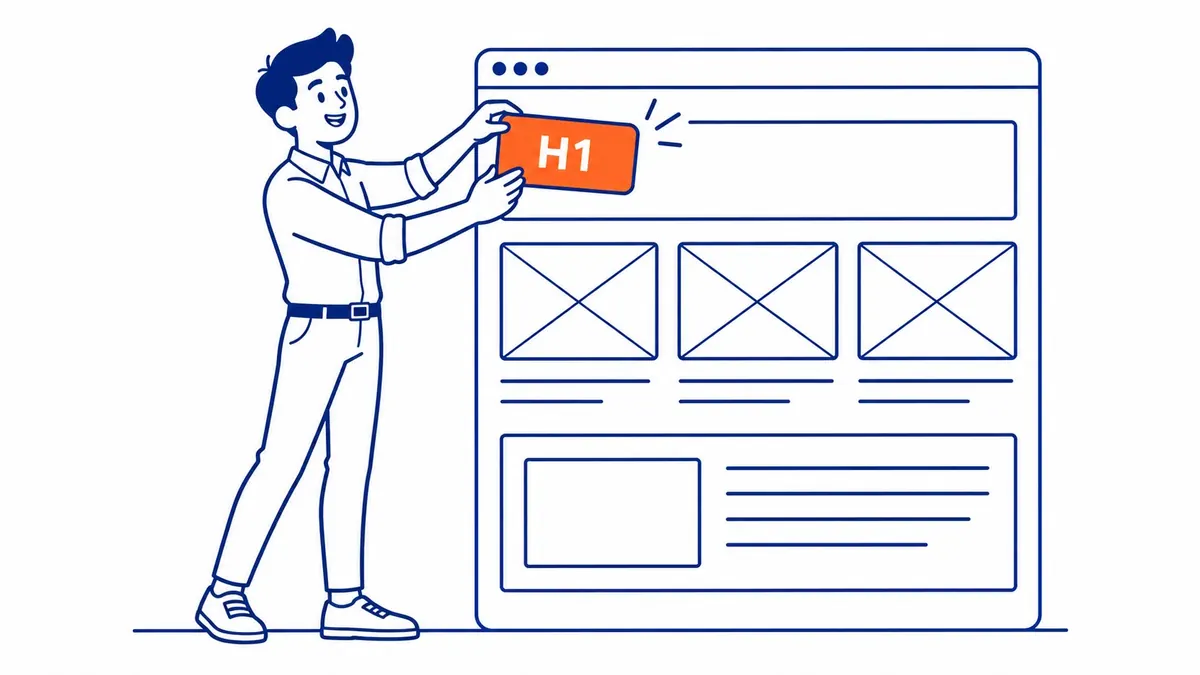
Google’s documentation on title links explains why the wording still deserves some thought. When Google builds the clickable title of a search result, it lists several sources, including the content of the title element, the main visual title on the page, heading elements such as the H1, anchor text on the page, the text of links that point to the page, and WebSite structured data. Your menu label, your H1 and your title tag are therefore all inputs to the same result, and Google may pick from them if it thinks the title element does not describe the page well. Google also notes that it has to recrawl and reprocess a page before it notices changes, which can take a few days to a few weeks.
The same page gives a direct hint for this question. Google advises against “vague descriptors like “Home” for your home page, or “Profile” for a specific person’s profile”. A title element that reads only “About Us” has the same weakness by the same reasoning, because a great many sites share it, although Google does not name that wording itself. A title tag such as “About Acme Roofing | Calgary Roofers Since 2004” tells the searcher which business and which page in one line, while “About Us” alone tells them almost nothing. If you want a refresher on length and format, the guide to how title tags work covers the details.
There is also a quality angle. In its guidance on helpful, people-first content, Google suggests asking whether a site gives “background about the author or the site that publishes it, such as through links to an author page or a site’s About page”. In other words, the About page is one of the places readers go to find out who stands behind a website, which is a large part of what SEO people mean by E-E-A-T. A page that never says who it is about does that job badly, whatever the heading says.

The real cost of “About Us” sits in the copy underneath
The label has a quiet effect on the writing below it. A page headed “About Us” tends to slide into the first person straight away, so paragraph one opens with something like “We were founded in 2004 by two brothers who spotted a gap”, paragraph two talks about “our team” and paragraph three says what “we believe”. Read that as a stranger arriving from a search result would, and the subject of the page never gets named. There is no ranking penalty involved; it is simply a page about a company that never says which company.
A heading with the company name in it tends to pull the first sentence along with it, because “About Acme Roofing” invites “Acme Roofing was founded in Calgary in 2004”, which can stand on its own. That matters because the opening of an About page is a part that often gets lifted and reused elsewhere. An AI tool summarizing the business, an editor filling in a directory listing, a journalist writing a roundup and your own staff pasting a paragraph into a proposal all need a sentence that names its subject. “We were founded in 2004” cannot travel anywhere without being rewritten, while the version with the name can be quoted as it stands. (Both examples here are illustrative.)
A quick check of your own About page
You can test this on your own site in under a minute. Open the About page and count how many times the business name appears in the body copy, leaving out the logo, the header, the footer and the copyright line. Then read the first sentence of the page out loud on its own, with nothing around it, and ask whether a stranger could tell which business it describes and where that business is.
If the count is zero or one, or the first sentence only works because the logo sits above it, you have found the thing worth fixing, and it is not the heading. The fix is usually small: name the business, its city and what it does in the opening sentence, mention the name once more where it reads naturally further down, and leave the rest of the page alone. Running the same check on two or three competitors’ About pages is a useful comparison while you are there.
Where the company name earns its place
The simplest way to settle the debate is to give each spot on the page its own wording. The table below is a practical default for a small or mid-sized business site, using an illustrative Calgary roofing company.
| Where | Recommended wording (illustrative) | Why |
|---|---|---|
| Menu link | “About” or “About Us” | Visitors have already seen the logo, menus have little room, and the same link repeats on every page |
| Title tag | “About Acme Roofing | Calgary Roofers Since 2004” | Google uses the title element as a main source for the result title and warns against vague titles |
| H1 | “About Acme Roofing” | Tells a visitor which page they opened, and headings are another source Google uses for title links |
| Opening sentence | “Acme Roofing is a Calgary roofing company founded in 2004 that…” | A sentence that often gets quoted, summarized or pasted elsewhere |
| Organization structured data | name, alternateName (if any), legalName (if different), address, phone, logo | Gives Google the administrative details once (home page or About page) without cluttering the visible page |
| Footer | Legal name, address, phone | Where readers expect formal details |
If you have to rank these, the opening sentence matters most and gets skipped most often. The order of the rest matters less than having the name present in each of them, and once it is, the heading debate stops being interesting.
The structured data row deserves a word of explanation because it is the easiest one to overlook. Google’s Organization structured data documentation recommends placing the markup “on your home page, or a single page that describes your organization, for example the about us page”, and suggests focusing on properties such as name or alternateName for the business name, plus address, telephone, url and logo. It only needs to live in one of those places, so if your home page or SEO plugin already outputs it, check that one block rather than adding a second. It also asks you to use “the same name and alternateName that you’re using for your site name”. Many WordPress SEO plugins add this schema markup from their settings, so check that the name there matches the one on the page. Google’s own Organization examples, fittingly, use a plain “About Us” title element with the full company details in the markup.
What the menu link should say
The menu is the one place where the company name earns very little. Anyone scanning the navigation has already seen the logo and knows whose site they are on, and a menu bar has room for only a handful of short labels before it wraps or collapses on a phone. “About” is the cleanest choice, and “About Us” is equally fine if it suits the tone of the site. Neither the menu link nor the H1 has to match the other.
Google describes good anchor text as “descriptive, reasonably concise, and relevant to the page that it’s on and to the page it links to”. “About” is concise, and in the context of a navigation bar beside your logo it is descriptive enough. A menu link that reads “About Acme Roofing” repeats the company name on every page of the site without telling a visitor anything new, so it adds length and very little else.
When the company name reads badly
Some names do not fit neatly into a heading. “About Precision Industrial Fabrication Services Group Ltd.” reads like a court filing, so use the trading name people actually say out loud in the H1 and keep the full version for the footer and the legalName property in your structured data. Google defines legalName as “the registered, legal name of your Organization, if applicable and different from the name property”, which is exactly this case. The same applies to Alberta numbered companies: Alberta’s Corporate Registry can assign a number name such as “9999999 Alberta Ltd.”, and a business registered that way but trading as something else is usually better served by the trading name in its H1, with the number name kept for the footer and legalName.
Generic or keyword-style names cause the opposite worry. A business called Calgary Home Services ends up with an H1 of “About Calgary Home Services”, which can look like a stuffed heading even though it is simply the name. Google’s starter guide warns against keyword stuffing, but Google describes stuffing as excessively repeating the same words over and over, and your own name used once in the heading of your own About page is not that. Write it once in the H1 and naturally in the body, and do not repeat it for effect. If the real question behind the search is whether a company name should contain a keyword in the first place, that is a different decision with its own trade-offs.
Solo operators and owner-led firms have a third option. “About Us” can sound like a team that does not exist, so “About”, “About [Your Name]” or “About [Company Name]” may fit better, with the person and the business both named in the first paragraph. Softer labels such as “Our Story” or “Meet the Team” work well as subheadings inside the page, but they make weaker H1s because neither says which company the page belongs to.
About page naming for Calgary businesses
For most Calgary and Alberta businesses, the practical answer is the same: keep “About” in the menu, use “About [Company Name]” in the H1 and title tag, name the business, its city and what it does in the opening sentence, and make sure the Organization details in your structured data match. It is one of the smallest fixes on a typical site and one of the quickest to finish.
It will not, on its own, bring in new customers. Growth comes from pages built to answer the non-branded searches your customers actually type, and SEO work on those pages takes months to show in rankings, not days. If you would like to know which of those pages your site already has and which are missing, a website audit is a sensible place to start, and To-The-TOP! is happy to talk it through at (403) 308-5949.
Contact Calgary SEO Company To-The-TOP!
Questions about anything in this article, or about your own rankings? Talk to a Calgary SEO specialist directly.
Phone: (403) 308-5949
Address: 1509 14 Ave SW, Calgary, AB T3C 0W4
Hours:
Monday to Friday: 10:00 am – 7:00 pm
Saturday: 12:00 pm – 4:00 pm
Sunday: closed