What Are Callout Extensions in Google Ads?
Clients ask this every few months. Not the definition. The point of them.
Most advertisers running Google Ads already know the main ad pieces. Headline. Description. A destination link. But below that main ad copy, Google uses extra space. Callout extensions live there.

Short phrases. No links. Just additional text attached to your ad.
Used well, they surface real information before the click. Left empty, a competitor fills that space with theirs.
They are sometimes called callout assets in newer versions of the Google Ads interface. Same function, different label.

What Callouts Actually Do
Different from sitelinks. Get that straight first.
Short phrases below your headline and description. That is what callout extensions add to search ads. They do not link anywhere, however. Someone cannot click a callout to reach a separate page. The text still sits below the main ad body, visible to anyone who sees it.
Visible text. No click destination required.
Google shows two to four phrases per ad, depending on available space and the device. Mobile users often see fewer. Desktop tends to display more. Callouts stay simple that way, unlike automatic insertion in sitelinks and the rules around it.
What Callout Text Looks Like
Specific and short. Those are the two rules.
25 characters per callout. That is the hard limit. Double-width character sets, like Chinese, cut that limit to around 12 to 15 characters. Title Case Is the Standard. Most top-performing ads follow it. Symbols like % and $ are allowed. Exclamation marks are not.
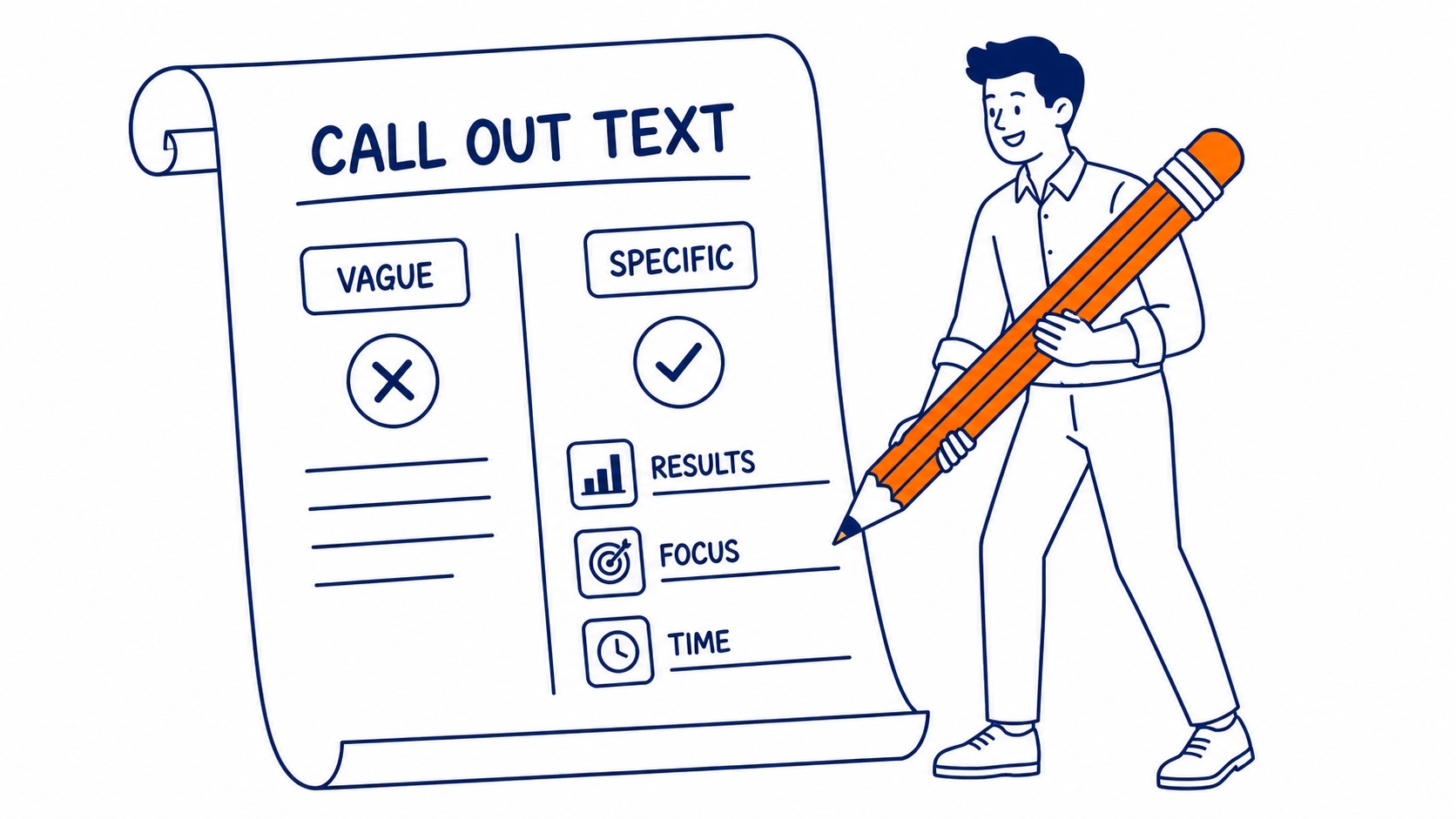
“Free Shipping.” “No Long-Term Contracts.” “Price Match Guarantee.” “Family-Owned Since 2007.” Those phrases carry real information. “We Are a Great Company.” “Serving You Better.” Those do not. Searchers scan this text in under a second. A vague claim still gets ignored.
Callout Extensions vs. Sitelinks
Two different jobs. Worth separating clearly.
Sitelinks link to specific pages on your site. A callout carries no link at all. They direct someone to a destination page. These share information before the click decision.
Both run on the same ad at the same time. Google determines which ones show and how many, based on ad rank and search context. Sitelinks take more visual space. These are compact. Both still matter to overall ad performance. Most accounts still skip both, though adding extensions to a campaign takes minutes. Space aside, what sitelinks in Google Ads mean for a click is the bigger difference.
Three Levels, One Setup
One choice determines scope.
Account-level phrases attach automatically to every campaign in the account. Campaign-level phrases show only on ads in that specific build. Ad group level phrases narrow further, running only within that group.
More specific levels override the broader defaults. Universal claims like “Canadian-Owned” or “Free Estimates” belong at the account level. Offers tied to a specific product or service go at campaign or ad group level. A roofing setup might carry different phrases than a windows setup running in the same build.
Most setups start at the account level. That is the right instinct. Refine from there once you see which builds need different messaging.
Writing Callout Text That Works
Specifics beat vague claims. Every time.
“Free Shipping” performs better than “Great Service.” “Licensed and Insured” beats “Professional Team.” Specific text reduces uncertainty before the click. A searcher comparing two ads stops at the one that tells them something real.
Most accounts we audit while providing Google Ads management services at To-The-TOP! (SEO Company To-The-TOP!) carry four or five generic phrases nobody has updated since the account launched. Eight to ten specific candidates give Google real rotation options.
Google rotates callout assets based on performance. Higher performers show more often over time. Review data after 30 days. Pause the ones that appear frequently but do not move CTR. Replace them with something tied to your actual offer.
Google also offers auto-generated callouts in some accounts. The platform pulls callout text from your site content automatically. Worth knowing. In practice, manually written callout assets tend to outperform these auto-versions because you control the specifics. The performance benefits compound when the phrases are specific to your actual offers.
If you have us manage your Google Ads in Calgary, the extension setup is one of the first tasks after the overall structure is confirmed. Not the most complex part of the build. However, it is free ad space that most advertisers leave incomplete.
A website keyword analysis also shapes these choices. The phrases searchers use around your product or service become strong extension candidates. “Same-Day Service” works when urgency terms show up in the search behaviour around your category.

If the rest of your ads are structured well, a strong set of callout extensions is one of the lower-effort ways to pick up incremental performance. Worth doing before revisiting bid adjustments or audience layering. To-The-TOP! handles this as part of its SEO Calgary and paid search work.
FAQ
What does a callout ad extension provide?
Extra text space below your main ad copy. No link attached. The extension surfaces additional information, offers, policies, or service differentiators that did not fit in the headline and description. Free shipping details. Support hours. Money-back guarantees. Those are common examples.
Are callouts good for SEO?
Callout extensions have no direct effect on organic rankings. They run inside Google Ads, separate from search engine optimization. A well-run Calgary SEO campaign and a well-managed paid search setup serve different purposes. They touch only the paid side.
What is the purpose of callouts?
Extra selling points the headline and description cannot fit. They surface specifics before the click. Offers, policies, and differentiators that never made it into the ad copy. A second read for someone already considering your ad.
What is the best practice for Google Ads callout extensions?
Short phrases. Specific claims. Title Case. Run at least six to eight per campaign so Google has rotation options. Review performance after 30 days. Pause ones that show often but do not help CTR. Add new ones as offers change or new differentiators come up.
Contact Calgary SEO Company To-The-TOP!
Questions about anything in this article, or about your own rankings? Talk to a Calgary SEO specialist directly.
Phone: (403) 308-5949
Address: 1509 14 Ave SW, Calgary, AB T3C 0W4
Hours:
Monday to Friday: 10:00 am – 7:00 pm
Saturday: 12:00 pm – 4:00 pm
Sunday: closed
