
What Is a Good CPC for Google Ads?
LocaliQ’s 2026 search advertising benchmarks put the average cost per click at $5.42 across all industries, with industry averages running from $1.63 for arts and entertainment to $9.87 for attorneys and legal services. Those figures come from LocaliQ’s own customers’ search campaigns on Google Ads and Microsoft Ads combined, and the page does not say which currency they are in or which countries the campaigns ran in, so they are a rough reference point rather than a Canadian price list. A good CPC for your own account is any CPC that sits comfortably below your break-even CPC. For a lead-generation campaign, that is your gross profit per sale multiplied by the share of clicks that become leads and by the share of leads that become paying customers. A CPC above the industry average can still be a good one, and a CPC below it can still lose money.
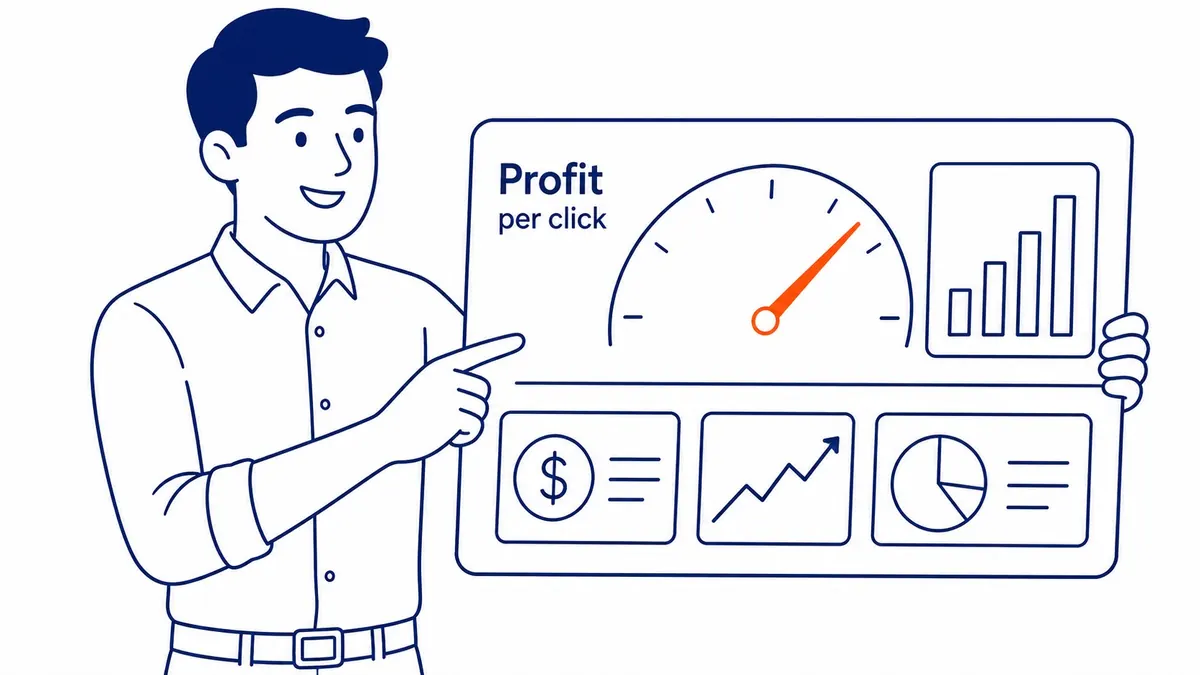
This guide comes from SEO Company To-The-TOP!, a Calgary practice that has worked in search since 2007 and holds Google Ads certification. It covers the 2026 benchmarks and what they can and cannot tell you, why your own market can differ from them, how to calculate the CPC your business can afford, and what changes when Google sets your bids for you. Where a statement comes from Google or a published report, the article names it, and where a number is an example, it is labelled as one.
Average CPC by industry in 2026
LocaliQ, working with WordStream by LocaliQ, published its 2026 benchmarks in May 2026 and last updated the page on 1 June 2026, based on data from thousands of its customers’ campaigns across Google Ads and Microsoft Ads. The page does not state a currency, the countries the campaigns ran in or how much of the data comes from each platform, so the figures below are shown exactly as LocaliQ published them, without a currency label or a conversion. They are most useful as a broad picture of how industries compare with one another, rather than as the going rate in any one city.
| Industry (LocaliQ category) | Average CPC, 2026 (as published) |
|---|---|
| All industries | $5.42 |
| Attorneys and legal services | $9.87 |
| Home and home improvement | $8.33 |
| Dentists and dental services | $8.00 |
| Personal services | $7.17 |
| Health and fitness | $6.17 |
| Business services | $5.87 |
| Industrial and commercial | $5.87 |
| Career and employment | $5.81 |
| Education and instruction | $4.81 |
| Physicians and surgeons | $4.76 |
| Beauty and personal care | $4.62 |
| Apparel, fashion and jewellery | $4.44 |
| Automotive repair, service and parts | $4.35 |
| Shopping, collectibles and gifts | $4.14 |
| Animals and pets | $4.06 |
| Furniture | $3.97 |
| Finance and insurance | $3.39 |
| Real estate | $3.22 |
| Sports and recreation | $2.77 |
| Automotive for sale | $2.27 |
| Travel | $2.14 |
| Restaurants and food | $2.05 |
| Arts and entertainment | $1.63 |
Two things in this table surprise people who learned the older rules of thumb. Finance and insurance, often described as one of the most expensive categories, averages $3.39 in this data set, well below home improvement and dental, which is a reminder that the result depends on whose accounts are in the sample. The all-industry figure is also far above the “a dollar or two per click” that still circulates online, so an old benchmark can make a normal CPC look alarming.

Why your market may not match the benchmark
A benchmark tells you whether your CPC is in a plausible range, not whether it is right for you. The LocaliQ figures are averages, so a handful of accounts paying very high prices can pull them up, and a typical account in the same category may pay noticeably less. They also blend Google Ads with Microsoft Ads, they reflect the kinds of businesses that buy advertising through LocaliQ, and the page does not say where the campaigns ran, so the figures cannot tell you what clicks cost in Calgary, Edmonton or Vancouver. Your own account reports bids and charges in the currency it was set up in, which is one more reason to treat any comparison with the table as approximate.
The better check is your own market. Keyword Planner shows a “top of page bid” low and high range for each keyword, which Google describes as approximations of the 20th and 80th percentiles of what advertisers have historically paid for a top of page bid, based on the location and network settings you choose. Set the location to Calgary, or to your actual service area, and those ranges become a local benchmark for the exact keywords you plan to buy. The walkthrough for looking up what a keyword costs shows where to find these figures. Once a campaign is running, the Auction insights report shows which other advertisers are entering the same auctions and how often, which helps explain a CPC that climbs when a new competitor arrives.
Benchmarks for one campaign type also should not be used for another. LocaliQ’s figures are for search advertising, where someone has typed a query, and Display or video campaigns reach people who have not searched for anything, so their click prices and conversion rates belong in separate comparisons. Keeping search and display in separate campaigns makes each CPC much easier to judge.

Work out your own break-even CPC
The number that decides whether a CPC is good is the most you can pay for a click before the advertising eats all the profit from the sales it brings in. For a lead-generation business you need three figures: gross profit per sale (revenue minus the direct cost of delivering the job or product), close rate (the share of leads that become paying customers) and conversion rate, meaning the share of clicks that become an enquiry, a call or a form submission. Google defines conversion rate as conversions divided by ad interactions, and on a search campaign the interactions are mostly clicks. Multiply the three together and you have your break-even CPC.
Break-even CPC for lead generation = gross profit per sale x close rate x conversion rate (clicks to leads)
Break-even CPC when the conversion is the sale = gross profit per sale x conversion rate (clicks to purchases)
The second version suits online shops and any campaign where the tracked conversion is a completed purchase, because applying a close rate on top of a purchase would count the sale twice. Either way, base the conversion rate on the one primary conversion action that stands for a lead or a sale. Google notes that tracking more than one conversion action, or counting every conversion, can push the conversion rate above 100%, and a figure inflated like that makes any break-even CPC look far more generous than it is.
The three examples below are illustrative. The figures are made up to show the arithmetic and are not client data or market averages.
| Illustrative business | Gross profit per sale | Close rate | Conversion rate | Break-even CPC | LocaliQ 2026 category average |
|---|---|---|---|---|---|
| Calgary roofing contractor | $3,000 | 25% | 6% (clicks to leads) | $45.00 | $8.33 (home and home improvement) |
| Calgary bookkeeping firm | $1,200 | 40% | 5% (clicks to leads) | $24.00 | $5.87 (business services) |
| Online gift shop | $30 | Not used, the conversion is the sale | 2% (clicks to purchases) | $0.60 | $4.14 (shopping, collectibles and gifts) |
Even allowing for the open question about LocaliQ’s currency, the roofer could pay several times the published category average and still make money, because one job carries a large profit. The bookkeeping firm has plenty of room too. The gift shop is in the opposite position, because even a click at a fifth of its category average would wipe out the profit on the sale, so search ads on broad gift keywords are unlikely to work for it at all unless the order value or the conversion rate rises. That is why one CPC can be excellent for one business and a disaster for another.

Break-even is a ceiling, not a target. At exactly that CPC the ads pay for themselves and leave nothing for overheads or profit, so a good CPC sits well below it, and how much room to leave is a business decision about what share of gross profit you are willing to spend to win a customer. If you do not know your conversion rate yet, the conversion rate benchmarks give you a starting estimate, but replace it with your own tracked figure as soon as you have one. Every input in the formula moves the answer in proportion, so a conversion rate inflated by loose tracking overstates what you can afford just as much as an optimistic profit figure would.
Why your CPC is what it is
With manual bidding, your maximum CPC bid is the most you will normally be charged for a click, and the actual charge is often lower. Google says you pay only what is needed to clear the Ad Rank thresholds and beat the Ad Rank of the advertiser directly below you, or the reserve price if nobody below you clears their thresholds. Thresholds are higher for ads shown above the search results, so a top position usually costs more per click, and Google also notes that the advertisers further down the page can influence what you pay. Google publishes no formula for the calculation, so the often-quoted “Ad Rank of the advertiser below divided by your Quality Score, plus one cent” is not Google’s method. There is more on how actual CPC is worked out in a separate guide.
Ad Rank weighs your bid against the quality of your ad and landing page, measured at the moment of each search (including expected clickthrough rate, ad relevance and landing page experience), along with Google’s thresholds, the competitiveness of the auction, the context of the search and the expected impact of your assets. The Quality Score you see in your account is a different thing. Google describes it as a diagnostic tool and states that it “is not an input in the ad auction.” It is still worth checking, because a low score on expected clickthrough rate, ad relevance or landing page experience points to the same weaknesses the live auction penalises, and Google says that higher quality ads can often lead to lower CPCs.
With Manual CPC, a click normally costs no more than your maximum CPC bid, but Google lists exceptions: bid adjustments, for a device or a location for example, and manual bidding for Search Partners can both take the actual bid above the maximum you set. Automated bid strategies set their own bids at auction time, so a manual maximum is not the ceiling there. Enhanced CPC, which used to nudge manual bids up and down, was retired for Search and Display campaigns in the week of 31 March 2025, and campaigns still set to it now run as Manual CPC.
When Google sets your bids, judge CPA and ROAS instead
Many accounts now use automated bidding, where Google sets the bid for each auction. With Target CPA, you set the average cost per conversion you want, and with Target ROAS, you set the average return on ad spend you want, measured as conversion value divided by cost. On those strategies CPC is not the target you set. Portfolio versions of Target CPA and Target ROAS can carry maximum and minimum CPC bid limits, which apply in Search Network auctions only, but Google does not recommend them because they restrict its bid optimisation. CPC can also rise while the campaign performs better, because the system is paying more for the clicks it judges most likely to convert. The question “is my CPC good?” becomes “is my cost per conversion, or my return on ad spend, good?”
The same break-even logic answers both. For a lead-based business, break-even cost per lead is gross profit per sale multiplied by close rate, so the illustrative roofer above breaks even at $750 a lead ($3,000 x 25%), and a good Target CPA sits comfortably below that. For a business that tracks sales value, break-even ROAS is one divided by gross margin. A ROAS of 4 (Google shows it as 400%) means $4 of sales for every $1 of ad spend, which is exactly break-even at a 25% gross margin and leaves real profit at a 50% margin, where break-even is a ROAS of 2. So a ROAS of 4 is good only if your margin is comfortably above 25%, and that is before overheads and the cost of running the campaign.
Bringing a high CPC down
A CPC above your target is worth investigating before you lower the bid, because a lower bid on its own often just means fewer clicks in worse positions. The usual places to look are the search terms report, for searches that will never become customers and deserve negative keywords, the match types in use, and whether the landing page delivers what the ad promised, since landing page experience is one of the qualities the auction measures. The guide on how to improve CPC works through each of those fixes in more depth.
It also helps to sanity-check the budget against your CPC. As an illustration, if your clicks average $8, a $20 daily budget buys two or three clicks a day. Google says a campaign can spend up to twice its average daily budget on a given day but no more than 30.4 times that budget in a month, so $20 a day comes to at most about $608, or roughly 76 clicks a month at that price, which is only four or five conversions at a 6% conversion rate. Whether that is enough to learn from depends on how long your customers take to convert, how much results swing from week to week and what decision you are trying to make, but four or five conversions are too few to treat the cost per conversion as settled. It makes sense to plan a monthly budget from the CPC you expect to pay rather than from a round number.
A good CPC, in the end, is one your numbers can carry with room to spare. Use the 2026 benchmarks as a rough guide to whether you are in a plausible range, Keyword Planner set to your own city to see what your market charges, and your break-even CPC to decide what you can afford. If you would like a second opinion on what your account is paying per click, or help with Google Ads management, call To-The-TOP! at (403) 308-5949.
Contact Calgary SEO Company To-The-TOP!
Questions about anything in this article, or about your own rankings? Talk to a Calgary SEO specialist directly.
Phone: (403) 308-5949
Address: 1509 14 Ave SW, Calgary, AB T3C 0W4
Hours:
Monday to Friday: 10:00 am – 7:00 pm
Saturday: 12:00 pm – 4:00 pm
Sunday: closed