
What Is White Hat and Black Hat SEO?
White hat SEO and black hat SEO are the two opposite ways of getting a website to rank in search. White hat SEO works within the guidelines search engines publish, earning positions with useful content, a sound site and links other people choose to give. Black hat SEO breaks those rules to rank faster, using tricks such as keyword stuffing, cloaking and bought links. Google’s current documentation does not sort these practices under a “black hat” label: instead it publishes a list of “spam policies for Google web search“, and a site that breaks them “may rank lower in results or not appear in results at all”.
The difference matters most when you are paying someone else to do the work. A provider using black hat methods can deliver a quick rise that looks like success, and the cost arrives later, sometimes as a manual action from a Google reviewer and sometimes as a quiet slide that no one explains. Knowing which side a provider works on is one of the most useful things a small business can check before signing anything.
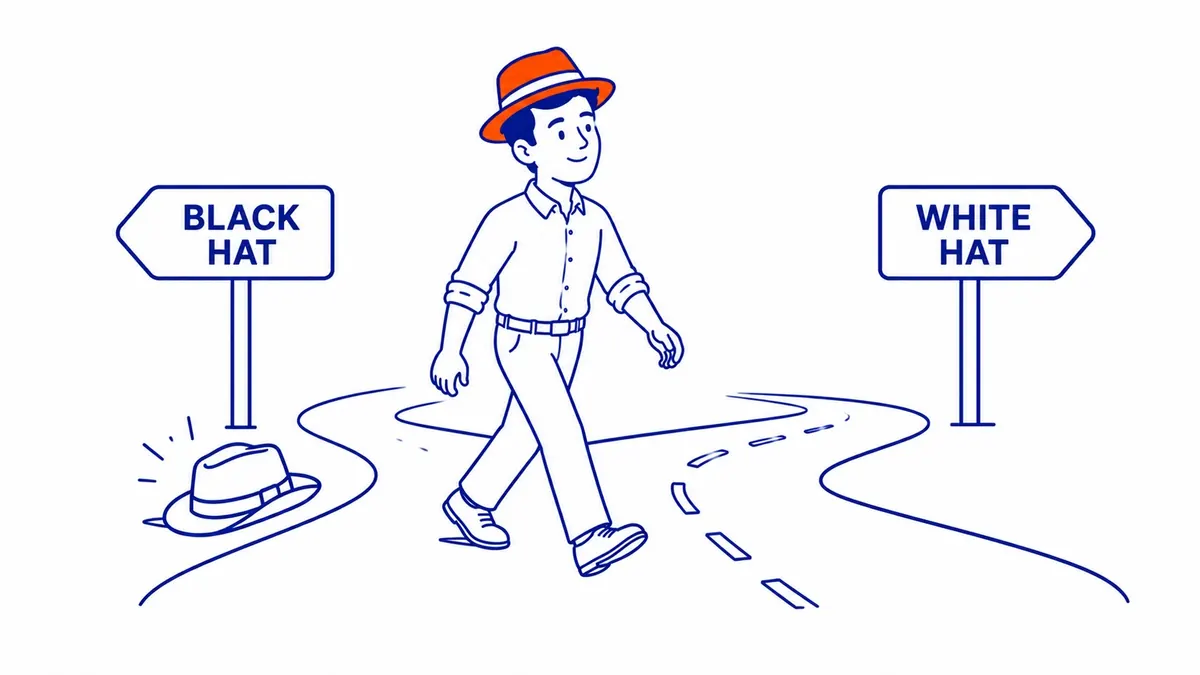
White hat SEO: playing by Google’s rules
White hat SEO is search engine optimization that stays inside the guidelines search engines publish. Google, Bing and the other major search platforms all document what they want from websites and what they will not tolerate, and white hat work treats that documentation as the boundary. The aim is simple to state and hard to do: build pages that deserve to rank for a search, then make it easy for search engines to understand why they do.

Day to day, that means writing content that answers the question a person actually typed, making pages load quickly and read well on a phone, and earning mentions and links because other sites found something worth citing. None of it is glamorous, but it compounds, because nothing about the result depends on a loophole that Google will eventually close. That does not make a position permanent, since Google’s ranking systems weigh many signals and keep changing, but it does take away the risk of losing it for breaking a spam policy.
The catch is speed, because white hat SEO takes months rather than weeks, and that wait is what tempts many people toward the methods on the other side. Most black hat tactics exist to skip that wait, which is also why they tend to be found out.
Black hat SEO: the shortcuts that backfire
Black hat SEO covers the tactics that violate search engine guidelines to win visibility faster than real work allows. It treats the ranking system as a puzzle to be gamed rather than an audience to be served. Sometimes it works for a while, and that short window is the whole trap, because the business owner reads the early rise as proof that the provider knows something others do not.
Google describes spam as “techniques used to deceive users or manipulate our Search systems into featuring content prominently”, and its current wording also covers attempts to manipulate generative AI responses in Search. It catches these practices through automated systems and, when needed, through human review that can end in a manual action. Those automated systems run all the time, and Google announces a spam update when it makes a notable improvement to them, so rankings that depend on breaking the policies stay exposed to being found and demoted.
Grey hat SEO: the murky middle
Between the two sits grey hat SEO: tactics that are not clearly named as violations but sit close to the line. Swapping links with a few related businesses, pushing exact-match anchor text into links that were otherwise earned, or refreshing old posts with a new date and only cosmetic changes are typical examples. Each can look harmless on its own, which is what makes the category attractive.
The trouble is that the line moves. In March 2024 Google added named spam policies for practices it said had grown in popularity, among them buying expired domains for their history and placing third-party pages on a well-known site mainly to borrow its ranking signals, and it built on its older rule about automatically generated content so that mass-produced pages are covered however they are made. Betting on grey hat work means betting that Google will not tighten a rule before you have moved on, and the guide to grey hat SEO goes through where those lines currently sit. To-The-TOP! does not offer grey hat work for that reason.

Black hat SEO tactics, in Google’s own words
It helps to know the specific tricks, because many of them are invisible to an owner looking at their own site in a browser. The table below puts the usual black hat labels next to the names Google uses in its spam policies, so you can look up the official definition of anything a provider proposes.
| Common black hat tactic | Google’s policy name | What Google describes |
|---|---|---|
| Keyword stuffing | Keyword stuffing | Filling a page with keywords or numbers to manipulate rankings, such as blocks of city names or phrases repeated until they sound unnatural |
| Cloaking | Cloaking | Showing search engines different content from what visitors see, with the intent to manipulate rankings and mislead users |
| Doorway pages | Doorway abuse | Pages or sites built to rank for similar searches that lead visitors through less useful intermediate pages, such as near-identical pages for different cities that all funnel to one page |
| Hidden text and links | Hidden text and link abuse | White text on a white background, text behind images or off-screen, or a link hidden in a single character |
| Paid links, link farms, private blog networks | Link spam | Buying or selling links that pass ranking credit, excessive link exchanges and automated link building (paid links marked rel=”sponsored” or rel=”nofollow” are allowed) |
| Sneaky redirects | Sneaky redirects | Redirecting visitors so they see different content from what search engines see, or unexpected content they did not ask for |
| Injected links on someone else’s site | Hacked content | Content placed on a site without permission through a security hole |
| Mass-produced pages, including AI-generated ones | Scaled content abuse (2024, building on the older automatically generated content policy) | Many pages generated mainly to manipulate rankings, with little value to users, “no matter how it’s created” |
| Buying an old domain to borrow its history | Expired domain abuse (added 2024) | An expired domain repurposed mainly to manipulate rankings with low-value content |
| Placing pages on a trusted site to borrow its rankings | Site reputation policy (added 2024) | Third-party content published on a host site mainly because of that site’s established ranking signals; third-party content on its own is not a violation |
The last three rows are the policies added in 2024. Google announced them on 5 March 2024, alongside its March 2024 core update, and gave site owners until 5 May 2024 before the site reputation rule took effect. Scaled content abuse matters to anyone being sold large batches of AI-written pages, because the policy targets the purpose and the value to readers, whatever tool produced the text.
White hat SEO techniques that hold up
The white hat side is less a list of tricks than a discipline, though the techniques are concrete enough. Content is built around what people search for and answers it fully, without repeating the keyword for its own sake. On-page basics are done properly: clear title tags, sensible headings, descriptive image text and internal links that help visitors move to the next useful page. The technical foundation lets search engines crawl and index every page without running into errors.

Links are earned rather than bought, by publishing something worth citing, being listed in directories that genuinely fit your industry and building real relationships with suppliers, associations and local media. Page experience counts as well, and Google’s guidance on helpful content says its “core ranking systems look to reward content that provides a good page experience” and asks site owners to look at the overall experience rather than one or two measurements. The thread running through all of it is that the page is improved for the person reading it first, and rankings follow from that.
Why the difference matters for your business
The distinction is practical rather than academic. White hat SEO builds an asset, because each month of sound work makes the next month easier and the gains do not depend on anything Google is trying to shut down. Black hat SEO is the opposite bet: it trades long-term safety for a short-term rise, and when a manual action or a spam update arrives, a page can drop from the first page of results to nowhere at once.
Fixing the damage afterwards takes time, and some of what was gained does not come back at all: Google’s page on spam updates says that when its systems remove the effect of spammy links, any ranking benefit those links once gave is lost and cannot be regained. Google’s own advice to site owners also points out that you are responsible for the actions of any company you hire, so a provider’s black hat work becomes your problem rather than theirs. SEO Company To-The-TOP! has offered White Hat SEO only since it was founded in Calgary in 2007, for exactly that reason.
Can you recover after a Google penalty?
Often, yes, though it is rarely quick, and the route depends on what kind of penalty it is. A manual action is issued when a human reviewer at Google decides that pages break the spam policies. Google says it will notify you in the Manual actions report and the Search Console message centre, and the report describes the issue and the patterns of affected pages. An algorithmic demotion is different: Google’s automated systems lower the pages, there is no report to read, and a fall in traffic or positions may be the only visible sign. A fall on its own does not prove a spam demotion, though, because rankings also shift with Google’s broader core updates and for many other reasons.
Either way, recovery starts with finding what caused the problem, which means a full SEO audit of the site’s content, technical setup and link profile. Stuffed or mass-produced pages are rewritten or removed, cloaking and sneaky redirects are taken out, and hacked content is cleaned up and the security hole closed. For a manual action, you then send a reconsideration request that explains what was fixed. Google says most reviews take several days or weeks, and link-related ones can take longer.
Links need particular care. Google recommends removing spammy or paid links at the source first, and its documentation says most sites will not need the disavow tool: it is meant for sites with a considerable number of artificial links that have caused, or are likely to cause, a manual action, and Google calls it an advanced feature that can harm a site if it is used incorrectly. After an algorithmic demotion there is nothing to submit, so the wait lasts as long as it takes Google to recrawl and reassess the cleaned-up site.
Is black hat SEO illegal?
Mostly not. Keyword stuffing, cloaking and bought links break Google’s spam policies, which are the rules of a private company deciding what appears in its own results, and the consequence is lost visibility rather than a fine. A few black hat tactics do overlap with Canadian law, though, for reasons that have nothing to do with search. Breaking into someone else’s website to plant links can, depending on the facts, amount to the Criminal Code’s offence of unauthorized use of a computer, and fake reviews or false claims made to promote a business can be reviewable conduct under the Competition Act, which covers representations to the public that are false or misleading in a material respect. The companion article on where black hat SEO does cross into law covers those cases in more detail, and none of this is legal advice.
Which approach should a small business pick?
White hat, and the choice is not close. A small business cannot afford to gamble its whole online presence on tactics that the next update may wipe out, and the temptation is strongest when a competitor seems to be cutting corners and winning. Some of them are, for now. Their gains rest on practices that Google’s systems are built to catch, whereas work that stays within the policies avoids that risk, even though no method can guarantee a position.
The harder part is telling which kind of work you are buying, because no provider describes itself as black hat. Google’s page “Do you need an SEO?” gives a good starting list, and a few questions built on it and on the spam policies will usually reveal how a provider works:
- Do they promise a ranking? Google states that “No one can guarantee a #1 ranking on Google”, and warns about anyone claiming a “special relationship” with Google or offering a “priority submit”.
- Where will the links come from? A white hat provider can name the kinds of sites and the reason each would link to you, and a list of guest posts on sites that exist only to sell them is link spam.
- How will the content be produced? Hundreds of pages in a month, or a page for every city with only the name changed, fits Google’s descriptions of scaled content abuse and doorway abuse.
- Will they explain every change? Google advises being careful with any company that is secretive or will not clearly explain what it intends to do, and reminds owners that they are responsible for what a hired SEO does.
- Who owns the work? The content, the accounts and any domains bought on your behalf should stay yours if you part ways.
If you need visibility while organic rankings build, pair the SEO with a well-run Google Ads campaign, which buys placement openly through Google’s own auction instead of trying to fake it in the organic results.
Common questions about white hat and black hat SEO
Is AI-generated content black hat SEO?
Not in itself, because Google’s spam policy on scaled content abuse targets many pages generated mainly to manipulate rankings with little value to users, “no matter how it’s created”, and lists using generative AI tools “to generate many pages without adding value for users” as one example. The test is purpose, scale and value rather than the tool, so a batch of hundreds of near-identical pages built to catch search variations falls under the policy whether a person or a tool wrote them, and having someone check them first does not change that. A page written with AI help is judged like any other page, by whether it is accurate and genuinely useful to the person reading it.
Can a competitor hurt my rankings with bad links?
It is unlikely. Google’s disavow documentation says that “Google works very hard to make sure that actions on third-party sites do not negatively affect a website”, and that in most cases it can work out which links to trust without help. The disavow tool is meant for the opposite situation, where you or an SEO you hired built paid or artificial links. If Search Console shows no manual action and your traffic is steady, a burst of spammy links from unknown sites usually needs no response.
Can I report a competitor who uses black hat SEO?
Yes. Google asks people who believe a site is breaking its spam policies to file a search quality user report, and it says it uses those reports to improve its spam detection systems, because its focus is on scalable, automated solutions. In practice, that means a single report rarely produces a visible change for a specific competitor, and the article on how to report it to Google explains the forms and what to expect.
Contact Calgary SEO Company To-The-TOP!
Questions about anything in this article, or about your own rankings? Talk to a Calgary SEO specialist directly.
Phone: (403) 308-5949
Address: 1509 14 Ave SW, Calgary, AB T3C 0W4
Hours:
Monday to Friday: 10:00 am – 7:00 pm
Saturday: 12:00 pm – 4:00 pm
Sunday: closed