
What to Avoid in an SEO Company: 9 Warning Signs
The things to avoid in an SEO company fall into two groups. Some show up in the sales pitch: guaranteed rankings, claims of a special relationship with Google, cold emails, and a refusal to explain what the work involves. Others only appear once the work starts, such as bought links, pages produced in bulk, accounts registered in the agency’s name, reports full of keywords nobody searches for, and a package that never changes. Google publishes its own advice on hiring an SEO, and most of this list comes straight from it.
Google’s guidance on hiring an SEO is direct about where the risk sits. Its Do you need an SEO? page, last updated in June 2026, says that “you are responsible for the actions of any companies you hire”. If the agency breaks Google’s rules, it is your domain that pays for it, and the agency can simply move on to its next client.
The nine warning signs below are worth checking whether you are comparing proposals or reviewing a company you already pay. They work alongside the wider question of how to choose an SEO company in the first place, which covers what a good one looks like rather than what to steer clear of.

1. Guaranteed rankings or a “special relationship” with Google
No one can promise a first-place ranking, because no one outside Google controls the results. Google says so plainly: “No one can guarantee a #1 ranking on Google.” The same page warns against SEOs that “allege a ‘special relationship’ with Google, or advertise a ‘priority submit’ to Google”, and adds that if an audit comes with a promise of first place, you should find someone else.
A guarantee usually works in one of two ways. Either it covers phrases so obscure that ranking for them proves nothing, or the fine print lets the company keep billing while it “keeps working” on the result. Google also states that advertising with it has no effect on organic rankings, so an agency that hints that buying ads will lift your organic results is either mistaken or misleading you. Contract terms and the other sales-stage signs are covered in more depth in the hiring-stage version of this list.
2. Links that are bought, swapped or mass-produced
Link building is legitimate work, but plenty of what gets invoiced under that name breaks Google’s rules. Google’s spam policies define link spam as links created “primarily for the purpose of manipulating search rankings”, and list examples that include paying for links or for posts that contain them, excessive link exchanges, and “using automated programs or services to create links to your site”. Private blog networks, paid guest posts that pass ranking credit, links with keyword-stuffed anchors and low-quality directory links all sit in that territory, although paid placements marked as sponsored are allowed.
The consequences land on your site. Google’s Manual actions report lists “unnatural links to your site” as one reason a site can lose some or all of its visibility, and the fix means removing or disavowing the links and filing a reconsideration request. Google’s Help page says most reconsideration reviews “can take several days or weeks”, and that link-related requests can take longer than usual. That is time the affected pages, or sometimes the whole site, spend suppressed for work you paid someone else to do.
Two simple tests help here. Ask for the actual URL of every link built for you, because a company doing deliberate outreach should be able to list the links it obtained, with the source page and anchor text, and compare it with the external links Google reports in the Links report in Search Console, which you can export. Also note Google’s line that “you should never have to link to an SEO”, so a contract that requires a footer link to the agency is a warning sign in its own right.

3. Pages produced in bulk for search engines rather than customers
Some agencies run one article template across dozens of clients and change the city name. Others generate hundreds of AI pages and publish them without editing. Google’s spam policies call this scaled content abuse, which it describes as “many pages are generated for the primary purpose of manipulating search rankings and not helping users”, and it names “using generative AI tools or other similar tools to generate many pages without adding value for users” as an example. The policy applies “no matter how it’s created”, so the problem is the lack of value, not the tool.
Google’s guidance on helpful, people-first content gives you a practical test. Read three recent pieces the company wrote for you or for another client and ask whether a real customer would learn something they could not get from the first result on Google. Then ask who writes the material and who checks it before it goes live. A writer who can name your main competitors and explain what your customers ask on the phone is a far better sign than a content calendar full of generic titles.

4. An agency that owns your accounts
This is the quiet one, because it causes no trouble until the relationship ends. The agency registers your domain in its own name, sets up analytics under its own login, or becomes the primary owner of your Google Business Profile. When you leave, you may find you have to ask the agency for access to your own profile, analytics or domain, and if it will not cooperate, getting them back can be slow and sometimes impossible.
Every account should be owned by the business, with the agency added as a user. Google’s own role definitions make the split easy to check:
| Account | What the business should hold | What an SEO company needs |
|---|---|---|
| Search Console | Verified owner, with a Google account the business controls | Full user, or restricted user while it is only auditing |
| Google Business Profile | Primary owner | Manager |
| Google Analytics (GA4) | Administrator at the account level | Editor or analyst access to the property |
| Domain and hosting | Registrant and account holder in the business’s name | Delegated access or a separate login, never the registration itself |
| Google Ads | The account and its billing in the business’s name | User access to the account |
The Search Console and Business Profile roles come from Google’s Help pages. A Business Profile manager has “mostly the same access to the profile as owners”, and the only things a manager cannot do are add or remove users or remove the profile, so manager access covers almost everything an agency needs for routine profile work. Google’s hiring page also says that if an SEO offers to audit your site, you should only grant read access to Search Console at that stage, not write access.
Checking takes a few minutes. Open the Business Profile and look at who is listed as primary owner, open Search Console and look under Settings, then Users and permissions, and confirm that the GA4 account and the domain registration are in the business’s name. The same rule applies to advertising, so if you also pay for Google Ads management, make sure the Ads account and its billing are yours as well.
5. Secrecy about what is being changed on your site
An SEO company that will not tell you what it changed, or explains its work in vague terms, deserves a direct question. Google’s page advises you to “be careful if a company is secretive or won’t clearly explain what they intend to do”, and adds that an SEO with FTP access to your server “should be willing to explain all the changes they are making to your site”. Invoice lines such as “on-page optimization tweaks” or “authority building” should come with a list of the pages, links or settings involved.
Good practice is easy to recognize. Changes are logged with dates, recommendations come with the reasoning behind them, and the company points to official Google documentation when it asks you to change something significant. Google lists that last point as a question worth asking: “Do they cite official Google documentation as supporting evidence for their recommendations?”

6. Rankings for keywords nobody searches for
A report showing page one for twenty phrases can still describe a campaign that brings in no customers. The company name usually ranks easily, and long, oddly specific phrases often rank because few others compete for them, sometimes because almost nobody searches for them. Reports padded this way look like progress while nothing changes in the phone log.
Before work starts, the target keywords should be agreed with you, each with a reason it could lead to revenue. After that, the report should track the same list every month, so a drop shows up as clearly as a gain. Ask what a reported keyword could earn your business. A company that chose the term for a reason will have an answer, and one that chose it because it was easy to rank for usually will not.
7. One package for every client, and a plan that never changes
“Ten backlinks, four blog posts and twenty directory listings a month” reads the same whether the client is a roofer, a dental clinic or a software firm. Google’s hiring page suggests checking whether the SEO is interested in your business at all: a good one asks what makes you different, who your competitors are and how your customers find you. A fixed menu of deliverables skips all of that.
Watch the plan over time as well. Six months of identical invoices and identical tasks while the numbers sit flat should prompt a conversation about what is not working and why. Sometimes the right answer is a different mix of work, or putting part of the budget into paid search while the organic side matures, which brings in traffic in the meantime but does not lift organic rankings, and a company that only sells one product is unlikely to suggest either.

8. AI-search promises and “Google-approved” tools
Many agencies now sell services for AI search, often called AEO or GEO. Google’s hiring page now asks two pointed questions about them: whether the advice on optimizing for AI experiences is “aligned with Google Search’s official guidance on optimizing for generative AI features”, and whether the company’s tools are aligned with Google’s guidance. A pitch built on secret techniques for getting quoted by AI answers deserves the same scepticism as a ranking guarantee.
The same page warns about tools. Google “doesn’t evaluate or endorse third-party SEO tools”, those tools have no access to Google’s internal ranking data, and Google tells site owners to “be wary of tools that claim to be ‘acceptable’ or ‘approved’ by Google Search”. A third-party score is a starting point for questions, not a reason to make major changes to your site on its own.
9. Cold emails promising to fix your rankings
Unsolicited emails with lines such as “you are not listed in most of the major search engines” are as old as SEO itself. Google says it receives these emails too, and recommends treating them with the same scepticism you would give to diet pills that burn fat overnight. It also warns against companies that talk about “submitting your site to thousands of search engines”, which it describes as “typically useless exercises”. A company that has to find clients by spamming strangers has not shown you anything about the quality of its work.
If you are already working with one
If several of these signs describe your current provider, start with the accounts. Make sure the business is the verified owner in Search Console, the primary owner of the Business Profile and the administrator of GA4, and that the domain is registered to the business. Then ask in writing for a list of every link built and every change made to the site in the last twelve months.
After that, look at Search Console yourself. The Manual actions report will show whether Google has applied a manual action to the site, and if it has, it shows which parts of the site are affected. An independent SEO audit can check the link profile and the content against Google’s spam policies, which gives you a clear picture before you decide whether to stay, renegotiate or leave.
If you believe a company deceived you, Google’s page suggests reporting it. For a company outside the United States, it points to econsumer.gov, which takes complaints about businesses based in other countries.
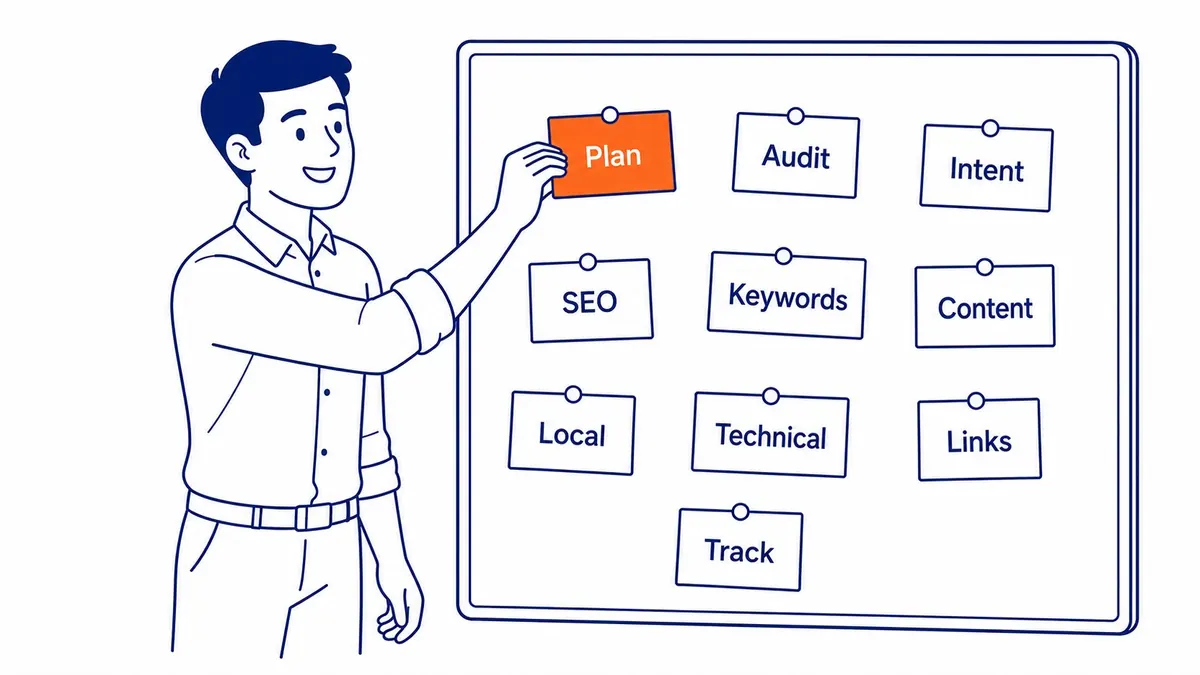
What a careful SEO company does instead
The opposite of this list is fairly plain. A careful company keeps every account in your name, follows Google’s spam policies, explains each change and the reason for it, tracks keywords you agreed on, and tells you when a month shows little movement. It also says at the start that SEO takes months rather than weeks, and it does not promise positions it cannot control.
Since 2007, SEO Company To-The-TOP! has worked on that basis in Calgary. It is a solo practice, so the person who plans the work is the person who does it, with no handoff to junior staff, and it uses White Hat methods only. It provides monthly position reports, and a public portfolio of ranked keywords shows results anyone can check. If you would like a second opinion on what your current SEO company is doing, call (403) 308-5949.
Contact Calgary SEO Company To-The-TOP!
Questions about anything in this article, or about your own rankings? Talk to a Calgary SEO specialist directly.
Phone: (403) 308-5949
Address: 1509 14 Ave SW, Calgary, AB T3C 0W4
Hours:
Monday to Friday: 10:00 am – 7:00 pm
Saturday: 12:00 pm – 4:00 pm
Sunday: closed