
Why Is Unique Content So Important in SEO?
Unique content is so important in SEO because Google does not need two pages that say the same thing. When several URLs carry the same or very similar content, Google picks one of them as the canonical and usually shows that version, leaving the others out, and when many pages on the web cover a topic in the same way, the ones that rank are usually the ones that add something the others lack. That is the real point of “unique”. Text that has never been published before is the minimum, while content that gives the reader new information, a clearer explanation or first-hand knowledge is what tends to earn rankings, clicks and links over time. This article explains what Google actually does with duplicate pages, which myths to ignore, and how to check your own site.

Unique is not the same as original
Most definitions treat unique content as text that does not appear anywhere else on the web, and a plagiarism checker can confirm that much. The trouble is that a page can pass every checker and still add nothing, because it rewords the same five points that every other result already makes. Some guides go further and give a rule that content becomes unique once a certain percentage of it has been changed. Google publishes no such threshold, and rewording an existing page until a tool stops flagging it is close to what Google’s guidance asks you not to do.
Google’s page on creating helpful, reliable, people-first content gives a list of questions for judging your own pages. Two of them describe originality better than any definition: “Does the content provide original information, reporting, research, or analysis?” and “If the content draws on other sources, does it avoid simply copying or rewriting those sources, and instead provide substantial additional value and originality?” Another asks whether the content provides “substantial value when compared to other pages in search results”. Those questions sit alongside the expertise and trust themes Google groups under E-E-A-T, and together they make a practical test. If a reader who had already seen the top three results would learn nothing new from your page, it is unique only in the narrowest sense.

What Google actually does with duplicate pages
Google documents the process in its page on canonicalization. When it finds a set of duplicate or very similar pages, it selects one representative URL, the canonical, and shows that version in its results. Google calls this deduplication and lists ordinary reasons a site might have duplicates, such as HTTP and HTTPS versions, mobile and desktop versions, and the sorting and filtering pages of a product category. The same page says that some duplicate content on a site “is normal and it’s not a violation of Google’s spam policies”, although having the same content at many URLs can be a bad experience for visitors.
The practical cost is that the duplicates you did not choose usually do not appear, and the page Google picks may not be the one you wanted to rank, although you can state a preference with a redirect or a rel=”canonical” link, as the guide to duplicate content explains in more detail.
This is why the “duplicate content penalty” that many site owners worry about is mostly a myth. In a 2008 Search Central post titled Demystifying the “duplicate content penalty”, Google wrote that there is no such penalty “in the way most people mean”. What Google does act on is described in its spam policies. Scraping covers republishing or lightly modifying content from other sites “without adding any original content or value”. Scaled content abuse is creating many pages “for the primary purpose of manipulating search rankings and not helping users”, whatever tool produced them. Doorway abuse includes pages “targeted at specific regions or cities that funnel users to one page”. Ordinary duplication on your own site is a ranking and housekeeping problem, while copying others at scale is a policy problem.

Why content that only repeats others struggles to rank
Duplication inside a site is only half of the issue. The more common problem for a small business is a page that is technically unique but says what twenty other pages already say. Nothing filters it out, yet it has no reason to rank above the pages that said it first, especially if those belong to larger and better-known sites. Google’s helpful-content question about “substantial value when compared to other pages in search results” describes exactly this situation.
Readers make the same comparison on their own. Someone searching for an answer opens a result, sees the familiar list of tips, and goes back to try another one. Google’s description of how it ranks results says it uses “aggregated and anonymized interaction data to assess whether search results are relevant to queries”, so how searchers respond to results in aggregate is part of the picture. Google does not publish detail beyond that, and claims that a particular bounce rate or time on page lowers rankings go further than Google’s documentation does. What a practitioner can say with confidence is that a page people find useful earns clicks, enquiries and mentions, and a page that repeats others earns none of them, whatever role those signals play inside Google’s systems.

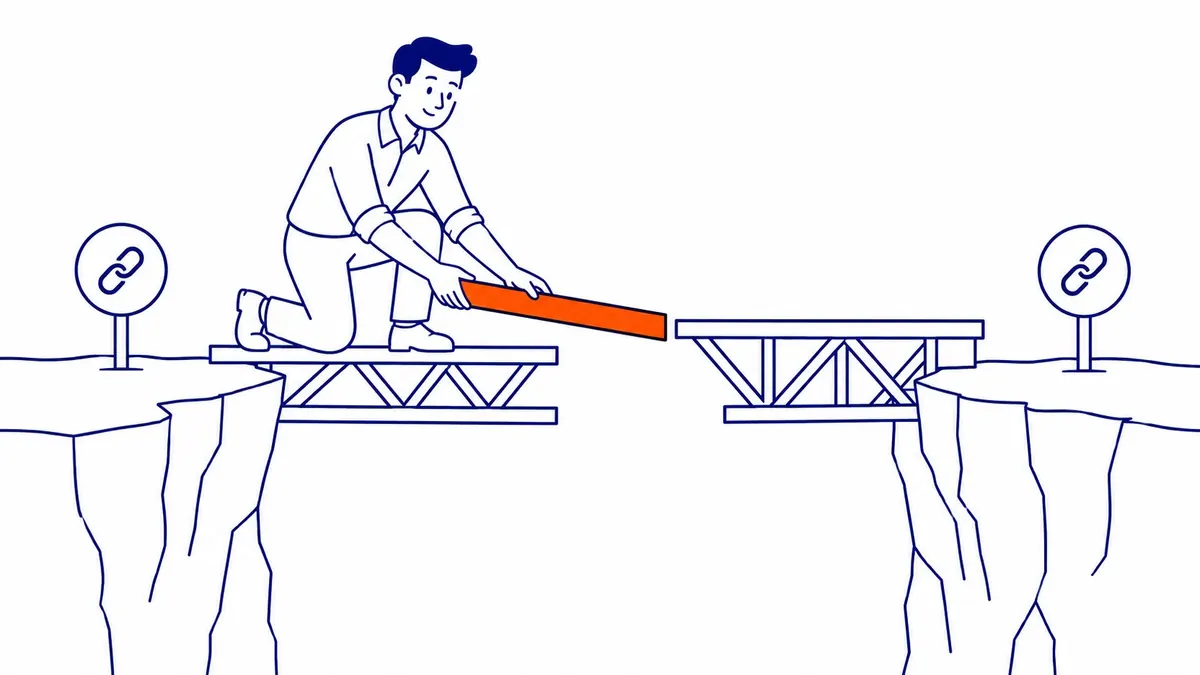
Original content is what earns links
Google’s description of how it ranks results says that one of the factors used to determine quality is “understanding if other prominent websites link or refer to the content”, and people link to pages that give them something to cite. A journalist, a blogger or an industry association looking for a source wants a figure, an explanation, a checklist or an example they cannot find in a dozen other places. A page that restates common knowledge gives them no reason to choose it over the page they already know.
For a small business, original material usually comes from what the business sees every day rather than from expensive research. A Calgary roofer knows which problems show up after a hail season, a bookkeeper knows which CRA deadlines clients most often miss, and a clinic knows the questions patients ask before their first visit. Written up clearly, with real examples and plain explanations, that knowledge is something competitors cannot copy without doing the same work. For a small business with limited time, a few substantial pages like that are usually a better use of effort than a long run of short posts that repeat the same ground, though no one can promise how many links any one page will earn.
Where small business sites lose uniqueness
Most duplicate content on a small business site is not copied from anyone. It builds up through templates, supplier material and good intentions. The cases below are common on Canadian service and retail sites.
| Situation | What Google does | What to do |
|---|---|---|
| Service-area pages for Calgary, Airdrie, Okotoks and other towns with only the city name changed | Likely treats them as near duplicates and shows one; if they exist mainly to rank for each city and funnel visitors to the same page, they can fall under doorway abuse | Keep a page only where you can say something specific about that area, such as local conditions, travel times or projects there; otherwise use one service page that lists the areas served |
| Product descriptions copied from the manufacturer or supplier | Many retailers carry the same text, so Google has many near-identical pages to choose from | Add what the supplier text lacks: who the product suits, sizing or fit notes, local availability, your own photos and answers to common questions |
| The same English text on a .ca and a .com site | Region variants in the same language are a normal duplicate case, even with hreflang; Google may choose one as the canonical, and hreflang helps it show each country’s searchers the right URL | Use a self-referencing canonical on each version plus reciprocal hreflang annotations, and make the content differ where the market differs, such as prices in Canadian dollars, GST and delivery |
| Two or more blog posts answering the same question | The posts compete for the same searches and Google may show the weaker one | Merge them into the stronger post and redirect the other URL to it |
| AI drafts published with light edits | Google’s guidance on generative AI content says AI can be useful for research and for adding structure to original content, but generating many pages without adding value for users may violate the scaled content abuse policy | Use AI for research and structure if it helps, then add the facts, examples and judgement only your business has |
| Your content copied by another site | Google’s 2008 post says having others scrape you is “a different story” from scraping others | Usually nothing; if a copy of your work outranks you, check that your page is indexable with a self-referencing canonical, ask the site or its host to remove it, and use Google’s legal removal request if it infringes your copyright |
Two related points need a note. Google’s page on localized versions says that pages in different languages are only considered duplicates if the main content remains untranslated, so a properly translated French page for Quebec visitors is not a duplicate of the English one. And the same logic applies to paid search: if you build landing pages for Google Ads, Google Ads Help describes landing page experience as “how relevant and useful your landing page is to people who click your ad”. Quality Score is a diagnostic that Google says is “not an input in the ad auction”, so a page with original, specific content helps because it serves the visitor better, not because uniqueness is scored for its own sake.

How to check your own site
1. Check Search Console for duplicates. In the Page indexing report, two statuses point to duplicates: “Duplicate without user-selected canonical” and “Duplicate, Google chose different canonical than user”. Google’s Page indexing report help says the first is not an error but working as intended, because Google does not serve duplicate pages, so the question is whether the page it chose is the one you want. For your key service and product pages, URL Inspection shows the canonical you declared next to the one Google selected. Where the pages really are duplicates, redirect or canonicalize one to the other, and where they should be separate, give each one content of its own.
2. Search for your own sentences. Copy a distinctive sentence from an important page, put it in quotation marks and search for it. This shows whether other sites carry your text, and whether your own site repeats it on several pages.
3. Compare each key page with what already ranks. Search for the page’s main query and read the top three results. Then put the helpful-content questions to your own page: what does it say that those results do not? A content audit does the same thing across the whole site, sorting pages into keep, improve, merge or remove.
4. Fix the highest-value pages first. Merging two overlapping posts or rewriting one important service page usually matters more than tidying dozens of minor URLs. After a change, Google needs time to recrawl and reassess the pages. Its canonicalization troubleshooting guide says pages can stay in a duplicate cluster for up to two weeks after a fix, and any ranking change can take longer and is not guaranteed.
Why this matters for a small business
Unique content will not rank a page on its own, since links, technical health, page experience and the strength of the competition all play their part. It is, however, the part a business controls completely, and it is the one Google’s own guidance keeps returning to. A site that repeats what others say gives Google and searchers no reason to choose it, while a site that explains what the business knows better than anyone gives them one. If you are unsure where your site stands, a full SEO audit will show the duplicate pages, the thin pages and the pages worth improving first.
Since 2007, SEO Company To-The-TOP! has provided White Hat SEO in Calgary and reports client positions monthly. To talk through your site’s content, call (403) 308-5949.
Contact Calgary SEO Company To-The-TOP!
Questions about anything in this article, or about your own rankings? Talk to a Calgary SEO specialist directly.
Phone: (403) 308-5949
Address: 1509 14 Ave SW, Calgary, AB T3C 0W4
Hours:
Monday to Friday: 10:00 am – 7:00 pm
Saturday: 12:00 pm – 4:00 pm
Sunday: closed