
Does Your Domain Name Affect SEO?
Clients raise this one early in the process. Usually it comes up when someone is registering a brand-new domain and wondering whether to put their primary keywords in the URL, or when an existing business starts questioning whether a rebrand might improve their search visibility. The short answer: yes, your domain name affects SEO. That impact is smaller and more indirect than most people expect, though.
Your domain name is a minor ranking factor. Content quality, backlinks, and technical performance are what move your site up in search results. We have been working as an SEO company Calgary businesses rely on since 2007, and the pattern holds consistently. A keyword-rich domain does not compensate for a weak site. Clean brand names on fast, well-structured websites outrank exact-match domains on neglected pages nearly every time. Understanding what your domain name actually does for your SEO saves a lot of second-guessing.

What the Research Actually Shows
Context matters before the details.
Google has confirmed that keywords in your domain name are a ranking factor. A lightweight one. Exact match domains (EMDs) carried a real advantage in the early 2000s. A URL containing your target keywords used to earn a meaningful rankings boost. That advantage eroded sharply after a 2012 algorithm update. The EMD ranking factor has since shrunk to nearly negligible. Still, the signal never fully disappeared.
Over the years, we have seen exact match domains hold positions their underlying content did not justify. The domain name was propping up a thin page. Once search engines improved their content quality evaluation, those positions collapsed. Your domain name still plays a role in your SEO. Rankings are affected through indirect signals: user trust, click-through rate from search results, and the authority accumulated on your domain over time. Not from keywords in the URL alone.
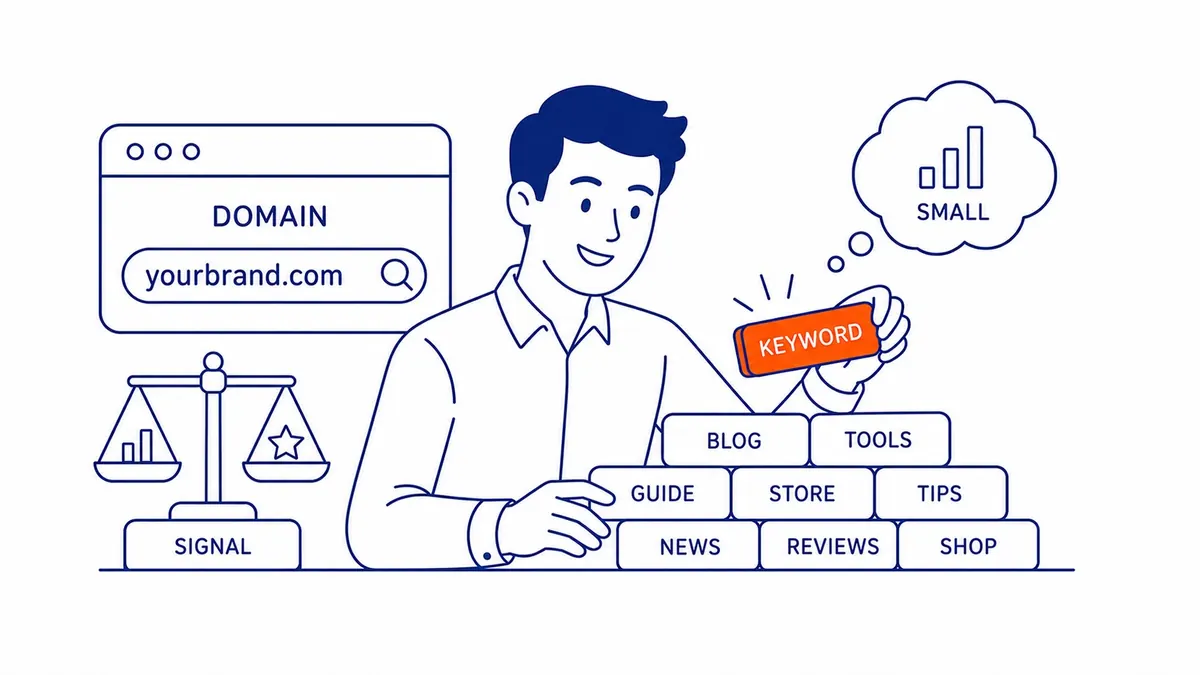
Keywords in Your Domain Name
Small signal now. That is the true size of it.
Exact Match Domains Then and Now
Partial match domains still carry a trace benefit. A site at “calgaryseoexperts.com” holds a marginal advantage for “Calgary SEO” queries over an otherwise identical site on a pure brand domain. Marginal is the right word. A tiebreaker, not a rankings multiplier. Google’s position, stated multiple times, is that exact match domains no longer carry the heavy lift they once did. The ranking factor is real but minor.
Hyphens and Special Characters
Worth more attention than most people give it.
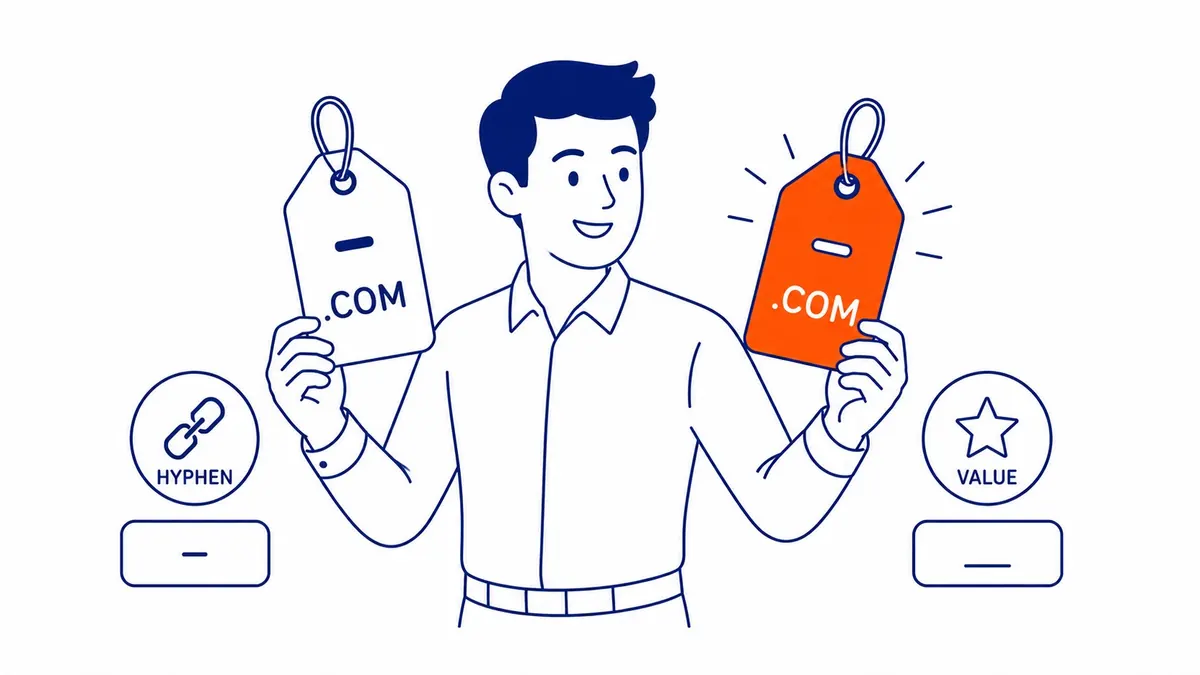
URL hyphens create user trust problems. URLs containing hyphens (“calgary-seo-services.com”) pattern-match with spam domains in users’ experience. Lower click-through rate from search results follows. Search engines have absorbed that behaviour pattern over time. Avoid hyphens in your domain name.
Special characters cause the same friction. Ampersands, underscores, and anything outside standard letters and numbers confuse users trying to type the URL from memory. Special characters also create friction in link sharing and backlinks. If someone cannot recite your domain clearly over the phone, it is working against your website too. Special characters in domain names are consistently associated with lower user experience and credibility signals.
Solid website keyword analysis belongs in your content strategy and internal link architecture. That is where it moves your site in practice.

TLD Choice: Does .com, .ca, or .net Change Your SEO?
Not equal in every context.
.com for General Use
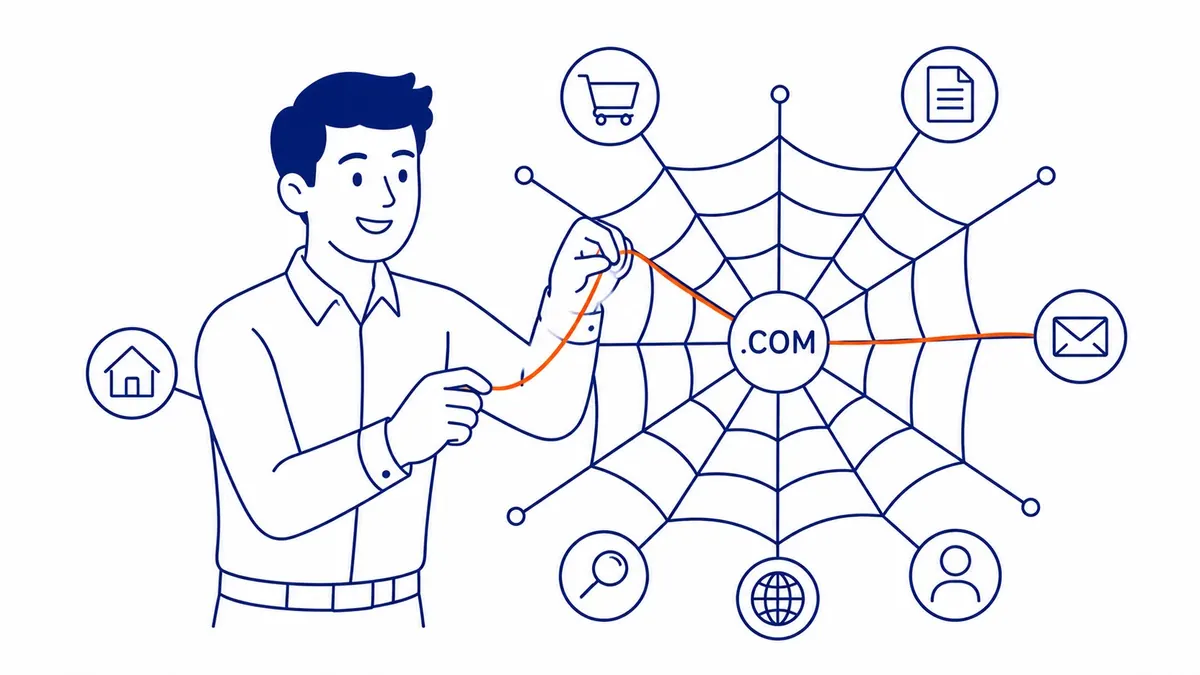
.com is the default. Search engines treat all generic top-level domains equally for ranking purposes. Users, however, click .com links more readily than any other extension. Higher click-through rate from search results feeds back into ranking signals. That indirect ranking case for .com is real.
.ca for Canadian Local SEO
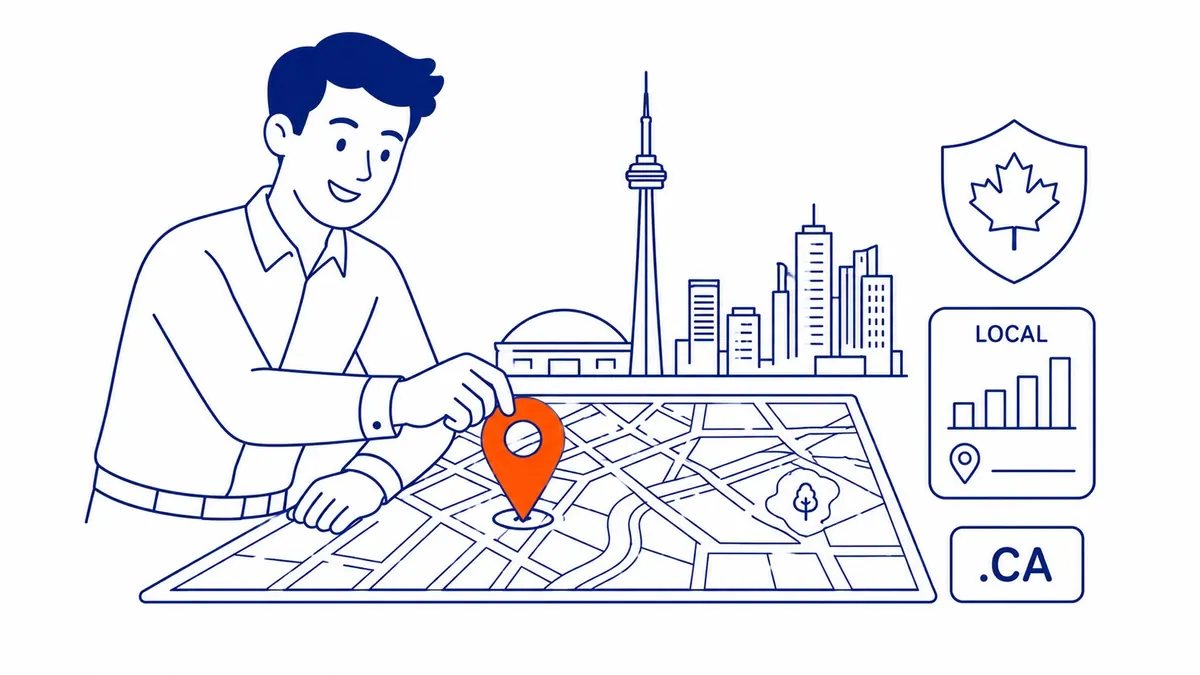
For Canadian businesses, .ca carries a specific local search advantage. Google uses the TLD as one of several geo-targeting signals to determine what country your site serves. A .ca domain earns a small edge in Canadian search results compared to a .com without strong geo-targeting settings in place. For most Calgary and Alberta businesses, .ca is the stronger choice. It also signals to Canadian users that your business operates locally, which affects click-through rate and user trust.
.com makes more sense if your website serves the United States market alongside Canada.
New Extensions and Generic TLDs
.net is a solid fallback when both .com and .ca are taken. .org signals non-profit and looks wrong for most service businesses. Newer extensions like .blog and .co carry no direct ranking penalty from Google. Generic TLDs receive equal treatment in Google’s ranking calculations. User recognition still strongly favours .com, however. A country-code TLD (ccTLD) is the right choice for businesses focused on a specific national market. For Canada, .ca is that ccTLD. Extension aside, the ranking impact of a URL comes mostly from what follows the domain. That trade-off is where com better for SEO actually lands for most Canadian businesses.
Domain Age: Ranking Factor or Background Signal?
Worth separating myth from the actual signal.
Older domains tend to outrank newer ones. That observation holds up broadly, though not because of the age number itself. What older domains carry is history: years of consistent crawling, accumulated backlinks, user behaviour data, and authority built over time. A site registered in 2007 with a steady backlink profile will typically outrank a site registered last month with thin link data.
Raw domain age as a direct ranking factor has been downplayed by Google explicitly. What search engines care about is what happened on the domain over those years. Parked domains earn almost nothing from their age. A two-year-old site with genuinely strong content and a real backlink profile can outrank much older competitors.
We have seen new domains reach page one within six to eight months when the content quality was meaningfully better than what was currently ranking. Domain age is one piece of the authority picture. Not a ceiling.
What Makes a Good Domain Name for Your SEO
Practical criteria.
Length and Memorability
Short domain names perform better across most metrics. Shorter means more memorable, fewer typos in shared links, and easier to recite clearly. Under 15 characters is a reasonable target for your domain name. Your brand name is the right anchor, not a keyword list.
Avoid in your domain name: hyphens, numbers that create spelling confusion, special characters, and strings long enough to trip anyone typing from memory. A good domain name is one someone can spell out over the phone without a follow-up question.
Brand Names vs. Keyword-Heavy Domains
The sites we have seen hold the strongest long-term SEO profiles almost never have keyword-stuffed domain names. They have brand names people search for directly. Branded search volume is a trust signal. When users search directly for a brand name, that tells search engines something qualitatively different from generic keyword traffic landing on your website from a thin domain.
A good domain name for your business is a long-horizon investment. It shapes your brand’s credibility with users and the authority signals your site projects over time. Build for year ten, not the next six months. Same logic applies to the verdict on hyphens, which comes down to readability more than ranking.
Changing Your Domain Name Without Losing SEO
Risky without the right setup.
Domain migration is the most disruptive SEO operation most businesses will ever go through. Done correctly, rankings recover within three to six months. Handled poorly, years of accumulated authority can be permanently lost.
The core requirement: 301 redirects from every URL on your old domain to the corresponding page on your new domain. Not 302 redirects. Each page needs its own 301. Search engines pass accumulated link equity through 301 redirects. Skip this step and your authority stays on the old domain.
Before any migration, run a complete site SEO audit. Map which pages on your website carry backlinks, which rank for target keywords, and which have internal linking worth preserving. A missed page in the redirect map means lost rankings you will not recover without rebuilding from scratch.
After the migration: update Google Search Console with your new domain property, resubmit your sitemap, update internal links throughout your new site, and contact major linking partners about updating their links. Traffic typically dips in the first few weeks. Recovery that stalls past three months usually means a broken redirect or an unresolved crawl issue.
For businesses that run organic SEO alongside paid campaigns through a Google Ads management company, a domain migration also requires updating all campaign destination URLs before the old domain stops resolving.
Frequently Asked Questions
Does your domain name matter for SEO?
Matters, though less than most people assume. Your domain name is a minor ranking factor, not a primary one. Keywords in the domain give a small signal. TLD choice affects geo-targeting and user trust. Domain age reflects accumulated authority. None of these individually outweigh content quality, backlinks, and site performance. Worth getting right at the start, however.
Do keywords in a domain name help SEO rankings?
Slightly. Exact match domains carried a much stronger effect before the 2012 algorithm update. Today, a partial keyword match in your domain name gives a marginal signal at best. The practical advice after 19 years of this work: build a brand name people will search for directly. Keyword research belongs in your content strategy and your site architecture, where it actually moves rankings.
How do I change my domain without losing SEO?
301 redirects from every old page to the matching new page are the core requirement. Beyond that: update Google Search Console, resubmit your sitemap, update all internal links on your new site, and reach out to major linking partners. Expect a traffic dip in the first few weeks. Plan for three to six months of monitoring before treating the migration as stable.
Does domain age affect SEO rankings?
Age itself is not the direct ranking factor. What matters is the authority and backlink profile accumulated over those years. An older domain typically outranks a newer one because of what was built on it. A parked or idle domain carries almost none of that advantage regardless of when it was registered.
Questions about your domain setup or a planned migration? SEO Company To-The-TOP! has been doing SEO services across Calgary since 2007. Take a look at the portfolio before reaching out. No quick wins promised. Nothing gets skipped.
Contact Calgary SEO Company To-The-TOP!
Questions about anything in this article, or about your own rankings? Talk to a Calgary SEO specialist directly.
Phone: (403) 308-5949
Address: 1509 14 Ave SW, Calgary, AB T3C 0W4
Hours:
Monday to Friday: 10:00 am – 7:00 pm
Saturday: 12:00 pm – 4:00 pm
Sunday: closed