
Is Google Ad Manager a DSP or an SSP?
It sits on the sell side. Google Ad Manager is a publisher’s ad server with an exchange built into it. So it works for whoever owns the space, never for whoever buys it. It is not a DSP. Google does sell a demand-side platform as well, under a different name and aimed at large advertisers. What Ad Manager does day to day already has a page here, so none of that gets repeated.
Something else about the question deserves a minute. Not one of those acronyms names a kind of software.

Neither Acronym Names a Kind of Software
Take the letters apart. Demand-side platform. Supply-side platform. The platform half is identical, so nothing is being distinguished there.
Every gram of the meaning sits in the first word. Then look at what those first words are. Demand and supply. Two halves of one market, lifted out of an economics textbook.
So the pair was never a taxonomy of products. Rather it is a supply and demand diagram with software bolted to each end. Same trap catches anybody arguing about Facebook advertising as pay per click.

A Side Is a Fact About Whose Money Moves
That leaves one question worth putting to any advertising product. Does it spend your money, or collect it?
Your Google Ads account spends. You put a budget in and it goes out over the month.
Ad Manager collects. Somebody hands over space on pages they own. Then money arrives from whoever won it.
One question sorts nearly every tool in this industry. No feature list required, and no acronym either.
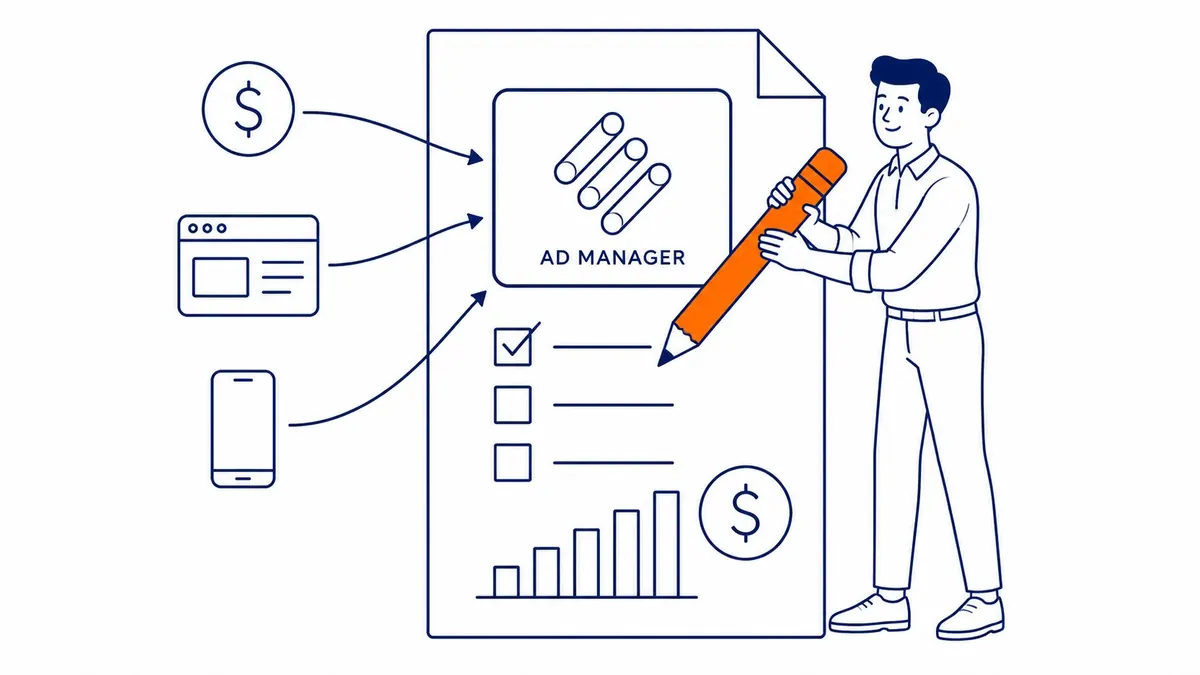
Google Ad Manager Sits Where the Money Arrives
Notice what that makes Ad Manager a tool for. Not advertising. Selling.
A publisher’s product is the space beside their content. They are running a shop, and the shelf is their own page. Ad Manager is the till, the price list and the queue at the counter.
An advertiser walks up to that counter from the other side. Whatever software they are holding, they hold it in order to spend.

Your Side Was Settled Before You Opened Anything
Here is where the question mostly dissolves. Nobody picks a side off a menu.
A plumber sells drain repair. So the plumber buys attention, permanently, for as long as the business exists. Nothing about that follows from a tool, and no subscription changes it.
Businesses do change sides, of course. Only that is a decision about what you sell. Never about which software you opened.
The whole supply-side half of this industry is infrastructure for one kind of company. Businesses whose product is the space on their own pages. A newspaper. An app somebody built. A hobby site carrying ads down the margin.
So a Calgary trades business asking that question has usually asked the wrong half of a real one. The useful version is shorter. Am I selling space, or buying attention?

Every Number in Advertising Has a Sign
Now the part nobody mentions. Which side you stand on decides what good means.
Take the price of a thousand impressions. High is a triumph for the publisher. Meanwhile high is a bill for the advertiser. Same number, same auction, same afternoon. Two people watching it move in opposite directions, both happy with their own reading.
A few numbers do read the same from both chairs. Load time, mostly. Nearly everything about money reads the other way. Every one of those figures carries a sign, and the sign comes from your side of the table rather than the number.
So somebody moving from buying to selling has to turn every instinct around. They spent years wanting the price down. Now the price going up is the job.
So the question underneath a DSP or SSP is really about direction. Which way do I read the numbers on this screen?

Somebody Will Point at Google Standing on Both Sides
Fair enough. The same company does sell into both ends of this market. That looks like it should make the labels useless.
Only watch which way it cuts. A product name tells you the vendor. The acronym tells you the role. That role is then the only thing left separating one vendor’s products at all.
So the labels get more useful there. Never less.

Why Nobody Remembers Which Acronym Is Which
None of the confusion is the reader’s fault. Look at the two naming systems side by side.
The acronyms are pure direction. Demand. Supply. Nothing else in them.
Then the product names carry no direction whatever. Nothing in the words Google Ad Manager says selling. The other name says nothing about buying either. Both read like something a marketing department would use, since both are.
So people arrive holding one name that says nothing about sides. Then an acronym that says nothing else.

Where the Google Ad Manager Argument Stops
None of this touches your rankings or your traffic. No acronym in advertising has ever moved a search result, and the SEO work goes on exactly as it did.
The edges are genuinely blurry, too. Practitioners argue about whether Ad Manager counts as an SSP or as an ad server with an exchange inside it. That argument is about where one product’s boundaries fall. It has never been about which side of the table the product sits on.
You can also stand on both sides at once. Sell ad space on your own website while buying search ads and you are both. Two hats, two logins. The buying hat comes with fiddly rules, right down to the ad character limit.

Put One Question to Any Ad Product
Try it on whatever somebody has recommended to you. Ignore the acronym. Find the money instead, then work out which way it travels.
Should the money leave you, the product is on the demand side, built to help you spend well. That is your half of the industry, and Ad Manager is not in it.
Should the money arrive, you are a publisher, whatever else you also happen to be. Then an SSP is worth learning about, since that is where your revenue gets priced.
No statistic about other companies settles which of those you are. Yours is one question away.

Google Ad Manager and Calgary Businesses
Businesses across Calgary rarely need any of this. They sell a service. So they buy attention. A Google Ads campaign is the tool that fits. Meanwhile Ad Manager sits in a part of the market they never enter.
An agency proposal thick with acronyms turns up often enough at SEO Company To-The-TOP!. Mostly the acronym describes a business the client is not in. What pays instead is keyword research, then search engine optimization.
To-The-TOP! has been doing SEO in Calgary since 2007. No guarantees. Positions move over three to six months, and the portfolio shows the keywords this work has reached.
Common Questions About Google Ad Manager, DSPs and SSPs
Is Google Ad Manager a DSP?
No. A DSP buys advertising space on behalf of advertisers, and Ad Manager does the opposite job. It manages and sells the space a publisher owns. Google sells a demand-side platform separately, under another name, aimed at large advertisers rather than local businesses.
Is Google Ad Manager an SSP or an ad server?
It behaves as both, which is why the answer varies depending on who you ask. Ad Manager grew out of an ad server and carries an exchange inside it. What nobody disagrees about is the side. Every part of it works for whoever owns the space.
Do I need Google Ad Manager if I already run Google Ads?
Almost certainly not. The buying tool is the one you already have, and a service business needs nothing more. Ad Manager only becomes relevant once you have inventory of your own to sell, meaning pages carrying other companies’ advertising.
What is the difference between the demand side and the supply side?
Demand is the money looking for attention. Supply is the attention looking for money. Advertisers sit on one, served by a DSP. Publishers sit on the other, served by an SSP. Nearly every piece of software here was built to represent one of them at the auction.
Can a small business use a DSP?
Technically yes, though the economics rarely work. Demand-side platforms are built around budgets far above what a local business spends. Plenty of them carry minimums to match. A Google Ads campaign covers what a local business needs for a fraction of the trouble.
Contact Calgary SEO Company To-The-TOP!
Questions about anything in this article, or about your own rankings? Talk to a Calgary SEO specialist directly.
Phone: (403) 308-5949
Address: 1509 14 Ave SW, Calgary, AB T3C 0W4
Hours:
Monday to Friday: 10:00 am – 7:00 pm
Saturday: 12:00 pm – 4:00 pm
Sunday: closed