
What Are the Three Pillars of SEO? Content, Links, Technical
The three pillars of SEO are content, links and technical. That is the answer. Every version of the list names the same three, then tells you to keep all three strong.
Sound advice. This site already explains what each pillar covers, so the definitions are not repeated here. What almost nobody says out loud is stranger. The three are not three of a kind. Two of them are things you do. The third one is not.

The Answer, Before We Argue With It
Content is what your pages say. Technical is whether a machine can reach them and read them. Links are the other websites pointing at you.
Nothing on that list is wrong. And nothing is missing from it. A business working on all three beats a business working on one.
So keep the list. Just look harder at the third item. Keyword performance measurement tells you which of the three is actually short.

A Pillar List Is a List of Things You Do
Read the word again. A pillar holds weight. All three hold the same kind of weight, or the word is decoration.
And a list like that is normally a list of jobs. Areas you put hours into. Work that lands on a Tuesday, gets done, then comes off the list.
Content passes that test easily. You sit down. Then you write the page. Nobody else is involved.
Technical passes it too. A developer fixes whatever is broken. The page then loads, or it does not. Either way the job had a beginning and an end. You started it.

Nobody Has Ever Done a Link
Now put the same test to links.
You cannot do a link. A link gets made by somebody else. On a website you do not own. At a moment you do not pick.
You can go and make one yourself, obviously. A directory. Some profile page. Anybody can, in an afternoon, which is precisely why those links are worth about what they cost. The ones that count are the ones you were never able to make.
Everything you can genuinely perform sits one step back from them. So you write something worth citing. Or you email a stranger and ask. Both are real work, covered elsewhere.
Yet neither one is a link. They are attempts. The link itself happens, or fails to, in a room you were never standing in.

Somebody Put a Result on a List of Chores
That is the flaw in the model, and it hides in plain sight.
Two inputs and one outcome got written down together. Same list, same font. As though they were the same kind of thing.
Nobody puts revenue on a list of departments. Revenue is what the departments produce. Put it on the list anyway and watch the next meeting.
Links are the revenue line of that list. And the model hands it to you as a chore.

Why Links Is the Only Pillar With a Market
Ask people to perform an outcome and, sooner or later, somebody offers to sell them one.
Look at how each pillar gets sold. Technical work is priced by the hour. Writing is priced by the page. Both are prices for somebody’s time.
Links get sold by the unit. Fifty of them, delivered, for a flat fee. That is not a price for work. It is a price for a result, and no other pillar has ever needed one.
Whether buying them is wise is an argument settled on another page. The point here is narrower. That market exists because the list told everybody to do a thing nobody can do.
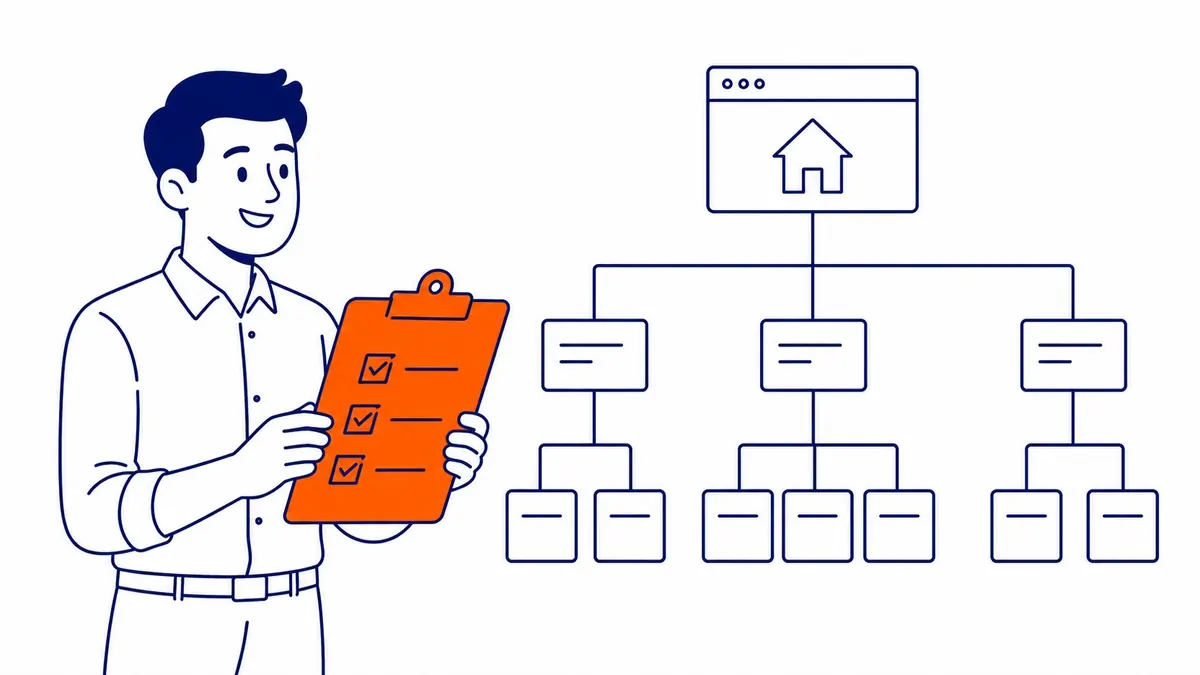
The Three Do Not Fail the Same Way
Watch how each one breaks. They break in three directions.
Technical fails at a gate. Block the crawler and no search engine ever reads your best writing. It is close to binary. Also silent, which is why a website audit exists.
Content fails by degree. The page still ranks. Just lower than it might have, and you can watch it happen.
Links fail by comparison. Your links did not get worse. Somebody else’s got better, and the gap opened while you were asleep. Nothing on your website changed.
One fails absolutely. Another fails gradually. The third fails against a target that moves on its own.
Read Your Own Report Like an Accountant Would
Open the last SEO report anybody sent you. Find the three sections. Then put one question to each. Does this row describe something a person did?
Two of them will. Somebody wrote four pages last month. A developer fixed the redirects.
The third row is different in kind. It reports a score. Eleven new referring domains, say. Or none, and nothing in that number tells you what anybody did all month.
None of which is a criticism of your agency. It is a fact about the row. Also the one row where a number can turn up with no work behind it you would recognize as work.

What You Can Actually Budget
Sort the list properly and the money sorts itself.
Technical spends down. Broadly it has an end, and after that it wants watching rather than funding.
Content never spends down. No last page exists. Keep adding for as long as the business stays open. That open-ended part is what search engine optimization is really asking of you.
Links get no budget line at all. Instead they get a forecast. You fund the thing that causes them. Then you wait, and you find out.
Anybody selling you a fixed number of links a month has quietly promised you other people’s decisions.

Where the Model Still Earns Its Keep
None of this makes the three pillars useless. Far from it.
The list names the right three areas. A beginner working across all three is well ahead of one polishing a single page all year. As a teaching tool it is close to perfect.
Trouble only starts when the list stops describing the work and starts issuing orders. Describe with it. Never plan with it.

How To-The-TOP! Splits the Work in Calgary
SEO Company To-The-TOP! has been doing this since 2007, and the split has barely moved. Technical gets fixed properly, then left alone. Content gets written every month, because that pillar genuinely never ends. Links get reported as what they are. An outcome. Some months bring several. Other months bring none, and saying so is part of the job.
A fair amount of the Calgary SEO work we pick up arrives from somebody promised a monthly link count. Nobody can promise that. What we will tell you instead is which of the three pillars your money went into last month, and what it bought. Need customers this quarter rather than next year? We will say so, then point you at Google Ads management, where the timeline runs in days. The portfolio shows the keywords where the patient version worked.
Common Questions About the Three Pillars of SEO
Is one pillar more important than the others?
Wrong question, slightly. Technical is mostly a prerequisite. Content is the thing being ranked. Links are evidence other people supplied about it. Ranking the three against each other is a category error.
Can a site rank on content alone?
In a quiet market, often yes. Plenty of small businesses rank on pages that simply answer the question. Competition changes that. The harder the keyword, the more the third pillar decides things you cannot decide.
Should I spend equally across all three?
No, and equal spending is usually a sign nobody looked. The three do not take the same kind of money. One terminates. Another runs forever. The third is not a spend at all.
Is technical SEO ever finished?
Mostly. A site gets settled once, then re-checked after a redesign or a migration. So the bill is a big one first, a small one after. Nothing like content, which has no last month.
What replaced the three-pillar model?
Nothing has, and nothing needs to. Use it as a description of where SEO work happens. Just stop reading the third pillar as an instruction, because it was never one.
Two of your three pillars are on your calendar this week. The third one is on somebody else’s, and they have not heard of you yet. Two of them land on a web development quote, and the third never does. Links come easier when the site holds strong page copy.
Contact Calgary SEO Company To-The-TOP!
Questions about anything in this article, or about your own rankings? Talk to a Calgary SEO specialist directly.
Phone: (403) 308-5949
Address: 1509 14 Ave SW, Calgary, AB T3C 0W4
Hours:
Monday to Friday: 10:00 am – 7:00 pm
Saturday: 12:00 pm – 4:00 pm
Sunday: closed