
How to Create a Link Wheel for SEO
A link wheel takes a weekend. Sometimes less than that.
Free publishing accounts, one short article on each, one link out to the next account in the line. Close the loop at the end. Point every property at the site you actually own. Finished by Sunday night.
The hard part arrives later. Sunday’s shape is the thing that gets the build noticed.
The Build Takes a Weekend

Here is the whole method, since that is what the question asks for.
Open five or six accounts on free publishing platforms. Blogger. Tumblr. Whatever still hands out a free subdomain. Write a short article on each one, loosely about your topic. Now chain them. Account one links to account two. Two links to three. The last account links back to the first, which closes the ring. Every account also links to your own site. That site is the money site.
Nothing has been held back there. Those instructions sit on hundreds of pages already. They have sat there for close to twenty years.
The Ring Is the Entire Trick

Peel the ring off and six throwaway blogs point at the money site. Nobody calls that a wheel. There would be nothing to name.
So the ring carries the promise. Authority lands on account one. Some flows to account two. Two passes a share to three. Round it travels, with every hop leaking a little into the money site. A closed circuit that recycles what would otherwise dribble away.
That is the pitch. The geometry is the product being sold.
What the Ring Was Invented to Beat

Link swaps were the currency of the early web. You link to me, I link back. Whole directories ran on the arrangement. Search engines caught on quickly, then began discounting pairs of sites that pointed at each other.
The workaround more or less wrote itself. Stop pointing back directly. Route the return trip through somebody else instead. A links to B. B links to C. C closes things off at A. No two of them form a matched pair. Then every link reads as one-way on paper.
That is where the wheel came from. It is a laundering pattern for reciprocity, drawn up in the mid-2000s. Read the old forum threads and the motive gets stated out loud.
That Filter Stopped Being the Filter

Reciprocal discounting was a rule about pairs. Crude, and simple to walk around, which is exactly what the wheel did.
Then link evaluation stopped being about pairs. Google began reading the neighbourhood around a link. Whether anything else ever links to that page. Which day the account appeared. What else that account has ever published. Which other properties share the same footprint.
A pattern that hides pairs does nothing about any of that. The wheel solved a problem that got replaced rather than removed. Technically it still solves it. A wheel really does avoid reciprocal pairs. Nobody has been grading on that for a long time.
Somebody Will Say to Randomize the Ring
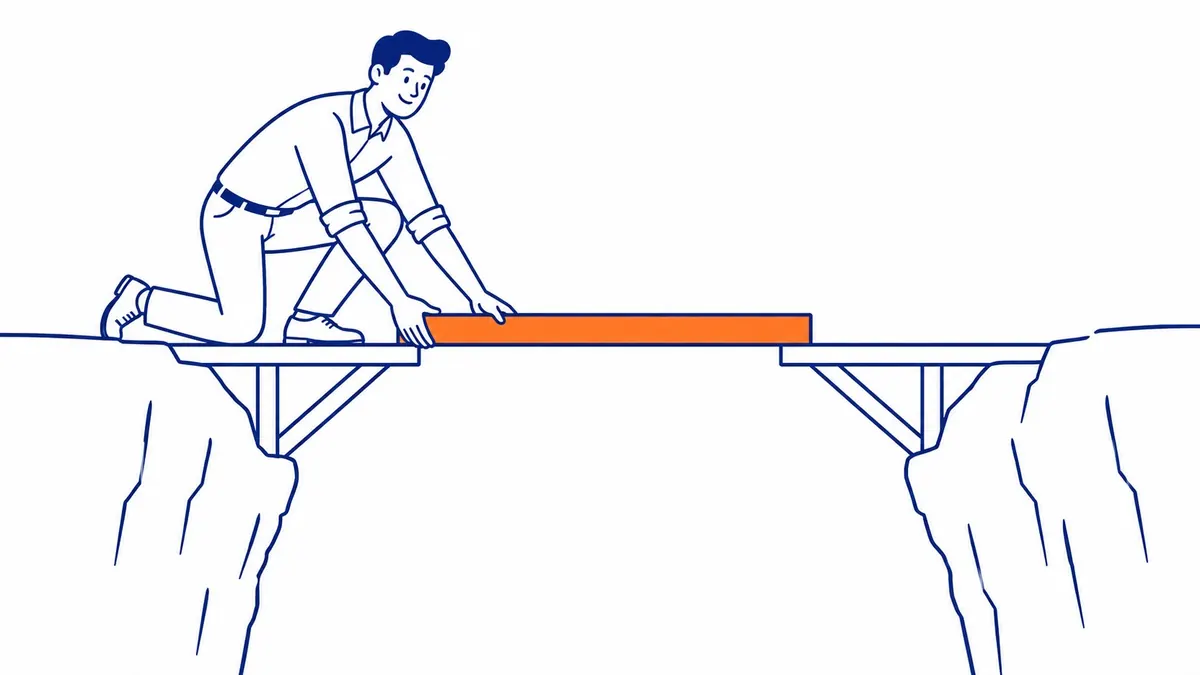
The objection turns up fast. Do not draw a clean circle. Skip a hop. Add a seventh property that only receives. Vary the anchors. Stagger the posting dates across a month. Make the graph look accidental.
Fair enough. Take it seriously for a moment, because it is the strongest thing anyone says in defence of the method.
Randomize thoroughly and the ring is gone. Not disguised. Gone. No circuit remains to recycle anything. A circuit has to close. Closing is the exact feature you just deleted in order to look natural.
So the objection lands. It lands on the wheel, though. Every step toward camouflage is a step away from the mechanism. Both cannot be true on the same Sunday.
Break the Circuit and Nothing Is Left

Picture the randomized version for a second.
Six free accounts. No pattern joining them up. Six short articles nobody requested and nobody reads. Each one carrying a link to your site.
Six self-made links, then. Identical to what you would have had by opening the accounts and skipping the wheel entirely. The shape was the only thing separating a link wheel from a pile of throwaway pages. Take the shape away. Then the pile is what remains.
Worth sitting with before the weekend gets spent.
The Anchor Text Problem
Every guide tells you to put the target keyword in each link. That instruction survives the randomizing. It also creates its own tell.
Six accounts you control. Half a dozen people deciding independently how to describe your business. Except they are not independent. So they agree.
Real backlinks never agree like that. A supplier writes your company name. Some forum poster writes “these guys”. Somebody else pastes the bare URL because that was faster. Disagreement is what an unplanned backlink profile looks like. Consistency across a handful of new accounts reads as one hand at one keyboard, which it was.
The Build Instructions Are the Detection Instructions
Anything published as a repeatable recipe is a recipe a search engine can read too. That is the awkward part of recommending this one.
A tell does not have to be inferred. It sits in the guide you followed.
Look at a fresh wheel from outside for a minute. Several brand new accounts. All registered in one sitting. Thin content circling one topic. Zero comments. No traffic worth measuring. Every account pointing at one commercial site that pays somebody’s mortgage. That description is short enough to write as a filter, which is roughly the trouble.
Nothing in a Wheel Tells You What Worked

Suppose you build one anyway. Rankings move a month later. Which piece did that?
You cannot say. Six properties went live in one weekend. So did all six links. Nothing separates them in time, which is the one thing that would let you attribute anything at all. Maybe the article you published that same week moved it. Or a competitor slipped.
So the wheel is built to be indistinguishable from itself. Not a small flaw either, yet people keep building them. Any tactic worth repeating has to tell you which part to repeat. A wheel refuses.
Try this instead of taking my word for it. Open Search Console. Count the referring pages you can name. Then count the ones you could deliberately go and get a second time. That second number decides whether you have a strategy.
The Version With Two Rings
There is always a bigger build on offer. A second wheel pointing at the first. Tier two, in the vocabulary.
That does not hide anything. It simply doubles the surface. Twelve accounts instead of six, all registered on a schedule you set, all resolving toward one address at the centre. Growth in the wrong direction.
Somebody Will Say Only the Wheel Gets Burned

Second objection, and a reasonable one. The wheel is disposable. Free accounts cost nothing. Lose them and rebuild.
True of the accounts. Not true of the site.
The money site is the single address every property in the wheel names. That is what makes it the money site. So the thing the pattern points at is never the thing you get to abandon. Google’s rule here is narrower than people assume. Links intended to manipulate rankings are the issue, whoever placed them. Your own domain is where intent gets attributed.
Disavow files exist for a reason. Filing one against links you built yourself makes for a strange afternoon.
The Properties Go Away on Their Own

Free platforms clean house. Thin content on one-post blogs with outbound commercial links is precisely what their spam teams remove. Sometimes within weeks.
So even the version that works carries a shelf life measured in months. Then the ring has holes. Soon it is not a ring at all.
A backlink on a site with actual readers behaves differently. It survives. Somebody would notice its absence, after all.
Where the Link Wheel Question Stops

The question was how to create a link wheel for SEO. The method sits above, written plainly. Pretending it is complicated helps nobody.
What the method cannot do is separate itself from its own footprint. Build the ring and the ring is legible. Break the ring for cover and the mechanism leaves with it. There is no third setting on the dial.
Which leaves the weekend free. Genuine link building runs slower. Duller, too. One page worth citing beats six pages nobody asked for. A supplier who lists your business. An association directory in your trade. Both of those outlive a platform purge.
Link Wheels and Calgary Businesses

Calgary contractors get some version of this pitch by email most months. A network of sites. Bulk SEO placements at a flat rate. Ranking movement within weeks. The wording shifts around. Its shape underneath rarely does.
SEO Company To-The-TOP! has worked on Calgary SEO since 2007, White Hat only. No wheel has ever been part of that. The tactic fails on its own terms well before ethics enter the room.
What replaces it looks unglamorous on a slide. A website audit that finds the pages already sitting close to page one. Proper keyword research so you stop competing for terms nobody in Alberta types. Then content on your own domain that another business might reasonably cite.
For a business that needs the phone ringing this quarter rather than next year, Google Ads management is the straight answer. Paid search buys attention immediately. Reporting inside Google Ads also shows which term produced the call. Underneath it, search engine optimization runs on its own slower clock. The two never compete for the same Sunday. Nineteen years of that approach sits in the SEO portfolio, ranked keywords and all.
Ask about it on (403) 308-5949 before anybody sells you a network.
Common Questions About Link Wheels
What is a link wheel in SEO?
A set of web properties linked in a closed ring, with every property also linking to one money site. The ring is the defining feature. Without it you have a handful of unrelated pages pointing at your website.
Do link wheels still work in 2026?
The mechanism targets reciprocal-link detection. That has not been the deciding factor in link evaluation for many years. Modern assessment looks at how accounts cluster and what they have published instead. A wheel gives up plenty of both.
Is a link wheel the same thing as a PBN?
Related, though not identical. A private blog network is defined by hidden common ownership, often on aged domains. The link wheel is defined by shape instead. You can build one without owning a single domain.
Will a link wheel get my site penalized?
Nobody outside Google can promise a ranking outcome either way. What is certain is where the risk sits. Every property in the ring names your site, so your domain is the address the pattern documents.
What should I build instead of a link wheel?
One citable page on your own site, then a reason for a real business to reference it. Suppliers and trade associations link to companies they deal with. Local media does too. Slower going. Those backlinks also stay put.
How do I clean up a link wheel I already built?
Delete the accounts you still control, since removal beats disavowal. For anything you cannot reach, list the domains in a disavow file. Then leave the site alone for a few months and watch what settles.
Contact Calgary SEO Company To-The-TOP!
Questions about anything in this article, or about your own rankings? Talk to a Calgary SEO specialist directly.
Phone: (403) 308-5949
Address: 1509 14 Ave SW, Calgary, AB T3C 0W4
Hours:
Monday to Friday: 10:00 am – 7:00 pm
Saturday: 12:00 pm – 4:00 pm
Sunday: closed