
Can You Use Keyword Insertion in Sitelink Extensions? Google Ads
We have seen this more than once. A client sets up sitelink extensions, types {Keyword:Default Text} into the link label. Saves it. The ad shows the literal placeholder. Not a search term.
That is not a bug. Keyword insertion does not work in sitelink extensions. Google built it that way deliberately.
Understanding this shapes how you structure an account. Google Ads campaign management requires knowing which fields accept dynamic tags and which render static text. Getting it wrong early wastes setup time.
The Short Answer
One rule. Every account, every campaign.
No, in short. Sitelink extensions do not support keyword insertion. The {Keyword:Default Text} syntax works in headlines and descriptions only. Your sitelinks render exactly as you wrote them. No token replacement happens at auction time.
Google does offer automatic dynamic sitelinks. They are separate from keyword insertion entirely. More on that below.

What Sitelink Extensions Do for Your Campaigns
Extra links. Specific pages.
Sitelink extensions appear below the main headline and URL. Up to four show on desktop. Fewer on mobile. Each one has a link label capped at 25 characters, with optional descriptions at 35 characters each. Users who click go directly to the linked page on your website, not to the main landing page.
Specificity is the value. A user searching for emergency plumbing and seeing a sitelink reading “Emergency Service” clicks through faster. Sending them to a homepage instead means hunting. CTR still improves when sitelink extensions match what users are already looking for.
Google decides when your sitelinks display. Ad rank factors in. So does device and query type. The link text itself never changes based on what a user typed.
Branded searches often pull more links into view. Higher ad position helps too. The text you write is still fixed regardless of how many appear. Sitelinks are only one of the ad extensions in Google Ads worth setting up properly. How many show is out of your hands, a quirk covered in callout extensions in Google Ads explained.

How Keyword Insertion Works in Google Ads
Headlines and descriptions. Sitelinks excluded.
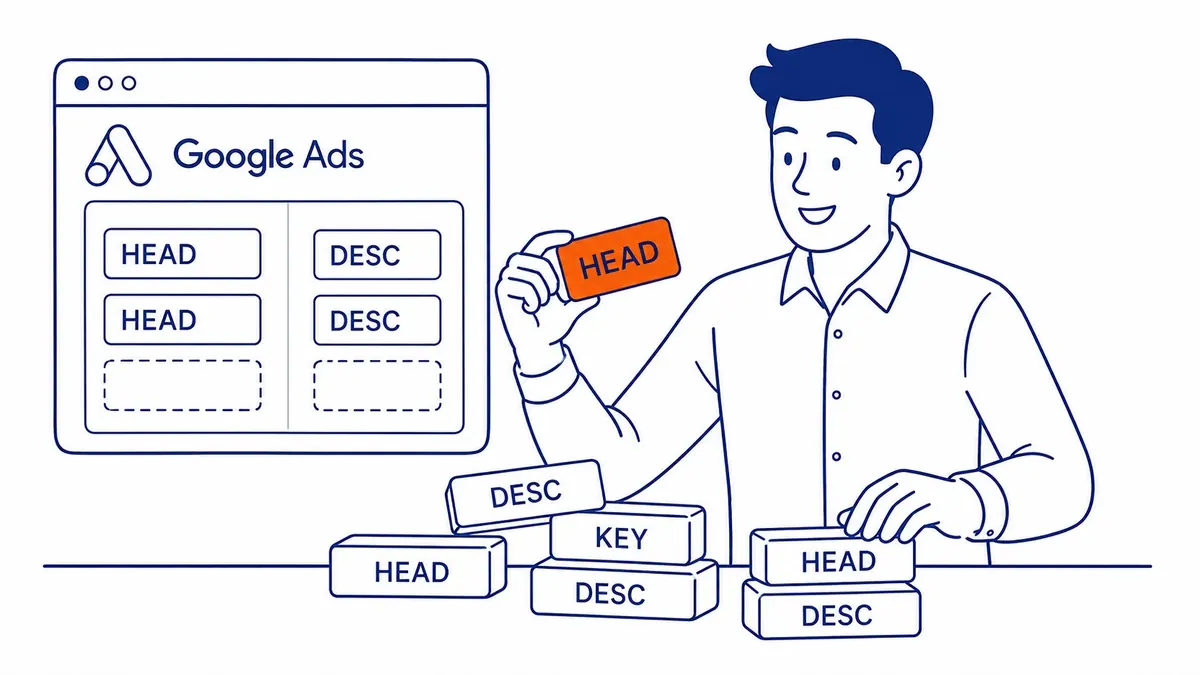
{Keyword:Default Text} is a dynamic tag. The platform replaces it at auction time with the keyword that triggered your ad. Character limits of the field still apply. Default text fills in when the keyword is too long to fit.
Advertisers use keyword insertion to mirror the exact search term in ad copy. Users also tend to click more often when the headline reflects their own query. The default text backs up the match when the keyword is too long.
Sitelink extensions sit outside this system. They pull from the text you wrote at setup. The platform does not run token replacement on sitelink fields. That limitation applies, however, whether your sitelinks are at campaign level or ad group level.
Why the Distinction Matters for Campaign Setup
Your sitelinks need deliberate writing. Not dynamic tags.
Advertisers expecting sitelink extensions to adapt dynamically write link labels that are too general. We have seen sitelink extensions labelled “Our Services” and “Contact Us” running across every campaign in an account. Static text still needs to be written for the searcher.
Ad group level sitelink extensions solve this. Write specific link labels for each tightly themed ad group. Ask any SEO company Calgary advertisers work with: an SEO campaign and a paid search campaign still need distinct link labels. Tailored labels consistently outperform generic ones.
Consider, also, what stage the user is at when they see your ad. Someone searching for pricing information needs different link labels than someone in research mode. Writing for intent, therefore, beats writing for a generic offer.
What to Use Instead
Two options actually support dynamic text.
RSAs support keyword insertion in headlines. Add {Keyword:Default Text} to one or two of the 15 headline slots. The system tests combinations and serves the best-performing mix across users over time.
Ad customizers go further. A data feed you upload can swap product names and prices across your ads at auction time. Common with e-commerce advertisers running large product catalogs.
Dynamic sitelinks exist outside your control. These generate automatically from your site content and ad data. You cannot write or edit the text on dynamic sitelinks. They appear based on relevance signals. Higher-performing accounts also see them more often.
For sitelink extensions you write yourself: intent-matched link labels outperform generic ones. Look at what users are asking after reading your headline. “What’s Included.” “How Pricing Works.” “Client Results.” Those labels still convert better than filler. Campaigns promoting the local SEO services Calgary businesses search for benefit especially from links built around the next question a searcher actually has.

Frequently Asked Questions
What can a sitelink ad extension provide?
Direct links to specific pages below your main ad. Up to four on desktop. Each entry has a label and optional descriptions. Users who click go to the linked page, not the main landing URL. CTR on branded searches and high-intent queries typically improves when sitelink extensions are present.
How to use keyword insertion in Google Ads?
Add {Keyword:Default Text} to a headline or description in a responsive search ad or text ad. Google Ads replaces the tag at auction time with the triggering keyword. Default text shows when the keyword is too long. Character limits apply to the rendered text. Sitelink extensions do not support this tag.
Is $20 a day good for Google Ads?
Depends on keyword cost. Competitive service terms in Calgary run $8-25 per click. At that cost, $20 a day covers two clicks on some searches. On lower-competition terms, $20 goes further. Good competitor keyword research matters more than budget when spend is limited.
Are Google Ads no longer running on keywords?
Still keyword-driven at its core. Broad match and Performance Max campaigns do expand targeting beyond exact lists. The underlying auction is still keyword-based, however. Exact match and phrase match still work. Google Ads management still centres on keyword strategy. Matching mechanics changed. The role of keywords did not.
Contact Calgary SEO Company To-The-TOP!
Questions about anything in this article, or about your own rankings? Talk to a Calgary SEO specialist directly.
Phone: (403) 308-5949
Address: 1509 14 Ave SW, Calgary, AB T3C 0W4
Hours:
Monday to Friday: 10:00 am – 7:00 pm
Saturday: 12:00 pm – 4:00 pm
Sunday: closed