How to Become an SEO Specialist
People ask me how to become an SEO specialist more often than they ask almost anything else about the work. Usually it is someone three years into a marketing job, a little bored, who has noticed that the person handling search seems to have steady demand and real influence. So here is the plain version, from someone who has done this since 2007 rather than a career-guide summary written by committee.
I run SEO Company To-The-TOP! out of Calgary, solo, which means I am the specialist, the strategist, and the person who explains a ranking drop to a worried client on a Friday afternoon. That shapes how I see the role. An SEO specialist is not a job title you unlock. It is a set of skills you can prove, applied to a website, that move it up in search.

What an SEO Specialist Actually Does All Day
Forget the brochure description for a second. The day-to-day is less glamorous and more interesting than people expect.

Most of it is diagnosis. A website is not ranking, and your job is working out why. Maybe the pages load slowly. Perhaps nobody mapped the content to what people actually search. Often the technical setup quietly blocks Google from reading half the site. You pull data, form a theory, test it, and watch what the search results do over the following weeks.
The rest splits between building and reporting. Building means keyword research, content briefs, on-page fixes, and the slow accumulation of links and authority. Reporting means showing an owner what moved on their website and what it earned. An SEO expert who cannot connect their work to traffic and revenue does not keep clients long. I learned that early.
One thing worth saying plainly: this is a patient profession. Three to six months before meaningful movement in a competitive market. That is the realistic timeline, and a specialist who promises faster is selling something.
The Skills You Need to Become an SEO Specialist
There is no single qualification that makes you an SEO specialist. You build a stack of skills instead, layer by layer. Here is the stack that actually matters, in the rough order I would learn it.
Technical health comes first. You do not need to code like a developer, but you do need to read a site the way search engines do. Crawling. Indexing. Site speed. Mobile rendering. Structured data. If you want a grounding here, technical SEO is its own discipline and worth studying on its own. A page that cannot be crawled will not rank, no matter how good the writing is.
At the centre sit keyword competitive analysis and the content built on it. This is where most of the value lives. Knowing the keywords your audience types, how much demand sits behind each phrase, and which keywords you can realistically compete for. Then turning that into content that answers the intent fully. Strong research here is the difference between writing pages people want and writing pages nobody searches for. Skip it and the best writing in the world ranks for nothing.
Analytics is the third leg. Google Analytics, Search Console, and whatever rank tracker you settle on. The job is reading data without lying to yourself about it. A specialist who cannot tell whether traffic went up because of their work or because of seasonality is guessing. Clients pay for the difference.
SEO rarely sits alone, either. It lives inside digital marketing, next to content marketing, paid media, social media, and email marketing. You do not have to master all of them. Knowing how SEO specialists hand work off to those channels, and borrow attention back from them, makes you more useful and widens the kind of SEO specialist job you can take. Search engines reward sites that earn traffic across digital channels, not only in organic search.
A few softer skills carry more weight than the job ads admit. Writing clearly, because most of this work is explaining trade-offs to people who do not live in search. Patience, because results lag effort by months. And a stubborn curiosity about why one page wins where another does not. That last trait separates an SEO expert from someone who memorised a checklist.

Do You Need a Degree or Certification?
No. I will say it flatly because the career guides hedge, and the hedging wastes your time.
Not once have I been asked for a degree by a client. Nobody checks. What they check is whether their website ranks and whether their phone rings. A business or marketing degree helps you think, and it does not hurt. It is not the gate.
Certifications tell a similar story. The Google certifications, the analytics badges, the various course completions: useful for learning, weak as proof. A certificate says you sat through material. Ranked results say you can do the work. One of those is worth far more, and it is not the certificate.
Starting cold, your fastest education is structured self-teaching plus a real site to practise on. You can learn SEO from free and paid material that is genuinely excellent now, far better than what existed when I started. The catch is that reading about search engine optimization teaches you almost nothing until you apply it to something live.

A Realistic Path Into Your First SEO Job
Here is the route I would take starting today, stripped of the motivational filler.
Build a site of your own first. A blog, a small local business idea, anything with real pages and a real goal. Practise the whole loop on it: research, write, fix the technical issues, watch the rankings, adjust. You will learn more from one website you own than from ten courses, because the feedback is candid and the mistakes are yours. Running that whole loop end to end is the fastest education there is, which is exactly what a walkthrough of how to do SEO lays out step by step.
Get a second site as proof. Offer to help a friend’s shop or a local nonprofit for free or cheap. Now you have a portfolio, which matters more than any line on a resume. Two sites you moved up in search beats a stack of certificates every time.
Then decide your direction. Some SEO specialists go in-house at one company. Others join an agency and learn fast across many clients. A few go independent, which is harder and slower but answers to nobody. There is no wrong door, though the agency path teaches volume and the in-house path teaches depth. Going independent teaches everything at once, usually the hard way.
When you apply, lead with results, not vocabulary. Anybody can list on-page optimization on a resume. The candidate who says “I grew this site from 200 to 4,000 monthly visitors in eight months, here is the report” gets the interview. Specifics win because they are hard to fake. Your first months as an SEO specialist will feel slow, then the work compounds.
SEO Specialist Salary and Career Outlook
Money is a fair question, so here are real numbers rather than ranges copied from a salary site.
In Canada, an SEO specialist early in their career tends to land in the high-five-figure range, with the salary climbing as you prove results. Senior specialists and those who own strategy push higher. The independents and consultants who build a reputation can clear well past any salaried role, though that income comes with the usual feast-and-famine of running your own shop. On the other side of the table, owners wondering what that expertise costs to hire will find what SEO costs is its own conversation.
Career outlook is steadier than the “SEO is dead” headlines suggest. Search is not shrinking. Every business that wants to be found still needs someone who understands how being found works. Demand for that skill has held remarkably constant across the nineteen years I have watched it. Tooling changes constantly. The underlying job does not.
What does move is where the work sits. Digital marketing has folded SEO in alongside paid media, content marketing, and analytics, so a digital marketing specialist who understands the wider picture has more doors open. Some of my own work crosses into paid search. If you are reading this as a business owner rather than a future specialist, you can have us manage your Google Ads instead, since matching the right keywords to the right intent controls cost there too. The broader your range, the more durable your career.
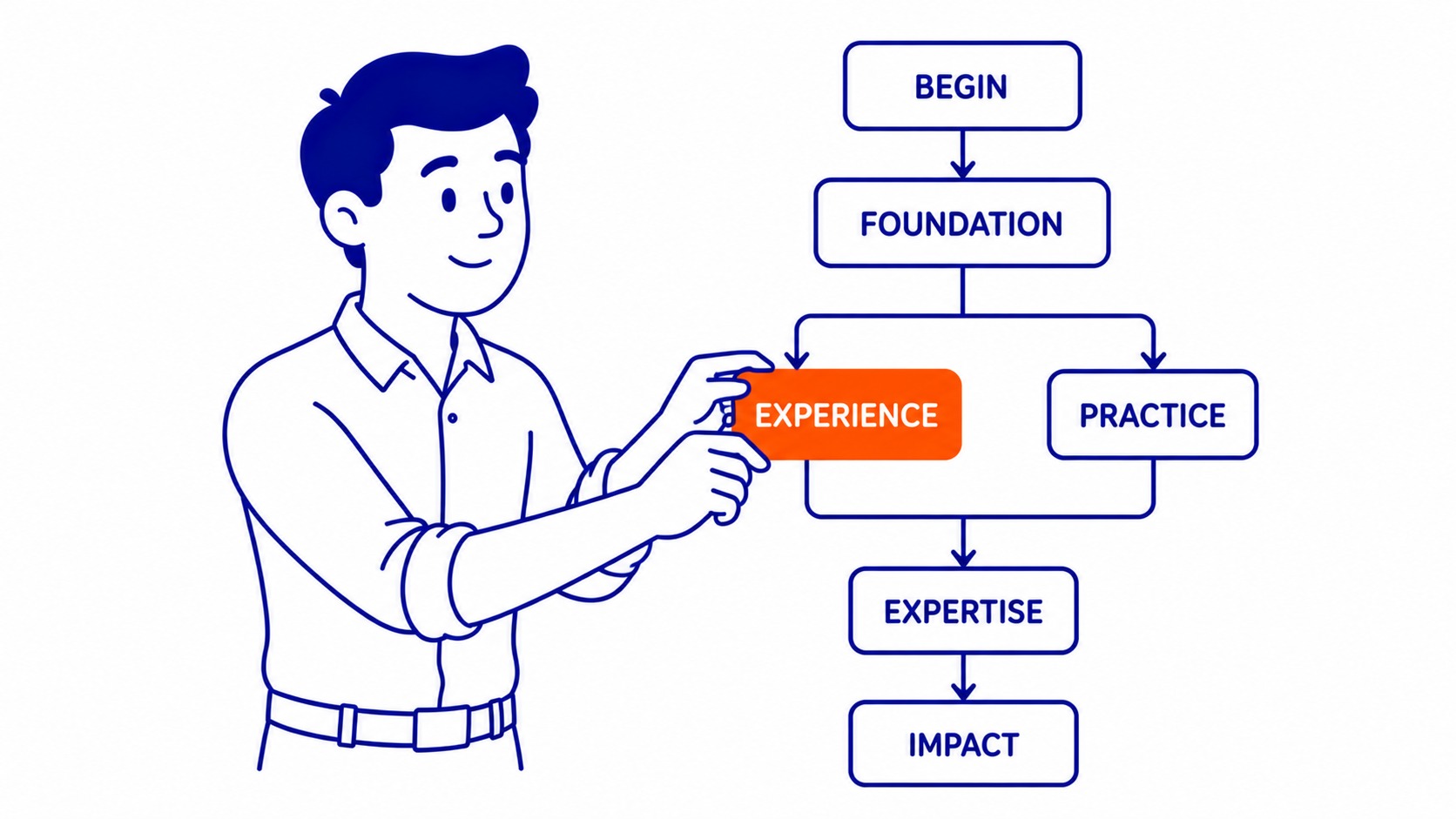
Specialist or Expert? Where Real Experience Counts
People use specialist and expert loosely, and the difference is mostly time. A specialist knows the methods. As an SEO expert, you have watched those methods succeed and fail across dozens of sites and developed judgment about which to reach for. You get there by doing, not by reading.
That judgment is the part you cannot shortcut. It is knowing that a particular industry rewards depth over backlinks, or that a certain ranking drop is a Google update rather than something you broke. I did not have that in 2007. Now I have it, earned by sitting through the mistakes. There is no course for it, and that is the true gap between knowing the steps and becoming an SEO expert.
Want to see experience applied to a real market? The way To-The-TOP!, a one-specialist shop, handles SEO for local Calgary businesses is a decent model: pick the right terms, build pages that earn their rankings, report plainly, repeat for years. Unglamorous, and it works. The same approach scales whether you go in-house, agency, or independent. For anyone weighing whether to hire that out versus learn it, the SEO work we do for clients answers a different question than this guide does. If you do decide to hire, knowing how to choose the right SEO company saves more money than any salary comparison.
The short version of the whole path: learn the craft, prove it on real sites, stay curious, and let results do your talking. Your title follows the work, never the other way around.
Frequently Asked Questions
What do you need to be an SEO specialist?
Skills, not credentials. A working grasp of technical health, keyword research, content, and analytics, plus a real website or two where you have applied them. Employers and clients care whether you can move a site up in search. They almost never ask how you learned it.
What qualifications do you need for SEO?
None that are mandatory. No licence, no required degree, no gatekeeping exam. Certifications from Google and analytics platforms help you learn and look fine on a profile, though a portfolio of sites you have ranked carries far more weight. Proof beats paperwork in this field.
Is SEO being replaced by AI?
No, though it is changing under the pressure. Search engines and AI assistants still pull their answers from ranked, well-structured pages, so the underlying work of earning that ranking matters more, not less. The specialists who adapt to how AI reads content will do fine. If you want the longer argument, whether SEO is dead is a question I have answered in detail. Short version: the job evolves, it does not vanish.
How long until I can call myself an SEO specialist?
Sooner than you think for the title, longer than you hope for the judgment. You can do competent specialist work within six months of focused practice on real sites. Becoming the kind of expert clients trust with money takes years of watching what actually moves traffic. Start now, stay patient, and keep a site live to learn on the whole way through.
Contact SEO Company To-The-TOP! in Calgary
Questions about anything in this article, or about your own rankings? Talk to a Calgary SEO specialist directly.
Phone: (403) 308-5949
Address: 1509 14 Ave SW, Calgary, AB T3C 0W4
Hours:
Monday to Friday: 10:00 am – 7:00 pm
Saturday: 12:00 pm – 4:00 pm
Sunday: closed
