How to Calculate Your PPC Budget
Most businesses we talk to pick their PPC budget the same way. A round number that feels manageable. Five hundred dollars a month. Sometimes a thousand. No math behind it.
That approach falls apart at the first month of thin data. The result is usually an underfunded campaign or money spent with no clear benchmark for success. Here is how to build from actual numbers instead.

Start With the Outcome, Not the Spend
Wrong frame from the start.
Most guides open with how much you can afford to spend. That is backwards. Start with the result you need. Leads per month. A monthly revenue target. The budget is what it costs to get there. Running the calculation the other way turns PPC into a spending exercise instead of a buying one.
Starting with a fixed number and hoping it produces enough leads is a gamble. The math can tell you ahead of time whether that number makes sense for the conversion volume you need.
We have provided Calgary Google Ads management since 2007. Budget conversations almost always start with a number someone made up. Rarely with a conversion target. Work backward from realistic Google Ads revenue and the budget answers itself.
The Core PPC Budget Formula
Three inputs. That is the whole calculation.
Monthly budget = clicks needed × average CPC
Clicks needed = leads needed ÷ conversion rate
Work through it. Say you need 30 leads a month. Landing page converts at 4%. Keywords averaging $4.50 per click.
$4.50 ÷ 0.04 = $112.50 per lead
30 leads × $112.50 = $3,375 per month
That is what it costs to hit your goal. Not what you feel like spending. Still shaky on the meaning of PPC and where the money actually goes? Budget is one half of it; calculating PPC ROI on the other end tells you whether the spend earned anything.

Estimating Your Average CPC
You should have your keywords researched first. Always.
You need a realistic CPC estimate before the formula makes sense. Google Keyword Planner gives cost ranges for most terms. The high end of each range is usually closer to real-world performance in competitive markets.
Industry matters. Legal CPCs run high. Finance too. Home services typically see $8 to $15 per click. Calgary’s local service market often runs $3 to $8. Knowing your industry floor still keeps the formula grounded.
No account history yet? Keyword research is the starting point. Google Keyword Planner gives rough CPC ranges. Treat the estimates as ballpark figures, not exact. CPCs at launch often run higher than estimates until Quality Score builds. Our keyword research work starts here, pulling actual cost data for the exact terms you plan to bid on. That alone can change the budget calculation before a dollar is spent.
ROAS-Based Budgeting
Different math. Same logic underneath.
Businesses selling products use ROAS (return on ad spend) instead of a lead target. The formula works from revenue.
Say the target is $20,000 in monthly revenue. Target ROAS is 4 to 1.
$20,000 ÷ 4 = $5,000 monthly ad spend needed.
ROAS targets depend on margin, however. A 50% margin product can run at 2 to 1 and stay profitable. Products at 20% margin need 5 to 1 or better just to break even. Know your margin before setting a target.
New campaigns have no history, though. Use 2 to 1 as a conservative starting point. Revisit after 90 days of real data.
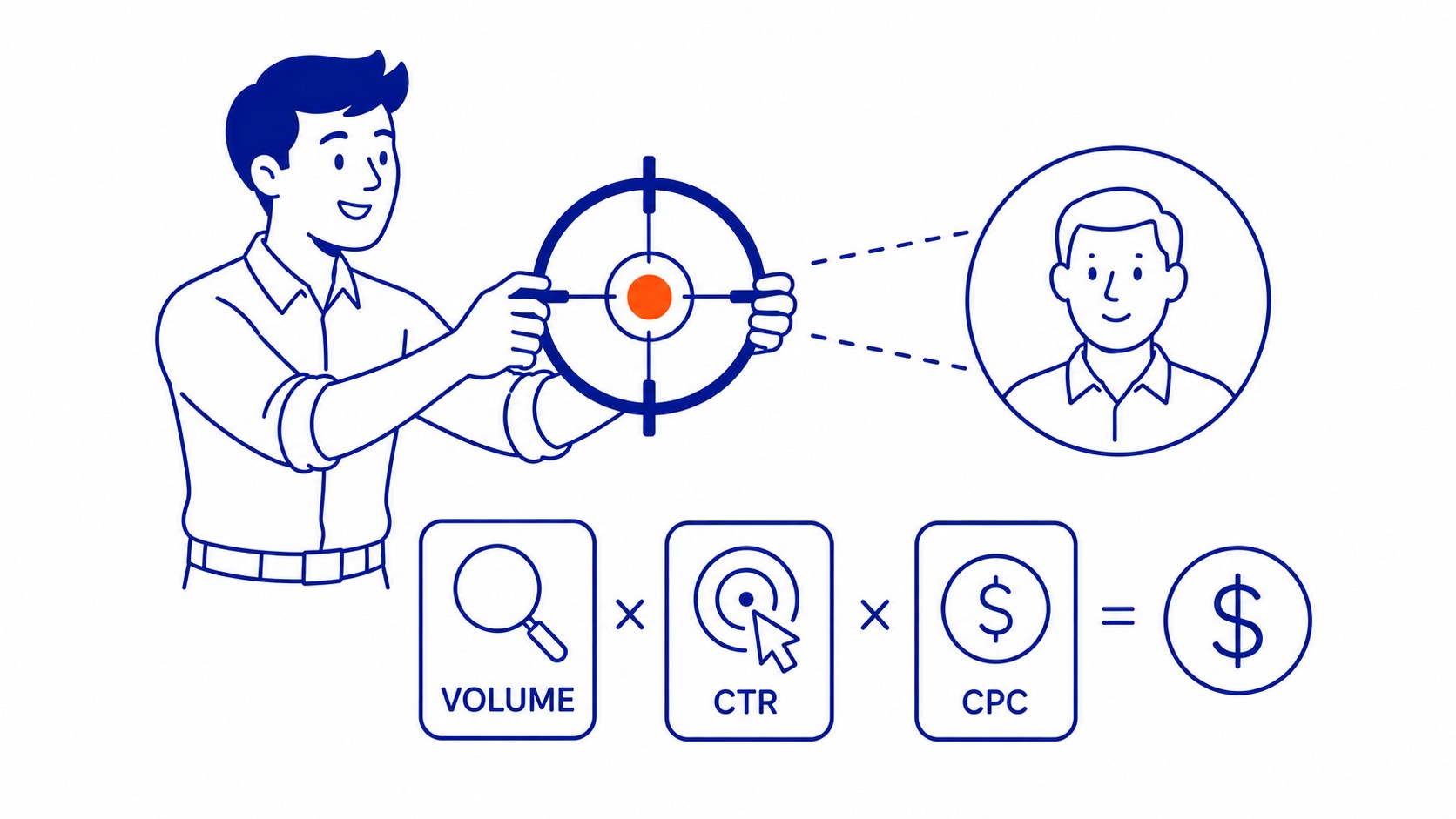
CPA-Based Budgeting
What does landing one customer actually cost?
CPA (cost per acquisition) works like cost per lead, with customer value factored in. A customer worth $600 to the business can still be profitably acquired at $120. Spending $500 to acquire the same customer does not pencil out.
Budget = target CPA × conversions needed per month
Say you need 20 customers a month. Target CPA is $120.
$120 × 20 = $2,400 per month
That is the ceiling for ad spend. CPA below it means the campaign is profitable. Above it means something needs work. Usually the budget. Sometimes the keywords. The landing page, too. Most accounts above target CPA have one of two problems. Bids on terms that are too broad. Or traffic landing on a page that does not match the ad. Both are still fixable.
Accounting for Seasonality
Most campaigns are not flat year-round.
A landscaping company runs hot from April through September. Retailers peak in November. Budgets should follow demand. Not sit at a fixed year-round average. Pull 12 months of search volume data for your target keywords before setting monthly caps. Slow months run leaner. High months need more fuel.
Quarterly budget reviews are worth scheduling. Competitive pressure shifts with the season. Some advertisers pull back in slow periods. Your CPC can drop temporarily when they do.

When to Raise or Cut Your PPC Budget
Data drives this. Not feelings.
Three signals say raise the budget. Conversion rate is strong. Enquiries are converting to sales. The campaign hits its daily cap regularly. Different signals say cut it. Cost per lead is above target CPA. Lead quality is dropping. Wasted spend is climbing.
Irrelevant traffic is the most common budget drain we see in accounts. Search terms that look related but never convert. A roofing company bidding on “roofing jobs” instead of “roofing contractors Calgary” pulls in job seekers rather than homeowners. Negative keywords still clean that up fast.
Pairing PPC with an SEO campaign from To-The-TOP! often reveals which keywords deserve the most organic effort too. The PPC data also tells you what actually converts. Not just what drives impressions.

Frequently Asked Questions
What is the formula for PPC budget?
Monthly budget = clicks needed × average CPC. Clicks needed = leads wanted ÷ landing page conversion rate. Run the math against your specific targets before committing to a number.
How do you calculate PPC?
Start with your landing page conversion rate and average cost per click. Divide cost per click by that rate to get cost per lead. Multiply by leads needed to get the monthly budget. Google Keyword Planner gives starting cost estimates when account history is zero. Six months of real data? Use your actual average cost per click instead. Real data still beats projections every time.
What is the 70/20/10 rule for marketing budget?
A budget allocation model. Proven channels claim around 70 percent of total spend. Channels showing early results get roughly 20 percent. The remaining 10 percent goes to experiments. PPC advertising typically sits in the 70 percent bucket for businesses where Google Ads campaign management is already delivering reliable conversions. Not a hard rule. A starting point for dividing ad spend across multiple channels.
What is PPC and how to calculate PPC?
PPC stands for pay-per-click. Advertisers pay when someone clicks the ad, not when it displays. Budget = (daily traffic target) × (average cost per click) × (days in the month). Or work backwards from a lead target using the formula above.
Contact Calgary SEO Company To-The-TOP!
Questions about anything in this article, or about your own rankings? Talk to a Calgary SEO specialist directly.
Phone: (403) 308-5949
Address: 1509 14 Ave SW, Calgary, AB T3C 0W4
Hours:
Monday to Friday: 10:00 am – 7:00 pm
Saturday: 12:00 pm – 4:00 pm
Sunday: closed
