
What Is PPC Campaign Management? What the Work Includes and How Often
PPC campaign management is the ongoing work of running pay-per-click advertising after the campaigns are built, so that the money spent on clicks keeps turning into calls, leads or sales at a cost the business can live with. In practice it covers seven jobs: keeping conversion tracking accurate, reviewing keywords and the searches that trigger your ads, adding negative keywords, adjusting bids and budgets, testing ads, refining targeting and landing pages, and reporting on cost per result. Setup is largely a one-off project, but management continues for as long as the ads run. Most of it happens in Google Ads, which is the focus here; Microsoft Advertising works much the same way, while paid social adds its own creative and audience work.

Setup and management are two different jobs
Building a campaign means choosing keywords, writing the first ads, setting a budget and a bid strategy, picking locations and connecting conversion tracking. That work is front-loaded and largely done once. Management starts the day the ads go live, because the moment real money meets real searches, the account starts producing evidence about what works, and that evidence has to be read and acted on.
Accounts drift for reasons the advertiser does not control. The searches people type change with the seasons, competitors enter and leave auctions, and Google changes the platform itself. Within recent memory, Google retired Enhanced CPC for Search and Display campaigns in the week of March 31, 2025, stopped the creation of new call ads in February 2026 with existing ones due to stop serving in February 2027, and announced that DSA campaigns, the ad type that builds its headlines from your website content, will be upgraded to AI Max starting in February 2027. An account that nobody watches keeps running on settings that may no longer exist in the form it was built for.
There is also the account’s own advice. Google Ads can apply some of its recommendations automatically once that option is switched on, and its help page notes that you can review upcoming changes in a queue and see past ones on a “History” tab. Part of managing an account is checking that tab and deciding which of those changes actually suit the business, because a recommendation that raises reach is not always one that lowers cost per lead.
What PPC campaign management includes
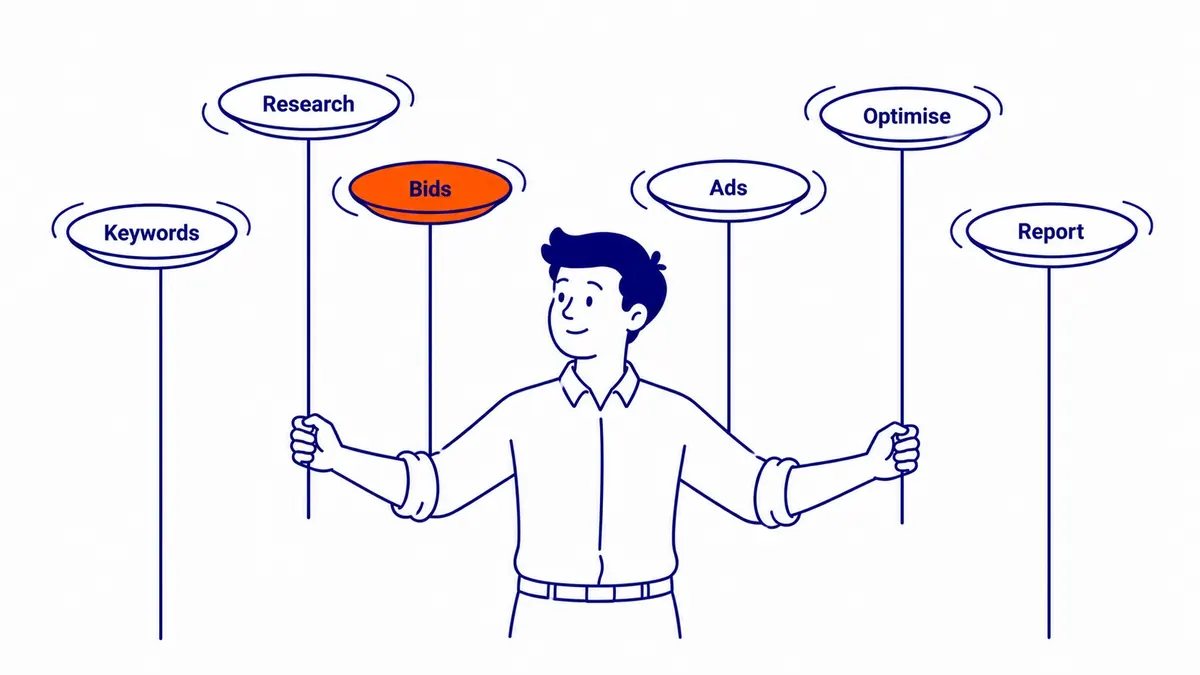
The work breaks down into seven parts. They overlap, and a change in one usually shows up in another, which is why they are best handled by the same person on a regular schedule.
Conversion tracking comes first
Every other decision depends on knowing which clicks became customers. If a form submission is counted twice, if phone calls are not counted at all, or if a “thank you” page view fires for people who never filled in the form, the account is optimizing toward the wrong signal, and automated bidding will happily spend more on traffic that only looks successful. A manager checks that conversion tracking is set up and tested before launch and then watches for actions that stop recording, which often happens quietly after a website update.
Keywords, search terms and negatives
Keyword research does not stop at launch: new services, seasonal demand and the search terms report itself keep suggesting keywords to add, and match types decide how far each one reaches. Keywords decide which auctions you enter, but the search terms report shows what people actually typed. Google describes that report as a list of terms “that a significant number of people have used”, and it omits searches with too little activity to protect privacy, so some spend can go to searches the report never shows. That makes regular reviews of the visible terms more important, not less. Terms that convert can be added as keywords, and terms that never could (job seekers, do-it-yourself searches, a product you do not sell) become negative keywords.
Negative keywords need care in both directions. Google notes that negatives do not match close variants, so a block on one wording does not automatically block its plural or a near spelling, and it also warns that too many negatives can cut your reach. A shared, account-level negative list handles terms that are wrong for every campaign, and campaign-level negatives handle the rest.
Bids and budgets
Where an account uses automated bidding, bid management is less about setting a price for each keyword and more about choosing the right strategy, giving it accurate conversion data and setting realistic targets. Google says a Smart Bidding strategy can show a “Learning” status for up to seven days after a structural change, that performance usually settles over one to two conversion cycles, and that changes to budgets, targets, creatives or targeting settings never trigger the Learning status. That last point contradicts a common belief that touching the budget resets the campaign, although it is still sensible to avoid stacking several target changes inside one conversion cycle.
Budgets need watching too, because Google may spend up to twice a campaign’s average daily budget on a busy day while keeping the month to no more than 30.4 times the daily figure. A manager reads spend across the month rather than reacting to a single expensive Tuesday, and moves budget from campaigns that produce little toward the ones that produce leads.
Ads and assets
A responsive search ad can carry up to 15 headlines and 4 descriptions, and Google assembles combinations from them for each search. Management means retiring weak headlines, testing new offers and calls to action, and keeping sitelinks, callouts and call assets current, so that a promotion that ended in September is not still promising savings in November. The work never quite finishes, because every change in the business (a new service, a new location, new hours) needs to reach the ads.

Targeting
Location is the setting that most often surprises Calgary advertisers. Google’s default and recommended option, “Presence or Interest”, reaches people who are in or regularly in your area and also people who have shown interest in it, which can include someone in Edmonton or Vancouver researching Calgary. Google documents a second option, “Presence”, for advertisers who only want people located in or regularly in the area. For a furnace repair company that only serves the city and nearby towns, the narrower setting is often the safer choice, while a hotel or an event venue may want the out-of-town interest. Device, schedule and audience settings get the same treatment, adjusted from what the conversion data shows rather than from assumptions.
Landing pages
The ad earns the click, but the page earns the call or the form. A manager checks that each ad sends people to the page that matches its promise, that the phone number and form work on a phone, and that the page loads quickly. An ad about emergency plumbing that lands on a general home page loses people who were ready to call, and no bid strategy can compensate for that.
Reporting
A useful monthly report starts from cost per lead or sale and return on ad spend, then explains what changed and what will change next. Impressions and clicks belong in it, but a report that stops there says how busy the account was rather than whether it paid.
How quality affects what you pay
Google ranks ads in each auction by Ad Rank, which it calculates twice, first to decide whether an ad can show at all and then to decide its position. Ad Rank weighs your bid against the quality of your ad and landing page, measured at the moment of each search, along with Google’s minimum thresholds, the competitiveness of the auction, the context of the search and the expected impact of your assets. Google also notes that higher quality ads can often lead to lower costs per click.
The Quality Score shown in the account is a different thing, and it is often misdescribed. It is a 1 to 10 diagnostic built from the last 90 days of searches that exactly match the keyword, rating expected clickthrough rate, ad relevance and landing page experience against other advertisers, and Google states that it “is not an input in the ad auction.” Managers still watch it, because a “Below average” rating on any of the three parts points to the ad copy or landing page work described above.
A realistic management calendar
How often each task needs doing depends on spend and on how many conversions the account produces, but the rhythm below is a reasonable starting point for a local service business. Treat it as a practitioner guide, not a Google rule.
| How often | What gets done |
|---|---|
| Weekly | Search terms review and negatives, spend pacing against the monthly budget, checks for disapproved ads and conversion actions that stopped recording, a look at the auto-applied recommendations history |
| Monthly | Ad and asset tests, bid strategy targets reviewed against cost per lead, location, device and schedule adjustments, landing page checks, the monthly report |
| Quarterly | Campaign structure, match types and the account-level negative list, conversion values and goals, Google platform changes that affect the account, a review of whether the targets still match the business |
Small accounts with few conversions should change less often, because decisions made on a handful of leads are mostly noise. For the practical side of each task, the step-by-step guide to optimizing a Google Ads account goes into more detail.
Signs a PPC account is not being managed
You can usually tell within a few minutes of looking whether anyone is minding an account. The common signs are these:
- The search terms report is full of irrelevant queries and the negative keyword list has not changed in months.
- The ads and assets are the same ones written at launch, including expired offers or old hours.
- Conversions show zero or jump to implausible numbers, and nobody has asked why.
- Location targeting is still on the default even though the business only serves one area.
- Recommendations have been applied automatically without anyone reviewing them.
- Reports list impressions and clicks but never cost per lead or sale.
None of these is proof of bad work on its own, but two or three together usually mean the account is spending on autopilot.
Managing it yourself or hiring a specialist
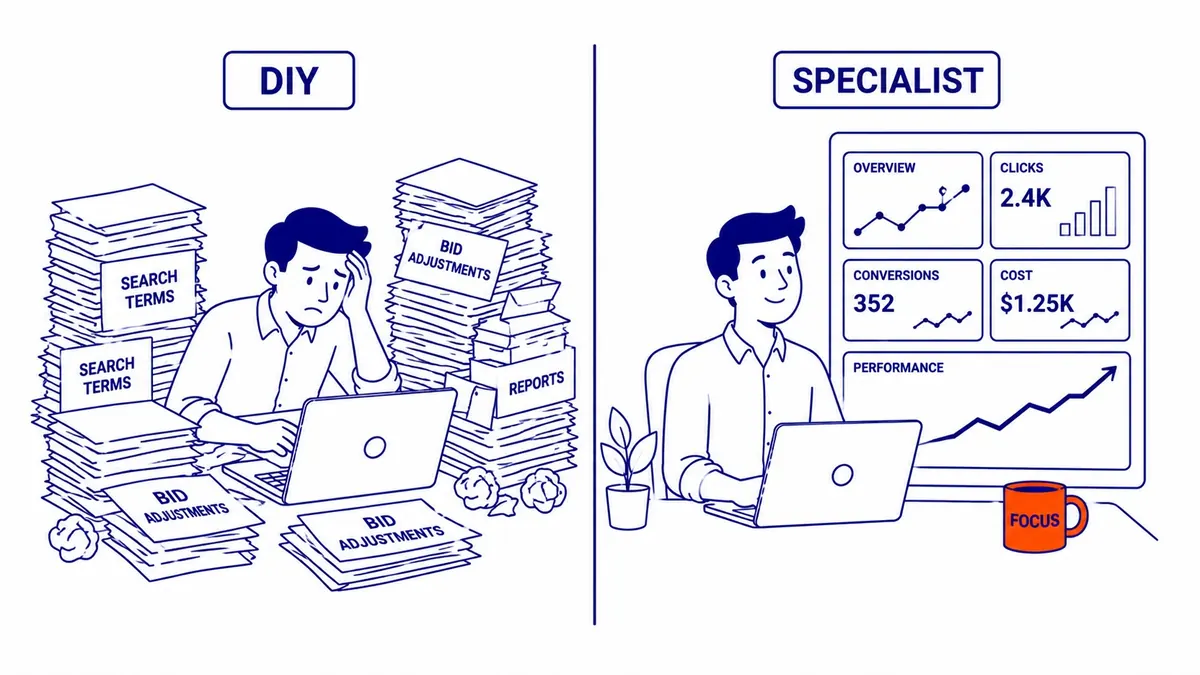
Running your own campaigns is entirely possible, and plenty of owners do it well when they have the time to follow the calendar above and the patience to learn the platform. The trouble usually comes from consistency rather than skill: the weekly review slips during a busy month, the account keeps spending, and the waste only shows up later in the cost per lead.
Hiring a specialist buys that consistency, plus experience of what tends to go wrong. Whoever runs the account, the Google Ads account itself should stay in the business’s name, with the owner keeping Admin access, so that the data and history stay with you if the arrangement ends.
Fees vary widely, which is why the management fee and the ad spend should always be compared as two separate numbers. Among Calgary agencies that publish a Google Ads fee, Kobzza lists Google Ads Management at $1,000 a month with no setup fee, although its page does not state the currency, and GrowME lists campaign management at $500 to $3,800 a month plus a startup fee of $25 to $3,000 (both pages read on 31 October 2026). A fuller comparison of what PPC agencies charge covers flat, percentage and hybrid pricing.
If you decide to hire, the questions about who does the work, who owns the account and what the reports will show matter more than the price alone, and the guide on how to vet a PPC agency lists them with good and bad answers.
PPC management alongside SEO
Paid search and organic search answer the same searches in different ways. Ads can bring traffic the day they launch and stop when the budget stops, while organic rankings usually take longer to build and can keep bringing traffic without a per-click cost, although they still need upkeep. The search terms report is one of the best sources of organic keyword ideas, because it shows which real searches led to calls and sales, so the two channels inform each other when they are run together.
SEO Company To-The-TOP! is a Calgary practice, founded in 2007, where one Google Ads certified specialist does the client work for both channels, with no junior handoffs. It offers Google Ads management for businesses in Calgary, Edmonton, Vancouver and across Alberta and British Columbia, alongside SEO. With any provider, To-The-TOP! included, ask for the management fee and the ad spend as two separate numbers before you compare offers. If you would like a second opinion on an account you run yourself or one an agency runs for you, call (403) 308-5949.
Contact Calgary SEO Company To-The-TOP!
Questions about anything in this article, or about your own rankings? Talk to a Calgary SEO specialist directly.
Phone: (403) 308-5949
Address: 1509 14 Ave SW, Calgary, AB T3C 0W4
Hours:
Monday to Friday: 10:00 am – 7:00 pm
Saturday: 12:00 pm – 4:00 pm
Sunday: closed