
How to Do Keyword Research for SEO | Calgary
Keyword research is figuring out which searches your pages actually show up for, not which ones you wish they showed up for. The tools and metrics come after. First you need to know what your customers actually type, which is usually not the same thing your business calls it.
Most businesses do it once. Pull a list, write some pages, never revisit it. Then six months in they want to know why the traffic has not moved. Often the keywords were fine but the intent was wrong. Sometimes the terms had volume but the searchers were not buyers. Usually the list was built wrong, or nobody checked whether ranking for those terms would actually send useful traffic.

2007 is when I started doing this work. Long enough to watch that pattern repeat.
What Keyword Research Actually Is
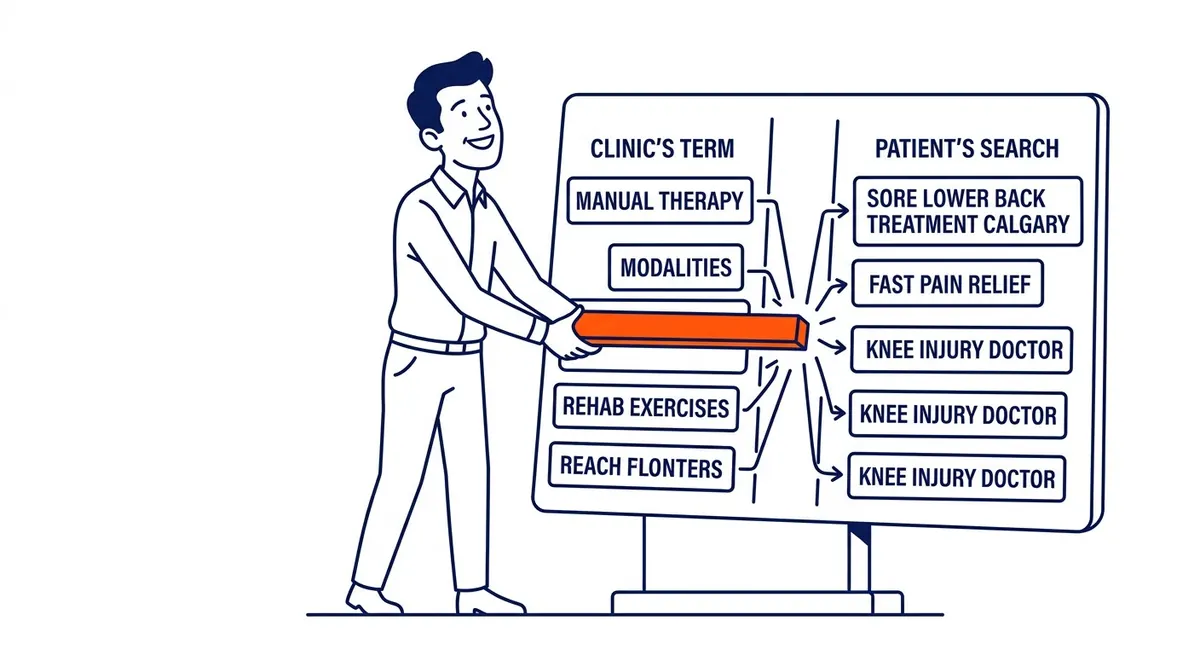
Your business has a vocabulary. Your customers have a different one. Keyword research finds the overlap. A physiotherapy clinic calls it “manual therapy.” Their patients type “sore lower back treatment Calgary.” Same service, different language. The page written in clinic vocabulary does not rank for the patient’s search.
Organic traffic only reaches you if your pages use the words people actually search. No industry jargon. The real phrases. Before writing anything, keyword research tells you what to build and how to build it. It helps to start from what SEO keywords are at all.
You cannot rank for something you have not mapped. Identifying the right targets means knowing what is actually being searched, and what already ranks for those terms, not what you assume. That is why professional competitor keyword research is the first thing we address when building an organic strategy for a Calgary client. Everything else builds from there.

How to Do Keyword Research Step by Step
No single correct method, but there is a sequence that works.
Start broad. Seed keywords are the obvious ones: “plumber Calgary,” “keyword research tool,” whatever describes the business without filtering. Write everything down. Services, problems, locations. No cutting yet.
From there, put each seed keyword into a tool. Google Keyword Planner is the default starting point. Real search data, free, tied to Google Ads. What comes back is raw material: question-based searches, longer phrases, variations you had not considered. Ahrefs and SEMrush add keyword difficulty and competitive data. Both are paid tools. Pulling ideas straight from Google’s own surfaces is a routine of its own, walked through in how to find Google keywords.
The list needs cutting. Some terms will not convert even if you rank for them. Others you cannot realistically rank for yet. Keywords covering the same topic belong on one page. Not scattered across three. Splitting them kills authority. Pages end up competing against each other in the SERP.
Then sequence priorities. That comes down to domain authority, the competitive landscape, and which content gaps are most expensive to leave open. That sequencing sits at the core of how to choose keywords for SEO.
In our Calgary SEO work, keyword research gets applied at the site level, not just at the page level. Worth understanding before you start writing.

Keyword Metrics That Matter
Four numbers come up in every keyword research tool. They do not all mean what they look like they mean.
Search Volume
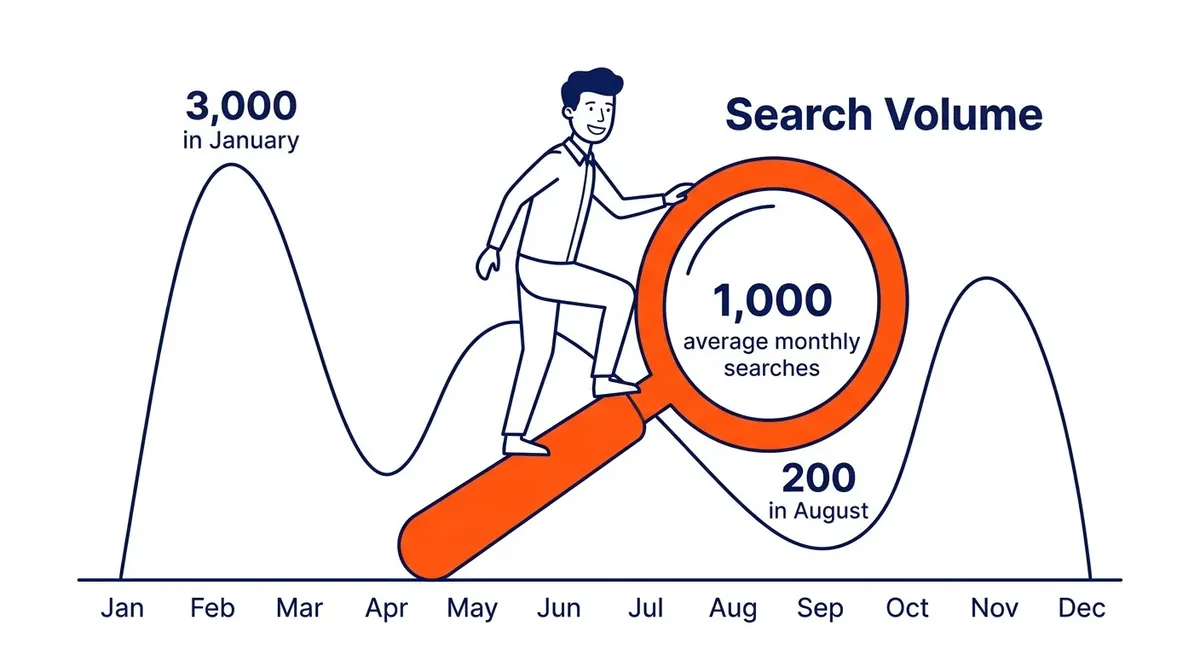
Search volume is the average monthly search count for a term, smoothed across twelve months. That smoothing hides real patterns. A term sitting at 1,000 monthly average might peak at 3,000 in January and drop to 200 in August. Seasonal businesses get burned by this regularly.
The count confirms a topic gets searched at all. Beyond that, it says nothing about how much traffic you would actually receive from ranking, because a dozen other pages are already capturing those clicks. And many searches end without any click, especially where a featured snippet or AI overview fills the answer. Use search volume to identify live topics, not to forecast outcomes.

Keyword Difficulty
Keyword difficulty runs 0 to 100. Ahrefs weights it toward the backlink profiles of pages already ranking for the term. SEMrush uses different signals. The specific numbers are not comparable between tools, but the direction holds: higher score means more established competition. New sites stay below 30 for a while. Real authority opens up the 30-60 range. Above 70 means competing with publications that have been building links for years.

Cost Per Click
Cost per click is what advertisers pay for each click on a given search term. You will meet the same number if you have us manage your Google Ads. High CPC is an indirect signal worth paying attention to. Businesses bidding $18 per click on a term do it because the term converts. $20 CPC at 300 searches per month often beats $0.30 CPC at 3,000 searches. High volume, low CPC tends to signal curiosity traffic. Curiosity does not buy.
Traffic Potential
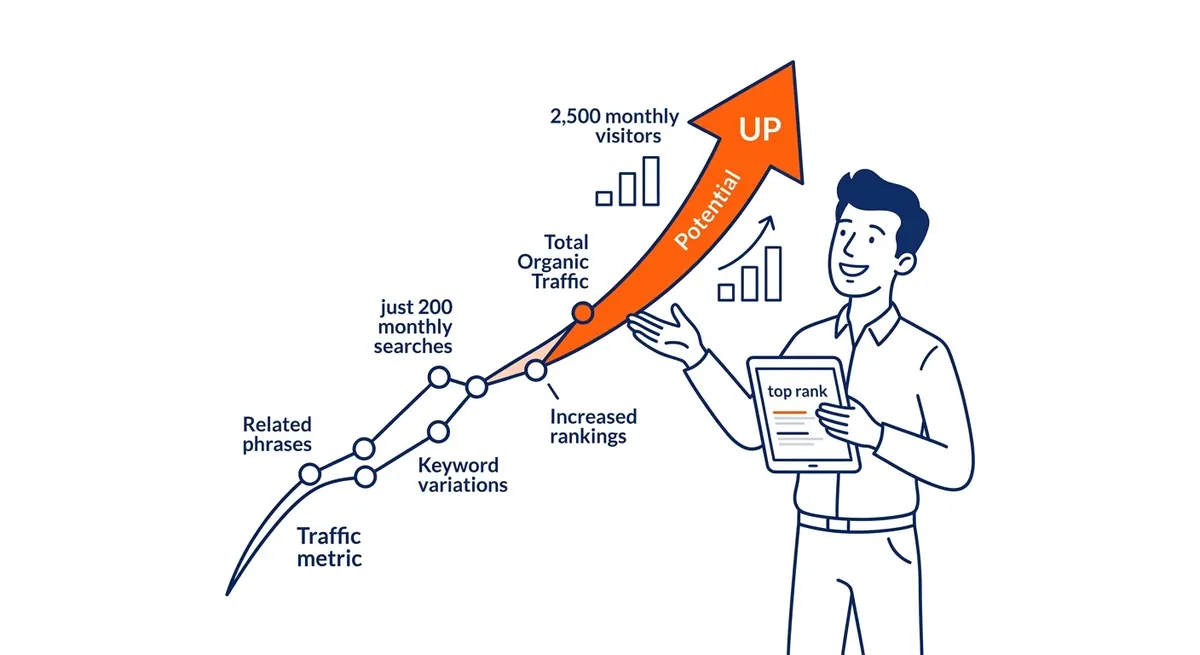
Traffic potential is an Ahrefs metric. Total organic traffic the top result pulls across all keyword variations it ranks for, not just the primary phrase. 200 monthly searches on a term. Top result might pull 2,500 visitors because it ranks for 40 related phrases at once. More accurate than search volume alone. Volume understates what is actually available.
No single metric makes the call. Run all four together.

Understanding Search Intent
Search intent is why someone is typing a phrase into Google at all. The SERP reflects it. Wrong content type for a keyword and the page does not rank, whatever the coverage. This is where most sites miss: not the keyword selection, the intent match.
Four categories cover almost everything.
Informational queries want learning. “How to do keyword research” is informational. “What is a seed keyword” is informational. Guides, tutorials, explainers. These pages run longer because the intent is to understand something in depth.
Commercial investigation queries are comparison-focused. People are nearly ready to buy but still weighing options. “Best keyword research tools,” comparison lists, review articles. The searcher knows what they need; they are choosing between options.
Transactional queries mean the person is ready to act. Service landing pages, product pages, booking forms. Not guides.
Navigational queries are destination-focused. Someone searching “Google Keyword Planner login” is going somewhere specific. Rarely worth targeting unless people already search for you by name.
Run your target keyword in Google before writing anything. What shows up on page one reveals the intent Google has assigned to that phrase. Match that format, or the page will not compete.

Long-Tail Keywords vs Head Terms
Head terms are short. “Keyword research.” “Lawyer.” “Running shoes.” High volume, high competition, low specificity. They say almost nothing about where the searcher is in the process. A student doing research. A journalist. Someone ready to hire. That ambiguity makes head terms hard to convert even when you rank.
Long-tail keywords are specific. Three, four, five words. Lower volume, lower competition, and the intent is usually readable. “How to do keyword research for a local service business in Calgary.” The person typing that has a clear purpose.
Someone typing “personal injury lawyer Calgary rear-end collision settlement” is not browsing. They are ready to call.
Long-tail keywords have smaller audiences. You need enough of them to build meaningful traffic. The practical sequence for most sites: go after long-tail phrases first while building authority, then work toward head terms as the domain grows. Skipping head terms entirely is a mistake. If “best keyword research tool” pulls 5,000 monthly searches in your market, that page is worth building. Just not first.

Keyword Research Tools
Google Keyword Planner is the default starting point. Free, tied to Google Ads, real search data. Volume ranges round off when the account has no active ad spend, so you see “1K to 10K” instead of a specific number. Active spend sharpens the figures. For organic research, directional data is enough to confirm a topic has real search volume behind it. Pinning down those numbers more precisely is its own routine, covered in how to find search volume for keywords.
Google Search Console is the most underused tool for keyword research. It shows which queries already bring traffic to your actual pages, with position and click-through rate data. First-party Google data on what is working right now. Pages ranking at position 11 to 20 for terms you care about show up clearly. Those are your clearest wins. They move with less work than building from scratch.
Ahrefs is the standard for keyword difficulty and competitive gap work. Keywords Explorer returns volume, keyword difficulty, traffic potential, and related terms. Site Explorer shows what any URL ranks for. Around $129 per month.
SEMrush covers similar ground with different methodology and stronger competitive intelligence. Keyword gap reporting makes the subscription worth it. Enter your domain and a few competitors. The tool shows queries they rank for that you do not. Starts around $139.95 per month.
Ubersuggest costs less, limited free tier. Adequate for basic research. Thinner data than the major tools.
For most small businesses: Google Keyword Planner plus Search Console handles the core needs. Add a paid tool once you are ready to run competitive gap analysis at scale.
How to Prioritize Keywords
Knowing what to target and knowing what to target first are different skills. Most people have the first one.
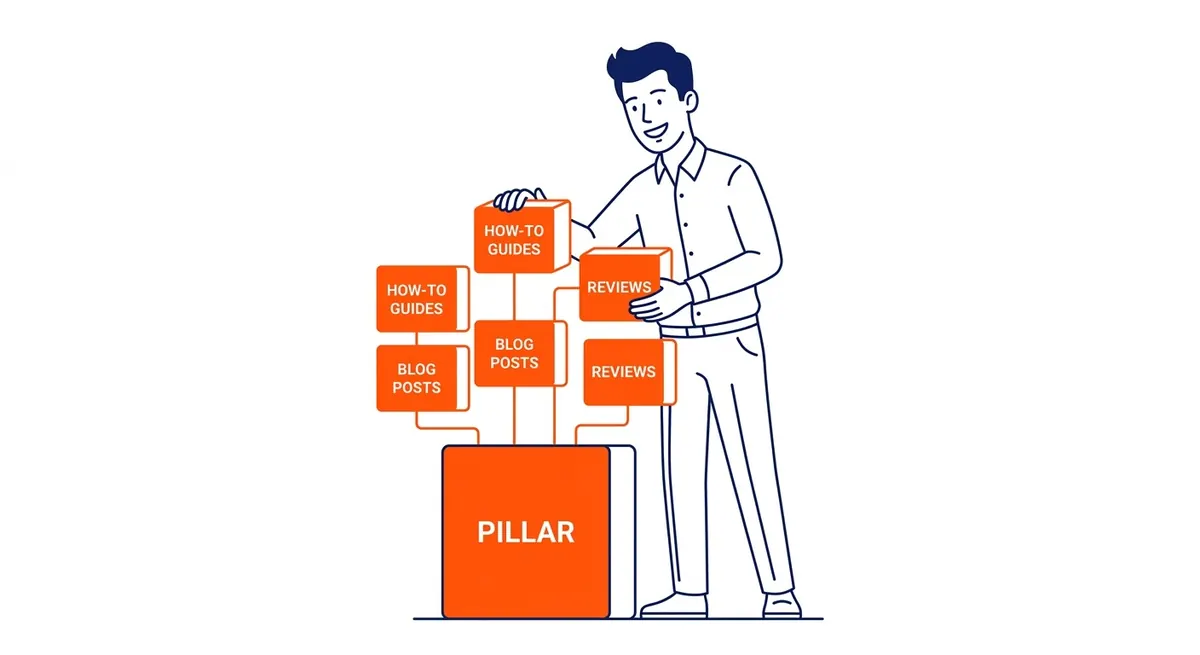
The topic cluster is the structural framework. One pillar page covers a broad topic in depth. Supporting pages each handle a related subtopic, all linking back to the pillar. The pillar targets the head term. Supporting pages target the long-tail variations within the topic cluster. Each subtopic gets its own page. No cannibalization.
Four variables: search volume, keyword difficulty, business relevance, conversion potential. A keyword with KD of 85 and weak conversion intent is a long-term goal, regardless of search volume. One with 200 monthly searches, KD of 20, and strong purchase intent might be the next page. Score informally across those four dimensions. High on business relevance and conversion potential with manageable difficulty, that goes first. That scoring is the practical heart of how to choose keywords.
Competitive gap analysis finds what your competitors rank for that you do not. Run the gap report in Ahrefs or SEMrush, filter by positions 1 through 20, look for patterns. What topics have they covered? Which ones align with your services? Those are your clearest gaps.
Our Calgary SEO services, along with the work we do in Edmonton and Vancouver, get built on a content roadmap driven by actual keyword data, not topics that sounded interesting. The sites that compound organic traffic year over year share that one characteristic.
FAQ
How long does keyword research take?
Initial pass for a new site: eight to twelve hours. That covers seed keywords, competitor analysis, competitive gap analysis, clustering, and prioritization. Adding a new content vertical to an existing site usually runs four to six hours. Not a one-time task. Search behaviour shifts. Competitors add pages. Topics grow or shrink in search volume. Twice a year at minimum.
How many keywords should I target per page?
One primary keyword, with related variations worked in naturally. A page on “how to do keyword research” will also rank for “how to find keywords for SEO” and similar phrases. All of those belong on the same page. Targeting unrelated keywords on one page dilutes relevance for all of them.
What is the difference between keyword research for SEO and PPC?
Same data, different criteria. PPC filters hard for commercial intent and conversion value because every click in Google Ads costs real money. SEO keyword research covers a broader range of intents, since informational and comparison content builds organic traffic even when immediate conversions are low. PPC blocks irrelevant traffic with negative keywords. In SEO, that filtering happens at the content level instead.
How often should I redo keyword research?
Full pass when starting a new content push or entering a new market. After that: quarterly Google Search Console check, semi-annual competitive look. Shifted queries, new competitor pages, topics that grew in search volume.
Can I do keyword research without paid tools?
Yes. Google Keyword Planner and Google Search Console handle the core needs for a site still building its content base. Manual SERP checks add judgment no tool fully replaces. Paid tools accelerate the research, especially competitive gap work. Not a prerequisite. Start with free tools, build content, add paid tools when you have enough data.
Contact Calgary SEO Company To-The-TOP!
Questions about anything in this article, or about your own rankings? Talk to a Calgary SEO specialist directly.
Phone: (403) 308-5949
Address: 1509 14 Ave SW, Calgary, AB T3C 0W4
Hours:
Monday to Friday: 10:00 am – 7:00 pm
Saturday: 12:00 pm – 4:00 pm
Sunday: closed