
How to Improve Internal Linking in Ecommerce for SEO
Take the standard method first, since it works.
Blog posts point at category pages. Category pages point down at the products worth selling. Product pages point back up at their category, then sideways at whatever else a shopper wants. Give the anchor text something to say. Sound SEO, every bit of it. All covered properly elsewhere on this site, so none of it gets repeated here.
What nobody asks is how many internal links your store already has.

Your Store Has Already Made Ten Thousand Internal Links
Go and count them. Or rather, do not.
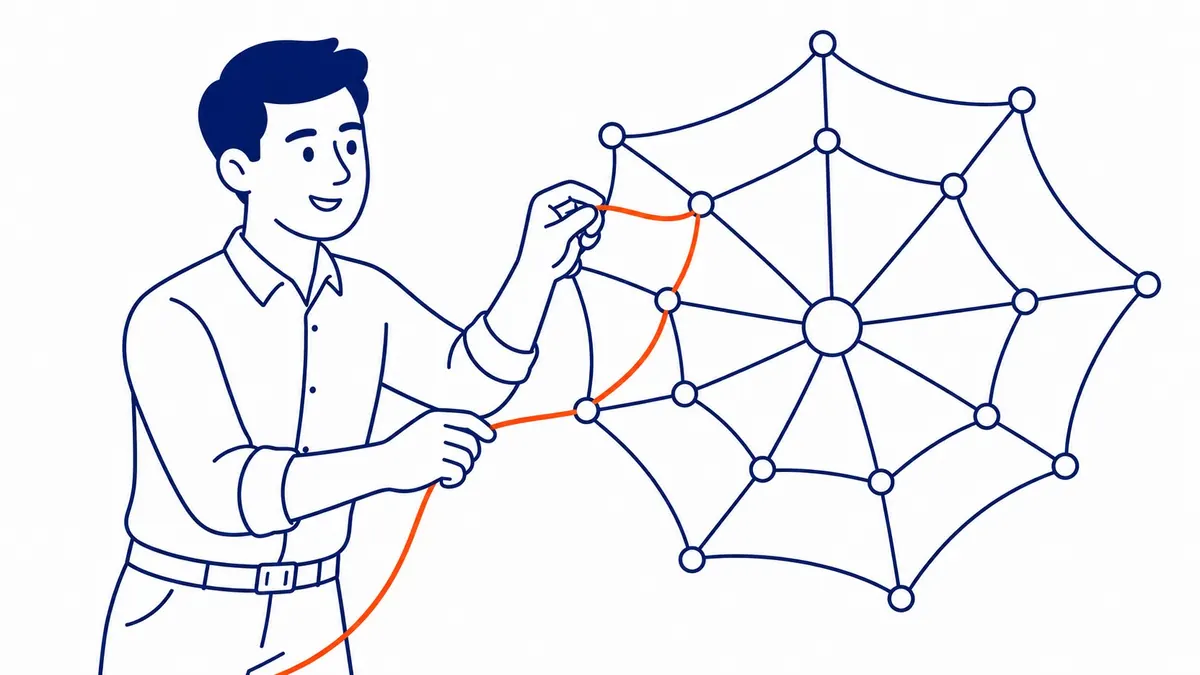
Every product sits inside a grid on a category page. That grid is a link. Every product page carries a breadcrumb back up the chain. Another link. Then the navigation across the top, printed on every page you own. The footer beneath it. Related items under the buy button. Filters down the left.
Each of those is a link. On every page. Then multiply by the size of your catalogue.
A blog with sixty posts might hold two hundred internal links. Meanwhile a modest store holds tens of thousands.
So add some internal links is a strange thing to tell a shop. Nobody adds to a pile that size by hand. Not in an afternoon, nor a year.
Not One of Them Was Typed
Nobody typed them. Not one at a time, and not for any SEO reason. A designer settled the navigation once, years ago. Then a template has printed it ever since. Breadcrumbs come out of the platform. The grid gets filled from the database when somebody opens the page. Related items get picked by a rule.
Meanwhile the interesting half is what every one of those links has in common.

Every Generated Link Joins Two Things That Share a Field
Ask how a machine decides which product stands beside another.
It reads the record. Category, brand, a price band. Perhaps a tag somebody typed into the admin two summers ago. Then it prints a link.
That is the whole trick. It runs on every page, instantly.
Only look at what it works with. A rule joins two things solely where your store already holds a record of both. So your link structure is no picture of what your customers want. Rather it is a picture of the fields in your database.
Which is fine, so long as your customers shop by field.
Somebody Will Point at the Recommendation Engine
Fair enough. Some of those rules are cleverer than a matching field.
Bought together is no category match. It watches carts, learns which pairs keep turning up, then joins them. A boot gets linked to a sock, across two categories, since enough people bought both.
Only ask what it learned from. Carts. Purchases already made.
So it finds the pair you were already selling. What it cannot find is the pair nobody has bought. Yet that is the interesting pair. Sometimes nobody bought it for want of finding the second item.
The rule reports your shop back to itself. Every one of these rules does.

A Customer Does Not Have a Category
A basement floods on a Sunday night.
The man mopping it needs a pump. He needs a battery too, since the power went out and that is rather how the water arrived. Then a hose that fits the pump. And a valve, so the water does not run back in.
Four things. All of them in different corners of your store. Not one field joins them, since nothing in your database says these four objects solve one problem.
So no rule in your store has put them on the same page. The navigation cannot. Nor can the grid. Bought together may get there eventually, once enough people have solved it the hard way.
That is what a customer arrives with. Never a category. Instead a bad night, and a list.
The Internal Link Your Database Could Not Have Worked Out
Which hands you the test.
Take any internal link you mean to add. Then put one question to it. Could a rule have worked this out from the catalogue alone?
Often the answer is yes. Leave it alone, then. Your platform does that job at a scale nobody matches by hand.
Sometimes the answer is no. A link from the pump to the battery, made because you have taken that phone call forty times. Then a guide about flooded basements, pointing at all four. Nothing in the catalogue knows either. They came off a phone call. Out of a returns form. From behind the counter on a Saturday.
So improving internal linking in an ecommerce store is not really a linking job. What it asks for is knowledge. The links are where you put it down.
Try it on your own store. Open the last five conversations you had with a customer. Not the orders. The conversations. Write down what they asked for, then what they needed.
Now find out whether any page you own joins the two.
Perhaps one does, and somebody has been doing this quietly. Or nothing joins them, in which case you have just written your internal linking plan. No statistic about other people’s stores was going to hand you that. Yours is sitting in your own inbox. No list of top ecommerce SEO agencies was going to hand you that either.

Where the Ecommerce Internal Linking Argument Stops
None of this makes the generated links weak. They do real work, moving people around a store nobody could walk through otherwise. Leave them alone.
Nor does one clever link move a ranking by itself. A link into a category page nobody wants is still a link into a page nobody wants. Which pages are worth wanting is a question for keyword research. Never for linking.
Then there is the store selling one thing, in one category, to one kind of buyer. Nothing in it crosses anything, so this page is a footnote for them. Run the standard method instead.
Yet the argument holds wherever a customer’s problem is larger than any category of yours. Which is most of the time.
Working With SEO Company To-The-TOP!
That worry reaches To-The-TOP! often enough. A business holding tens of thousands of internal links, certain it has too few. Often the first useful hour goes on the other question. Which of these could a computer not have made?
To-The-TOP! has been doing this work in Calgary since 2007. Solo, so whoever reads your catalogue is whoever writes the links. That work sits inside search engine optimization rather than beside it. Then a website audit shows where the generated structure already reaches. Meanwhile a Google Ads campaign can carry the traffic while the slow half gets built. The portfolio shows the keywords this work has reached. Businesses across Calgary tend to want it faster than three to six months. No guarantees. The wider job, SEO for an ecommerce website, runs on the same clock. Platform matters less than people think, though SEO on Magento has its own quirks.
Ecommerce Internal Linking Questions
How many internal links should an ecommerce product page have?
Counts are covered elsewhere on this site. No number gets invented here. Notice what your product page holds already. A breadcrumb, a navigation bar, a footer, a row of related items. Some template settled that count long before you asked.
Do related products count as internal links?
They do. A search engine’s crawler follows them like anything else, so the authority moves. Only remember who chose them. A rule did, working from fields in your database. Nobody asked it which page you were trying to rank.
Should product pages link to blog posts?
A blog post is content, and content shares no field with a product. So that is one of the few links a rule will never make for you. Yes, then, wherever the post helps somebody standing at that product.
Does internal linking really help ecommerce SEO?
It helps, and the mechanism is covered on the pages that own it. The trouble in a store is rarely too little linking. It is that nearly all of it got worked out from the catalogue. And the catalogue has never met anybody.
What is the quickest internal linking win for an online store?
Write the page that crosses two categories. The guide answering the problem your customers phone about, linking to every product that solves it. It earns the internal links no rule in your store could make.
Contact Calgary SEO Company To-The-TOP!
Questions about anything in this article, or about your own rankings? Talk to a Calgary SEO specialist directly.
Phone: (403) 308-5949
Address: 1509 14 Ave SW, Calgary, AB T3C 0W4
Hours:
Monday to Friday: 10:00 am – 7:00 pm
Saturday: 12:00 pm – 4:00 pm
Sunday: closed