
Search Engine Ranking: How Google Decides Where a Site Appears
A search engine ranking is the position a page holds in Google’s organic results for one particular search, made from one particular place. Google sets that order with automated systems that, in its own words, “look at many factors and signals, including the words of your query, relevance and usability of pages, expertise of sources, and your location and settings.” For search engine optimization, ranking therefore starts with the five broad areas Google uses to explain it: understanding the meaning of the query, being relevant to it, showing quality, being usable, and fitting the searcher’s context. This guide explains each one, the myths worth ignoring, how over-optimization backfires, and how to work out why a site is not ranking.

What a search engine ranking is, and what it is not
A website does not have one ranking. Each page can appear for hundreds of different searches, and it holds a separate position for every one of them, so “where does my site rank?” only has an answer once you name the query. The position also changes with the searcher’s location, language and settings. Google’s How Search Works page gives the example of someone searching “football” in Chicago, who will likely see American football results, while the same search in London turns up soccer. For a Calgary plumber or accountant, a search made from Calgary and the same words typed in Edmonton or Vancouver can produce noticeably different pages, especially when the query has local intent.
Organic rankings are also separate from advertising. Google states that its search results are “not influenced by whether a business, individual, or organization buys ads,” and that ads are always labelled “Sponsored” or “Ad.” Its guide to how Search works goes further: Google “doesn’t accept payment to crawl a site more frequently, or rank it higher.” Anyone who offers a paid shortcut into the organic results is describing something Google says does not exist.
Measuring a ranking takes some care for the same reasons. The average position in Google Search Console is the average of a page’s topmost position across all the searches, places and devices where it appeared, so a page can average around 15 in Search Console and still sit outside the top 100 for a search made in Calgary. That is why serious rank tracking checks named keywords from a named location, on a schedule, rather than relying on one blended number or a quick search from your own browser.
How Google decides the order: five groups of signals
Google describes its ranking as the work of many automated systems rather than a single formula. Its guide to the ranking systems says they “look at many factors and signals about hundreds of billions of web pages,” that they work mainly at the page level, and that site-wide signals also contribute. The How Search Works page groups the key signals into five areas, and it adds that “the weight applied to each factor varies depending on the nature of your query.” Fresh content matters more for a news search than for a dictionary definition, for example.
| Signal group | What Google says it looks at | What it means for a business page |
|---|---|---|
| Meaning | The intent behind the words, including spelling correction and synonyms | Answer the question people are really asking; Google can match “adjust” to “change” without exact wording |
| Relevance | Whether the content contains the search terms and other relevant material, plus aggregated and anonymized interaction data | Use the words customers use, then cover the topic properly rather than repeating one phrase |
| Quality | Signals of expertise, authoritativeness and trustworthiness, including whether prominent sites link to or refer to the content | Show real knowledge and earn mentions and links from respected local and industry sites |
| Usability | Page experience, such as mobile-friendly content that loads quickly, which helps “when all other signals are relatively equal” | A fast, readable mobile page breaks ties; it rarely rescues a page that answers the wrong question |
| Context | Location, past search history and search settings | Local pages need a clear local focus, and rankings must be judged from the place customers search from |

The ranking systems guide also names some of the systems behind these groups. PageRank, one of Google’s original link analysis systems, “continues to be part of” the core ranking systems, while RankBrain and neural matching help Google relate the words in a search to the concepts on a page. In practice, the order of the table is a sensible order of work as well: a page that misreads the searcher’s intent will not be saved by speed or links, while a page that answers the query well often needs only modest help with the other groups.
Before a page can rank, Google has to crawl and index it
Ranking is the last of three stages. Google’s guide to how Search works describes them as crawling (finding and downloading pages), indexing (analyzing them and storing them in the index) and serving search results, and it says plainly that “not all pages make it through each stage.” Google also “doesn’t guarantee that it will crawl, index, or serve your page, even if your page follows the Google Search Essentials.”
So the first check for any page that does not rank is whether Google has it at all. The URL Inspection tool in Search Console shows whether a page is indexed and why it might not be, and a site: search for the address gives a rough second opinion. A leftover noindex tag from a site redesign keeps a page out of the index, a robots.txt block stops Google reading it, and a canonical pointing at another URL can lead Google to index that URL instead, so a well-written page can still fail to rank or appear at all. In practice, these technical blockers are some of the quickest problems to fix, which is why they belong at the top of any review.
Ranking factor myths that are worth ignoring
Many “ranking factor” lists, including several that rank for this topic, present opinions as rules. Google’s SEO Starter Guide addresses some of the most common ones directly. There is “no magical word count target, minimum or maximum,” so length should follow what the reader needs. It answers “Thinking E-E-A-T is a ranking factor” with “No, it’s not,” even though Google’s systems look for signals of expertise and trust. It says there is “no magical, ideal amount of headings,” and that using headings out of order does not matter to Google Search. It also says PageRank “is one of the fundamental algorithms” but that “there’s much more to Google Search than just links.”
Two more beliefs have been settled for years. Google Search does not use the keywords meta tag at all, so filling it in does nothing for rankings. And a domain name built around a phrase, such as one containing “best-places-to-eat-lunch”, gets limited help: Google’s exact match domain system exists to ensure it doesn’t give such domains too much credit. Neither point means content length, links or a sensible domain are irrelevant. They mean none of them works as a lever on its own.
How over-optimization costs rankings
The effort to rank turns into over-optimization when it starts to replace the effort to be useful. Google’s spam policies describe the main forms. Keyword stuffing includes “repeating the same words or phrases so often that it sounds unnatural” and “blocks of text that list cities and regions that a web page is trying to rank for,” a pattern that still turns up on service-area pages listing every town from Airdrie to Okotoks. Link spam is “the practice of creating links to or from a site primarily for the purpose of manipulating search rankings,” which covers buying or selling links, excessive link exchanges, automated link building, and low-quality directory or bookmark links.
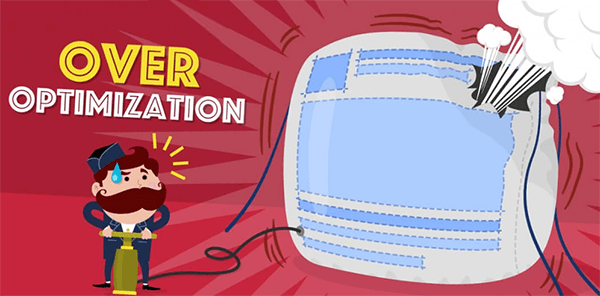
Google detects these practices “through automated systems and, as needed, human review that can result in a manual action,” and it says sites that violate the policies “may rank lower in results or not appear in results at all.” The Penguin update, announced in 2012 to combat link spam, was integrated into Google’s core ranking systems in 2016, according to Google’s ranking systems guide. There is no separate Penguin to “comply with” any more. Link spam is handled by the same systems that rank everything else, along with Google’s spam detection systems, which include SpamBrain.
Cleaning up old link building
Many established business sites carry links from an earlier era of SEO, such as mass directory submissions or paid link packages. The right response depends on whether those links are causing a problem, and Google’s guidance here is more restrained than a lot of the advice sold to worried site owners. Start in Search Console with the Manual actions report, which shows whether a human reviewer has taken action against the site and lets you request reconsideration once the problem is fixed.

Google’s help page on disavowing links says that “in most cases, Google can assess which links to trust without additional guidance, so most sites will not need to use this tool.” It recommends a disavow file only when a site has a considerable number of spammy, artificial or low-quality links and those links have caused, or will likely cause, a manual action. Even then, Google says to remove as many of the bad links from the web as possible first, and it warns that using the tool incorrectly can harm a site’s performance. Disavowing every unfamiliar link is not a ranking strategy, and deleting or erroring out your own pages to shed outside links usually costs more than it saves, because the page and any good links to it go with them.
Why a website is not ranking: a diagnostic order
When a page does not rank, the cause is usually found faster by checking in a fixed order than by trying fixes at random. This is the order a practitioner would follow, starting with the problems that stop everything else from mattering.
- Is the page indexed? Check URL Inspection in Search Console. If it is not indexed, nothing else on this list applies yet.
- Which query, and from where? Look at the Search Console queries the page already appears for, and check positions from the location your customers search from.
- Does the page match the intent? Search the target phrase and look at what ranks. If page one is all service pages and yours is a blog post, or the reverse, the format may be the problem.
- Is it the most useful answer? Read it against the top results using the questions in Google’s guide to creating helpful, reliable, people-first content. Does it add something the others do not?
- Is it usable on a phone? Google says page experience helps when other signals are relatively equal, so a slow, cluttered mobile page can lose a close call.
- How does its authority compare? If the pages above it are far better known and more often cited by respected local and industry sites, content changes alone may not close the gap.
- Is anything working against it? Check the Manual actions and Security issues reports, keyword stuffing, and doorway-style location pages.
- Has it had enough time? Google’s SEO Starter Guide says some changes “might take effect in a few hours, others could take several months,” and that you likely want to “wait a few weeks” before judging whether a change helped.

The last step is the one most often skipped. SEO takes months, and changing several things at once makes it impossible to tell which one worked. If the checks above do not reveal an obvious cause, a site audit that looks at indexing, content, competition and links together is usually the quickest way to find what is holding a page back.
Getting help with your rankings
Since 2007, SEO Company To-The-TOP! has worked on search engine ranking for businesses in Calgary, Edmonton, Vancouver and across Alberta and British Columbia. It is a solo practice, so the person who reviews a site is the person who does the work, using White Hat methods only, and SEO clients receive monthly position reporting, so rankings are measured against named keywords rather than guessed at.
Because organic rankings take time to build, some businesses also run Google Ads to bring in inquiries while the SEO work matures; as Google states, buying ads has no effect on organic positions, so the two need to be planned and measured separately. If you would like a second opinion on why your site is not ranking, or on an SEO plan you have already been given, call (403) 308-5949.
Contact Calgary SEO Company To-The-TOP!
Questions about anything in this article, or about your own rankings? Talk to a Calgary SEO specialist directly.
Phone: (403) 308-5949
Address: 1509 14 Ave SW, Calgary, AB T3C 0W4
Hours:
Monday to Friday: 10:00 am – 7:00 pm
Saturday: 12:00 pm – 4:00 pm
Sunday: closed