
Should Your Google Ads Landing Page Be on Your Website?
Most Google Ads campaigns we pick up share one common pattern: traffic going to the homepage. Budget burning. Phone quiet. The client is often confused, because the keywords look right and the ads are getting clicks. What they are not getting is conversions.
The question of whether a Google Ads landing page should link to your website’s existing pages assumes the two are interchangeable. Sometimes they are close enough. Usually they are not. Getting this wrong is one of the faster ways to drain a paid search budget without understanding why.
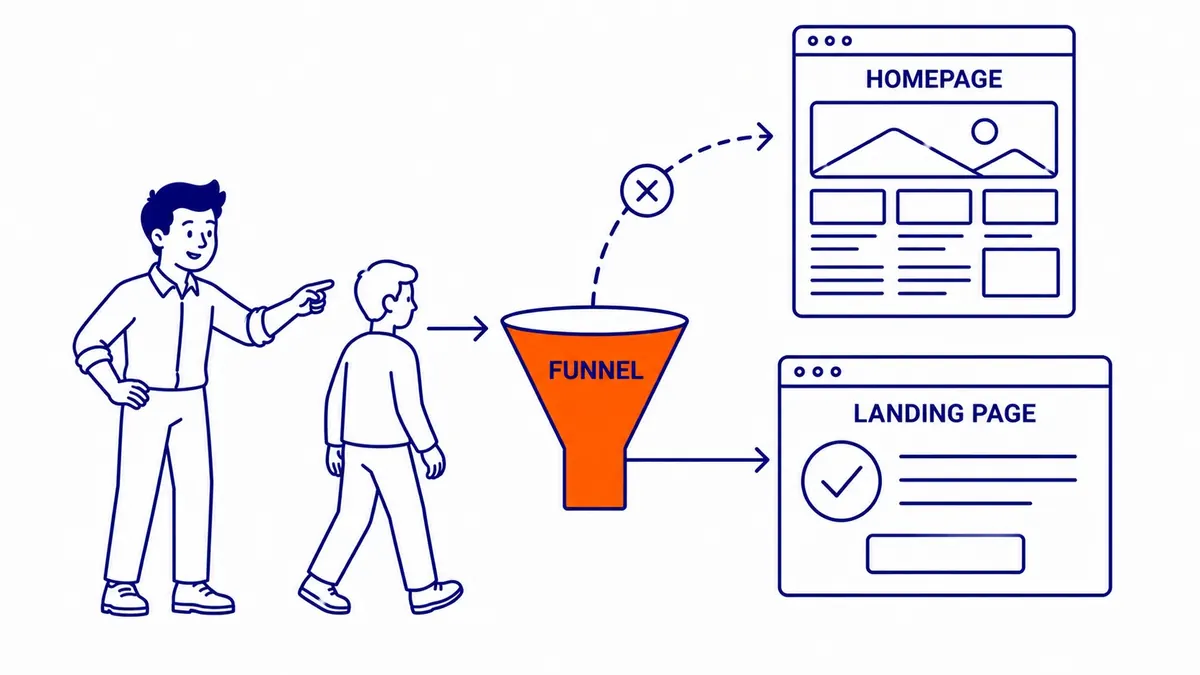
Decisions like this sit inside the wider job of Google Ads campaign management. To-The-TOP! has been doing that work for Calgary and Alberta businesses since 2007, and the destination page affects results more than most advertisers expect. The homepage-send is the most common structural mistake we see on inherited accounts. Second most common is the opposite: a dedicated page that does not reflect what the ad promised the user who clicked.
Two Types of Pages, Two Jobs
A website exists to tell the full business story. Navigation. Services. Blog. About. Contact. That is what a website does well, and what users expect when they search a brand name directly.
A Google Ads landing page has one job: convert the user who clicked a specific ad. One message. A single call to action. No exits.
These two tools serve fundamentally different purposes. Sending Google Ads traffic to the main homepage is like running an ad for emergency drain cleaning and routing callers to a long hold queue with a five-item menu. Technically reachable. Practically a lost lead.
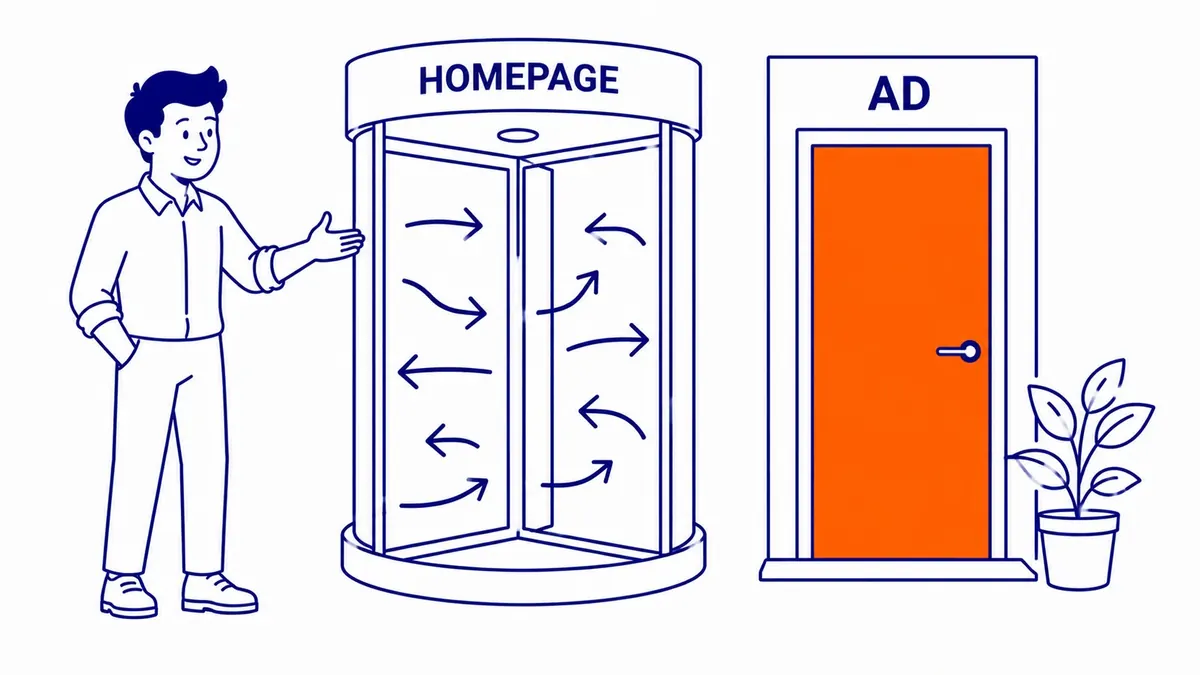
Dedicated landing pages do not always require separate platforms. They can live on your website’s domain, on their own URL, with stripped-down navigation. What separates them from standard website pages is structure: messaging that matches the specific ad, a clear call to action visible before the scroll, and no competing content pulling the user in another direction. A plumber running ads on “Calgary emergency drain cleaning” should land users on a page that says exactly that. Not a homepage with four service categories, a blog preview, and a newsletter form competing for the same click. Match the page to the ad and a good CTR for Google Ads follows the same logic.
What Google Scores as Landing Page Experience
Quality Score (1 to 10) multiplies against your bid. Three factors go into it: keyword-to-ad match, landing page fit, and historical click-through rate. Landing page experience is the component most campaigns leave unaddressed.
The guide on Google Ads setup and strategy covers campaign structure and Quality Score factors that landing page choice directly affects.
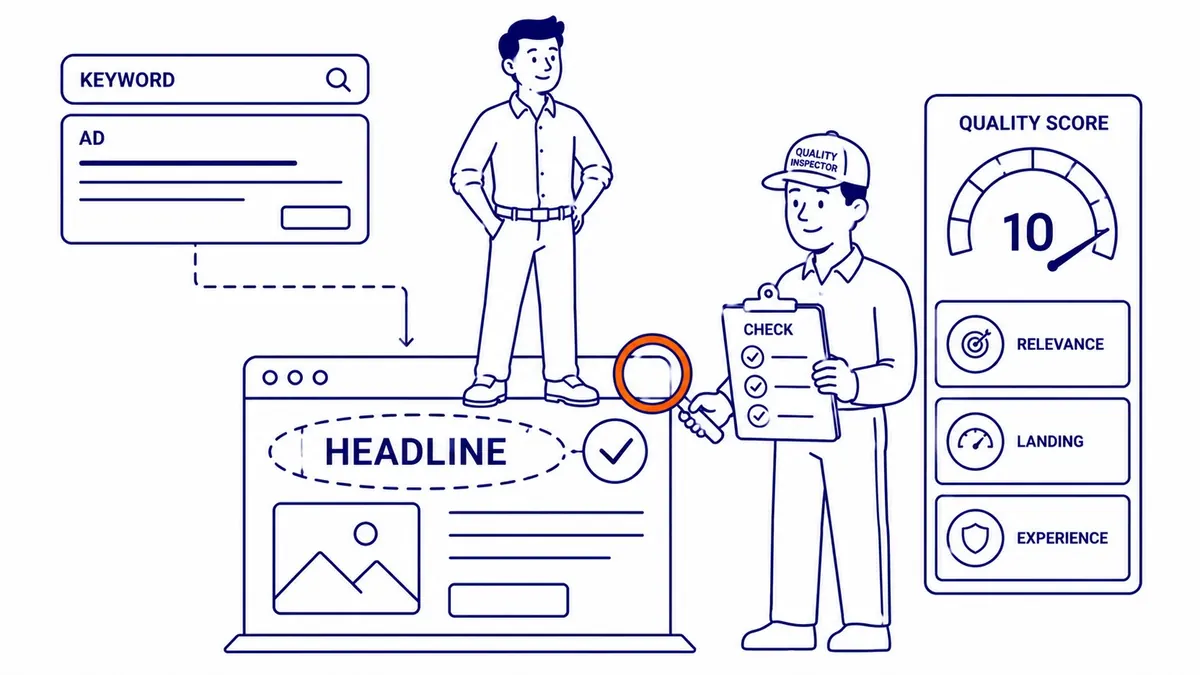
Google crawls your destination URL. It reads the content and estimates what users will find when they arrive. General service copy and full navigation menus signal low relevance to a specific query. A focused page built around the exact keyword and ad copy signals high relevance. That difference still shows up in your Quality Score.
With a strong Quality Score, you pay less per click and compete against higher bids. A weak one means paying an ongoing relevance penalty on every click. In accounts where we have replaced homepage destinations with focused landing pages, Quality Score climbs inside the first two weeks. Cost per click drops. Conversions follow. The arithmetic is not complicated; most accounts just never do the work. The page is half of it; the steps to write Google Ads copy cover the rest. Most of that comes down to the basics of learning Google Ads, oddly enough.
When an Existing Website Page Can Work
Not every campaign needs a separately built destination. A service page that is already tightly focused, loads fast, has a clear call to action above the fold, and matches the ad headline closely enough: that page can work.
The principles covered in what is on-page SEO apply directly to paid landing pages as well as organic ones.
What it cannot carry is full site navigation, multiple competing calls to action, or content which dilutes the primary offer. A page built around SEO services Calgary as its core offer is a reasonable destination for an ad targeting local search optimization queries. That same page is not a reasonable destination for an ad promising users a free website audit.
The test is simple: read the ad headline, then read the page headline. Do they match? Read the call to action in the ad, then find the CTA on the page. Does the user land on the same offer they clicked for? Two yes answers and the page can work. Either no and you are leaking conversions quietly, with no alert in the account to tell you.

This check still runs on every account we take on. Mismatched messaging between ad and landing page is the most expensive quiet leak in paid search. Clicks keep coming. Conversions do not.
Homepage as Landing Page: What Actually Happens
Users who click a specific paid search result arrive with specific intent. Something narrow brought them. An ad matched it. They clicked. That click cost real money.
A homepage greets them with a general business overview. Most users have about four seconds to find what they came for before they leave. That is not a user failure. It is a structural mismatch between what the ad promised and what the page delivers.
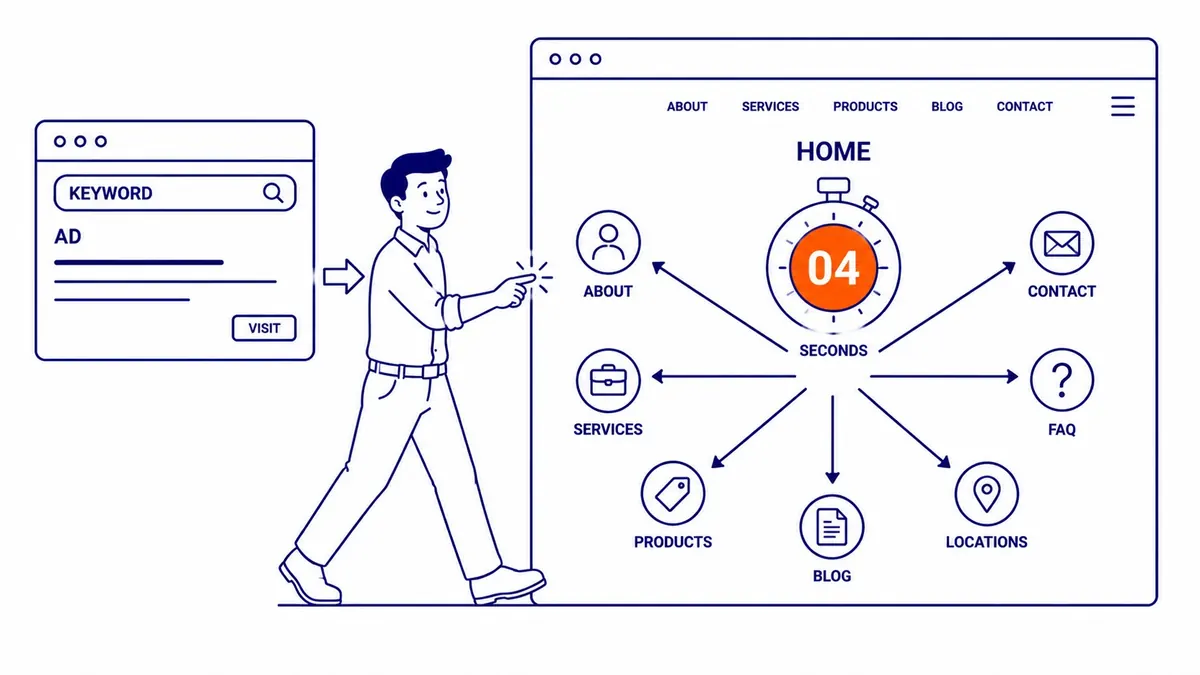
Navigation menus are the core problem. Eight nav items give users eight ways to avoid converting. Each click away from the primary call to action is a lost conversion. Effective landing pages still remove navigation entirely or reduce it to a single line. There is nowhere to go except the form or the phone number.
Bounce rate climbs when a homepage serves as the ad destination. That signal, however, feeds back into Quality Score over time. The campaign degrades, costs rise, and performance drops without an obvious cause. Proper keyword research informs both what to bid on and how the landing page content should be structured; the two decisions are connected. The work starts in the same place either way: run an SEO keyword analysis on the terms you are about to buy, then write the page around what comes back.
Worth noting: some businesses run broad brand campaigns that intentionally send to the homepage. That is a specific tactic with specific goals. Service campaigns targeting users ready to take action are not brand awareness campaigns, however, and treating them the same way is a budget problem.
Advertisers in Olds SEO, Oliver SEO, and Ottawa SEO face the same landing page alignment question when setting up conversion-focused campaigns.
FAQ
Is a landing page connected to a website?
It can be, and often it should be. Many Google Ads landing pages live on the same domain as the main site, on dedicated URLs without full navigation. Others also use standalone platforms entirely. Technical relationship matters less than page relevance to the specific ad and the query which brought the user there.
What is the best practice for Google Ads landing pages?
Match the headline to the ad. One call to action, visible before the scroll. No navigation bar. Mobile-optimised layout. Page load time under three seconds. Those are the baseline mechanics. The more practical point: build the page around the specific query the user typed, not the general service category the business is in.
Should you always use the website homepage as a landing page?
Almost never, for service campaigns. Homepage sends consistently produce lower conversion rates and higher cost per conversion. Brand campaigns targeting your own name can sometimes use the homepage reasonably. Service ads rarely can.
What are common landing page mistakes?
Sending service campaign traffic to the homepage. Competing calls to action on one page. Full website navigation left intact. A headline which does not match the ad. Forms which ask for too much information before delivering anything. Slow load times on mobile. Any single one of these is enough to hurt conversion rates noticeably.
Getting the Setup Right
Bid strategy and targeting take up most of the attention in Google Ads PPC management. Landing page experience is where most of the easy performance gains are sitting, untouched.
To-The-TOP! has worked as an SEO agency in Calgary since 2007, managing search and Google Ads campaigns for local businesses. If your campaigns are spending without converting, the destination page is the first thing worth reviewing. Look at what the page is actually delivering against what the ad promised the user. That gap, if it exists, costs more per month than most account optimisation would.
Contact Calgary SEO Company To-The-TOP!
Questions about anything in this article, or about your own rankings? Talk to a Calgary SEO specialist directly.
Phone: (403) 308-5949
Address: 1509 14 Ave SW, Calgary, AB T3C 0W4
Hours:
Monday to Friday: 10:00 am – 7:00 pm
Saturday: 12:00 pm – 4:00 pm
Sunday: closed