
What Is a Good SEO Visibility Score?
There is no universal good SEO visibility score, because every tool builds the number from its own keyword list, click curve and scale. As a rough guide, Keyword.com says a score above 20% in its tool generally indicates a strong search presence, and Semrush defines 100% as ranking first for every keyword you track, so a single-digit score is normal when many of the keywords you track do not yet rank near the top. The test that matters is whether your score is rising over time and how it compares with your direct competitors on the same keyword list, measured in the same tool.

The rest of this guide explains how the main tools calculate the score, why the same site gets different numbers in different tools, and how to decide whether your own number is good. It deals with rank-tracking visibility, which is a different thing from a site audit score, the health percentage that crawlers such as Semrush Site Audit report. SEO Company To-The-TOP! has worked on search for Calgary businesses since 2007, and visibility is one of the metrics that comes up in monthly position reporting, so it is worth knowing what the percentage can and cannot tell you. If you came here for the audit number instead, see a site audit score and what it measures.
How a visibility score is calculated
Most visibility metrics start from the same idea: take a set of keywords, record where the site ranks for each one, and give higher positions more weight. Many tools, Semrush and Keyword.com among them, do the weighting with an estimated click-through rate for each position and the keyword’s search volume, then add the results up, because a first-place ranking earns far more clicks than eighth place. The click curve is the tool’s own estimate, not your real click data, which is why the score is best read as a model of potential traffic rather than a count of visits.
Where the tools part ways is in how they turn that total into a number you see on the dashboard. Some divide it by the maximum you could earn on your keyword list and show a percentage, while others distribute a fixed pool of points across all the sites that rank and show an open-ended index. The table below sets out how the main tools describe their own metric.
| Tool | What the number is | What the tool says about the scale |
|---|---|---|
| Semrush Position Tracking | Visibility %, based on click-through rate across Google’s top 100 for your tracked keywords | 100% would mean the tracked domain or URL ranks first for every tracked keyword; adding a business name brings the Google 3-pack into the metric |
| SISTRIX | Visibility Index, a points total rather than a percentage | 100,000 visibility points are distributed across all rankings found for about a million queries per country, weighted by search volume and expected click-through rate |
| Keyword.com | Visibility score as a percentage of your tracked keywords | Based on rankings, the click-through rate of each position and search volume; above 20% generally indicates a strong presence |
| Advanced Web Ranking | Visibility Score (rank points, 30 for first place down to 1 for 30th), Visibility Percent and a pixel-based measure | The percentage normalizes the weighted points against a hypothetical first-place ranking for every keyword |
Sources: Semrush Knowledge Base, “What is Visibility?”; SISTRIX, “Calculation of the Visibility Index”; Keyword.com, “Visibility Score”; Advanced Web Ranking, “SEO Visibility” (all checked November 2026).

Why there is no single good number
The tools do not even agree on what a perfect score looks like. Semrush treats 100% as first place for every keyword, while a JetOctopus guide treats about 35% as what a first-place ranking earns, because no site can own every organic slot and feature such as featured snippets on the page. A score of 18% therefore means something quite different in a tool whose ceiling is 100% than under a model where first place for every keyword tops out near 35%, and SISTRIX’s index is not a percentage at all.
The keyword list is the other big variable, and it is the one you control. In a percentage-based rank tracker, your score is your estimated clicks divided by what your own list could produce, so the same rankings give a high score on a short list of keywords you already rank for and a low score on a long, ambitious list. A business that tracks 20 terms it ranks well for and a competitor that tracks 300 terms across its whole market can both be doing well, even though one reports 45% and the other 9%.
That is why the useful benchmark is not an industry average. It is your own score over time, and your competitors’ scores on the same keyword list, in the same tool, from the same location.

A worked example: one keyword list, two scores
The numbers below are made up to show the mechanics. They are not real search volumes or real click-through rates. Imagine a Calgary furnace-repair company tracking three keywords in a tool that credits a first-place ranking with 30% of clicks, third place with 10% and eighth place with 3%.
| Keyword (illustrative) | Monthly searches | Position | Estimated clicks | Clicks at position 1 |
|---|---|---|---|---|
| furnace repair calgary | 1,000 | 3 | 100 | 300 |
| furnace repair cost calgary | 200 | 1 | 60 | 60 |
| furnace not igniting | 300 | 8 | 9 | 90 |
| Total | 1,500 | 169 | 450 |
The site earns an estimated 169 of a possible 450 clicks, which is a visibility score of about 38%. The biggest keyword dominates the result: moving “furnace repair calgary” from third to first would add 200 estimated clicks and lift the score to about 82%, while moving the third keyword from eighth to third would add only 21 and lift it to about 42%.
Now suppose the company adds five new keywords of 100 monthly searches each, none of which it ranks for yet. The possible total rises to 600 clicks, and the score falls to about 28% even though not a single ranking moved. Adding unranked keywords to the list is one way a report can show a sudden drop even though no ranking changed, and it is why the keyword list should stay fixed whenever you compare one month with another.
How to judge your own score
A score is good when it is moving in the right direction on a keyword list that reflects what your customers actually search for. Start by checking that the list is right, because a high score on keywords that never bring a customer is not worth much, and a low score on the terms that do is worth fixing. For a local service business, the list should hold the searches that lead to calls and bookings, and it should be tracked from Calgary or your own service area rather than Canada-wide, since local results differ from city to city.
If you are building the list from scratch, look first at which keywords your site already ranks for, then add the commercial terms you want to win. Proper keyword research also tells you which terms carry enough volume to move the score at all, because a cluster of tiny long-tail phrases can rank well and still barely register.
Then compare like with like. Add two to five direct competitors to the same project, track them on the same list from the same location, and decide once whether the map pack counts; in Semrush, adding your business name brings the Google 3-pack into the metric. From there, the questions that tell you whether a score is good are simple ones. Are you ahead of, level with or behind the competitors your customers actually compare you with? Is the trend over three months flat, rising or falling? Which few high-volume keywords would change the number most if they moved up?
Why a score drops when nothing changed on your site
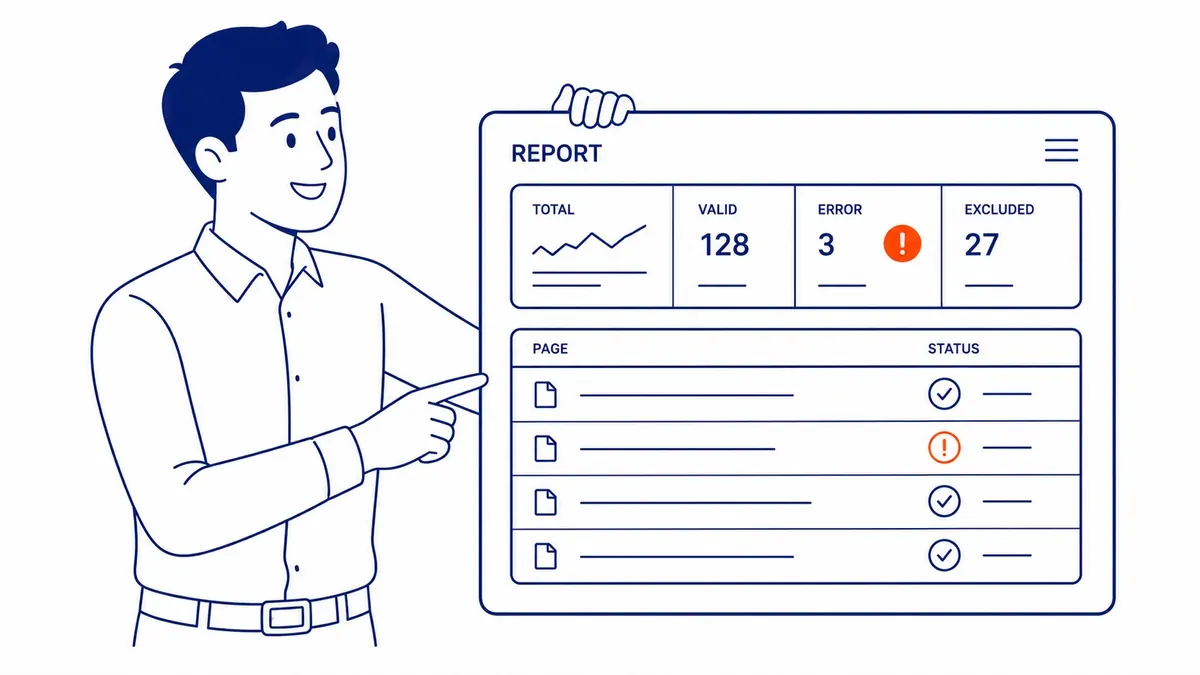
A visibility score is relative to the results page, so it can fall while your site stays exactly as it was. A competitor improves a page and moves above you on a shared keyword, Google adds a map pack or an AI Overview that pushes organic results down, or the tool updates its click curve or its keyword database. Seasonal demand also moves search volumes, which changes the weighting even when rankings hold.
Before treating a drop as a failure, look at the keyword-level data. If one or two high-volume terms slipped a position, that explains most of the change, and the response is to strengthen those pages rather than to rework the whole site. If a competitor has moved up across many shared terms, their gains often come from better content, stronger links or technical fixes, and domain authority metrics can help you size the link side of the gap. SEO changes also take months to show in rankings, so a score that has not moved four weeks after new work is normal.
The levers that raise a score are the usual ones, applied to the keywords that carry the most weight. Pages ranking just off the first page are usually the quickest gains, because a content update and better internal links can push them into positions that earn real clicks. Technical problems that stop Google from crawling or indexing pages hold every ranking back, so they come first if they exist.

Visibility score versus traffic and Search Console
A visibility score estimates the clicks your rankings could earn, while organic traffic is what actually arrived. The two can drift apart, for example when a page ranks well but its title does not match what searchers want, or when ads and other results take most of the clicks on a query. If the score rises and traffic does not, look at click-through rate on the pages concerned before celebrating.
Google Search Console does not give you a visibility score, but it is the free check on your own site’s real performance. Google defines an impression as a user having seen, or potentially seen, a link to your site, and the position it reports is the topmost position your site held for a query, averaged across all the queries where you appeared. That average blends strong and weak rankings together, so read positions query by query rather than relying on the site-wide figure. Search Console shows only your own site, which is why a rank tracker is still needed for competitor comparisons.
For businesses that also run Google Ads, keyword-level visibility data helps decide where paid search is worth the cost. A commercial keyword where the site already ranks near the top may need less paid coverage, while one where organic visibility is weak is a candidate for ads while the SEO work catches up. Make that call from the Google Ads data itself, such as impression share, cost and conversions, rather than from the visibility score alone.
A note on AI visibility
Traditional visibility scores are built from search rankings, organic results and in some tools the local map pack, so they say nothing about whether your business is cited in Google’s AI Overviews or in answers from tools such as ChatGPT and Perplexity. Several rank trackers now report a separate AI visibility metric, each with its own method, and Advanced Web Ranking for one keeps it apart from its SEO visibility percentage. Treat it as a second, separate number rather than a replacement, and compare it only within the same tool, just as you would the organic score.
If you would like help reading what your visibility report is telling you, To-The-TOP! works with businesses in Calgary, Edmonton and Vancouver and reports keyword positions every month. Call (403) 308-5949 to talk it through.
Contact Calgary SEO Company To-The-TOP!
Questions about anything in this article, or about your own rankings? Talk to a Calgary SEO specialist directly.
Phone: (403) 308-5949
Address: 1509 14 Ave SW, Calgary, AB T3C 0W4
Hours:
Monday to Friday: 10:00 am – 7:00 pm
Saturday: 12:00 pm – 4:00 pm
Sunday: closed