How Much Do PPC Agencies Charge? A Straight Answer From a Calgary SEO
PPC pricing is the one question every business owner wants answered before the sales call, and almost nobody gives it straight. I have run paid search accounts for Calgary trades, clinics, and local shops since 2007. The number people actually pay falls into a much narrower band than the blog posts suggest.
So here is the honest version, in Canadian dollars, with the reasoning behind it. Most of what ranks for this query is written for London or San Jose. The figures do not translate cleanly to Alberta, and the incentives behind those figures rarely get explained at all.
Two decades of running these accounts taught me one thing above the rest. The fee is almost never the part that decides whether PPC works for a business. What sits behind that number decides it instead. A cheap fee on a wasteful account loses more money than an expensive fee on a sharp one, every time. So while this whole article is about price, keep the bigger picture in view: what you pay matters far less than what the payment buys.

What PPC Agencies Actually Charge in Calgary
Start with the real range. Managed PPC for a small Calgary business runs CAD 1,000 to CAD 2,500 a month in management, give or take. Add campaigns and the mid-sized bracket opens up, somewhere around CAD 2,500 to CAD 5,000. Bigger programs on several platforms and serious ad spend push past CAD 5,000, sometimes well past it.

That is the management fee only. It does not include the money handed to Google. More on that distinction shortly, because mixing the two is the single most common mistake I see in budget conversations.
Percentage deals are the other format. Most agencies that charge a cut of ad spend land between 10 and 20 percent, though some climb to 30 percent on smaller accounts. A shop spending CAD 8,000 a month on Google Ads management at a 15 percent rate pays CAD 1,200 in management. Simple math, with a catch I will come back to.
Why does the same service cost CAD 1,000 at one shop and CAD 4,000 at another? Different work, even when the pitch sounds identical. Overhead splits them. A solo specialist running one tight search campaign carries nothing like the cost base of a 40-person agency with account managers, strategists, and a sales team to feed.

Why No Two Quotes Look Alike
Quotes scatter for real reasons. Ad spend is the obvious one. More budget means more keywords, more ad variations, more daily decisions about where the money goes. The work scales with the dollars, though not always in a straight line.
Complexity drives the rest. One clean Google Ads search campaign for a Calgary plumber is a different animal than a program running search, Performance Max, Meta, and remarketing across two provinces. Each platform adds its own learning curve, its own reporting, its own optimization rhythm. A bigger budget on one channel can be easier to manage than a small budget split four ways.

Then there is competition. A Calgary personal injury lawyer bids against deep-pocketed firms for clicks that cost CAD 40 or more. Meanwhile a local bakery competes with almost nobody on PPC. The lawyer’s account needs constant attention to keep the cost per lead sane, and that attention costs money. Industry sets the floor more than most owners expect.
Geography matters too, though less in PPC than in organic. Targeting Calgary and Edmonton pulls in two competitive markets at once. Provincial targeting across Alberta widens the net and the workload. The tighter the radius, usually the simpler the build.
Platform choice shifts the cost too, since each one prices clicks differently. Google search ads sit around CAD 3 to CAD 4 a click on average across industries, and far higher in the competitive trades. Display clicks run cheap, often under a dollar, because the intent is weaker. For most local advertisers, Facebook and Instagram land somewhere in the middle. LinkedIn is the pricey one. CAD 7 or more a click is normal there, because it sells access to a professional audience that is hard to reach anywhere else. Four platforms means four cost structures, four reporting setups, four optimization rhythms. Running all of them at once is why multi-platform accounts cost more than a single clean search campaign.

The PPC Pricing Models, and What Each One Costs You
Pricing here is not infinite. Most agencies pick one model or blend two, and the menu is short. Each choice shapes the agency’s incentives differently, which is the part that rarely makes it into a proposal.
Flat monthly retainer. You pay one flat fee every month, and the work scope is agreed up front. Predictability is the whole point. You plan your media budget without wondering whether the invoice jumps when you raise ad spend. Calgary small businesses usually pay CAD 1,000 to CAD 2,500 here. The risk runs the other way, toward scope creep. A low retainer quietly leaves out the work you assumed was covered.

Percentage of ad spend. The fee floats as a cut of what you spend on ads, commonly 10 to 20 percent. It scales cleanly as you grow. That also rewards the agency for spending more of your money, which is its own problem. I give that model its own section below because it deserves one.
Performance-based. The fee ties to results: leads, booked calls, sales, or a bonus on hitting a target. Sounds ideal. It only works when tracking is clean and both sides agree on what counts as a real lead. Reward raw volume and you drown in junk form fills. Define quality tightly and the model can be fair.
Hourly. The agency bills agreed hours at a set rate, often CAD 100 to CAD 200 an hour in this market, tracked with software. Accountability is high. The quiet downside is that slow work pays better than fast work, so the incentive points the wrong way on efficiency.
Hybrid. A base retainer plus a performance bonus, tied to ROAS, a lower cost per acquisition, or qualified leads under a set cost. Done right, this is often the strongest structure. The base keeps the agency stable enough to do real work. That bonus rewards the outcome you actually care about. It has to be tied to revenue, though, not clicks. Nobody pays staff with impressions. Model choice aside, why hire a PPC agency comes down to what you cannot run in-house.

The Percentage-of-Ad-Spend Trap
This model hides a conflict. On paper it looks fair, since the fee grows with the account. Look closer at what it rewards, however, and the picture changes.
The agency earns more when you spend more. Not when you spend better. Those two things are supposed to move together, and on a healthy account they do. On a lazy account they come apart fast. An agency on a percentage deal has a quiet reason to nudge your budget up rather than tighten your targeting down, because a leaner, sharper account that spends less also pays them less.

I am not saying every percentage agency does this. Plenty are honest and good. The structure simply points the incentive in an awkward direction, and you should know that going in. Here is the fix. Tie budget increases to performance. More ad spend should follow better numbers, never replace them.
When does the percentage model genuinely make sense? Growing accounts where more spend really does create more work. Ecommerce brands scaling across products. Situations where the workload and the budget rise together for real. For a stable CAD 4,000-a-month account that does not change much, a flat retainer usually serves you better and costs you less.
There is a version of this model that fixes the conflict, and it is worth asking for by name. A base management fee plus a smaller percentage on top. The base keeps the agency stable enough to recommend cutting wasted spend without starving itself, because its revenue no longer depends entirely on your budget climbing. I have seen this structure turn an adversarial pricing conversation into a genuinely aligned one. The agency makes money when you grow, sure, but it also keeps making money when it tightens your account and your spend drops. That balance is the whole point.
What the Management Fee Is Supposed to Buy
The fee buys work, not magic. Worth knowing exactly what that work is, because a vague proposal often hides a thin one. A fair management fee covers a defined list, and you should see that list before signing.
Account audit and build. Keyword research mapped to how Calgary customers actually search. Ad copywriting and ongoing creative updates. Bid management and budget allocation across campaigns. Conversion tracking setup so the numbers mean something. Monthly reporting tied to leads and revenue, not vanity metrics. A real strategy call where someone explains what changed and why.
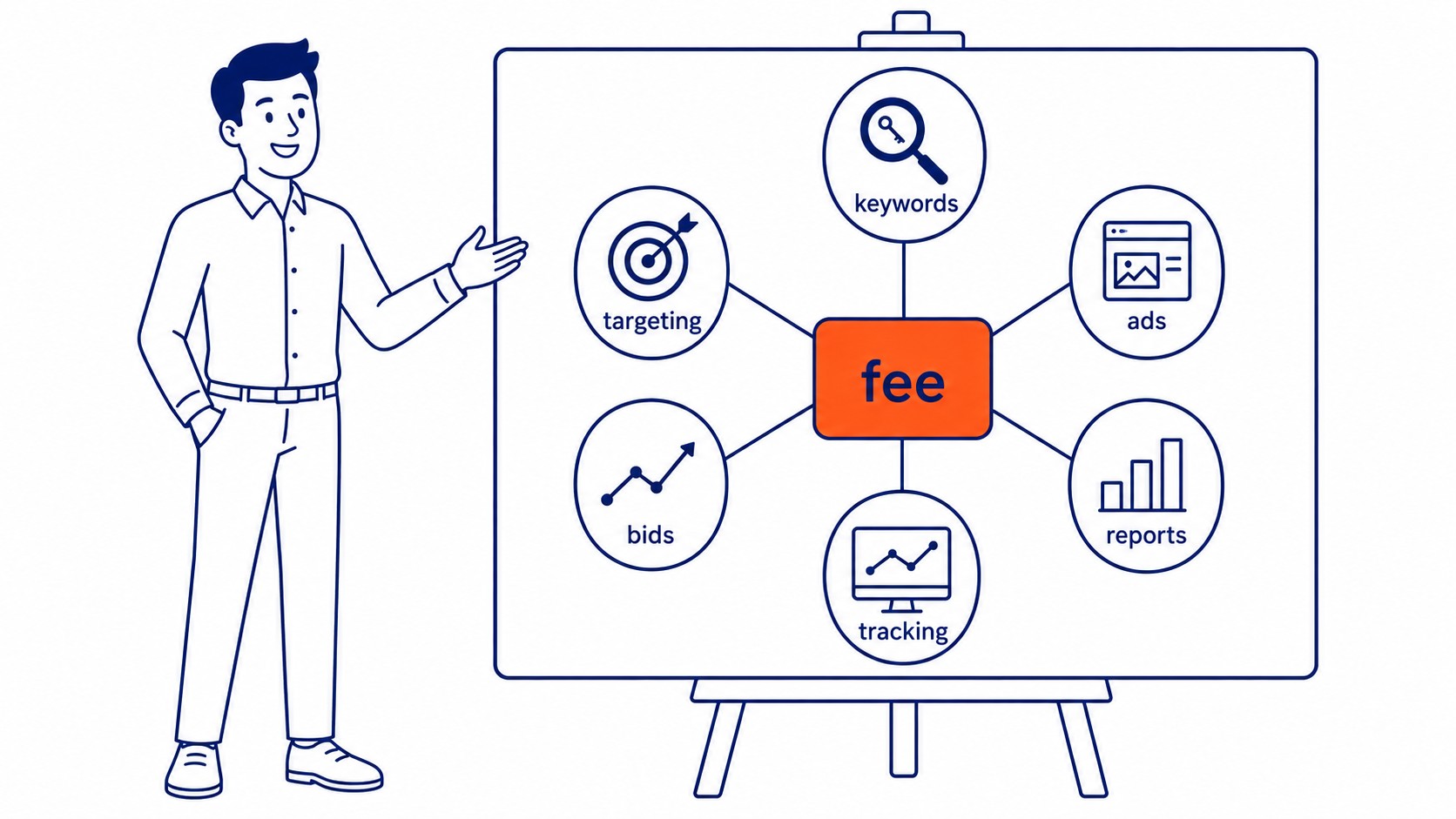
That keyword research piece carries more weight than people credit. The wrong keyword list burns budget on clicks that never convert, and no amount of clever bidding rescues it. Solid keyword research and selection sits underneath every PPC account that performs, which is the same discipline that anchors good search engine optimization on the organic side.
Optimization is the ongoing part, and it never really stops. Search terms get reviewed. Negative keywords get added. Underperforming ads get cut, new angles get tested, bids get adjusted as the data comes in. An account left on autopilot drifts, and a drifting account quietly wastes money every single day.
Here is the part owners underestimate most. A Google Ads account is not a set-and-forget machine, even with all the automation Google now bakes in. The platform’s automated bidding will happily spend your full budget on the wrong searches if nobody is watching the search terms report. I have inherited accounts where 40 percent of the spend went to queries the business could never serve, month after month, because the previous setup had no negative keyword discipline. That waste is invisible on a surface-level report. It only shows up when someone actually digs into where the clicks came from, which is exactly the work a real management fee is supposed to pay for. Owners newer to paid search often want PPC in plain terms before judging any fee. Digging like that is a defined exercise, and doing a PPC audit properly is exactly what it looks like.
Management Fee vs Ad Spend: Two Separate Numbers
Keep these two apart. The confusion costs people thousands. Your monthly PPC investment is two numbers added together, never one.
The ad spend is the money Google or Meta actually charges to show your ads. Management fees are what the agency charges to run the account. A business might spend CAD 8,000 on ads and pay CAD 1,500 to the agency, for a total monthly investment of CAD 9,500. The ads are the bigger number on most accounts, and they go to the platform, not the agency.
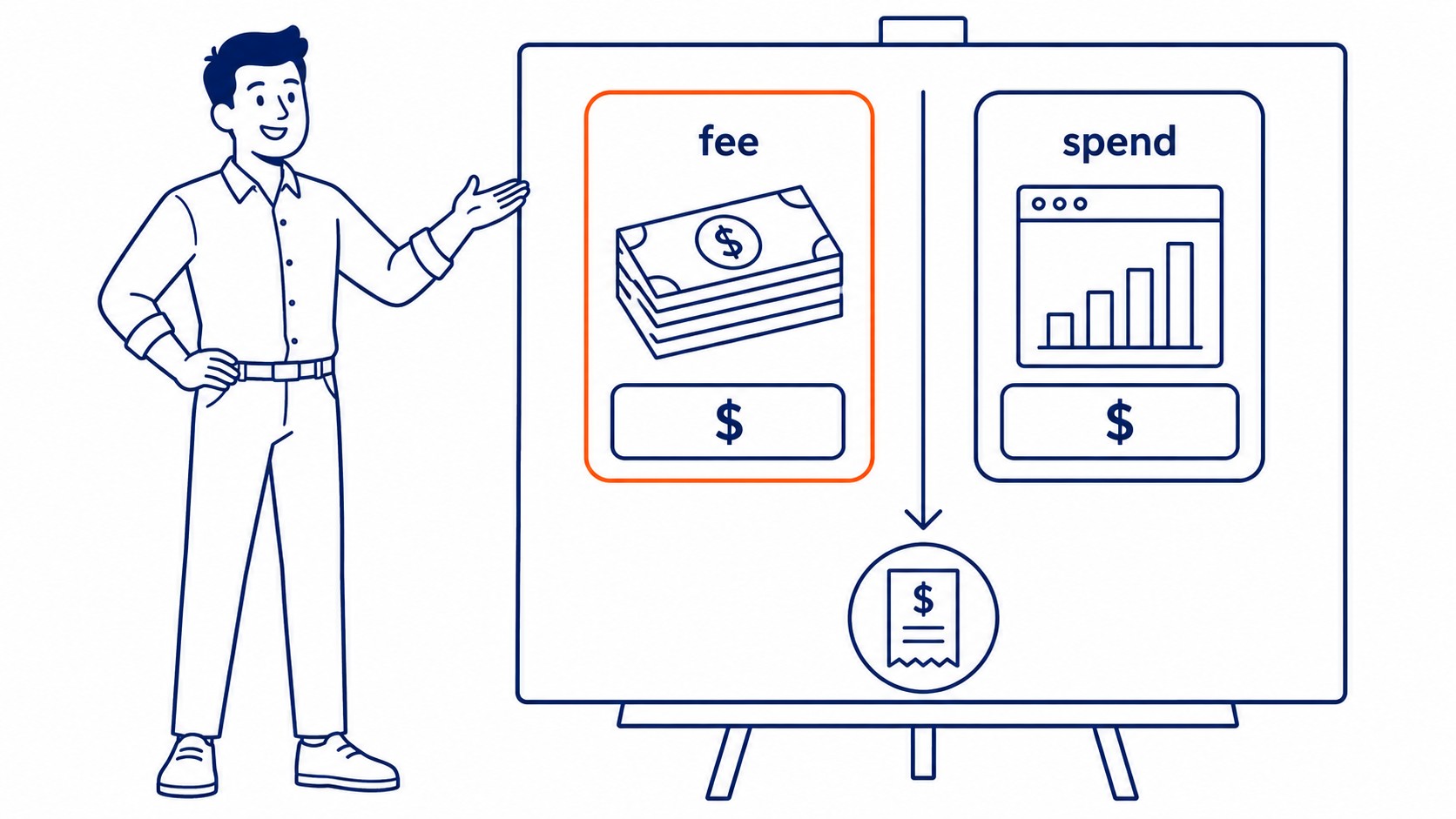
Here is where it goes sideways. An owner hears “CAD 1,500 a month” and pictures the whole cost. Then the first Google invoice lands and the budget conversation falls apart. A good agency states both numbers plainly, in writing, before anything launches. If a proposal blurs the line between fee and spend, treat that as a warning, because clarity here is the easiest honesty test there is.
ROI gets judged on the total, not the fee alone. A CAD 1,500 fee can be a bargain on a CAD 20,000 account that prints profit. The same fee feels heavy on a CAD 3,000 account that barely converts. Either way, the price is only part of the story.
What It Costs by Business Size and Calgary Industry
Size moves the number. So does the trade you are in. A few real patterns from running these accounts in Alberta.
Picture a single-location Calgary clinic, or a trades operator. Ad spend usually runs CAD 1,500 to CAD 5,000 a month, with management somewhere near CAD 1,000 to CAD 2,000. Several services or a few locations, and you climb into the mid-sized bracket. Spend there lands nearer CAD 5,000 to CAD 15,000, management nearer CAD 2,000 to CAD 4,000. Larger advertisers run higher on both, and the arrangements get custom enough to defy a tidy table.
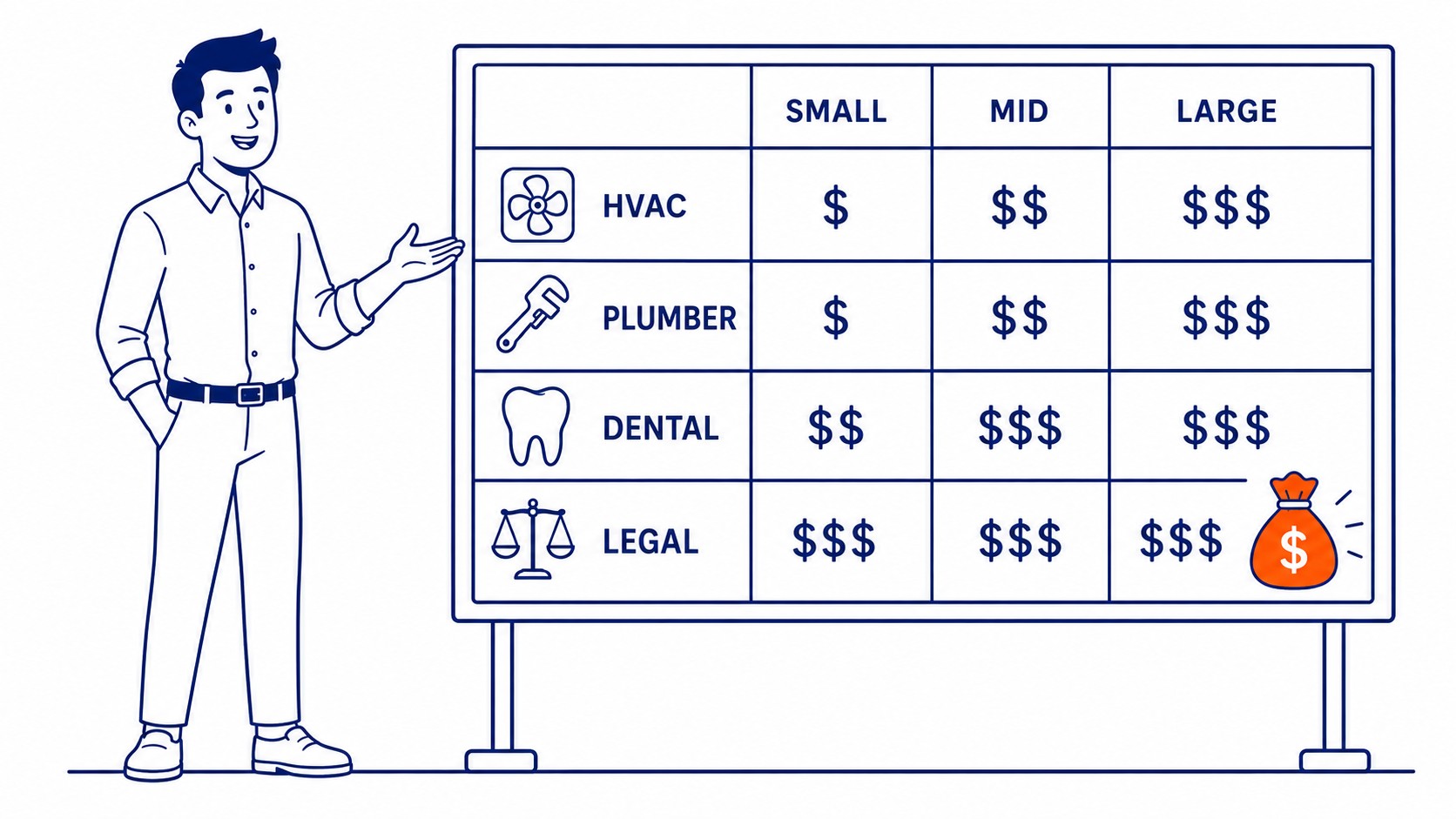
Industry rewrites the math through cost per click. A Calgary plumber or HVAC company bids on emergency keywords that run CAD 8 to CAD 40 a click, because the person searching at 11pm with a flooded basement is worth a lot. Personal injury law, cosmetic dentistry, and insurance sit even higher. A boutique or a niche retailer pays a fraction of that. Same management effort, wildly different ad spend, which is exactly why the cost per click matters as much as the fee.
High-competition trades also need tighter management, not looser. When each click costs CAD 30, a sloppy negative keyword list bleeds real money in a week. The accounts that look expensive to manage are usually the ones where management pays for itself fastest.
Startups sit in their own awkward spot. The instinct is to spend almost nothing, CAD 300 or CAD 500 a month, and expect leads to roll in. That budget barely clears the noise in most Calgary markets. It generates enough data to learn from and not enough volume to grow on. Early-stage businesses get the blunt version from me. Commit enough to actually test the channel, usually CAD 1,500 a month or more in ad spend, or wait until you can. Half-funded campaigns produce half-baked data. They also produce a frustrated owner, and neither outcome justifies a management fee.
The Fee-to-Spend Ratio: One Number That Flags Overpaying
One ratio tells you a lot. Divide the agency fee by the monthly ad spend. The result exposes whether the pricing is sane for the size of the account.
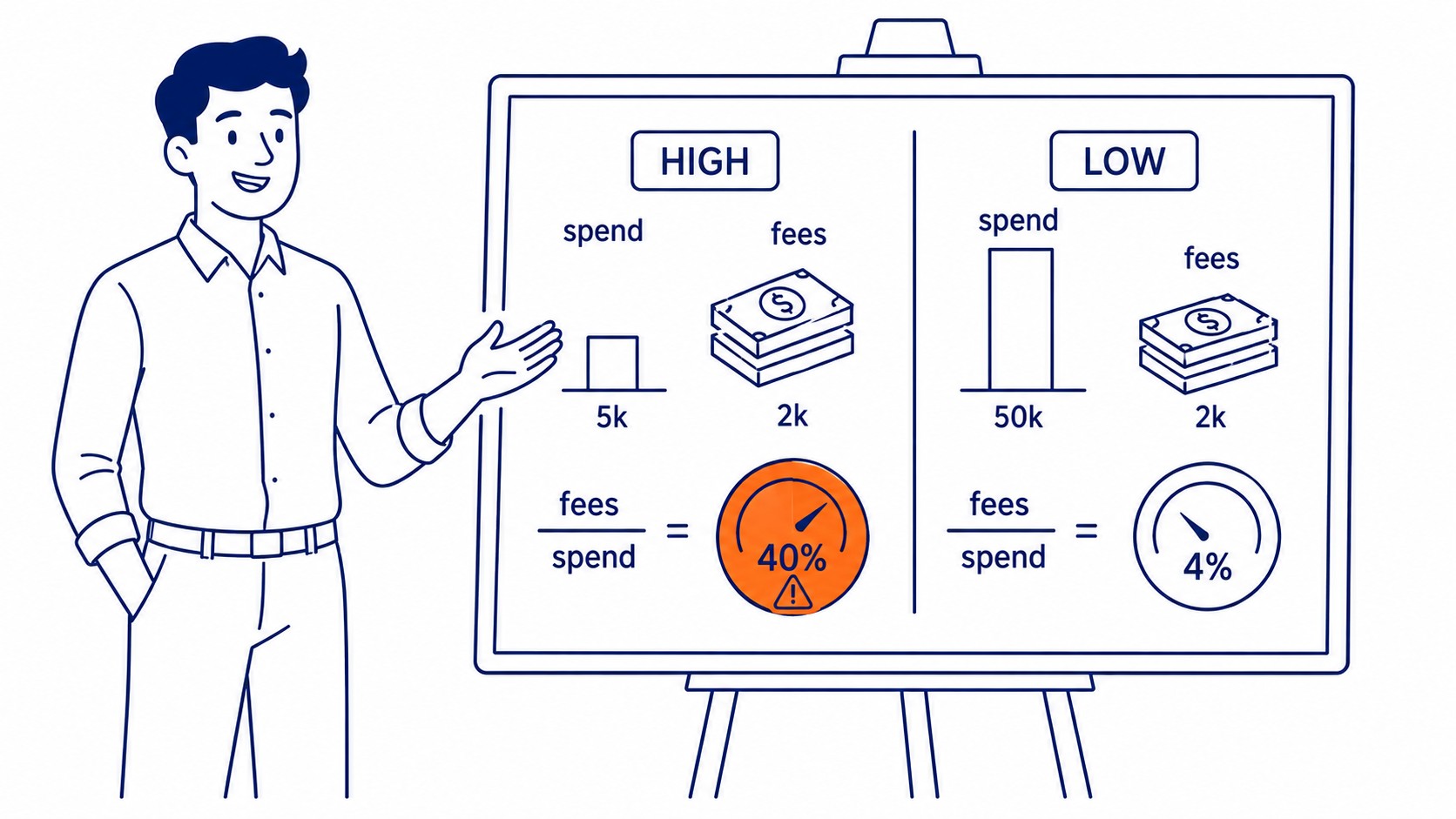
CAD 5,000 in ad spend against CAD 2,000 in fees. That works out to a 40 percent ratio. Push spend up to CAD 50,000 against CAD 5,000 in fees, and the same ratio falls to 10 percent. Same agency, same work style, completely different economics. The small account carries a heavier fee load per dollar, which is normal up to a point.
A high ratio is not automatically a rip-off. It has to be earned, though. Forty percent can be fair if the agency rebuilds your tracking, restructures campaigns, tests landing pages, and reviews search terms weekly. That same cut for “we check the account twice a month and send a report” is robbery. The ratio is a flag, not a verdict.
Below 10 percent on a small account usually signals the opposite problem. Either the agency is barely touching it, or the work is automated and shallow. Suspiciously cheap PPC management tends to cost more in wasted spend than it ever saves in fees. The cheap fee is rarely the cheap option.
Does the Fee Pay for Itself? The Break-Even Math
Run the break-even test. It cuts through the whole “is this expensive” debate in one line. The fee is only too high if it fails to pay for itself, and you can calculate that.
Required extra revenue equals the agency fee divided by your profit margin. Say the fee is CAD 3,000 and your margin sits at 30 percent. The agency then has to generate roughly CAD 10,000 in extra revenue just to cover its own cost. Above that line, the fee earns its keep. Below it, you are subsidizing the relationship.
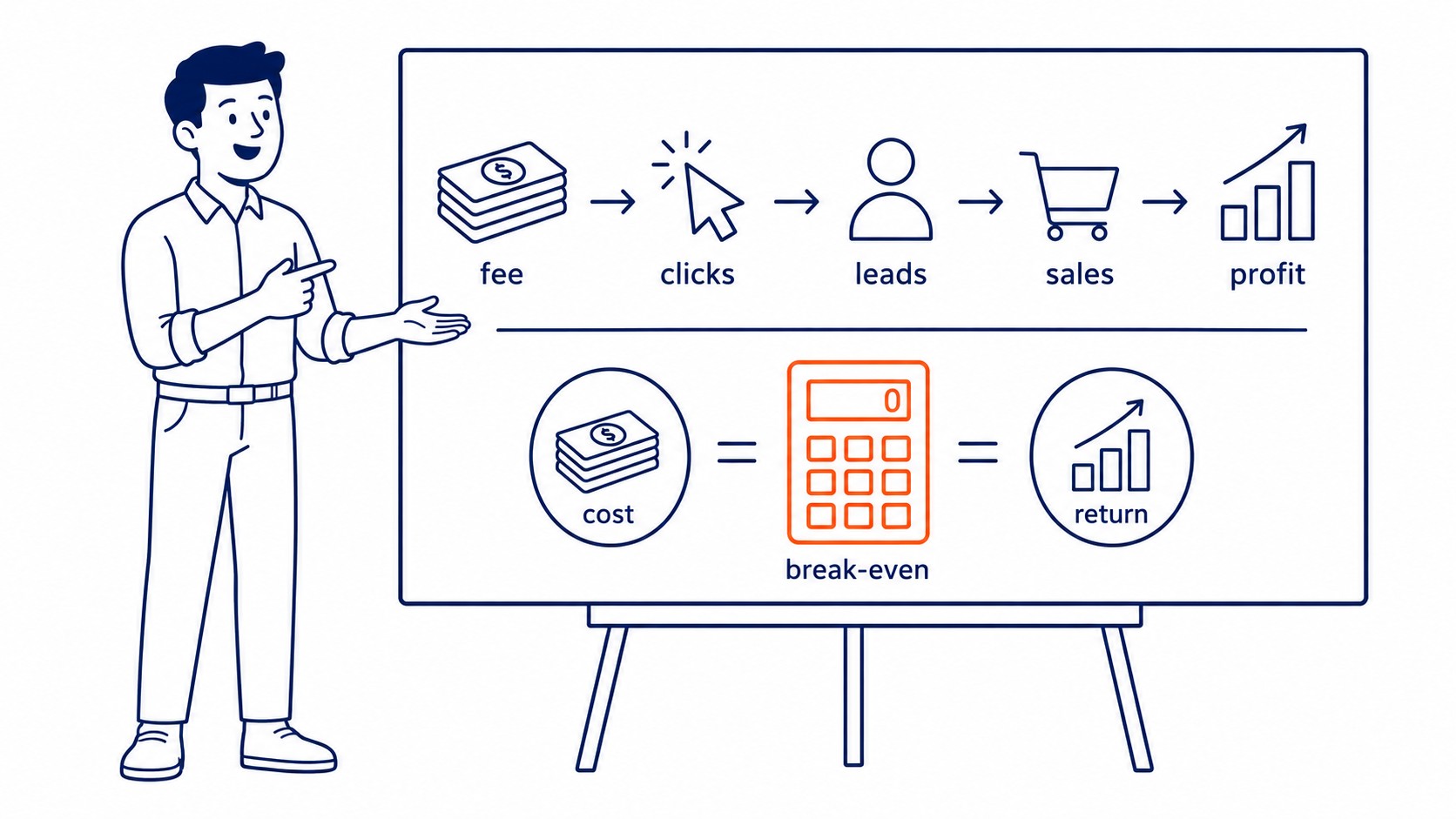
That framing changes the question. The argument stops being “CAD 3,000 is a lot” and becomes “can this account produce CAD 10,000 in profitable revenue I would not have captured otherwise.” For most Calgary businesses with decent margins and real demand, the answer is yes, as long as the account is run properly. For a business with thin margins and a tiny addressable market, the honest answer is sometimes no, and a good agency tells you that before taking your money.
Judge the agency on the signals that move the break-even point. Is cost per acquisition dropping. Does ROAS keep climbing. Has lead quality improved so the sales team closes more of them. Tracked honestly, those numbers settle the whole question. Expense, or investment.
Hidden Fees and the Scope-Creep Tax
Watch the extras. The headline retainer is rarely the whole bill. Some agencies quote a clean monthly number, then layer charges on top for work you assumed was included.
Setup and onboarding fees. Conversion tracking installation billed separately. Landing page design and testing. Creative production per asset. Reporting dashboard fees. Extra charges for each additional platform. Cancellation fees buried in the contract. I call this the scope-creep tax, and it turns an “affordable” quote into an expensive surprise three months in.
None of these charges are automatically wrong. A landing page build is real work and deserves payment. The problem is disclosure. A fair agency tells you up front what the base fee covers and what costs extra, in writing, before you sign. By contrast, a vague proposal with a low headline number often hides the real cost in the fine print.
The one extra worth fighting over is ownership. Who owns the ad account, the campaign data, and the tracking setup when you leave? It should be you, every time. Some agencies build everything inside their own account and hold it hostage at the exit. Ask the question before signing, because the answer tells you a great deal about how the relationship ends.
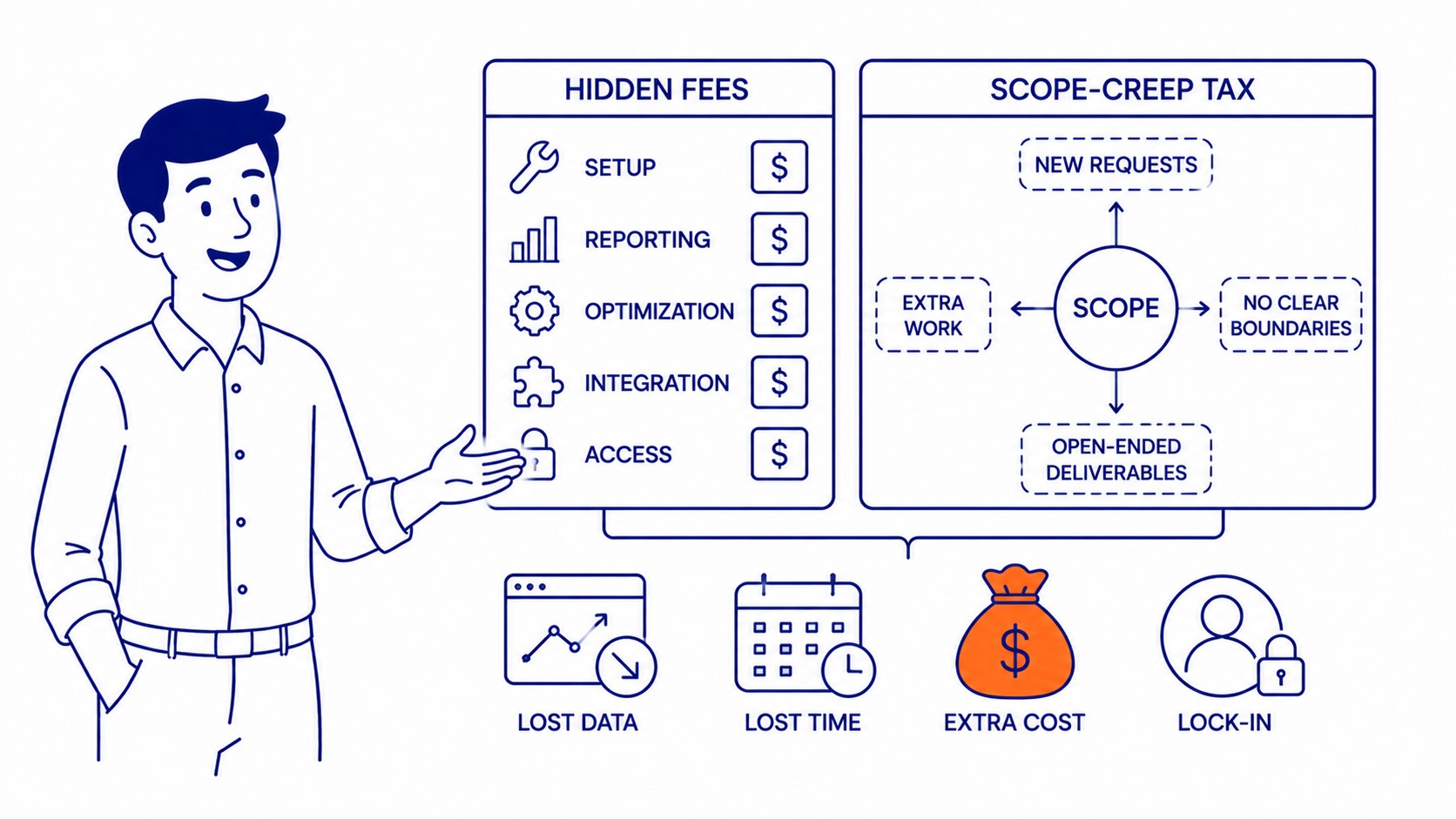
I have watched businesses lose years of conversion history this way. They switch agencies, expect a clean handover, and discover the account, the data, and the tracking all lived in the old agency’s house. Starting over means a fresh learning phase and a fresh waste of budget, all because nobody asked one question at the start. Insist that the ad account is registered under your business, that you hold admin access, and that the data is yours to take. A confident agency agrees without blinking. The ones that resist are telling you exactly why you should keep the keys.
In-House, Big Agency, or Solo Specialist
Three paths exist. Each one hides its real cost behind a different structure, and the headline fee shows you almost none of it. Ignore the sticker. Compare the real numbers instead.
Hiring in-house means a salary. A competent paid search manager in Alberta runs CAD 70,000 to CAD 95,000 a year, plus benefits, plus the software stack, plus the ramp-up time before they produce. That is CAD 7,000-plus a month all in, for one person who also takes vacations and gets sick. It makes sense at real scale, when the ad spend justifies a full-time hire and then some.
A big agency spreads the cost across a team, which sounds better than it often is. The pitch comes from a senior strategist. Day-to-day work frequently lands with a junior who juggles a dozen accounts. You pay senior rates for junior attention, and your account competes with everyone else’s on that account manager’s roster.
A solo specialist is the third path, and it is the one I run. No junior handoffs. The person who pitches the work does the work. Overhead is lower, so more of your money buys actual account management instead of feeding a sales department. Capacity is the trade-off, since one person takes a limited number of clients. That constraint is also why the attention stays high. There is no roster to get lost in.
A quieter advantage exists too, and it took me years to appreciate it fully. Watching the same Calgary markets since 2007 builds pattern memory that no junior can fake. I know roughly what a plumbing keyword costs here, what a dental lead is worth, which seasons spike for which trades, and where the wasted spend usually hides. That context shortens the learning phase, because the account does not start from zero. Big agencies rebuild that knowledge on every new hire. A solo operator who has stayed in one market just has it. For a small business, that experience often matters more than the size of the team behind the login.
How Long Before Paid Actually Pays
Patience is part of the cost. Anyone promising instant PPC results is selling you something. Paid search does start faster than organic, true. Faster is not instant, though, and that gap trips up new advertisers constantly.
Traffic shows up the day the campaign goes live. Profitable traffic takes longer. The platforms run a learning phase while the algorithm figures out who converts, and the first two to four weeks are mostly data collection. Real optimization needs that data before it can do anything useful. Spending hard in week one and judging the account in week two is how good campaigns get killed early.
Most accounts find a stable cost per acquisition somewhere in the one-to-three-month window. The competitive Calgary trades take longer, because each click costs more and the data accumulates slower. That is the honest timeline, and it is worth saying plainly: budget for three months before you decide whether the account works. This is also where paid and organic differ, since search engine optimization compounds over many months while a well-run paid account can hold steady once it settles.
Cutting the budget in month one almost guarantees you waste the setup investment. The learning phase resets, and you pay for it twice.
What does steady look like once the account settles? The numbers stop swinging week to week. Cost per lead settles into a predictable band. The search terms report stays clean. Conversations move from is this working to how do we scale it. Getting there takes disciplined management and a budget that holds steady through the messy early weeks. Owners who understand the timeline going in tend to get there. The ones who expect week-one profit tend to pull the plug right before the account would have turned the corner, which is the most expensive mistake in paid search and also the most common.
What to Ask Before You Sign
Push on specifics first. A good PPC agency answers plainly. Weak ones get vague, overcomplicate the answer, or steer everything back to clicks and impressions. The questions below sort one from the other fast.
What exactly does the monthly fee include, and what costs extra. Do you charge a separate setup fee. Is conversion tracking part of the package or billed on top. Do you review lead quality or only lead volume. Who owns the ad account and the data when we part ways. What happens to the fee if we raise ad spend. Which metrics show up in the report: cost per acquisition and revenue, or just traffic and clicks.
The answers matter less than the manner. Clear, direct, comfortable with the hard questions: that is the agency you want. Defensive, foggy, allergic to specifics: keep looking. Confusing answers before the contract turn into frustrating invoices after it.
One more thing worth doing. Ask to see real numbers from accounts like yours. Any PPC agency worth hiring keeps a portfolio it can point to, and a Calgary business should expect Calgary-relevant examples in it, not a wall of logos with nothing behind them. Still weighing whether to run paid at all? A plain conversation about your goals beats any pricing table. The team handling your Google Ads management should be the same one explaining the strategy behind it. That holds whether you start with paid, with Calgary SEO, or with some blend of the two.
Frequently Asked Questions
How much does an agency charge for PPC?
Small Calgary account: CAD 1,000 to CAD 2,500 a month. Mid-sized: CAD 2,500 to CAD 5,000. Larger programs push past CAD 5,000. All of that is management only, kept separate from ad spend. Percentage deals usually land at 10 to 20 percent of what you hand the platforms. Complexity moves the number more than size ever does.
What is the average cost of PPC management?
No single average means much here, because the inputs swing so wildly. One honest benchmark, though. Most small-to-mid Calgary businesses pay management between CAD 1,000 and CAD 4,000 a month. Stack the ad spend on top and the total monthly investment usually lands somewhere around CAD 5,000 to CAD 15,000, depending on how competitive your market runs.
How do you charge for PPC services?
Five structures cover it. Flat monthly retainer. A percentage of ad spend. Performance-based fees. Hourly billing. Or a hybrid, retainer plus a results bonus. Stable accounts do best on a flat retainer, where the cost stays predictable. Hybrids tend to align incentives best, because the base keeps the work steady while the bonus pays out on real results. The model you pick matters as much as the number on it.
Is $5 a day enough for Facebook ads?
For testing, yes. As a real growth channel, rarely. Five dollars a day works out to about CAD 150 a month. Enough to learn something, nowhere near enough to scale. As a first experiment to see whether an audience bites, fine. A real lead-gen or sales campaign in a competitive Calgary market needs more fuel than that to clear the learning phase and return anything steady.
Should a small business hire a PPC agency at all?
Often, though not always. Decent margins, real demand, and no time to run the account yourself: a good agency usually pays for itself there. When your margins are thin or your market is tiny, the math can work against you instead, and a straight answer up front saves everyone the trouble. The honest test is the break-even calculation, run before you sign anything. Time is the other honest test. Managing a paid account properly is a few hours a week of focused work, every week, and most owners do not have those hours to spare. Buying back that time, and the expertise that comes with it, is often the real value an agency delivers, well beyond the clicks themselves.
Contact Calgary SEO Company To-The-TOP!
Questions about anything in this article, or about your own rankings? Talk to a Calgary SEO specialist directly.
Phone: (403) 308-5949
Address: 1509 14 Ave SW, Calgary, AB T3C 0W4
Hours:
Monday to Friday: 10:00 am – 7:00 pm
Saturday: 12:00 pm – 4:00 pm
Sunday: closed