
What to Do After Keyword Research
What to do after keyword research comes down to turning the list into a plan of pages. Group the keywords by what the searcher wants, check the search results to confirm which groups can share a page, give every group one owner URL (an existing page or a new one), put the groups in order by business value and difficulty, and then write, link and measure. A keyword list has never ranked anything on its own, because Google ranks pages. The job is finished when you can point to a short list of URLs, each with its target group and a date, and not before.
That sounds simple, and the steps themselves are not complicated, but most keyword files stall somewhere between the export and the first draft. The sections below follow the order the work should happen in, with the decisions that tend to go wrong at each stage, including a few that matter more for a Canadian or Calgary business than the usual guides suggest.
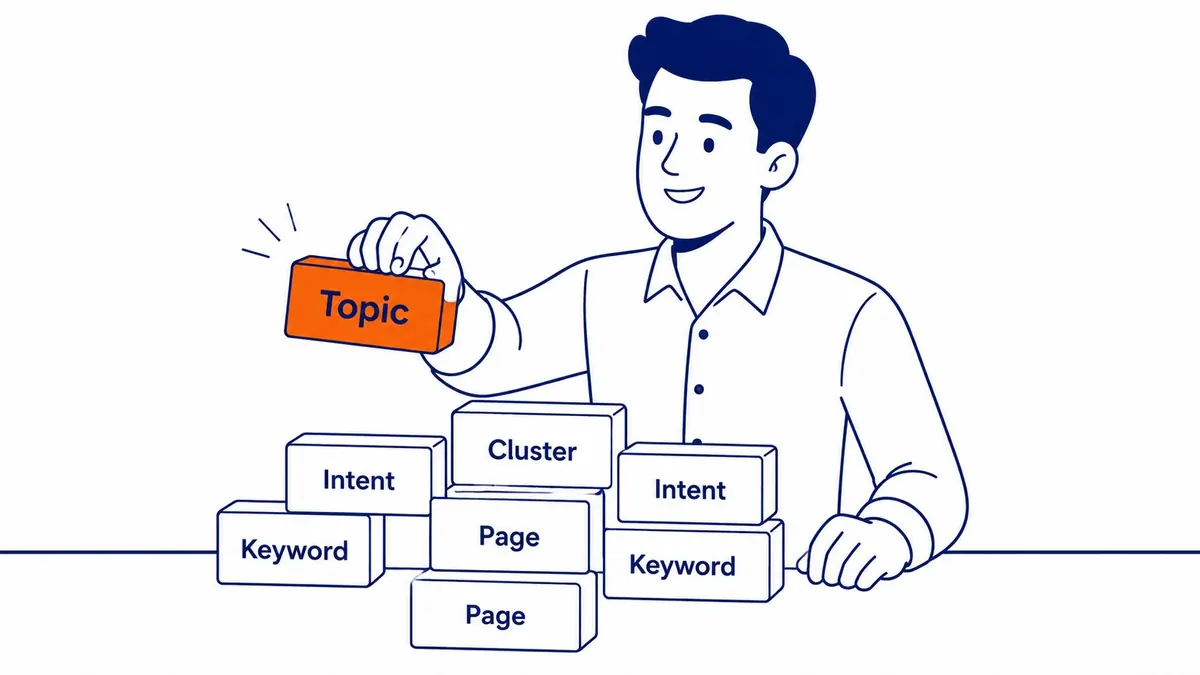
Group the keywords by what the searcher wants
Most raw lists contain the same search written several ways. “Bookkeeper Calgary”, “Calgary bookkeeping services” and “bookkeeping company in Calgary” are one person looking for one thing, so they belong together, and the grouping should follow search intent rather than shared words. Google’s SEO Starter Guide supports this: it says Google’s language matching systems can understand how a page relates to many queries even when the page does not use the exact terms. You do not need a page for every phrasing, and building one usually produces thin, near-duplicate pages.
When two keywords look alike but you are not sure they share a page, search both and compare the results. If the same handful of pages rank for both, one page can serve both. If the results are different kinds of pages, for example service pages for one and how-to articles for the other, the searchers want different things and the keywords need different pages. A common working rule is that three or more shared URLs in the top ten means one group, but treat it as a rule of thumb, not a Google threshold.
Local searches need their own judgement. A group like “furnace repair Calgary” or “accountant near me” is usually answered by a map pack and service pages, so it belongs to a service page and to the Google Business Profile, not to a blog post. Google’s local ranking help page says local results are mainly based on relevance, distance and popularity, and no article on a website changes the distance part. Be careful with the urge to split one service into a page per suburb, too. Google’s spam policies list doorway abuse, which includes pages targeted at specific regions or cities that funnel users to one page, so a separate Airdrie or Cochrane page is only worth building when there is something real and different to say about serving that place.

Give every group one page
Once the groups are settled, build a keyword map: a simple sheet that lists each group, its main keyword, the page type the search results reward and the URL that will own it. Every group gets exactly one owner. When two pages on the same site chase the same group, they can end up competing with each other, and the usual fix is to merge them or give each one a clearly different target.
Here is what the start of a map can look like for a small business. It is an illustrative example for an imaginary Calgary bookkeeping firm, not a real client, and the decisions in the last column are the point of the exercise.
| Group (main keyword) | Page type the results show | Owner URL | Decision |
|---|---|---|---|
| bookkeeping services Calgary | Service pages and a map pack | /bookkeeping-services/ (exists) | Update the page; tie it to the Business Profile |
| how much does a bookkeeper cost | Articles with price ranges | /bookkeeper-cost/ (new) | Write a new article |
| GST filing for small business | Government pages and guides | /gst-filing-help/ (new) | Write it only if the firm offers GST filing |
| bookkeeper vs accountant | Comparison articles | /bookkeeper-vs-accountant/ (exists) | Leave it; it already ranks on page one |
Before writing anything new, check what each existing page already does in Google Search Console. In the Performance report, open a page and look at the queries it shows for. A page that already appears for its group, even on page two or three, is usually the better candidate for an update than a new URL, because it already shows for those searches, and a second page on the same topic would only compete with it. Read the position column with care, though: Google defines average position as the position of the topmost result, and at page level it blends every query the page appears for, so check the figure for the specific query rather than the page total.

Put the groups in order by business value
Search volume is the most tempting number in the sheet, but on its own it is a poor guide to the order. A group close to a phone call or a booking is worth more than a bigger group of people who are only reading, so ask three questions of each group. Is it close to something you sell? Can you realistically compete with the pages that rank now? Do you already have a page for it? Groups that get three yes answers go to the top, and for most service businesses that means service pages before any blog post.
Volume figures need extra care in Canada. Check the country setting behind every volume figure, because some keyword tools default to a US database, and a US number says little about demand in Calgary or Edmonton. Google’s Keyword Planner help also notes that keywords with very low search volumes are not discoverable or forecastable, and narrow local commercial searches can fall into that group. A Calgary keyword that shows no volume is not proof that nobody searches it, and a term with a small number can still be worth a page if the people searching it are ready to hire.
When a commercial group matters and the SEO page will take months to earn its place, a small Google Ads campaign can fill the gap and teach you something along the way. The search terms report shows the searches that triggered your ads (Google leaves out terms used by too few people), so it gives a good sample of how people phrase the group in your area. That wording can then go into the SEO page, and the ads can be scaled back once the page holds its own.

Match the page type, then write a brief
Before writing, look again at the results for the main keyword of the group and build the kind of page that already ranks there. If the top results are service pages, a blog post will struggle; if they are step-by-step guides, a sales page will struggle. Google’s guidance on helpful, people-first content asks whether a page provides substantial value compared with other pages in the search results, and matching the format is the starting point for that, not the finish.
A short brief keeps the writing on target. For each page, note the main keyword and the close variants from its group, the type of page that ranks and what those pages cover, what yours can add that they do not (local detail, a decision rule, a worked example, a question the others skip), the questions a reader would ask next, and which existing pages will link to it. Keep the brief short and in proportion to the page, although a technical or regulated topic needs more source checking than a simple article.

Publish, link and measure
Work down the priority list at a pace you can keep up, because a handful of solid pages beats a burst of thin ones, and put the dates into a publishing calendar so the plan does not stall after the first month. As each page goes live, add links to it from related pages that already get impressions, using anchor text that reads naturally in the sentence. A new page with no internal links is hard for both visitors and Google to find.
Then give it time. SEO results take months, and a new page on a young site often shows little in its first few weeks. After a couple of months, open the page in Search Console and compare the queries it shows for with the group it was written for. Queries you planned for confirm the map; queries you did not plan for are new research, and they either go to an existing page or start a new group. Revisit the whole map whenever the business adds a service, the results for a main keyword change, or two of your pages start showing for the same search.
Turning the list into a plan
The short version is that keyword research ends with a list of pages, not a spreadsheet. Group by intent, check the results, give each group one owner, start with the groups closest to a sale, and measure what each page actually ranks for. SEO Company To-The-TOP! has been a Calgary SEO practice since 2007, and if you have a keyword file that has not turned into pages yet, the keyword research and mapping service is a good place to start the conversation. You can also see the wider range of services on the SEO Company To-The-TOP! home page.
Contact Calgary SEO Company To-The-TOP!
Questions about anything in this article, or about your own rankings? Talk to a Calgary SEO specialist directly.
Phone: (403) 308-5949
Address: 1509 14 Ave SW, Calgary, AB T3C 0W4
Hours:
Monday to Friday: 10:00 am – 7:00 pm
Saturday: 12:00 pm – 4:00 pm
Sunday: closed