How to Find Niche Keywords | Calgary
Niche keywords are the specific, lower-competition search terms that pull in the exact people most likely to buy from you. I have run SEO since 2007, and the clients who win in tight markets almost never win on the broad head terms. They win on the narrow ones nobody else bothered to chase. One Calgary client sells cold-weather dog gear. She does not rank for “dog coats,” a term owned by national retailers. Her store ranks for “insulated dog coat for short-haired breeds,” and that phrase converts at roughly three times the rate.
So here is the practical guide I give business owners who ask how to find niche keywords without a five-figure tool budget. It is the same groundwork behind every Calgary SEO campaign I run. No theory you cannot use. Just the process that fills a shortlist with phrases worth writing for.
What Niche Keywords Are and Why They Convert
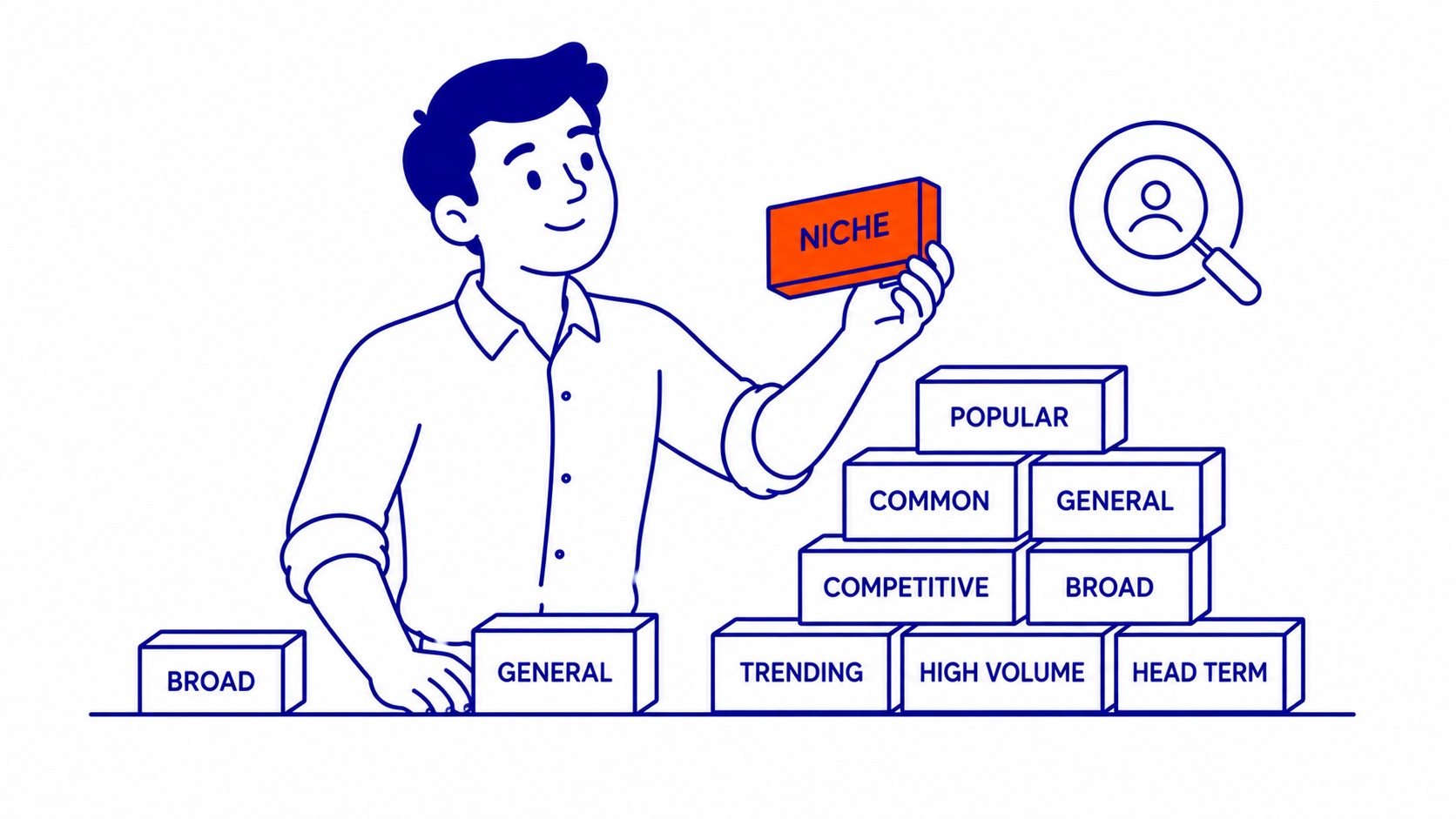
Start with the definition, because it gets muddled fast. A niche keyword is a search term tied to a specific corner of a broader market. “Running shoes” is a head term. “Trail running shoes for flat feet” is a niche keyword. Narrower audience, lower search demand, and far less competition fighting over it.

Why do they convert better? Intent. Someone typing a long, specific phrase already knows what they want, so they sit deeper in the buying cycle than the person searching the generic term. Lower traffic, higher conversion. That trade is the entire reason niche keywords matter to a small business. You stop fighting national brands for a vague phrase. Instead you answer a precise question your competitors skipped over. People searching broad terms are often just browsing; people searching specific ones are frequently ready to act. If you want the wider picture first, our explainer on what SEO keywords are covers how all the pieces fit together.
Start Your Niche Keyword Research With Seed Terms
Every keyword list begins somewhere, and that somewhere is a seed keyword. A seed keyword is just a broad word or two describing what you do. “Dog gear.” “Tax help.” “Yoga studio.” Plain, obvious, the kind of phrase you would say out loud to a stranger at a barbecue.
From there, niche keyword research is mostly expansion and listening. Where does your audience actually talk? Reddit threads, Facebook groups, the question section under Amazon listings, the one-star reviews on a competitor’s product. People describe their problems in their own words in those places, and their words are keywords waiting to be collected. I keep a running doc open while I read them and paste anything that sounds like a search. Google autocomplete pulls its weight too. Type that seed term into the search bar and watch what Google suggests underneath. Those suggestions come straight from real search queries, which makes them reliable raw material for the seed list. Ten minutes of this usually surfaces phrases no tool would have handed me cold.

Mine Competitors for Niche Keywords You Are Missing
Your competitors already did some of this work. Borrow it. Find two or three sites that rank for the terms you want, then study what else they rank for. The gaps are where the real opportunity hides, because those are the searches with demand that nobody in your space has answered well.
This is competitor keyword gap analysis, and it does not require expensive software to start. Read their content first. Note the niche keywords showing up in their page titles and headings that never made it onto your own list. A free account on most keyword tools will then surface a competitor’s top organic terms in a few clicks. Phrases with steady search demand and weak competition go straight onto your list. The goal here is not to copy what they rank for. It is to spot the specific phrases they own that you have ignored, then cover those topics in more depth than they did. That depth is usually what tips the rankings your way over the following months.
Use Keyword Tools to Expand and Filter the List
Now the software. A keyword tool turns a short seed list into hundreds of candidates, then helps you cut the pile back down to something usable. Google Keyword Planner comes free with an ads account and works fine for raw volume estimates. Search Console is the one people forget about entirely. It reports the exact queries already sending visitors to your site, including long-tail phrases you never deliberately targeted, which is often the fastest route to a niche term with proven demand.
Paid platforms go deeper. Ahrefs, Semrush, and Moz Keyword Explorer each generate large keyword lists with difficulty scores attached to every term. You do not need all three, and a tight budget can lean on the free options for a long time. Honestly, the filtering matters more than the tool. Sort the candidates by search volume, screen out anything wildly competitive, and flag the long-tail terms carrying obvious buyer intent. What is left is your real keyword list. Running that structured keyword research process is exactly the work we take off clients who would rather not live inside these dashboards themselves.
Judge Search Volume, Intent, and Competition Together
Here is where most keyword lists quietly go wrong. People chase search volume on its own. Raw volume with no intent behind it is a vanity number that feels good and books nothing. Weighing those factors against each other is what how to choose keywords really comes down to.
Judge three things at once instead. Volume tells you how many people search for it each month. Search intent tells you what those people actually want, whether they are reading to learn, comparing options, or ready to spend. Competition tells you how hard ranking for it will realistically be. A niche keyword with modest volume, clear commercial intent, and weak competition beats a high-traffic term you will never rank for on page one. That is the 80/20 reality of this work: a small, well-chosen set of terms drives most of the return, while the rest mostly pad the spreadsheet. When competition keeps blocking otherwise great terms, our guide to finding low-competition keywords digs further into how to score that trade-off.

Turn the Keyword List Into Content
A keyword list sitting in a spreadsheet earns nothing. It has to become content. Group the related phrases into topics, and hand each topic its own page. One core niche keyword per page, supported by the close variations and long-tail phrases that naturally cluster around it.
That mapping is the bridge between research and rankings, and it is the step most do-it-yourself efforts skip. A focused page answering one specific question, built around a single cluster of niche keywords, will outrank a sprawling page that tries to cover everything at once. For the terms sitting at the very specific end of your list, our piece on long-tail keywords shows how to build content that targets them cleanly. And while the organic side takes its usual few months to mature, a tightly aimed Google Ads management campaign can put those same niche keywords in front of buyers this week, which buys you traffic and conversion data while the rankings build.
What are niche keywords?
Specific, lower-competition search terms aimed at a defined slice of a bigger market. “Coffee maker” is broad. “Pour over coffee maker for hard water” is a niche keyword. Smaller audience, lighter competition, and usually a visitor who is much closer to buying than the one typing the generic phrase.
How do I find keywords for my niche?
Start with a seed keyword describing what you do, then expand outward. Listen to how your audience phrases problems in forums and reviews, check Google autocomplete, mine competitors for gaps, and run the candidates through a keyword tool. Then filter the results by search volume, intent, and competition. Whatever survives that screen is your working niche keyword list.
What is the 80/20 rule in SEO?
Roughly 20 percent of your keywords tend to drive about 80 percent of the meaningful results. A handful of well-matched niche keywords, chosen for genuine buyer intent rather than raw volume, usually outperforms a long list of broad phrases. Find that 20 percent and aim your content effort there before anything else.
Is SEO still worth it in 2026?
Yes, although it keeps shifting under our feet. Search behaviour is moving toward AI-assisted answers, yet those answers still pull from ranked, well-structured pages underneath. Niche keywords matter more in that world, not less, because specific and genuinely useful content is what gets surfaced and cited. SEO is slower than paid advertising, however, and steadier in what it returns over time.
