
How to Complete a Topical Map for SEO
A topical map is a structured plan that documents which topics and subtopics your site will cover, which page covers each one, and how those pages connect to each other through internal links. The purpose is topical authority: the signal search engines use to identify which sites genuinely cover a subject in depth, versus sites that happened to publish a few pages about it.
Completing your topical map is not a one-afternoon task. It requires researching the full scope of your subject, mapping everything to specific pages, and building the internal link structure that connects them. What you get when the work is done is a content strategy that compounds — each new page strengthens the existing ones, rather than competing with them.
What a Topical Map Actually Is
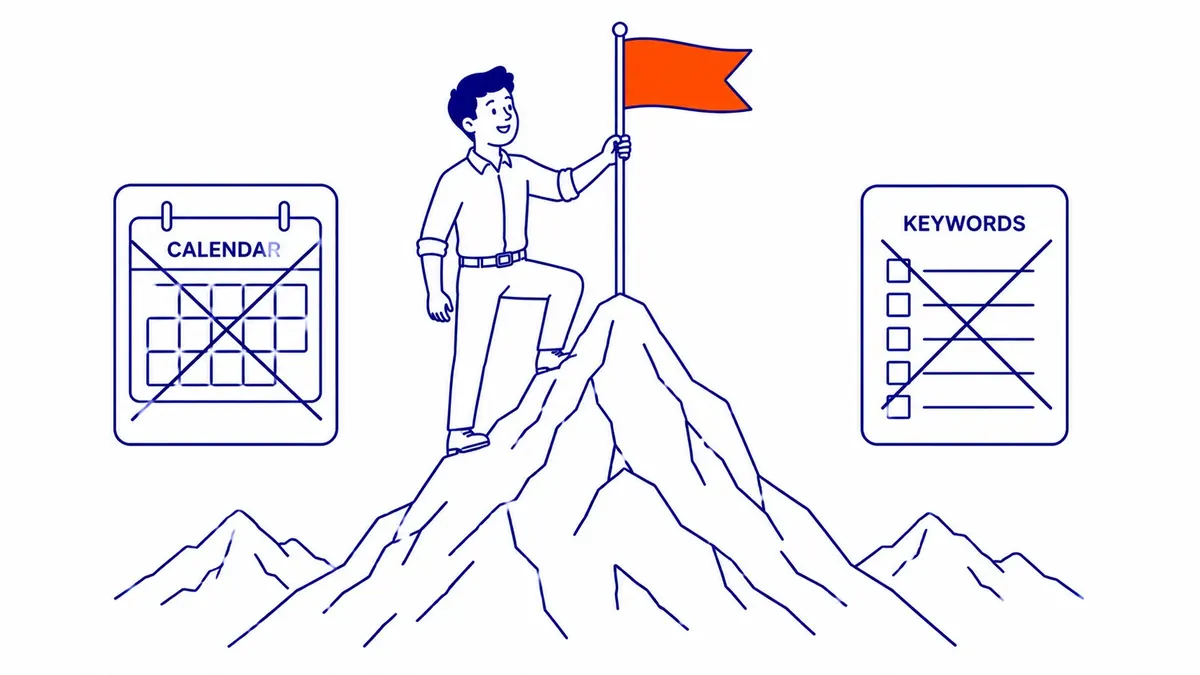
Your topical map is a master document that shows the full coverage plan for your site’s subject matter. It lists every topic and subtopic worth covering, assigns each one to a specific URL, and defines the hierarchy: which pages are pillar content, which pages are supporting content, and how them together create a complete coverage of the subject.
Search engines process everything on a site as a signal of what that site is about. A site that covers ten subtopics of a subject with dedicated pages reads differently to them than a site with one page that mentions all ten subtopics briefly. Depth signals authority. Your topical map is the plan for building that depth systematically. Depth is also how a site picks up organic keywords it never explicitly targeted. Finding the holes in that plan is content gap analysis in SEO explained at its simplest.
Step 1: Identify Your Core Topics
Start with the subjects your business genuinely knows well. For most businesses, this maps to their services or products. An SEO company covers topics like keyword research, on-page optimisation, link building, technical audits, local SEO, and content strategy. Each of those is a core topic. Your topical map begins by listing them all.
Do not filter at this stage. The goal is to identify everything that belongs under your subject, not to decide what you have time to write. A complete picture of what topics exist in your space gives you the full scope before you prioritise. Most businesses underestimate everything their category covers; the map reveals what is actually out there.

Step 2: Research Your Subtopics
Each core topic has subtopics, and competitor keyword research helps surface them. Enter your core topic into a keyword tool and look at the related questions, modifiers, and long-tail variants. Group them by intent: informational (what is, how does, why), commercial (what is the best, how to choose), and navigational (brand or tool specific). Each intent cluster represents a potential page or content type.
People Also Ask boxes in Google search results are another source. Search your core topic and collect every PAA question. Them together form a list of what users are actually asking about your subject — which is more useful than what you assume they are asking. Your topical map should answer all of it, not just the high-volume queries at the top.
Step 3: Assign Topics to Pages
Map each subtopic to a specific URL. One page per topic. Topics that overlap should be handled by one page rather than two competing pages on the same subject. Content cannibalisation — where two pages compete against each other for the same keyword — is a common topical map failure mode. Your map should make it clear which page owns which topic, with no ambiguity.
Create a spreadsheet. Columns: topic, assigned URL, content type, word count estimate, existing or new. The “existing or new” column is what makes your topical map immediately actionable — it shows you what you already have versus what you need to build. Some topics you will already cover on existing pages. Mark them and move to what is missing.

Step 4: Build the Internal Link Structure
Your topical map is incomplete without internal links. The map defines the topics; internal links are what communicate your topical map structure to search engines. A pillar page about a core topic should link to every subtopic page beneath it. Each subtopic page should link back to the pillar and sideways to closely related subtopics.
Search engines follow links to understand relationships between content. A cluster of pages about a topic, linked together, sends a stronger authority signal than the same pages existing independently without connection. Everything in your topical map should connect to at least one other page on the same topic. Orphan pages — pages with no internal links pointing to them — deliver almost nothing in topical authority terms, regardless of their content quality. Our guide on best site structure for SEO explained covers how the clusters connect at scale.
Prioritising What to Write First
Most sites do not have everything their topical map calls for. The map reveals the gap; prioritising closes it systematically. Start with topics that have the highest search volume and the weakest existing competition. Check your Google Search Console data to see which queries you already rank for on page 2 or 3 — those are your best candidates for new pages that strengthen existing signals rather than starting from zero.
For local businesses, topical depth in a tightly defined niche outperforms broad coverage across too many subjects. A Calgary SEO expert whose site covers local SEO thoroughly — map pack rankings, local keyword research, citation building, Google Business Profile optimisation — holds authority in that space more reliably than a generalist site that mentions those subjects in passing. Focus beats breadth for local topical authority, every time.
Topical Authority and What It Does
When your topical map is executed — topics identified, pages built, internal links in place — search engines begin treating your site as a topical authority. New pages on an authority site rank faster. Existing pages hold their positions more reliably. Competitors without the same depth of coverage lose ground over time, even when their individual pages are technically stronger.
Your topical map is the underlying architecture; our Google Ads management handles paid search traffic. Organic content from your completed topical map builds visibility that does not disappear when the budget runs out. The two work on different timelines. Your topical map is what makes the organic timeline worth the investment.
Frequently Asked Questions
What is topical relevance in SEO?
Topical relevance is the degree to which search engines associate a page or site with a particular subject area. A page can contain a keyword without being topically relevant — it might mention the term once without covering the subject with any depth. Topical relevance is built through consistent, comprehensive coverage of a subject across multiple pages with internal links connecting them. Pages with strong topical relevance hold rankings more reliably through algorithm updates than pages targeting individual keywords without that broader context.
What is the 80/20 rule in SEO?
Roughly 80% of a site’s organic traffic comes from 20% of its pages. The practical implication for your topical map: most sites have a small cluster of high-performing pages and a long tail of pages generating almost no traffic. Topical mapping identifies which subtopics belong in that top 20%, so time and content investment goes there first. Google Search Console data shows which pages are driving real traffic — compare them against your topical map to identify which clusters are performing and which need more content to reach their potential.
What are the 3 C’s of SEO?
Content, code, and credibility is one common framing; another version is content, crawlability, and citations. Your topical map addresses the content and credibility dimensions: it asks whether your site covers a subject comprehensively enough for search engines to treat it as a credible source. Code and crawlability still matter independently — a site with a complete topical map that search engines cannot crawl efficiently will not rank regardless of content quality. The 3 C’s work together; your topical map is the plan for the content and credibility layers of that combination.
How to do Google Maps SEO?
Google Maps SEO is local search engine optimisation focused on the map pack results. The core elements: a complete and accurate Google Business Profile, consistent NAP (name, address, phone) citations across directories, regular review generation, and a website that reinforces your Business Profile with locally-relevant content. Your topical map supports map pack rankings indirectly — a site with genuine expertise on local service topics earns more trust as a local authority, which feeds into map pack placement. Topical maps and Google Maps SEO are separate disciplines that work together when the content strategy is properly local-focused.
Contact Calgary SEO Company To-The-TOP!
Questions about anything in this article, or about your own rankings? Talk to a Calgary SEO specialist directly.
Phone: (403) 308-5949
Address: 1509 14 Ave SW, Calgary, AB T3C 0W4
Hours:
Monday to Friday: 10:00 am – 7:00 pm
Saturday: 12:00 pm – 4:00 pm
Sunday: closed