
How to Find Long Tail Keywords: The Research Methods That Work
To find long tail keywords, start with the searches your site already appears for in Google Search Console, then collect longer phrasing from Google’s autocomplete, the “People also ask” box and the related searches at the foot of the results page. A keyword tool adds volume and difficulty estimates, while forums, customer questions, competitor gap reports and the Google Ads search terms report fill in what the tools miss. Before you write anything, search each phrase and look at what ranks, because that check tells you whether a phrase needs its own page or belongs on a page you already have.
What counts as a long tail keyword
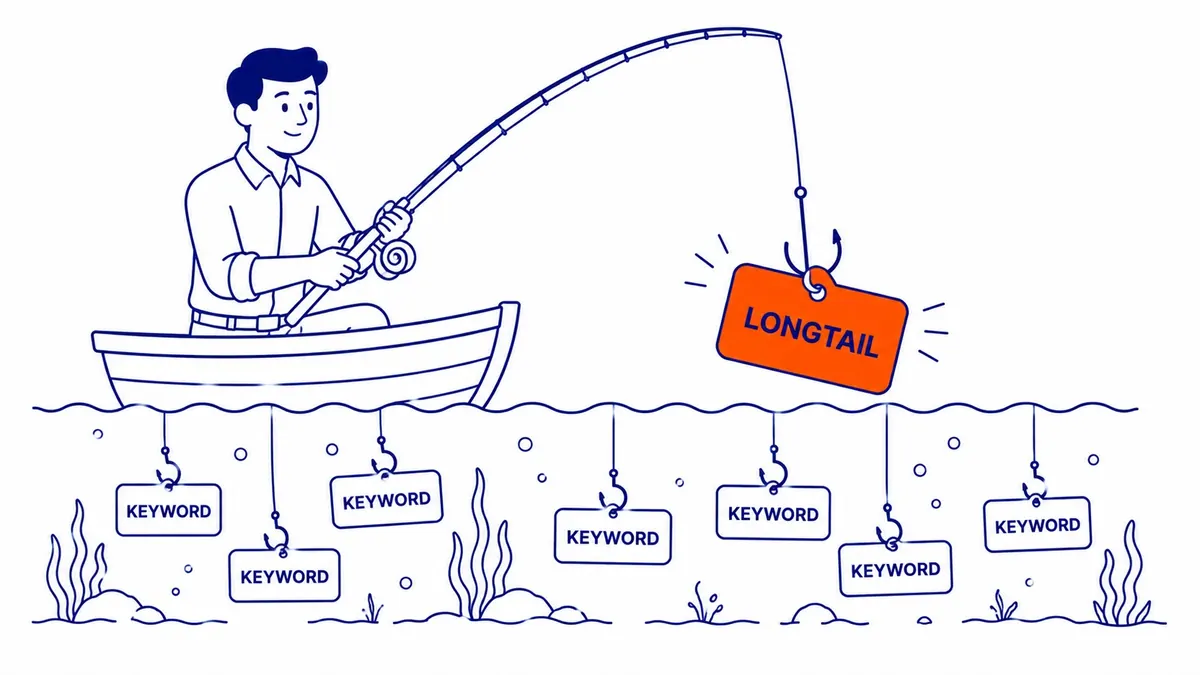
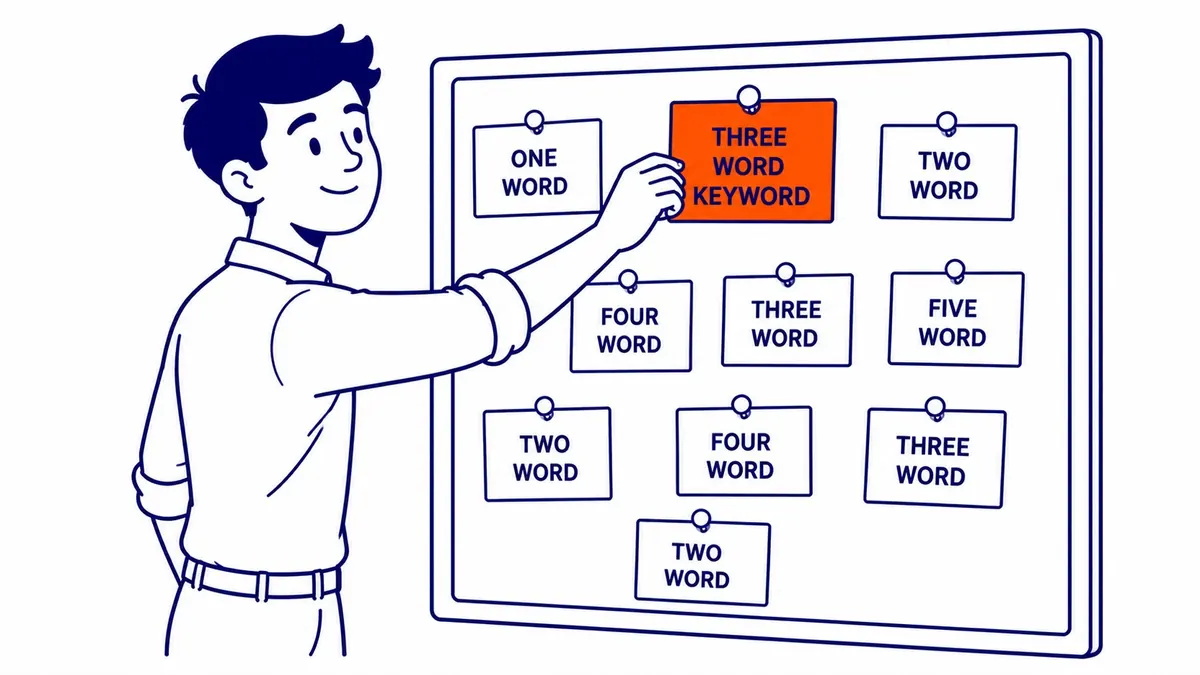
A long tail keyword is a search phrase with low search volume compared with the broader “head” term it relates to. The name comes from the shape of search demand: a small number of phrases get enormous volumes, and behind them sits a very long tail of phrases that each get only a few searches. Long tail phrases are usually three words or more and more specific than the head term, but length is only a rough guide. Ahrefs argues that volume, not word count, is what makes a keyword long tail, since some one-word terms get almost no searches and some five-word phrases get a great many.
The tail is bigger than any tool can show. When Google announced its BERT update in 2019, it said that 15 percent of the queries it sees every day have never been searched before, so a large share of long tail searches cannot be in any keyword database. Ahrefs reports that keywords with fewer than 10 searches a month make up almost 93% of its own US keyword database. That is why the methods below lean on Google’s own data and on the words customers use, not only on tools.
As an illustrative example, a Calgary furnace repair company has an obvious head term in “furnace repair Calgary”. The long tail around it includes phrases such as “furnace blowing cold air”, “furnace not starting after a power outage” or “furnace vent covered in ice”, each searched far less often, each by someone with a specific problem the company can solve.
Why long tail keywords are worth the effort
Three things usually make long tail phrases the most realistic targets for a smaller site. Fewer sites have written a page aimed squarely at a specific question, so the field is narrower. The searcher has already described the problem in detail, which makes it easier to write a page that answers it completely. And although each phrase brings little traffic, a site that answers many of them can build steady, well-matched traffic over time. Guides from Backlinko and SE Ranking also say that long tail searchers tend to convert better because they are further along in a decision, which is a reasonable expectation, though Ahrefs points out that it depends on the type of long tail keyword, and it always depends on whether the page serves that searcher.

The advantage is not automatic, though. Many long tail phrases are simply rewordings of a popular query, and Google shows the same well-established pages for them as for the head term, so they are no easier to win. A phrase about long tail keywords shows this well: “how to find long tail keywords” is four words long, yet Semrush rates it 60 out of 100 for difficulty on its US database, well above what a new page could expect to win quickly. Long tail work also takes as long as other SEO work, and a new page can take months to settle into its position.

Methods for finding long tail keywords
The methods below are in the order that tends to give the most useful phrases for the least effort. A site with some search history should start with the first one, while a brand new site can start with the second.
Start with the searches you already get
If your site has been live for a while, Google Search Console is the best source, because it shows real searches for which Google already shows your pages. Open the Performance report, look at the Queries tab and sort by impressions. Long tail phrases with steady impressions and an average position between roughly 8 and 30 are, in practice, good candidates, since a page is already close to page one for them and may only need a better section or a dedicated article to move up.
Search Console does not show every query, which matters a great deal for long tail work. Google’s Search Central blog explains that “anonymized queries”, those not issued by more than a few dozen users over a two-to-three month period, are left out of the query table to protect privacy, although their clicks are still counted in the chart totals. Rare long tail searches are exactly the kind that get anonymized, so if the total in the chart is much higher than the sum of the rows, a good share of your traffic comes from phrases you cannot see. The interface also exports a maximum of 1,000 rows. There is more on using Search Console to find and improve these pages elsewhere on the site.
Use Google’s own search features
Google’s autocomplete is the quickest free source. Google’s help page says that once you start typing, “autocomplete predictions reflect real searches that have been done on Google”, and that the predictions also take into account the language of the search, the location it comes from and trending interest. Type the main topic followed by a word such as “for”, “without”, “vs”, “near” or a question word, and note the longer predictions. Because location shapes the results, do this research from the market you serve or with your location set to it.
The “People also ask” box and the related searches at the bottom of the results page add more ideas, and opening one question usually loads several more. For this topic, the Calgary results on 2026-11-14 showed “What is an example of a long-tail keyword?”, “How can I generate long-tail keywords?”, “How to do long-tail keyword research?” and “What are long-tail and short tail keywords?”. Each of these is a candidate, although some belong in a section of a page rather than on a page of their own.
Add volume and difficulty with a keyword tool
A keyword tool turns a few seed terms into a long list and attaches estimated volume and difficulty to each phrase. In Semrush, Ahrefs or a similar tool, enter a seed term, filter the ideas to three or more words or to question phrases, and set the difficulty filter to the low end of that tool’s scale. Each tool calculates difficulty differently, so compare phrases within one tool rather than against a fixed number from another.

Google Keyword Planner is free with a Google Ads account and lets you set the location to a city such as Calgary. Its average monthly searches are averaged over 12 months, and Google Ads Help says that keywords with very low search volumes are not discoverable or forecastable in it. In other words, the phrases at the far end of the tail are the ones Keyword Planner cannot show you. Use it to check the volume of phrases you found elsewhere, and treat a blank or tiny number as “not measured” rather than “never searched”. Its Competition column measures how many advertisers bid on a keyword, not how hard the organic results are.
Run a competitor gap report
Most paid keyword tools have a gap report that lists keywords a competing site ranks for and yours does not. Choose a competitor of similar size rather than a national brand, because a peer’s long tail rankings show what a site like yours can realistically hold. The phrases that come back are already proven: a comparable site gets traffic from them, so the demand exists even when the volume estimate is small.
Listen to forums and customers
Reddit, Quora, Facebook groups and industry forums show questions in the words people actually use, including questions too new or too rare for any tool. A Reddit thread was the top result for “how to find long tail keywords” in Calgary on 2026-11-14, which says something about where people go when published guides leave them unsatisfied. Your own business is a source as well. The questions customers ask on the phone, in emails and in reviews are long tail keywords in their natural form, and they are the phrases your competitors’ tools cannot see.
Read the Google Ads search terms report
If you run a Google Ads campaign, the search terms report lists the actual searches that triggered your ads, along with clicks and conversions. It is one of the few places where long tail phrases come with real performance data. Google Ads also shows why listing long tail phrases one by one rarely works in paid search: a keyword with very little search history gets the “Low search volume” status and stays inactive until searches for it increase. Advertisers usually reach that demand through broader keywords and then read the search terms report to see which specific phrases actually came in. Phrases that convert there are strong candidates for organic pages too.
How to decide which long tail keywords deserve a page

A long list of phrases is only useful once you know what to do with each one. The deciding step is to search the phrase in a private window, set to your customers’ location, and compare what you see with the results for the head term. Ahrefs splits long tail keywords into types, and two of them are what this check separates. A “supporting” long tail is just a less popular way of asking the same thing, and Google ranks the same pages for it as for the head term, so it belongs on the page that covers the head term. A “topical” long tail is a distinct question, and if the results answer it poorly or only in passing, it is a good case for a page of its own.
The results page also shows the intent. If the top results are product or service pages, an article will struggle, and if they are guides, a service page will struggle. Check who is ranking as well: forum threads, small blogs and pages that only mention the topic in passing are good signs, while a page one made entirely of large brands is a bad one even for a long phrase.
As a worked example, here is what “how to find long tail keywords” showed from Calgary on 2026-11-14. The organic results were a Reddit thread, guides from Backlinko, Semrush, Ahrefs and SE Ranking, two free long tail keyword generators and two YouTube videos. That mix says searchers want a method they can follow and a tool they can use, and it shows that even forum and video results can hold page one positions next to the large software companies.
Before you commit to a new page, check your own site. If one of your pages already ranks for a close variant, strengthening that page is usually better than adding a second page that competes with it, and the same applies to near-duplicate phrases that differ by one word. Volume matters too, so a phrase with no searches, no customer questions behind it and no presence in Search Console is not worth a page however easy it looks. There is a fuller method for checking keyword difficulty on the results page.
Group the phrases you keep by intent. Several closely related long tail phrases usually belong on one page that answers each of them, with headings where a reader would naturally ask the next question, rather than on several thin pages. Once the groups are clear, the next job is to work long tail phrases into the copy so that they read naturally.
Long tail keywords for a Calgary business
For a business that serves one city, location words are often the easiest way into the long tail. Adding “Calgary”, a quadrant such as “NW” or a community name such as Beltline, Bridgeland or Mahogany narrows the field to businesses that actually serve that area. Service details do the same: “emergency”, “same day”, “for condos” or a specific brand or model each create a phrase that fewer sites have answered directly.
Two cautions apply. Keyword tools often show no volume at all for city and neighbourhood phrases, so the lack of a number is not proof that nobody searches; Keyword Planner set to Calgary and your own Search Console data are better checks. Many local service searches also show a map pack above the organic results. Google ranks those listings mainly on relevance, distance and prominence, judged largely from the Google Business Profile along with signals such as reviews and links to the business, so a new article on its own will not put a business into the map pack. The process is covered step by step in the guide to local keyword research.
Getting help with long tail keyword research
The methods above work with free tools and patience, and most of the value comes from the careful look at each results page. If you would rather have someone else build and sort the list, SEO Company To-The-TOP! has offered keyword research for Calgary businesses since 2007, and the person who studies your market is the same person who does the work. To talk about your site, call (403) 308-5949 or visit the To-The-TOP! home page.
Sources
- Google Search Help, How Google autocomplete predictions work
- Google Search Central blog, A deep dive into Search Console performance data filtering and limits (2022)
- Google, Understanding searches better than ever before (2019)
- Google Ads Help, About Keyword Planner forecasts
- Google Ads Help, Use Keyword Planner
- Google Ads Help, Low search volume: Definition
- Google Ads Help, About the search terms report
- Ahrefs, Long-tail Keywords: What They Are and How to Get Search Traffic From Them
- Google Business Profile Help, Tips to improve your local ranking on Google
Contact Calgary SEO Company To-The-TOP!
Questions about anything in this article, or about your own rankings? Talk to a Calgary SEO specialist directly.
Phone: (403) 308-5949
Address: 1509 14 Ave SW, Calgary, AB T3C 0W4
Hours:
Monday to Friday: 10:00 am – 7:00 pm
Saturday: 12:00 pm – 4:00 pm
Sunday: closed