
How to Find Niche Keywords in Six Steps
To find niche keywords, work in six steps: write down how your customers describe their problem, expand those phrases with Google’s free tools, see what competitors already rank for, treat “zero volume” with suspicion, check the results page before committing to a term, and give each keyword group its own page. The order matters because the best niche terms usually come from customers rather than from a tool. Tools are good at expanding a list and poor at inventing one. In a small market like Calgary there is a second problem, because many of the phrases that bring real buyers show little or no search volume in any tool, and the fourth step explains why that happens and what to do about it.
What counts as a niche keyword
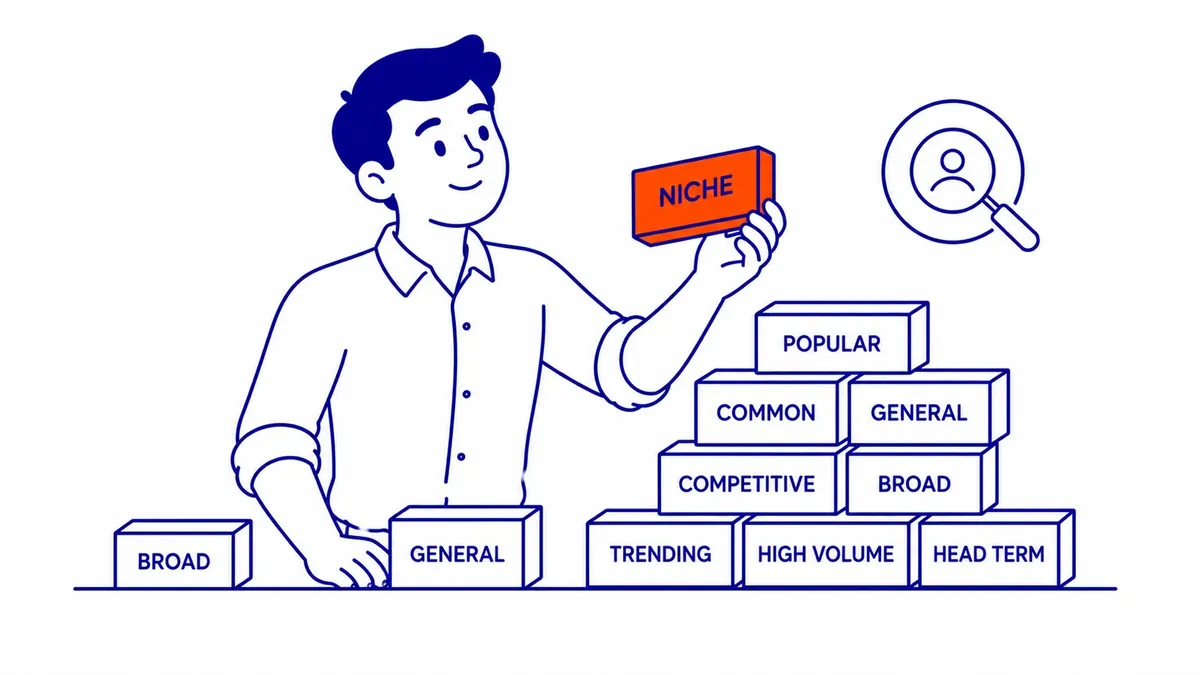
A niche keyword is a search term tied to one specific corner of a broader market. “Bookkeeping” is a head term that accountants, software companies and job seekers all compete over, while “bookkeeping for owner-operator truckers” belongs to a narrow audience with a narrow need. Niche terms usually have lower search volume and fewer strong pages competing for them, and the people typing them tend to know what they want. That last point is the reason they matter to a small business. A page that answers a precise question can earn a visit from someone close to a decision, even when it has no chance against national brands on the broad term.
Niche keywords overlap with long-tail keywords but are not the same thing. Long-tail describes how rarely a specific phrase is searched, while niche describes the market it belongs to. A two-word phrase can be a niche keyword if only one industry uses it, and a six-word phrase can still be a broad consumer search.

Step 1: Write down how your customers describe the problem
Start with the audience rather than the product. List who buys from you, what situation pushes them to search, and the words they use when they call or email. Customers rarely use your industry’s vocabulary. A homeowner searches for help with “ice dams on the roof”, not “attic ventilation assessment”, and a business owner searches “CRA letter about GST” long before anything with “compliance” in it.
The best raw material is already in your inbox and phone notes. Questions people ask before they buy, the wording in reviews (yours and your competitors’), and threads in Reddit communities or Facebook groups where your customers talk to each other all show the phrases real people use. Copy them word for word, because a phrase that has been tidied up loses the detail that made it specific. Twenty or thirty of these phrases make a better seed list than two hundred tool suggestions.
Step 2: Expand the list with Google’s free tools
Google’s own tools turn a short list of customer phrases into a longer one at no cost. Type each seed phrase into Google and note the autocomplete suggestions. Google’s help page on autocomplete says the predictions “reflect real searches that have been done on Google” and take the language and location of the query into account, so suggestions seen from Calgary can reveal local wording, although your own past searches and Google’s filtering also shape what you see. The “People also ask” box and the related searches at the bottom of the results page add related questions and phrasings to investigate.
Keyword Planner, inside a Google Ads account, works in two ways that suit niche research. “Start with keywords” takes your seed phrases and returns related ideas, and “Start with a website” accepts any site and looks for keywords related to its content. Set the location before reading the numbers, because Google describes average monthly searches as covering a keyword and its close variants for the location and network settings you selected. The default view usually covers a whole country, which makes a niche term look bigger or smaller than it is in the city you actually serve.
Google Search Console belongs in this step once a site has been live for a while. Its Performance report shows the queries that already bring your pages impressions, and some of them are niche phrases you never targeted on purpose. Those deserve a close look, since Google already connects your site with them, although a query showing at position 60 is a lead to check rather than an easy win.
Step 3: See what competitors already rank for
Pick two or three sites that serve the same customers, ideally smaller specialists rather than national brands, and look at the phrases in their page titles, headings and service names. Running a competitor’s site through Keyword Planner’s “Start with a website” option shows the keyword ideas Google associates with that content, which often surfaces terms you had not considered.
Paid tools such as Semrush, Ahrefs and Moz go further and estimate which keywords a competitor ranks for, along with a gap report of terms they rank for and you do not. Many of these tools show United States data unless you choose another country, so switch to the Canadian database before drawing any conclusion. What you are looking for is the specific questions their customers search that nobody in your market has answered well yet, rather than pages to copy.

Step 4: Treat “zero volume” with suspicion
This is where niche research in a small market goes wrong most often. A phrase that clearly brings in customers shows 0 or “no data” in a tool, and it gets deleted from the list. In many cases the searches exist and the tool simply cannot see them, and Google’s own documentation explains why.
Google Trends “only shows data for popular terms, so search terms with low volume appear as ‘0’”, according to its data FAQ. Search Console leaves out what Google calls anonymized queries, which a Search Central post describes as queries not issued by more than a few dozen users over a two-to-three month period. Even the search terms report in Google Ads shows the terms “used by a significant number of people”. A specialist phrase searched only a handful of times a month across Calgary can fall below any of those limits, and Google does not publish a number for them, so a third-party tool estimating from its own data samples can miss it as well.
A practical rule follows from that. Keep a zero-volume phrase if customers actually use those words, if autocomplete suggests it, or if the results page shows other businesses targeting it. Drop it if it only exists in your own head. When the stakes justify it, a small, tightly targeted Google Ads campaign can test demand around a group of these phrases, although keywords with very little search history can sit inactive with a “Low search volume” status, and the search terms report still withholds the rarest searches.
Canadian vocabulary needs its own check. “Eavestrough” and “gutter” are the same product to a roofer, and Google Trends treats them as separate terms because it does not combine spelling variations, synonyms or plural and singular forms. Keyword Planner, by contrast, folds close variants such as plurals and misspellings into one figure, so it can hide which form people prefer, which makes the results page the better place to see which wording Calgary searchers and competitors actually use.
Step 5: Check the results page before you commit
Search every shortlisted phrase on Google from your own market and look at what ranks. The results page tells you two things no volume figure can: the search intent Google has settled on, and whether a page like yours has a realistic chance. If the top results are product pages and you planned an article, or the results are all how-to guides and you planned a service page, the phrase belongs on a different page or off the list.
| What you see on page 1 | What it usually means for a niche term |
|---|---|
| Forum threads, old blog posts, thin directory listings | The question is under-served; a focused, useful page has a real chance |
| Pages from small local or specialist businesses | Winnable with a better page and some local signals |
| National retailers, government sites or large publishers on every result | Hard for a small site; keep it only if the term is central to the business |
| Results that do not match your page type | Wrong intent for your planned page; rethink the page or drop the term |
The query this article answers is a good example. On 2026-10-19 the Calgary results for “how to find niche keywords” had a ten-year-old Reddit thread in first place, ahead of large software companies. An old forum thread at the top often means searchers are not getting a clear, current answer elsewhere, although sometimes Google is favouring first-hand discussion, and the software companies below it still hold far more authority than a small site. For a closer look at weighing that kind of trade-off, the guide to low-competition keywords covers how to judge difficulty beyond a tool’s score.
Step 6: Give each keyword group its own page
A keyword list earns nothing until it becomes content. Group phrases that share the same intent, so that “ice dam removal” and “removing ice dams from the roof” sit together, and give each group one page. Each page gets one main niche keyword, with its close variations and related long-tail phrases covered naturally in the text. One page per group also stops two of your own pages competing for the same search.
Then measure. Note each page’s queries, impressions and average position in Search Console before and after the page goes live, and compare over months rather than weeks, because SEO takes months to show what a page can do. Phrases that start bringing impressions confirm the research, and new queries appearing in the report become the next round of seed phrases.

An illustrative example: a Calgary bookkeeper
This example is made up to show the method; the business and its phrases are illustrative, and no search volumes are claimed. Picture a Calgary bookkeeping firm that wants more clients among owner-operator truck drivers. The broad term “bookkeeping Calgary” is crowded with accounting firms and directories, so the firm starts with its own notes from client calls instead.
Those notes might produce phrases such as “bookkeeper for owner operator truck driver Alberta”, “IFTA fuel tax reporting help” and “how to track per diem for truckers in Canada”. Autocomplete adds a few variations, and Keyword Planner set to Alberta returns related ideas, several of them showing very low or no volume. Following step 4, the firm would keep the IFTA and owner-operator phrases if its clients use those exact words and autocomplete suggests them.
The results-page check can change a decision. If the per diem query returns government pages and national tax publishers on every result, that signals a hard fight for a small firm, so it moves to a lower priority. If the IFTA phrase returns a mix of software vendors and a few old forum posts, that signals room for a clear, local guide. The firm would then have two pages to write, one for each group of phrases with a different intent.
Where to go from here
Finding niche keywords is mostly patient listening, followed by a few free tools and a careful look at each results page. The tools help most with expanding and checking a list, and least with deciding which phrases matter to your business. SEO Company To-The-TOP!, a Calgary SEO and Google Ads practice founded in 2007, also offers keyword research done for you for businesses that would rather hand the work over. To talk through a keyword list you already have, call (403) 308-5949.
Contact Calgary SEO Company To-The-TOP!
Questions about anything in this article, or about your own rankings? Talk to a Calgary SEO specialist directly.
Phone: (403) 308-5949
Address: 1509 14 Ave SW, Calgary, AB T3C 0W4
Hours:
Monday to Friday: 10:00 am – 7:00 pm
Saturday: 12:00 pm – 4:00 pm
Sunday: closed