Quality Score in Google Ads: What It Is and Why It Matters
First Google Ads account I managed for a Calgary HVAC company had decent traffic but brutal cost per click. Quality Scores were sitting at 3 across most search terms. We tightened the ad groups, rewrote the copy to match what people were actually searching, and fixed the landing pages. Scores moved to 7. Cost per click dropped by roughly 40% on the same budget. No bid changes. That is the kind of lift a single metric can produce.
This metric in Google Ads runs on a 1 to 10 scale. Google assigns it at the keyword level, not the campaign level. The number multiplies against your bid in every auction and directly influences where your ad shows and how much you pay per click. Bid alone does not determine position. Your Quality Score is the other half of that equation.
Three factors behind the score
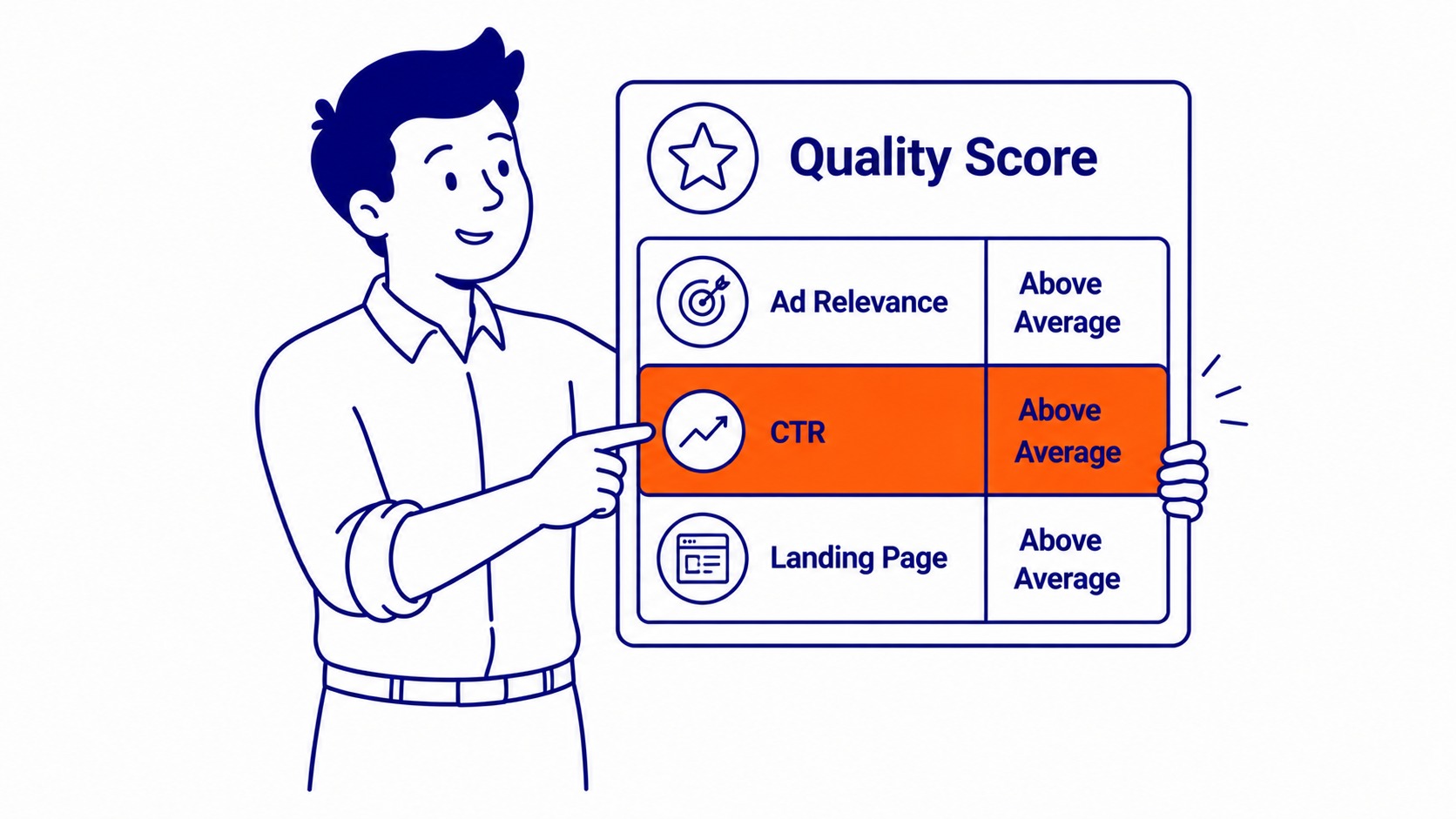
Ad relevance. Landing page experience. Expected click-through rate. Three signals feed into the calculation. Google rates each component Below Average, Average, or Above Average. The overall score reflects a weighted combination of all three, computed fresh at every auction.
Each factor still operates independently. An ad group can have strong ad relevance but weak landing page experience. That combination drags your Quality Score down regardless of how clean the copy is. The weakest component tends to set the ceiling. That ceiling shows up in the bill, since CPC in Google Ads is recalculated at every auction.
Ad relevance: does your ad match what the searcher asked?
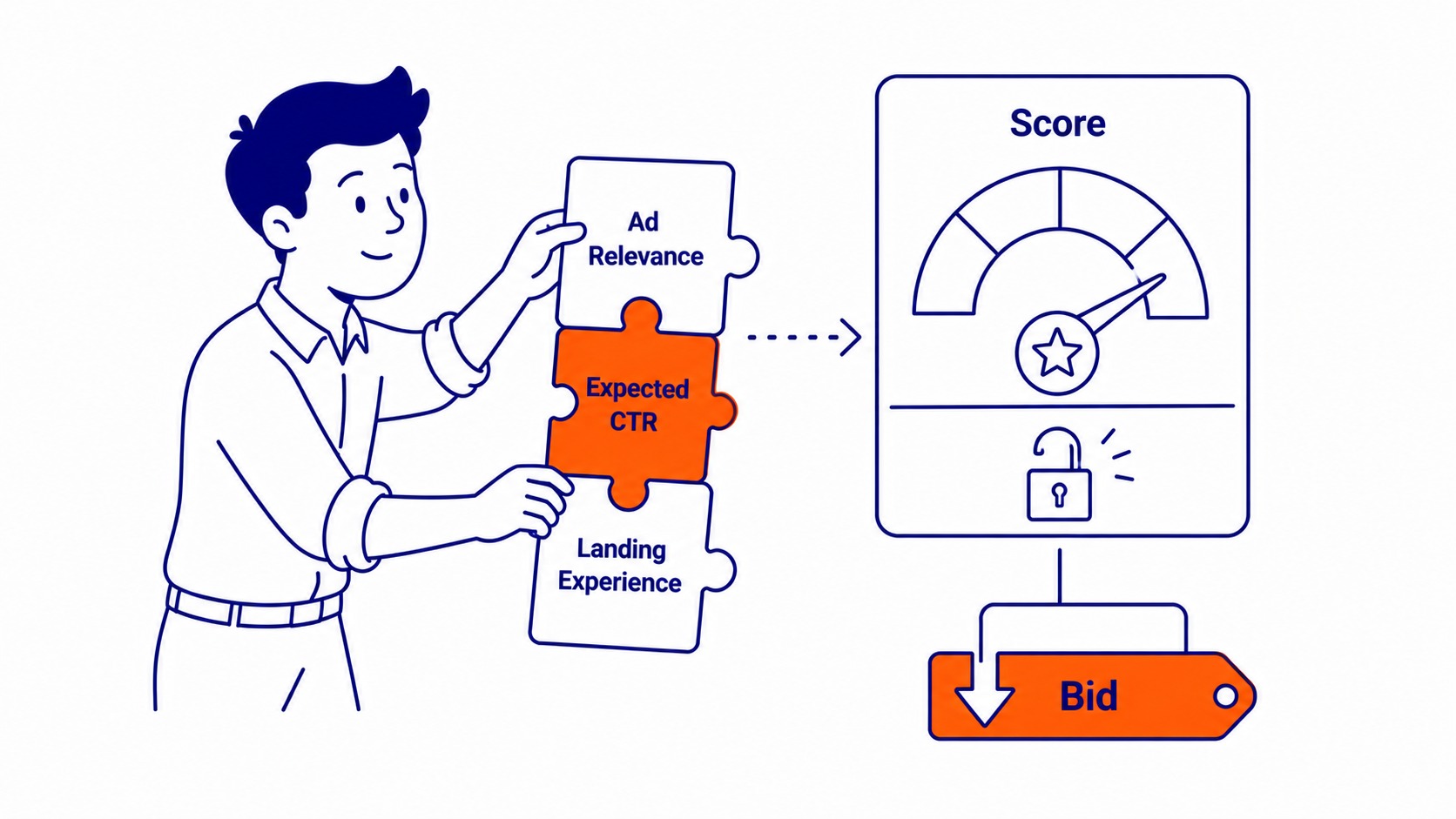
Ad relevance measures how closely your ad copy reflects the keyword and the search query behind it. Closer match, higher score on this component.
Quality Score factors apply to every ad group structure covered in Google Ads setup and strategy.
Where most accounts go wrong: too many keywords inside one ad group, all served by one generic ad. Take a landscaping company. Three different search terms in one group: “lawn mowing Calgary,” “lawn maintenance Calgary,” “grass cutting Calgary.” One ad. “Professional Lawn Services.” Not specifically relevant to any of those searches. Tighter groups, copy that mirrors the exact search language, and scores on this component improve fast.
Dynamic keyword insertion helps but is not a substitute for clean ad group structure. Sorting your terms into tight themes before launch does more for this component than any tool ever will. That sorting is the core of our keyword research work. Your ad copy should reflect one narrow theme per group.
Landing page experience: what happens after the click

Three things under review on every landing page: relevance to the search query and the ad, load speed, and mobile usability.
The guide on how much it costs to buy keywords on Google covers how Quality Score directly affects what you pay per click for the same keyword.
A page running ads for “metal roofing Calgary” that routes clicks to a generic Services page misses on relevance. Load speed above three seconds costs both the score and conversions. Mobile performance matters more now, given where most search clicks land.
Landing page experience is often the hardest component to improve because it requires actual development work, not just copy changes. Ad managers tend to overlook it because it lives outside the ad interface entirely, which is why solid Calgary Google Ads management has to reach past the interface and into the page itself. That oversight is expensive. The score here also reflects whether the page delivers what your ad promised. Page content gets reviewed against the keyword and the ad. Which raises a related question about linking ads to a landing page that already lives on the site.
Expected CTR: the signal from your history
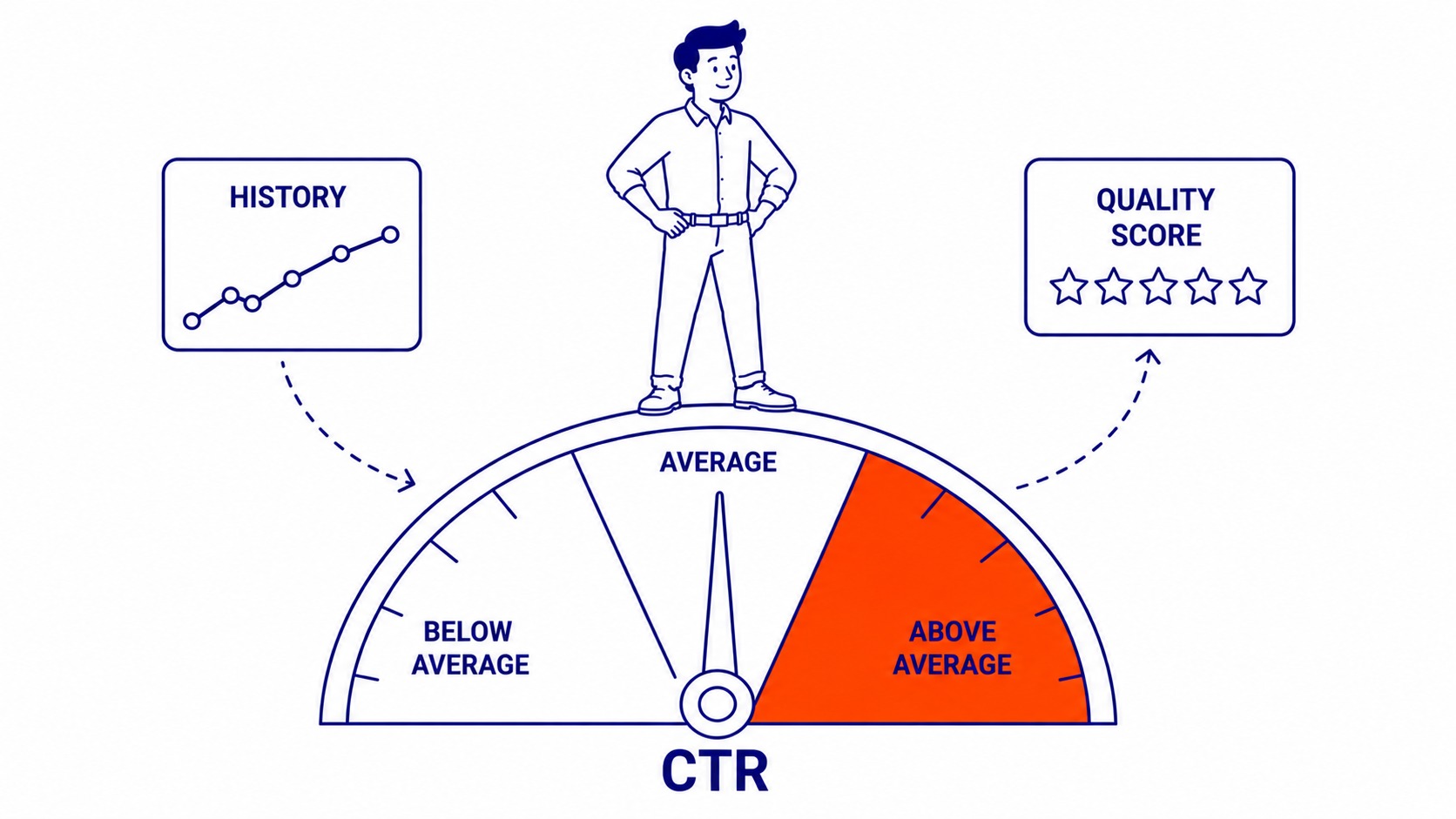
Expected CTR measures how likely your ad is to get clicked, adjusted for position. The calculation also draws on historical click-through rate data across your account and across comparable advertisers in the same auction.
New keywords start from a neutral baseline. Over time, though, a strong click-through rate relative to position pushes the expected CTR component up. A weak rate pulls it down. Pausing keywords with consistently poor click history, rather than letting them accumulate bad data, protects your overall account health.
Rate matters more than volume. A keyword with 5,000 impressions and 20 clicks looks worse than one with 500 impressions and 15 clicks. That is also why broad match keywords without tight negative keywords can quietly drag your Quality Score down through poor CTR history. Something worth monitoring from day one.
A good Quality Score: what to aim for
Seven or above is the practical target. At 7 to 10, your Quality Score earns you below-average CPC relative to your bid. Better ad placement than lower-scoring competitors at similar bid levels, too.
Five or six is average. You are still paying market rate. No particular advantage or penalty.
Below 5, a surcharge effectively applies. CPC rises, ad position falls. A score of 1 or 2 on a high-competition keyword makes it nearly unrunnable without a bid level that kills ROI. Open an account nobody has restructured and the pattern holds. In our Google Ads management work across Calgary service industries, most new accounts sit in the 4 to 6 range before any optimization. Moving from 4 to 7 typically cuts cost per click by 20 to 30 percent.
What a low score costs your campaigns

Auction math makes this concrete. Two advertisers bidding on the same keyword:
Advertiser A: $3 bid. Score: 8. Ad Rank: 24.
Advertiser B: $5 bid. Score: 3. Ad Rank: 15.
Advertiser A wins and pays less per click despite the lower bid. That is the mechanic at work.
A low score on top search terms is still not a minor inconvenience. It determines whether your budget outperforms a competitor’s or gets outcompeted by someone spending less. Advertisers who focus purely on bids and ignore score tend to carry the highest CPCs in their category. Your ads pay the price for that.
How to raise your Quality Score
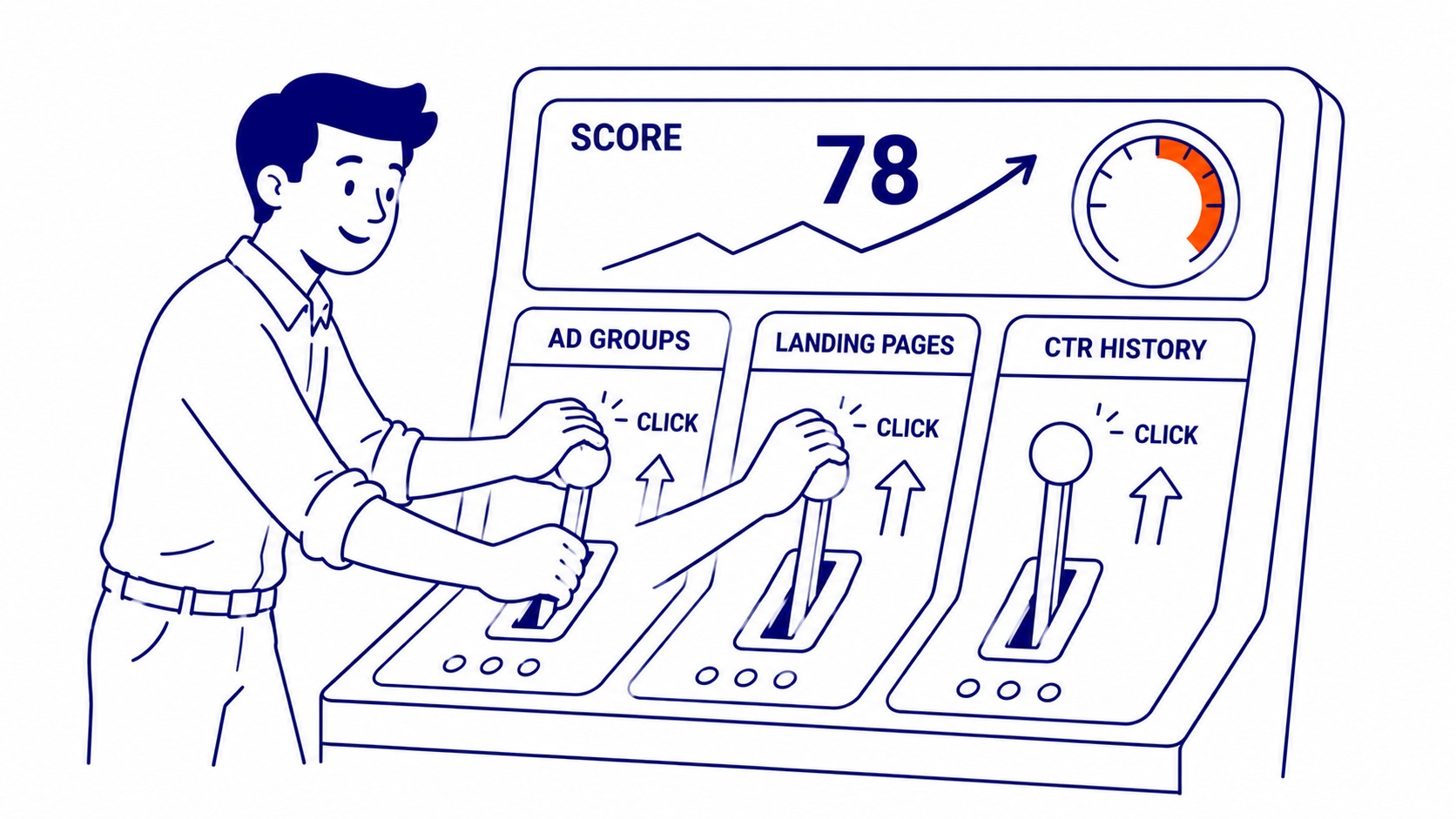
Tight ad groups come first. Group your keywords by specific intent, not broad theme. Separate “emergency plumber Calgary” from “plumbing repair Calgary” into distinct groups, each with tailored ad copy. The tighter the group, the easier it is to write ads that score well on ad relevance. Your Quality Score climbs faster on tightly structured campaigns.
Ad copy needs to mirror the keyword as closely as practical. The headline especially. Searchers are looking for what they typed. An ad that reflects the exact query earns more clicks and builds click-through rate history. The score responds to that history over time.
Landing pages also need to match the promise of the ad. A dedicated page for each core service outperforms a homepage for any targeted campaign. Page speed matters too. Under two seconds on mobile is the practical target.
Negative keywords remove irrelevant traffic that drags down click history. Running thorough keyword research before launch finds these faster than waiting for the search term report to show you where budget went wrong.
Quality Scores build on historical data. A new campaign starts from scratch. Three to four months before scores stabilize on a fresh account is a reasonable expectation. Since 2007, SEO Company To-The-TOP! has handled both SEO campaigns and Google Ads management. The accounts inherited most often have bloated ad groups, generic landing pages, and expected CTR pulling your Quality Score down. Tighten the groups, fix the pages, prune the bad keywords.
Worth asking any Google Ads management provider how they approach the structure on new campaigns before signing anything.
Advertisers in Richmond SEO, Rocky Mountain House SEO, and Rossland SEO improve Quality Score through the same combination of ad relevance and landing page work. Volume is the other variable here, and the answer on low search volume keywords surprises plenty of advertisers.
FAQ
Google Ads Quality Score: what is a good number to aim for?
Seven or above is still where the economics shift in your favour. Below 5, you are paying a premium relative to well-optimized competitors. The average across most industries sits around 5 or 6. A score of 10 is rare; most well-managed accounts run in the 7 to 8 range on their best keywords.
Quality Score: what role does it actually play?
This metric (1 to 10) multiplies against your bid to produce Ad Rank. Ad Rank then determines your ad position and the actual cost per click you pay. A higher score lets a lower bid outrank a higher one. The underlying mechanic has not changed since AdWords.
What happens when your ad has a low Quality Score?
Lower scores mean higher actual CPCs and weaker placements. At 3 or below on competitive terms, you will either pay significantly more per click than a well-optimized competitor, or your ads will not appear consistently. The gap compounds as bad history accumulates. No clear warning in the interface tells you it is happening.
Does Google still use Quality Score in 2025?
Still active. Smart bidding and automation have absorbed more campaign decisions, but this metric remains a keyword-level diagnostic inside any Google Ads account. Expected CTR, ad relevance, and landing page experience are still the three signals that determine competitiveness at auction beyond the bid.
Contact Calgary SEO Company To-The-TOP!
Questions about anything in this article, or about your own rankings? Talk to a Calgary SEO specialist directly.
Phone: (403) 308-5949
Address: 1509 14 Ave SW, Calgary, AB T3C 0W4
Hours:
Monday to Friday: 10:00 am – 7:00 pm
Saturday: 12:00 pm – 4:00 pm
Sunday: closed
