
What Is a Good CPC for Google Ads?
A Calgary roofing contractor came to us paying $47 per click. Booked jobs ran about $8,000 average. Conversion rate sat at 4%. That worked fine. A women’s clothing boutique with a $90 average order and a 1.5% conversion rate at $47 per click? That is a disaster. Same CPC, two completely different situations.
That is the short answer to this question. A good CPC for Google Ads is one where the revenue on the other side justifies the cost. No universal number exists. Industry benchmarks matter, though, because they tell you whether your account is paying above market for the clicks it is getting.
The Number That Actually Matters
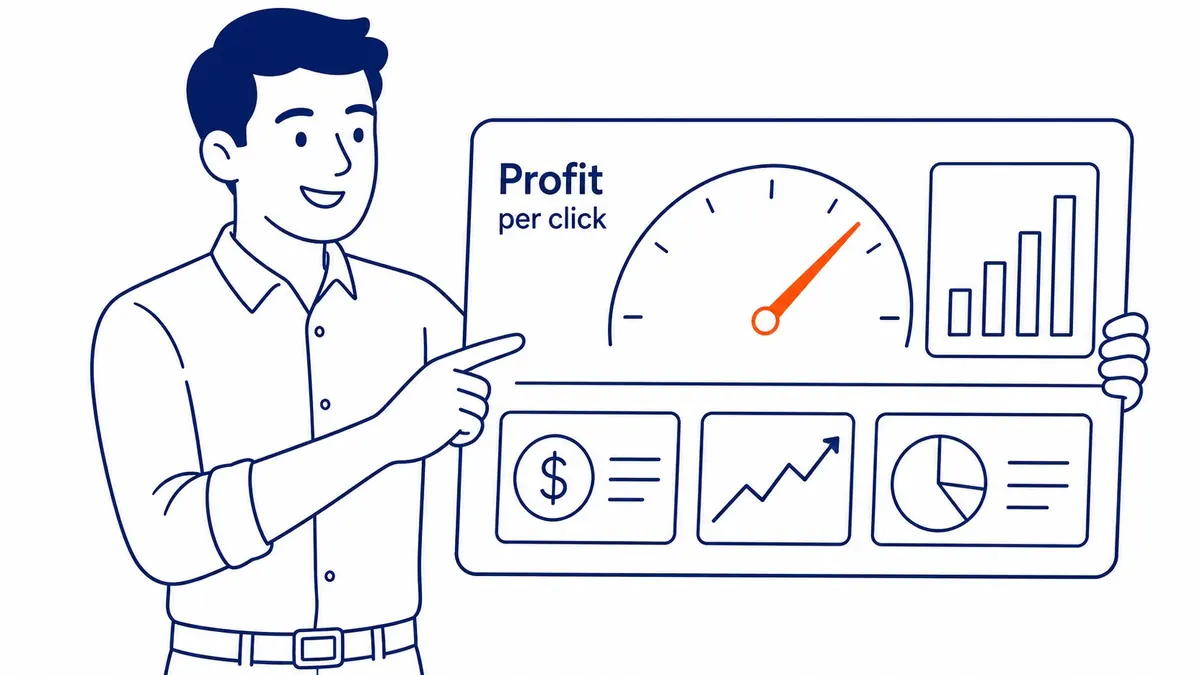
Profit per click. That is the real metric.
Take a law firm billing $5,000 for a retained matter. Conversion rate on a well-built landing page runs around 8%. At that rate, every 100 clicks produces 8 clients. Spread $5,000 across those 8 clients and each one is worth $625 in ad cost headroom before the campaign breaks even. A $40 CPC on legal keywords is still profitable. That same $40 per click would destroy a local cleaning service charging $200 for a home clean.
Calgary advertisers running Google Ads search campaigns for professional services, trades, and legal work tend to see CPCs ranging from $8 to $50 depending on the competitiveness of the keywords they are targeting. Retail and e-commerce accounts in the same market run $0.50 to $3.50 per click, sometimes lower on display. The difference is not arbitrary. High-intent commercial keywords in high-margin categories attract more bidders, which drives the auction price up. That is the mechanic behind the spread.

Industry Benchmarks: Where CPCs Actually Land
Legal services top the chart. Regularly $15 to $50 per click, sometimes higher on specific terms like injury lawyer or class action.
Finance and insurance sit close behind. Mortgage and insurance keywords run $10 to $35 per click across North American search ads auctions. These industries spend aggressively because a single conversion can be worth thousands.
Home services: plumbing, HVAC, electrical. These tend to run $6 to $18. Competitive in Calgary, not as punishing as finance.
Healthcare and medical practices run $5 to $15 per click on average. Dental practices targeting implants or orthodontics often still pay at the upper end.
Retail and e-commerce run much lower. Average CPCs of $0.60 to $2.50 are common on Search. Display ads across all industries run closer to $0.50 or less per click.
Travel and hospitality sit in the $1.50 to $5 range per click. Hotel and flight keywords are competitive but not at the legal-services level.
These are reference points. An account in Calgary running plumbing keywords at $12 per click is not overpaying. That same account at $30 per click is either targeting highly competitive terms or has a Quality Score problem.

Search Ads vs Display Ads: The CPC Gap
Search ads cost more per click. That is expected. Someone who types “emergency plumber Calgary” right now has intent. Display ads reach people who have not expressed intent yet. Lower CPC, lower conversion rate. The two channels serve different purposes and should not share CPC benchmarks.
A good CPC for search ads in a B2B SaaS context might be $8 to $25. For display running awareness campaigns on the same product, $0.30 to $1 per click is more typical. Mixing the two into a single average misleads the analysis.
Run search and display as separate campaigns. Evaluate CPCs separately. What counts as a good CPC for your display ads has nothing to do with what you should accept on search. The same trap catches anyone calling Facebook ads cheaper than Google Ads across the board.
How Google Calculates Your CPC
Quality Score (1 to 10) multiplies against the bid. Three factors go into it: keyword-to-ad match, landing page fit, and historical click-through rate.
The actual CPC paid is not the max bid. Google uses the formula: (competitor ad rank / your Quality Score) + $0.01. A $5 bid with a Quality Score of 9 routinely beats a $12 bid at Quality Score 3. That advertiser paying $12 per click is subsidising the one who built a tighter, more relevant campaign.
This is the mechanic people miss most often when they ask what a good CPC looks like. The CPC they see in the dashboard is partly a Quality Score problem in disguise. Paying $18 per click on a keyword where accounts with higher Quality Scores pay $9 means the account is losing $9 per click to poor campaign structure. Which is the real price of buying keywords on Google, hidden inside a score most owners ignore.
What Actually Moves Your Quality Score
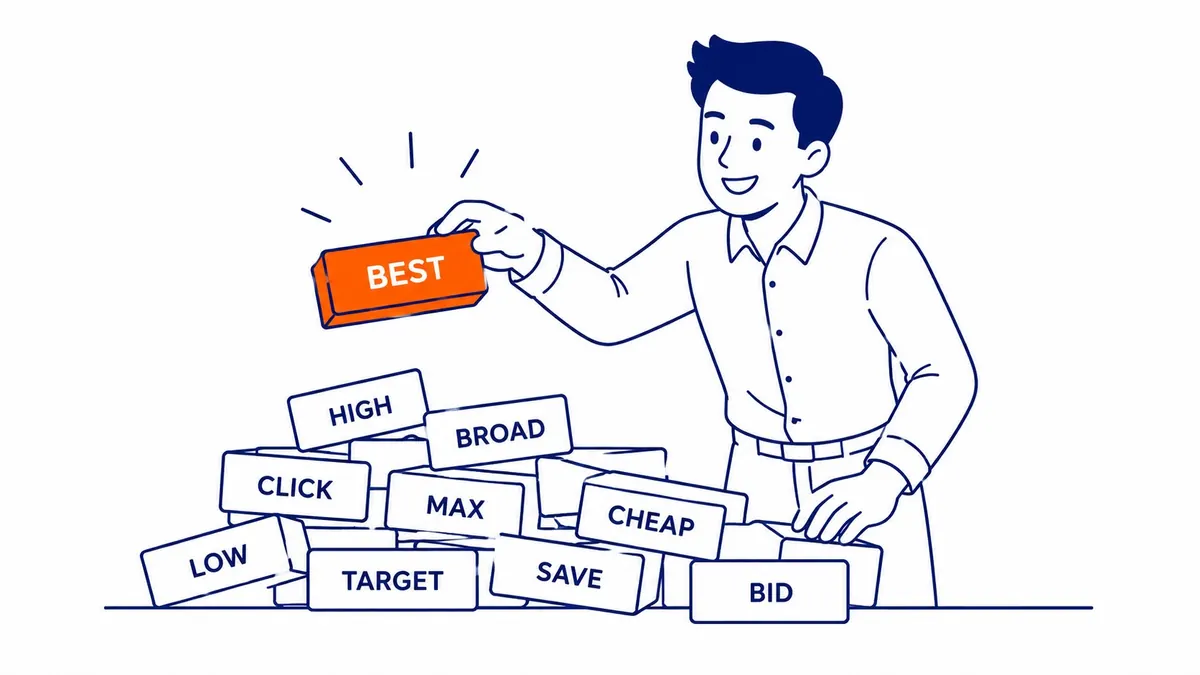
Ad relevance is first. The keyword needs to appear naturally in the ad headline. Not crammed in, but actually part of what the ad is saying. Accounts that use generic headlines across all ad groups watch their Quality Scores stay at 4 to 6 and wonder why CPCs are high.
Expected CTR is second. Google looks at the historical click-through rate of that keyword and ad combination, adjusted for position. A CTR below 2% on a search term signals that the ad is not compelling enough for the query. Tighter ad groups with fewer, more specific keywords fix this.
Landing page experience is third. Page load speed, mobile usability, and relevance between what the ad promises and what the landing page delivers all factor in. Slow pages that take 6 seconds to load on mobile are a Quality Score problem even if the ad copy is excellent. Solid SEO keyword research feeding into relevant landing pages is still how this gets resolved.
The Max CPC Formula: Working Backward From Margin
The formula most accounts ignore. Max CPC = profit per conversion × conversion rate. Everything else in the account flows from this number.
A Calgary accounting firm charges $3,500 for a small business tax package. Gross margin on that package is around 60%, making the profit per client roughly $2,100. If the landing page converts at 5%, every 100 clicks produces 5 clients. Five clients at $2,100 profit each means $10,500 in margin for every 100 clicks. Max CPC before the campaign becomes unprofitable: $105. That firm could bid aggressively on keywords that competitors have walked away from because the ROI still holds.
Run this calculation before setting bids. Most advertisers set bids based on what their competitors seem to be paying, not on what their own economics support. That is how accounts end up either overpaying on low-margin keywords or underinvesting on high-margin ones. CPA targets flow naturally from this same formula once the account has enough conversions to measure reliably.

Levers That Drop CPC Without Cutting Bids
Negative keywords. The fastest fix for accounts bleeding spend on irrelevant clicks. Adding negatives removes searches that would never drive conversions, which improves CTR on the remaining traffic, which lifts Quality Score, which drops CPC. Costs nothing to implement. Takes about 30 minutes to audit a Search Terms report and add a solid negative keyword list.
Match type tightening. Broad match sends ads to loosely related queries. Phrase and exact match pull in tighter, more relevant traffic. CTR goes up. Quality Score follows. CPC drops without touching a single bid, though it takes a week or two of data to confirm the shift.
Ad copy relevance. Each ad group should speak directly to the search intent of its keywords. An account we audited through our Google Ads management services had one ad running across 47 keywords. CPCs were high. Quality Scores were low. Splitting into tighter ad groups with specific headlines dropped average CPC by 31% in the first month without changing budget.
Landing page alignment. If the ad promises a free estimate and the landing page leads with a long about section before the contact form, people leave. Bounce rate rises. Google’s systems read that as poor landing page experience. Match what the ad says to what the page shows above the fold.
Frequently Asked Questions
What is the average CPC for Google Ads?
Across all industries on Search, the average runs roughly $1 to $2 per click. That number is pulled down by high-volume retail and e-commerce accounts. Legal, finance, and insurance drive the upper end well above $20. The global average is a poor benchmark for any individual campaign. Use your own industry vertical as the reference point.
Is $20 a day good for Google Ads?
Depends on the CPC. At $2 per click, $20 a day buys 10 clicks. Bump that to $15 per click and it buys one click and change. A daily budget of $20 is enough to test ad copy and gather early data in low-competition categories. In legal or finance, $20 a day barely covers a single click. Budget planning has to start from CPC expectations for the specific vertical, not from a round number.
What is a good CPC for Google Ads?
Lower than the revenue it produces. A $50 per click CPC is excellent if each click converts at 10% and the average client is worth $3,000. That same $1.50 CPC is too high if conversion rates are under 1% and average order value is $30. Good CPC is a profitability calculation, not an absolute number.
How much does Google charge per 1000 views?
On the Display Network, Google uses a CPM (cost per thousand impressions) model for some campaigns rather than CPC. Average display CPMs run roughly $0.50 to $2 per thousand impressions depending on targeting, audience quality, and the advertiser’s industry. Search ads do not use a CPM model. Advertisers on Search only pay when someone clicks, not when the ad shows.
Running CPC in Calgary
SEO Company To-The-TOP! has managed Google Ads campaigns in Calgary since 2007. The accounts that perform well share one pattern: they run from the math, not from the bid suggestions Google serves up in the interface. Google’s automated bid suggestions optimise for clicks, not for profitability.
As a Google Ads management company, we start with the max CPC formula above, then map keywords through keyword research to identify which terms the client’s economics actually support. An SEO website audit identifies where landing page problems are dragging Quality Scores down and inflating CPCs beyond what the market requires.
If your current CPCs feel high relative to the leads you are getting, it is usually one of two things: either the campaign is targeting keywords the conversion funnel cannot support, or Quality Score problems are causing you to overpay in the auction. Both are fixable, though not instantly. For businesses also working on organic visibility, Calgary SEO builds the foundation that Google Ads campaigns then accelerate.
Worth running the numbers before assuming the CPCs are the problem. Sometimes they are the symptom. Diagnosis gets easier with a plain reading of PPC and what each click is buying.
Contact Calgary SEO Company To-The-TOP!
Questions about anything in this article, or about your own rankings? Talk to a Calgary SEO specialist directly.
Phone: (403) 308-5949
Address: 1509 14 Ave SW, Calgary, AB T3C 0W4
Hours:
Monday to Friday: 10:00 am – 7:00 pm
Saturday: 12:00 pm – 4:00 pm
Sunday: closed