
How to Do an SEO Audit: Step-by-Step Guide
An SEO audit is the diagnostic before any sensible optimization work begins. Skip it, and the campaign starts blind. Most clients who hire a Calgary SEO expert do not need quarterly audits, but every site benefits from a thorough one at least once a year, and always before signing with a new agency.
What follows is the actual process. The tools that matter, the checks that catch the most issues, and the order to run them in. Designed for someone running their own audit, but useful for anyone hiring out the work who wants to know what should land in the deliverable.

When You Actually Need an SEO Audit
Four situations make an audit non-optional.
Rankings dropped suddenly. A 30% organic traffic drop overnight usually points to either a Google update, a technical breakage during a site change, or a manual action. The audit identifies which.
A new agency is about to start. Without a baseline audit, neither side knows what the campaign inherited or what changed. Bad place to be three months in when results disappoint.
A site redesign or migration just happened. Redirect maps get missed. URL structures shift. Internal links break. The most expensive Calgary SEO problems we see come from migrations done without a follow-up audit.
The site has never been audited. Every site accumulates issues. Old plugins, abandoned URLs, thin content, broken internal links. The first audit on a multi-year-old site usually surfaces between 40 and 200 fixable items.
A fifth situation worth flagging: ongoing campaigns plateauing after six months of solid work. A mid-campaign audit often surfaces a single technical issue blocking the next ranking jump. Worth running before scaling the retainer.
If none of those apply, the audit is optional. Save the budget for content and link building.

The Three Layers of an SEO Audit
Every comprehensive audit covers three layers. Skip one, the audit is incomplete.
Technical SEO Audit
What it checks: how search engines crawl your content, render, and index the site. Page speed, mobile usability, structured data, redirect chains, indexability rules, sitemap correctness. The technical layer is usually where the most invisible problems hide.
On-Page SEO Audit
What it checks: how each page is optimized for its target keywords. Title tags, meta descriptions, heading structure, content depth, internal linking, keyword targeting, image optimization. This is the layer most DIY auditors over-focus on, because the issues are visible.
Off-Page SEO Audit
What it checks: the backlink profile and the site’s external authority signals. Quality and quantity of inbound links, anchor text distribution, toxic link patterns, competitor gap analysis. Often the layer that explains why a technically clean site with good content still does not rank.

Tools You Will Need
A useful SEO audit needs at least three tools running together. One for crawling, one for analytics, one for backlink data.
Free Tools
Google Search Console is mandatory. If your website does not have it set up, that is fix number one before anything else. GSC shows crawl coverage, indexed page count, queries the site already ranks for, and Core Web Vitals data straight from Google.
Google Analytics 4 covers user behaviour. Bounce rate, session duration, conversion paths. Pair it with Google Search Console and most of the on-page diagnostic work for your site is covered.
Google PageSpeed Insights or Lighthouse runs Core Web Vitals checks for individual pages. Free and accurate.
Screaming Frog free tier crawls up to 500 URLs. For a site under that count, the free tier handles the technical audit completely.
Paid Tools
For sites over 500 URLs, Screaming Frog at $250 USD per year is the obvious upgrade. Crawls unlimited URLs, integrates with GSC and GA4, surfaces broken links, duplicate content, and redirect chains in a way the free version cannot.
Ahrefs or Semrush handle the off-page audit. Both start around $130 USD per month. Either will surface backlink data, competitor analysis, and keyword gap reports. Pick one, not both. If you are still comparing platforms, our rundown of the best SEO software weighs the main options against each other.
A toxic-link checker like LinkResearchTools or Majestic helps if a manual action is suspected or the link profile looks dirty. Optional for most audits, essential if a previous agency built spammy links.
For Calgary businesses, one local consideration: Google’s local pack rankings depend on Google Business Profile signals more than the main organic ranking. Audit GBP separately. Categories, NAP consistency across local directories, review velocity, and Q&A activity all matter for your local user experience and map pack visibility, and none of them show up in standard SEO audit tools. Spend an extra hour on GBP if local search drives your business.
How to Do a Technical SEO Audit
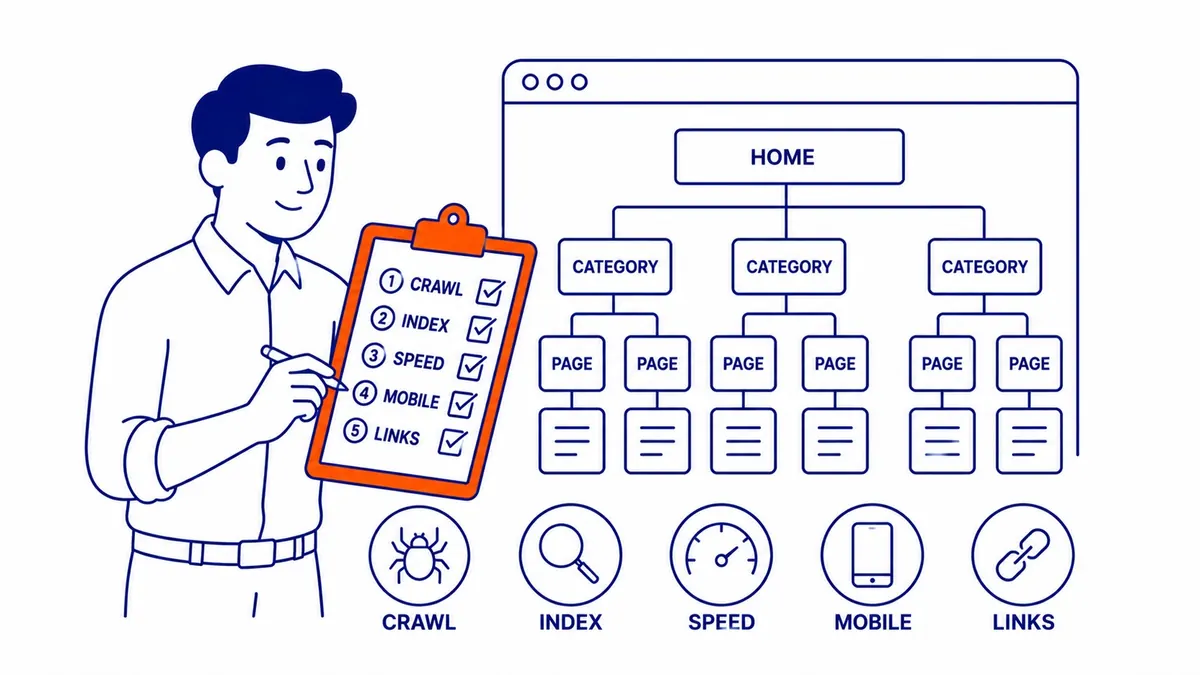
Five things to check, in order.
Indexability
The most fundamental question: search engines can actually index the pages on your site that matter. Open robots.txt at yoursite.ca/robots.txt and look for accidental disallow rules. Check the XML sitemap at /sitemap.xml or /sitemap_index.xml against GSC’s reported indexed page count. If the sitemap has 200 URLs and GSC shows 60 indexed, something is blocking the rest.
Common culprits: noindex tags left in place after launch, password-protected staging environments still live, canonical tags pointing to the wrong URL.
Crawl Errors
GSC’s Page indexing report shows every URL Google tried to crawl and what happened. 404 errors that should redirect, 500 errors that need server attention, redirect chains over two hops. Pull the list, export it, work through it.
Site Speed and Core Web Vitals
Run the homepage and the three most-trafficked pages through PageSpeed Insights. Look at Largest Contentful Paint, Interaction to Next Paint, and Cumulative Layout Shift. Anything outside the green zone is a real ranking factor in 2026, especially for competitive Calgary niches.
The fix is usually image optimization, caching, or removing unnecessary third-party scripts. Most of the time the fix lives in the WordPress plugin layer or the theme.
Mobile Usability
Open GSC’s Mobile Usability report. Two issues account for 90% of mobile problems: text too small to read and clickable elements too close together. Both come from poor responsive design and both kill mobile rankings.
Structured Data
GSC’s Enhancements report lists every type of structured data Google detected and flags errors. For most Calgary business sites, the structured data that matters is LocalBusiness, Organization, and Article schema. Validate at schema.org’s validator, fix any errors, resubmit.
How to Do an On-Page SEO Audit
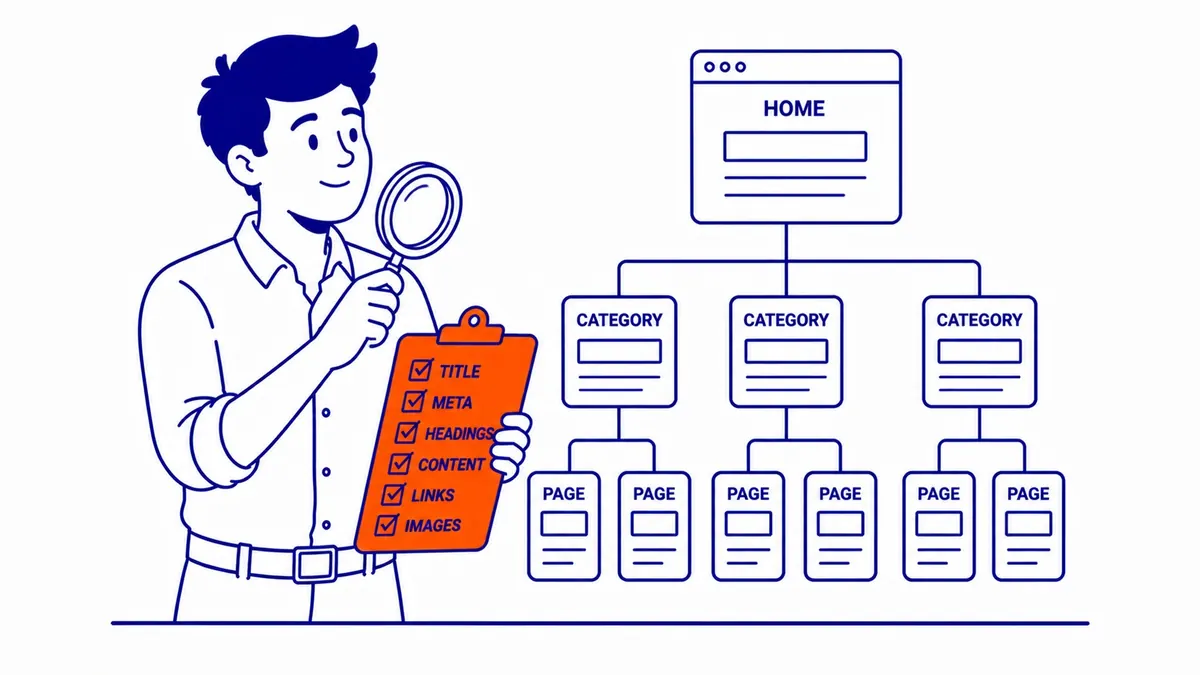
This layer is the longest part of any audit. Six things to check across every important page.
Title Tags and Meta Descriptions
Pull every page’s title tag and meta description into a spreadsheet. Check three things per row: is the title under 60 characters, does it include the target keyword near the front, is the meta description compelling and under 155 characters. Duplicate titles across the site are a common issue, especially on e-commerce sites and WordPress sites without a proper SEO plugin configured.
Heading Structure
Every page needs exactly one H1. The H1 should include the primary keyword for that page. H2 sections should structure the content logically, and H3 sections should subdivide H2s when needed. The most common heading issues we see on Calgary sites: missing H1s, multiple H1s on the same page, and H2 headings hijacked by sidebar elements.
Content Depth and Thin Pages
For each page, the question is whether the content actually answers the search intent at depth equal to or greater than the top-ranking competitors. Service pages under 500 words rarely rank against well-built competitors. Blog posts under 1000 words struggle in 2026 unless the topic is genuinely narrow.
Thin content can also be a site-wide problem. Pages with auto-generated tag archives, paginated category pages with no original content, or near-duplicate location pages all count as thin and dilute the overall site quality signal.
Internal Linking
Map the internal link structure of your website. Pages with zero internal links are effectively orphans. Important pages should be reachable in three clicks from the homepage. Anchor text variety matters. Generic anchors like “click here” and “learn more” waste an opportunity to send relevance signals.
Image Optimization
Every image should have descriptive alt text. File sizes should be under 200 KB for most use cases. File names should describe the image clearly, not be IMG_2034.jpg, so search engines can read them. Lazy loading should be enabled. Calgary sites with photo-heavy gallery pages are often where the biggest image-related speed losses hide.
Keyword Targeting
For each important page on your site, identify the single primary keyword it targets and verify the page is actually optimized for it. Title tag, H1, first paragraph, and at least two H2 sections should reference the keyword or close variants. Beyond that, natural usage is enough. Proper SEO keyword analysis upfront prevents most of the issues that show up in this section of an audit.
How to Do an Off-Page SEO Audit
Backlinks remain a strong ranking signal for search engines in 2026, despite recurring industry rumours otherwise. Three checks matter.
Backlink Profile Review
Pull your site’s backlinks from Ahrefs or Semrush. Sort by referring domain authority. The valuable links come from sites with real traffic and topical relevance. A Calgary law firm with backlinks from local business directories, Calgary news sites, and legal publications has a healthy profile. The same firm with 5,000 backlinks from random blogs has a problem.
Toxic Link Identification
Toxic links come from PBNs, paid link directories, foreign-language sites with no relevance, and sites with manual action histories. If any past agency used grey-hat tactics, the audit needs to surface those links. Once identified, the decision is whether to disavow or ignore. Google has gotten better at ignoring obvious spam, but a heavily polluted profile still hurts.
Competitor Gap Analysis
Use Ahrefs’ Link Intersect or Semrush’s Backlink Gap to find domains linking to the top three competitors that do not link to your website. Treat user experience signals from those competitor sites as a benchmark too. These are the highest-probability outreach targets for the next six months of link building. Treat the list as a starter, not a final plan. The full method for how to do competitor analysis in SEO reaches well beyond the backlink gap alone.
What to Prioritize After the Audit
A 200-item audit list of issues for your content is overwhelming. Prioritize by impact and effort.
High impact, low effort: title tag fixes, missing meta descriptions, broken internal links, image alt text. Tackle these in week one.
High impact, high effort: site speed work, thin content rewrites, structural redirects from a botched migration. Multi-week projects but where the real ranking lift comes from, and where user experience improvements compound.
Low impact: minor structured data tweaks, low-traffic page improvements, hreflang corrections on a single-language site. Important to fix eventually, not worth blocking other work for.
A common audit mistake: trying to fix everything at once. Pick five things, fix them, measure the impact, then move to the next batch.
Common SEO Audit Mistakes
Five recurring mistakes Calgary businesses make when running their own audits.
Auditing the homepage only. Most audits stop at the homepage and assume the rest of the site is similar. Service pages and blog posts often have different issues, sometimes worse ones. Audit at least the top ten URLs by traffic, not just the front door.
Confusing crawl errors with ranking problems. A page with a few 4xx errors can still rank fine. A page with no crawl errors can rank poorly. The audit’s job is to surface issues on your site, not assume the issue is the cause of the ranking gap.
Ignoring search intent. A page can pass every technical check, hit perfect on-page metrics, and still not rank because it does not match what users are searching for. The audit should always include a quick search-intent review for the top-targeted keywords.
Treating Ahrefs domain rating as the goal. Domain rating is one signal among many, and chasing it directly leads to bad link building decisions. Use it for competitive comparison, not as the target metric.
Skipping the GA4 cross-check. The audit findings should reconcile against actual user behaviour data. If GA4 shows users converting from a page the audit flagged as thin content, the priority changes. Without the user data, the audit is just opinions.
Avoiding these five raises the quality of any audit, DIY or professional.
What a Calgary SEO Audit Should Cost
Pricing depends on site size and depth. A small business site with 20 to 50 pages runs $1,500 to $3,000 for a professional audit. A mid-size site with 200 to 500 pages runs $3,500 to $7,000. Enterprise audits start at $10,000 and go up. For the wider context, see our breakdown on how much SEO costs in Calgary. Cheaper offers exist, and most of them are automated reports from SEO software with no manual review. Knowing what an SEO checker actually does clarifies why those automated reports fall short. Those identify issues but cannot tell you which ones matter for your specific situation.
What the price should include: a written report with prioritized findings, an executive summary that explains issues in business terms not jargon, and at least a one-hour walkthrough call. Turning those findings into a clean recurring format is its own skill, which a guide on how to create an SEO report covers. Anything missing those three pieces is incomplete.
The Calgary market specifically has agencies offering audit-only engagements as a low-risk way for new clients to evaluate fit before signing a retainer. Worth asking about if the prospective agency tries to push directly into a 12-month contract without a discovery phase. Ranges shift by market too, which our fuller breakdown of the cost of an SEO audit covers.
How Often to Do an SEO Audit
Once a year for sites with stable content. Twice a year for sites pushing new content monthly. After every major change. After any unexplained ranking drop.
Smaller spot audits of your site make sense more often. Monthly Core Web Vitals checks, quarterly backlink profile reviews, ongoing Google Search Console monitoring of your content. The annual full audit catches what the spot checks miss. Frequency matters less than why SEO audit is important in the first place. Frequency by sector is covered in how often to audit a site.
Should You DIY or Hire?
A motivated site owner with twenty hours and a copy of Screaming Frog can run a competent technical audit on a small site. The on-page audit is harder to DIY because it requires SEO judgment about competitor depth and keyword targeting. The off-page audit usually needs paid tool access most owners do not have.
The real economics: a professional website SEO audit in Calgary runs $1,500 to $5,000 depending on site size. A DIY audit costs $250 for Screaming Frog and roughly 25 hours of your time. If your hourly value is over $60, hiring it out usually wins.
The third option, often the best: pair with an experienced auditor for one session. They run the tools and surface the issues affecting your website, you handle the documentation and any in-house fixes. Splits the cost without losing the expertise. Worth reviewing the SEO portfolio of any auditor before committing.
For Calgary businesses also running paid campaigns, audit findings often interact with Google Ads campaign management. Page speed and landing page quality affect Quality Score directly, so a technical fix to one channel improves the other.
Frequently Asked Questions
How do you perform an SEO audit?
Three layers, in order. Technical first: indexability, crawl errors, page speed, mobile usability, structured data. On-page second: title tags, headings, content depth, internal links, keyword targeting. Off-page third: backlink profile, toxic links, competitor gaps. Use Google Search Console plus a crawler like Screaming Frog plus one paid tool for backlinks. The whole process takes 8 to 40 hours depending on site size.
Can ChatGPT do an SEO audit?
Partially. It can review individual pages for on-page issues, suggest title tag rewrites, and identify obvious content gaps. It cannot crawl the site, pull actual GSC data, check Core Web Vitals, or analyse the backlink profile. Use it as a writing assistant during the audit, not as the auditor.
What are the 3 C’s of SEO?
Content, code, and credibility. Content covers what each page says and how well it matches search intent. Code covers the technical implementation of the site. Credibility covers the backlink profile and external signals of authority. A complete audit addresses all three.
Can I do SEO myself?
Yes, with limits. Site owners can handle on-page basics, content production, and ongoing maintenance once an initial audit has set the foundation. Technical SEO and link building usually need either professional help or significant time investment to do well. The DIY ceiling for most Calgary businesses is local rankings in low-competition niches.
A good SEO audit is the difference between an SEO campaign that works and one that wastes the budget. Run yours before the next round of content or link building. Without it, the rest is guessing.
Contact Calgary SEO Company To-The-TOP!
Questions about anything in this article, or about your own rankings? Talk to a Calgary SEO specialist directly.
Phone: (403) 308-5949
Address: 1509 14 Ave SW, Calgary, AB T3C 0W4
Hours:
Monday to Friday: 10:00 am – 7:00 pm
Saturday: 12:00 pm – 4:00 pm
Sunday: closed