What Is a Keyword in SEO? Types, Search Volume, and How to Find Them
Every new client site audit at To-The-TOP!, an SEO company in Calgary, includes one question early on: what terms do you think people use to find you? The answers are almost always too broad (“plumber Calgary”), too specific (“emergency copper pipe re-route northeast quadrant”), or phrased the way the business owner talks rather than the way a customer searches. That gap between how a business describes itself and how customers actually search is exactly what keyword research closes.
A keyword, in SEO terms, is any word or phrase a person types into a search engine. The term covers everything from a single word (“plumber”) to a multi-word question (“how much does it cost to replace a water heater in Calgary”). Search engines match those queries against indexed pages and return results ranked by relevance and authority. Which queries your pages appear for, and at what position, is largely determined by which terms you have targeted and how well your content serves them. Understanding what makes a term an SEO keyword is the foundation of every keyword strategy.

Why Keywords Are the Starting Point for SEO
No target terms, no rankings. Pages cannot rank for terms they do not target. That sounds obvious, but the number of sites publishing content with no clear search intent behind each page is high. Useful content that never appears in relevant searches is invisible to the audience it was written for.

Search demand is the signal keyword research reads. People searching “furnace repair Calgary” are telling you what they need, when they need it, at higher buying intent than almost any other traffic source. Matching that intent with a page built around the right term is the basic mechanism of SEO. Everything else, including technical performance, backlinks, and page structure, amplifies a signal that starts with the right query.
For local operations competing on Calgary-specific searches, the search layer is often the clearest path to traffic that converts. A plumber ranking for “emergency plumber Calgary” captures demand that already exists and is ready to act. That is different from running ads to build awareness. The practical first step is to have your keywords researched and map that existing demand before any content gets written.

Short-Tail, Long-Tail, and Local: How Search Terms Differ
Short-tail and long-tail are the most common categories. Short-tail terms are one to two words, high volume, and broadly competitive: “SEO,” “plumber,” “mortgage.” Long-tail terms are three or more words, lower volume per query, and much closer to what a buyer-ready searcher actually types: “SEO company for small business Calgary,” “emergency plumber available Sunday northeast Calgary,” “fixed-rate mortgage calculator Alberta.” Long-tail volume adds up quickly across hundreds of specific queries, and the competition on individual terms is usually lower.
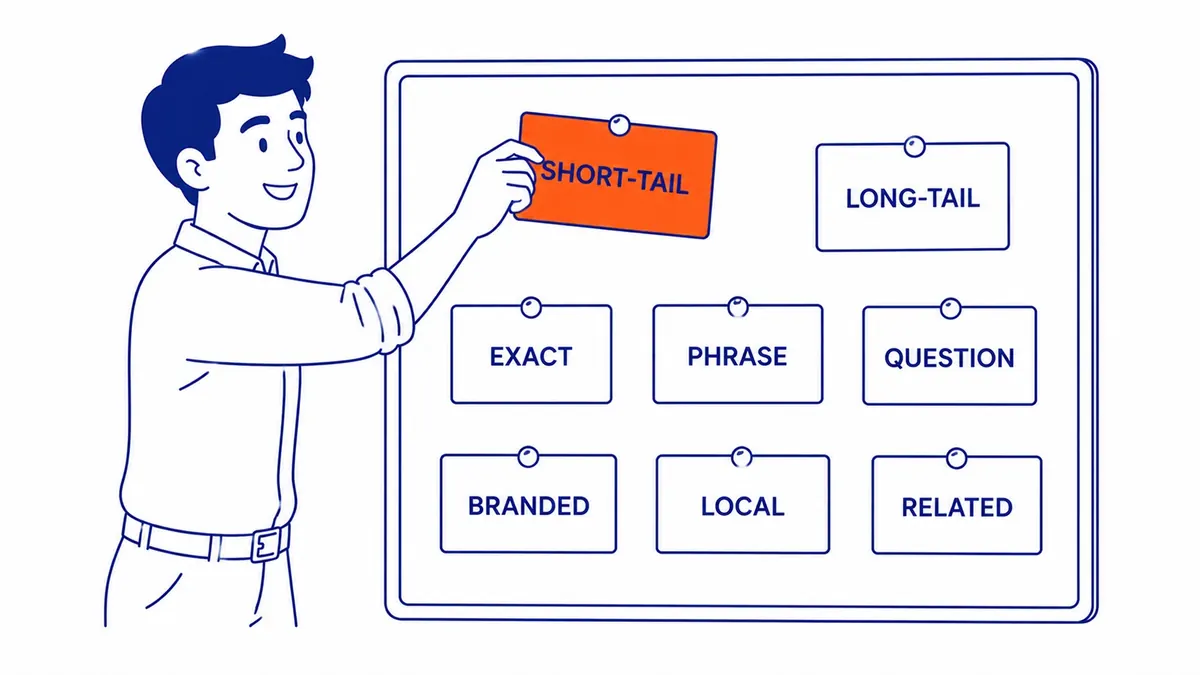
Informational, navigational, and commercial are the intent-based categories. Informational queries are research: “what is a keyword,” “how does SEO work,” “types of roofing materials.” Navigational queries are brand or site lookups: “To-The-TOP! SEO Calgary.” Commercial queries are comparison or purchase intent: “best Calgary SEO company,” “SEO pricing Alberta,” “hire a keyword research specialist.” Each intent type needs a different page type and a different content approach. Mixing them on a single page usually serves none of them well.
Local keywords carry a geographic qualifier, either explicit (“electrician Inglewood Calgary”) or implicit (searches from a Calgary IP address without the city name where Google still returns local results). Local SEO depends on targeting both. A page that ranks for “electrician Calgary” but misses suburb-level searches leaves demand on the table.
How Search Volume and Competition Shape Keyword Value
Search volume is the estimated number of times a term gets searched per month. High-volume terms sound attractive but are rarely the best starting point for a local service business. “Plumber” has enormous search volume nationally; “plumber Calgary” has a fraction of that volume but far higher relevance and far lower competition from non-local players.
Keyword difficulty measures how hard it is to rank for a term, based on the authority of the pages currently holding top positions. A term with high difficulty requires significant link authority and content depth to crack. Most local and regional businesses start with lower-difficulty, higher-specificity terms and build toward the harder targets as their domain authority grows. Trying to rank for “SEO” on a new site is not a strategy. Ranking for “SEO company Calgary” on a site with 19 years of history and strong local citations is a realistic goal.
The ratio between search volume and keyword difficulty is what determines where to invest. A term with 200 monthly searches and low difficulty often delivers more qualified traffic than one with 2,000 searches and near-impossible competition. Picking the right keywords requires looking at both numbers together, not volume alone. Paid search data also informs organic targeting. If you have us manage your Google Ads alongside the SEO work, the campaigns reveal what converts, not just what gets clicked, and that feeds back into the long-term strategy.

Where to Start Your Search Term Research
Start with what you already have. Google Search Console shows which queries are generating impressions and clicks for your site right now. Queries you rank for on page two or three are often the fastest organic wins: some additional content depth or a few backlinks can push a page from position 12 to position 4, producing traffic with minimal new investment. Knowing what your site currently ranks for is the baseline before any new targeting decision.
Competitor keyword gaps come next. Tools like Ahrefs and SEMrush show which terms your direct competitors rank for that your site does not. In a local market, the top-ranked competitor in any category is already doing some of the research for you: their ranking pages reveal which terms Google considers relevant enough to reward. Studying that list is faster than building a term list from scratch.
Keyword tools fill in the rest. Google Keyword Planner, Ahrefs Keywords Explorer, and similar tools generate term ideas around a seed query, show search volume, and estimate difficulty. The output is a starting list, not a final strategy. Every suggested term needs evaluation against the business category, the existing site content, and the realistic competitive position of the domain.
The keyword research process covers all of this in more detail: how to build a target term list from scratch, how to prioritise targets, and how to map terms to specific pages so nothing overlaps.
Frequently Asked Questions
What is a keyword example?
“Emergency plumber Calgary” is a keyword. So is “what is a keyword,” “SEO pricing for small business,” and “furnace replacement cost Alberta.” Any phrase typed into a search engine is a keyword. In practice, SEO targets the specific terms most likely to bring the right audience to the right page. A plumbing company targets “emergency plumber Calgary” and related long-tail variants, not generic terms like “pipes” that attract no commercial intent.
What is the definition of a keyword in SEO?
A word or phrase people enter into search engines to find information, products, or services. From an SEO perspective, a keyword is the target term a page is built around, with the goal of appearing in search results when someone types that term. The page’s title, headings, body content, and internal links all signal to Google what the page is about, and that signal is anchored in the keyword. How often that term appears, which is all what keyword density is measures, is a smaller piece than it sounds.
What is a keyword in writing?
In general writing, a keyword is a significant term that captures the core idea of a passage. In SEO writing specifically, it is the search term the content is designed to rank for. The practical difference: general writing uses keywords for emphasis or summary; SEO writing uses them to match search intent, appear in the right queries, and satisfy the reader who arrived via that specific search. Good SEO writing serves both purposes at once, though search intent takes priority. Related terms, sometimes called LSI keywords, support that match without any one phrase being forced.
What is the difference between a keyword and a keyphrase?
No meaningful difference in modern SEO usage. “Keyword” historically referred to a single word; “keyphrase” or “key phrase” referred to a multi-word string. Most searches today are multi-word strings, so the industry mostly uses “keyword” to mean any search term regardless of length. Some SEO tools still distinguish between them for classification purposes, but the strategy implications are the same.
Contact Calgary SEO Company To-The-TOP!
Questions about anything in this article, or about your own rankings? Talk to a Calgary SEO specialist directly.
Phone: (403) 308-5949
Address: 1509 14 Ave SW, Calgary, AB T3C 0W4
Hours:
Monday to Friday: 10:00 am – 7:00 pm
Saturday: 12:00 pm – 4:00 pm
Sunday: closed