What Is PPC? Pay-Per-Click Explained for Calgary
PPC stands for Pay-Per-Click. It is the advertising model where you only pay when someone actually clicks your ad. Google Ads is the largest PPC platform, but PPC also runs on Microsoft Ads, Meta, LinkedIn, TikTok, and most other ad networks. If your business has ever bought a sponsored result at the top of a Google search, that was PPC.
Quick disambiguation: in Canadian search, PPC also returns results about the People’s Party of Canada. This article is about pay-per-click advertising, not the political party.

What follows is what PPC actually is, what the main platforms cost, and how to decide whether it makes sense for your Calgary business.
What PPC Actually Is
PPC is the inverse of traditional advertising. With a billboard or a radio ad, you pay for the exposure regardless of whether anyone responds. Pay nothing with PPC until someone clicks. Impressions are free. Engagement costs money.
Every PPC ad lives inside an auction. When someone runs a search or scrolls Facebook, the platform runs a real-time auction among advertisers targeting that query or audience. The winners get the ad placements. Cost per click depends on competition, ad relevance, and platform-specific quality scores. Sizing up that competition starts with how to check competitors’ Google Ads.
Three things make PPC different from organic marketing. Speed: a PPC campaign can drive traffic the day it launches. Precision: targeting can narrow down to a postal code, an income range, or a specific keyword. Predictability: budget in, clicks out, with consistent math once a campaign is dialled in.
The Main PPC Platforms
Four platforms cover most Calgary PPC spend.
Google Ads
The largest. Search ads on google.com plus display ads across the Google Display Network and YouTube. For most local Calgary businesses, Google Ads search campaigns drive the highest-intent traffic. Someone typing “emergency plumber Calgary” is closer to buying than someone scrolling Facebook. Getting started is covered step by step in how to advertise on Google Ads.
Microsoft Ads
Bing and Yahoo search. Often overlooked because it has lower volume than Google, but the cost per click is usually 30 to 50% cheaper, and the audience skews older and more affluent in many B2B niches. Worth testing for any business already running Google Ads successfully.
Meta (Facebook and Instagram)
Image and video ads in Facebook and Instagram feeds. Lower intent than search ads because users are not actively looking for solutions, but the targeting options for interests, behaviours, and lookalike audiences make Meta strong for e-commerce, local services with visual products, and brand awareness.
LinkedIn Ads
B2B only. Most expensive cost per click of any major platform, but the targeting by job title, company size, and industry justifies it for businesses selling to specific corporate roles.
Other platforms worth knowing: TikTok (younger demographics), Pinterest (e-commerce, home and lifestyle), Reddit (niche communities). For most Calgary small and mid-size businesses, the first two platforms cover 90% of practical use cases. Marketplaces run PPC of their own, and what Amazon PPC is covers the biggest.
How PPC Auctions Work
The auction model is the same idea across every platform. Advertisers bid on placements. The platform decides who wins based on bid amount and ad quality combined.
Your bid is what you would pay per click if you won. Quality score adjusts that. A well-targeted ad with relevant landing pages can outbid a poorly-targeted ad even if the second advertiser is willing to pay more per click. Google rewards relevance because users click on relevant ads more often, which makes Google more money over time. We break that mechanism down in how Google Ads works.
What this means in practice: throwing money at PPC without optimizing the ad copy, keywords, and landing pages is the most common reason campaigns lose money. The platform charges more per click for poorly-targeted campaigns specifically to push them out of the auction.
What You Pay For
Three metrics matter for PPC budgeting.
Cost per click. The price of a single click. Google Ads in Calgary ranges from $1 to $50 depending on industry. Legal, dental, and insurance run high. Local services and e-commerce usually run lower.
Cost per acquisition. The cost to actually generate a paying customer. If 50 clicks at $3 each produces 1 customer, your CPA is $150. The number that actually matters for ROI math.
Return on ad spend. Revenue divided by ad spend. A 4:1 ROAS means $4 in revenue for every $1 spent. Profitable for most businesses with healthy margins. A 2:1 ROAS is breakeven for many service businesses once labour and overhead are included.
Always do the CPA math before scaling. A campaign with great cost per click metrics but terrible CPA is burning budget.
PPC vs SEO: When to Use Which
The two compete for budget in most marketing plans, but they solve different problems. The umbrella term covering both is explained in what SEO and SEM marketing is.
PPC delivers traffic immediately. Launch a campaign Monday, see clicks Tuesday. SEO takes three to twelve months before meaningful rankings show up. For an established business that needs leads next week, PPC wins.
SEO produces traffic that does not stop when the budget does. Stop paying for PPC ads, the clicks stop the same day. Doing that cleanly without losing the account history is what how to cancel a Google Ads campaign covers. Cancel the SEO budget and the rankings stay for months or years before they fade. SEO compounds. PPC is rented attention.
The practical answer for most Calgary businesses is both. Run PPC to drive immediate traffic while Calgary SEO builds the long-term foundation. We covered the budget side in detail in our guide to SEO costs in Calgary. PPC budgets follow similar logic but the math runs faster because results are visible inside the first month. If your customers search locally, the paid and organic sides also overlap with local SEO, since both fight for the same map and search real estate.
What a Calgary PPC Campaign Costs
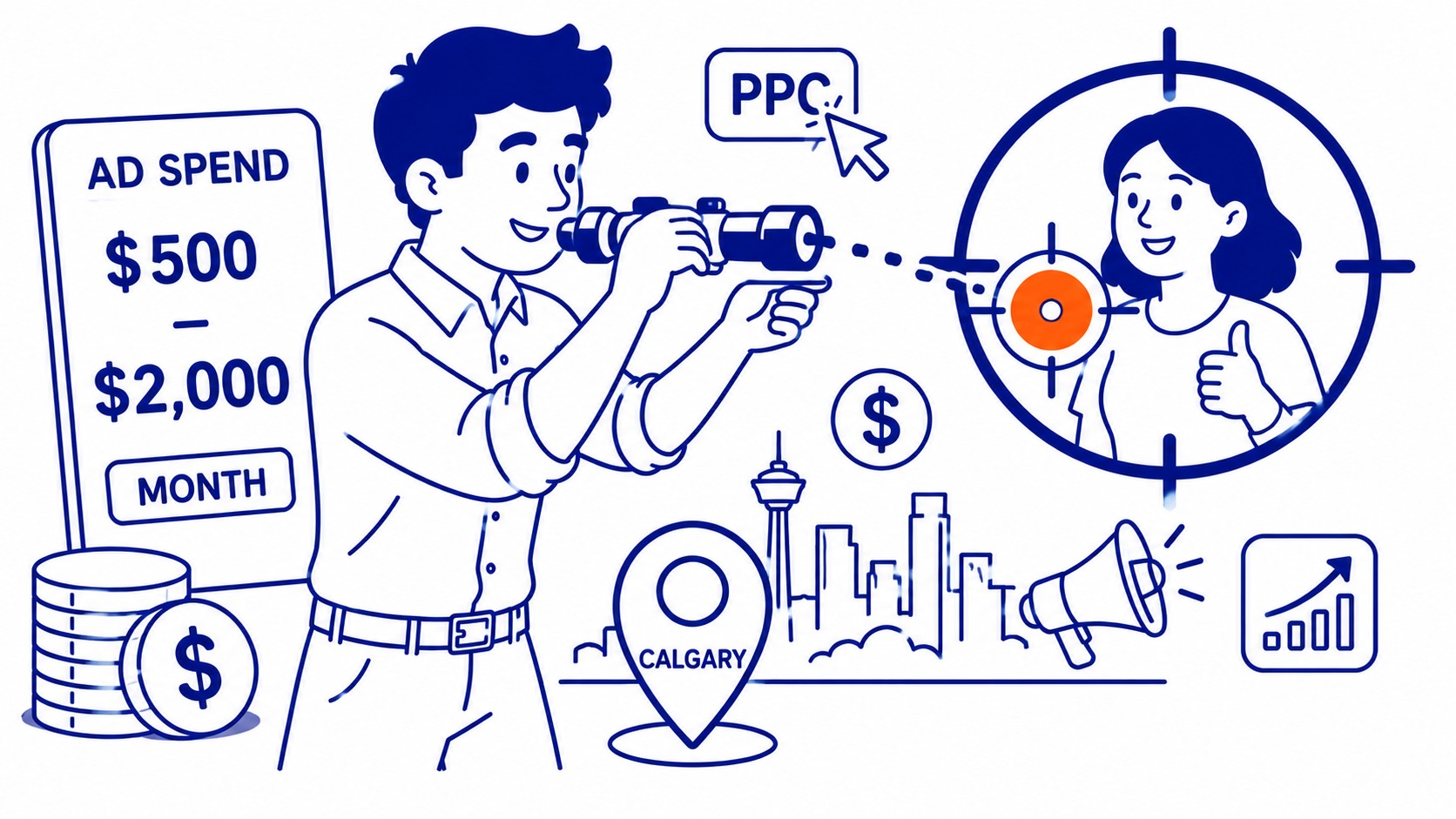
For a small Calgary business, $500 to $2,000 per month in ad spend is the typical starting range. Below $500 and the data takes too long to optimize the campaign. If a campaign is not converting, knowing how to stop Google Ads cleanly beats letting it bleed. Above $5,000 needs serious campaign structure, often a dedicated PPC specialist managing the account.
Add 15 to 20% of ad spend on top for management fees if working with an agency. A $2,000 monthly ad budget plus management runs about $2,400 to $2,500. Higher-tier accounts negotiate flat fees instead of percentage management.
What the budget actually buys: keyword research, campaign structure, ad copy variations, landing page recommendations, daily bid adjustments, weekly reporting, and ongoing optimization. The reporting matters. Without it, neither side knows whether the campaign is working.
Common PPC Mistakes
Five mistakes account for most failed PPC campaigns.
Targeting broad keywords. Bidding on “lawyer” instead of “personal injury lawyer Calgary” wastes most of the budget on irrelevant clicks. Always narrow the keyword targeting before increasing bids. Those bid terms are what AdWords keywords are, the older name for Google Ads keywords.
No negative keywords. A plumber bidding on “plumbing” without excluding “DIY plumbing tutorial” pays for traffic from people who will never hire a plumber. Negative keywords filter out wasted clicks.
Sending traffic to the homepage. The ad promised something specific. Your landing page should match that promise. Sending PPC traffic to a generic homepage instead of a targeted landing page kills conversion rates.
Not tracking conversions. If the campaign cannot tell you which clicks converted, the optimization is guessing. Conversion tracking is mandatory before spending more than $200 in test budget.
Letting the platform auto-bid blindly. Smart Bidding works once the campaign has 30 to 50 conversions of training data. Before that, manual bidding gives better control. Most failed accounts ran auto-bidding from day one and never built the conversion data the algorithm needs.
Should You Run PPC Yourself or Hire?
For a single product or service with a clear target audience, a motivated business owner can run a basic PPC campaign with twenty hours of learning. Google’s free PPC training covers the fundamentals.
For multi-service businesses, e-commerce with hundreds of products, or any campaign over $3,000 monthly, professional management usually pays for itself. The wasted spend on poorly-structured campaigns easily exceeds management fees.
Professional Google Ads management in Calgary runs $400 to $1,500 monthly depending on account complexity. For Edmonton and Vancouver businesses, expect similar rates with slightly higher overhead in the Vancouver market. The ranked campaigns in the SEO portfolio came from the same hands-on approach, no junior handoffs.
Frequently Asked Questions
What does PPC stand for?
Pay-Per-Click. An advertising model where the advertiser pays only when a user clicks the ad, not for impressions or views. Google Ads is the largest PPC platform; Microsoft Ads, Meta, LinkedIn, and TikTok all run on the same model.
Is PPC the same as Google Ads?
No. Google Ads is one PPC platform among several. PPC is the broader advertising model that includes Google Ads, Microsoft Ads, Meta, LinkedIn, Pinterest, TikTok, and many smaller networks. Our deeper guide to what Google Ads is covers that specific platform in detail.
How much should a small business spend on PPC?
Most Calgary small businesses start with $500 to $2,000 per month in ad spend, plus 15 to 20% for management if working with an agency. The right number depends on average customer value, conversion rate, and target cost per acquisition. Above $3,000 monthly usually justifies professional management.
Is PPC worth it for small businesses?
For businesses with customers who actively search for what they sell, almost always yes. The math depends on average sale value and the cost per acquisition the campaign achieves. Service businesses with $500+ average jobs and a working conversion path on the website usually find PPC profitable within two to three months. Businesses with very low margins or no clear conversion tracking should fix those first.
How long until PPC starts working?
First clicks come within hours of campaign launch. Profitable performance usually takes 30 to 90 days of optimization to dial in. Faster than SEO, but not instant either. The first month is mostly data collection. Real profitability shows up after the campaign has enough conversions to optimize against.
PPC is the fastest paid channel for most Calgary businesses, but only when targeting, ad copy, and landing pages line up. Without that work, the budget evaporates. Done right, it pairs with SEO to cover both immediate traffic and long-term organic growth. Worth running a small test campaign before committing to a major spend.
