
How to Do SEO: A Plain-Language Guide for Business Owners
Search engine optimization, or SEO, is one of the best long-term investments you can make for your business online. This guide covers how to do SEO from the ground up. What it is, what the steps actually look like, and what you can realistically expect. No hype, no shortcuts.

What Is SEO and How Does It Work?
Most business owners think of SEO as some kind of mystery. It is not. SEO is the process of making your website easier for Google to find, read, and recommend to people searching for what you offer.
Here is how it works. Google runs automated programs called crawlers. They read your pages, follow links, and build an index of what’s online. When someone types a query, the search engine pulls from that index and ranks results based on hundreds of signals. Is the content on the page relevant? Does it load quickly? How many quality websites link to it? Does it match what the person was actually looking for?
Improving those signals is the ongoing work of SEO. Organically. Without paying for placement.
And the results compound. Pages that earn strong positions in search results keep attracting visitors month after month, even without ongoing ad spend. Unlike PPC, the traffic doesn’t stop when you stop paying. That’s the real value of it. Businesses that stay consistent for two to three years typically find the return significantly higher than what they were spending on paid placement.
How to Do SEO: The Core Steps
There’s no single action that does SEO for you. It’s a set of ongoing practices, each one strengthening how a search engine interprets and ranks your pages. Here’s what the process actually looks like in practice.
Step 1: Keyword Research
This is where everything starts, and where most business owners make their first mistake.
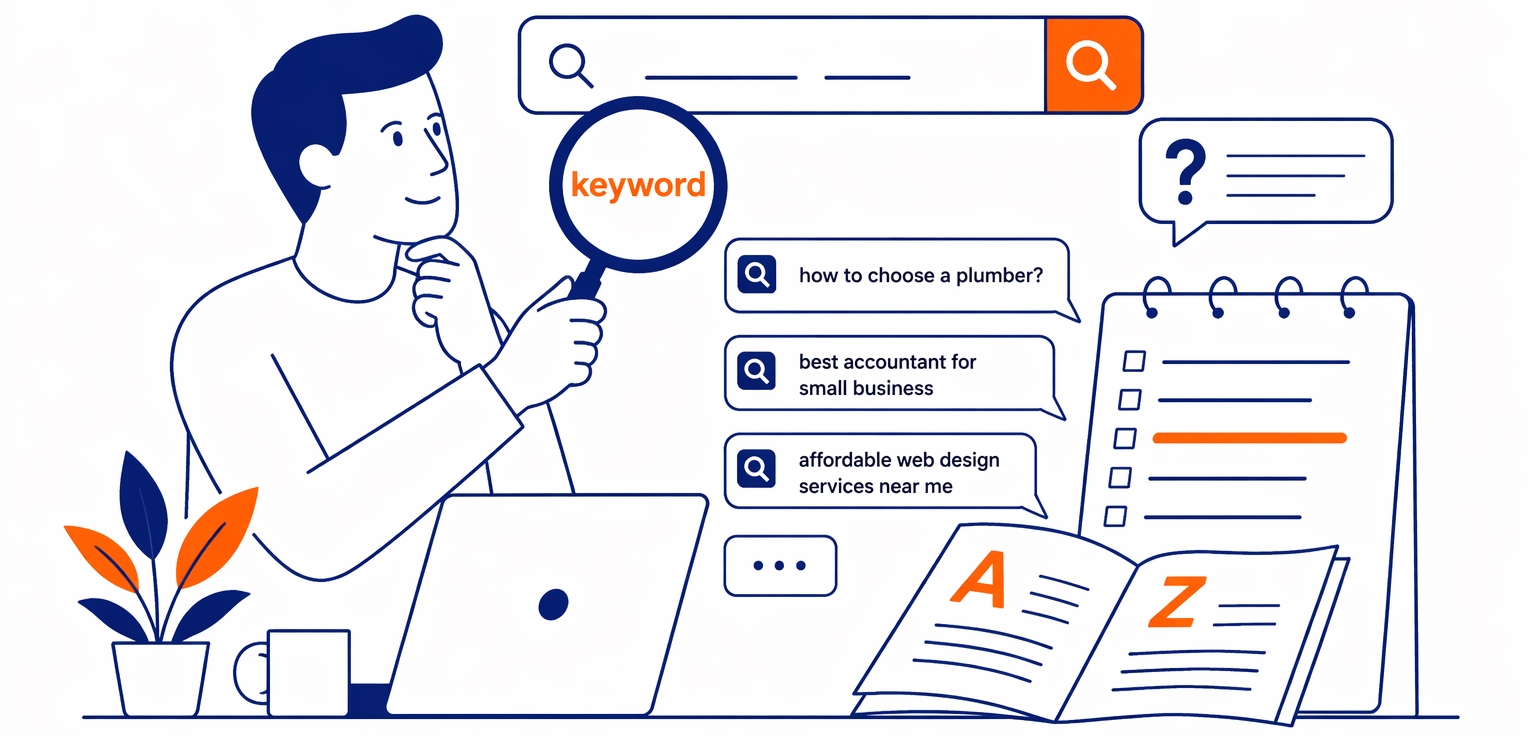
Before you optimize a page or write a word of content, you need to understand what people are actually searching for. Keyword research means identifying the exact words and phrases your potential customers type when they look for what you offer. Most business owners think they already know these terms. They usually have a partial picture. Optimizing your site around the wrong keywords means months of effort that produces nothing.
Three questions drive good keyword research. What terms are people actually using? What’s the monthly search volume? How competitive is it to rank for them?
Start with 20 to 30 terms relevant to your business. Then run them through a tool. Google Keyword Planner, Ahrefs, and SEMrush all check monthly search volume and surface related keywords you hadn’t considered. You want terms that are relevant to the page, searched often enough to matter, and realistic to rank for given where your site currently stands.
Each page on your site should target one primary keyword. For local SEO, that keyword will often include a location: “plumber Calgary,” “accountant Vancouver,” and so on. Local SEO adds an extra layer because users searching for local services want results near them, not just topically relevant pages. Build your keyword list around what your customers actually search for, not what sounds right internally. The keywords in your titles, headings, and body copy also signal to search engines what your content is about.
Getting keyword research right from the start gives you a clear plan to improve your website systematically. Alternatively, optimizing pages around the wrong terms means starting over. In 18 years doing this work, keyword selection errors are the single most common reason an SEO campaign stalls.
Step 2: On-Page SEO
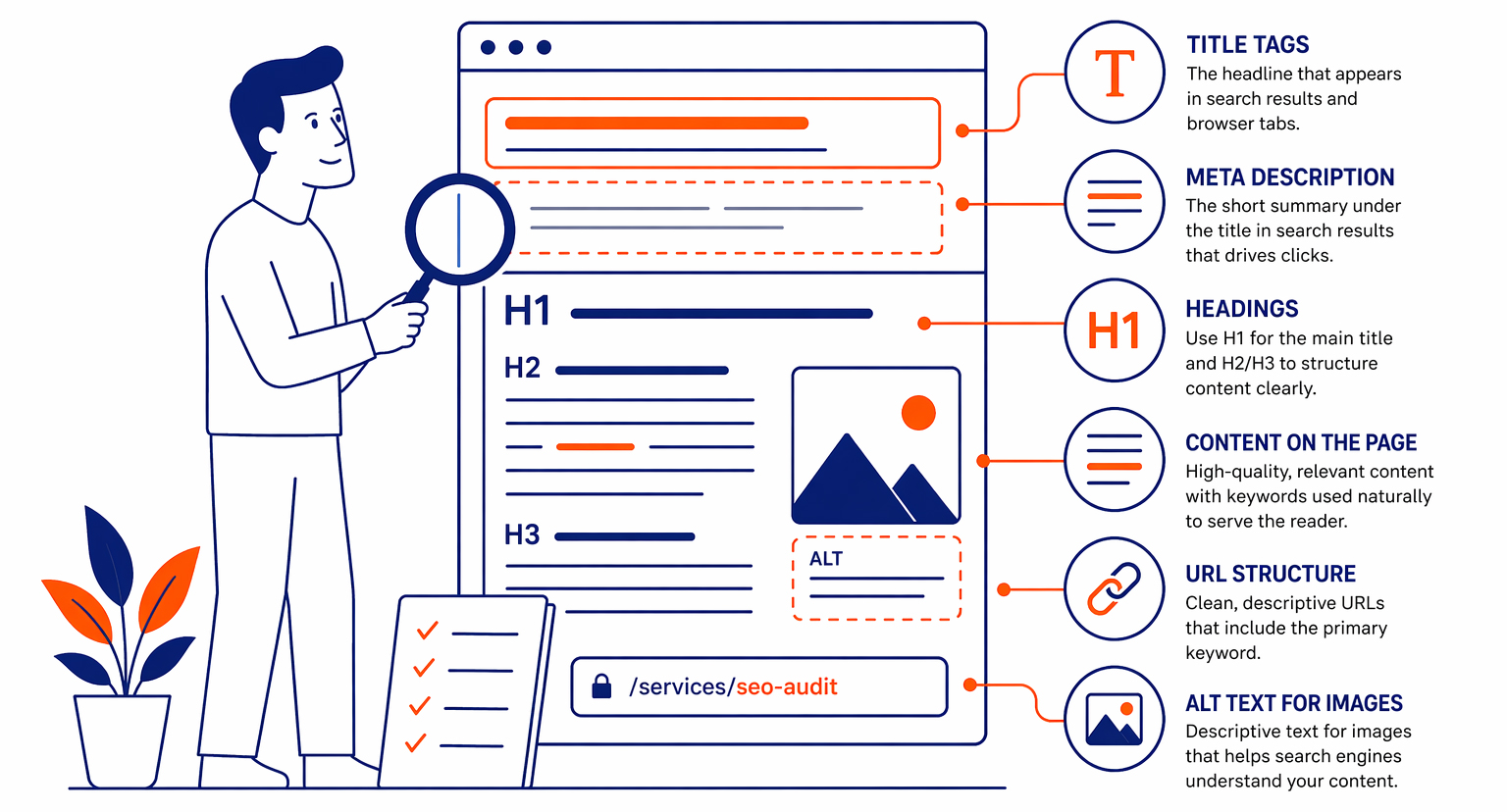
On-page SEO is the optimization of individual pages on your site. It covers the elements on the page itself that tell each search engine what it’s about. These are the most direct signals you control. Getting them right is the foundation of everything else.
Key components of on-page SEO:
Title tags. The title tag is the headline that shows up in search results and in browser tabs. Title tags are one of the strongest on-page signals for search engines, so they’re worth getting right. Pages with keyword-rich titles that match what users are actually looking for consistently outperform generic ones. Keep it under 60 characters. Write for the person reading it, not just the algorithm. A well-crafted title helps users decide which result to click before they even land on your site. Getting the title right is often the single highest-impact on-page change you can make. Most businesses underestimate how much that click decision matters.
Meta description. A meta description is the short description that appears under the title tag in search results. It’s not a direct ranking signal, but pages with a well-written meta description get more clicks. A strong description can lift click-through rates even on a page with a modest ranking position. Keep it under 160 characters, include the keyword naturally, and write it to be useful rather than clever. Most businesses write meta descriptions as an afterthought. They’re a free click-rate lever.
Headings. One H1 per page, with your primary keyword in it. H2 and H3 headings organize your content and help search engines understand the structure of the page. Keywords in headings carry more weight than keywords buried in body text. That’s been consistent across every algorithm update since 2007, and it’s why well-structured headings help pages rank more cleanly than pages with flat, unbroken copy. People also navigate by headings when skimming, so the structure serves both the reader and the search engine.
Content on the page. The actual body copy of your page matters more than any other on-page element. Keywords should appear naturally throughout: in the opening paragraph, in headings, distributed through the text. Write for the reader first. Keyword stuffing, forcing terms in unnaturally, does more harm than good and violates Google’s guidelines. Pages written for the algorithm rather than the reader rarely convert even when they rank.
URL structure. A descriptive URL sends a clear signal to search engines. Real words, not strings of numbers or random characters. Include your primary keyword. Keep it short, lowercase, with dashes between words, because clean URLs help both users and search engines before they even click. A clean URL structure helps both search engines and users understand what a page is about before clicking.
Alt text for images. Search engines can’t see images. Alt text is the descriptive text attached to each image that tells search engines, and screen readers, what the image shows. Optimizing images with descriptive alt text is one of the most overlooked ways to help search engines understand your content. Image search traffic is real, and most businesses leave it on the table by skipping alt text entirely. We check this on every site audit. It’s almost always incomplete.

Step 3: Content Creation
Content is what gives your site something to rank for. Search engines rank individual pages, not websites as a whole. Each page targets a specific topic. The more pages your site covers relevant topics well, the more search queries it can appear for. In practice, each well-targeted page is another entry point for customers. Moreover, each new page gives users another way to find you.
Providing genuinely useful information on each page is what gives a search engine reason to show it. Good content answers the question the searcher is asking: completely, clearly, and better than competing pages. Search engines evaluate content for relevance, depth, and usefulness. Writing for the user, not the search engine, is the consistent advice from Google. And in practice, it holds.
Principles that apply across every page you create:
One topic per page. Build each page around a single theme. It’s easier for search engines to classify your page and match it to the right queries. And it helps users quickly find the information they came to your site to get. People skim. Most people decide within seconds whether a page has what they need. A page with a clear, focused topic gives users what they came for faster, which improves both engagement and ranking signals.
Use keywords naturally. Include your target keyword in the title, the opening paragraph, at least one heading, and throughout the body copy. Distribute your primary and secondary keywords throughout your content so the page covers the topic completely. Repeating keywords in the title, headings, and body text gives search engines the context they need to match your page to the right queries. Every instance should read naturally, though. Stuffing doesn’t rank. It gets penalized.
Keep content current. Outdated pages lose ranking over time. Audit your content periodically and update facts, examples, and any information that’s become stale. Fresh content can help recover lost positions without a full rewrite. Search engines view regularly updated content as a sign of relevance. Additionally, pages that provide current information tend to earn more links naturally, since other sites are more likely to reference accurate content.
Length matters only when it reflects depth. A thorough answer to a specific question at 900 words will outrank a thin page at 2,500 words. That’s not about word count. It’s about whether the page actually covers the topic.
Step 4: Technical SEO
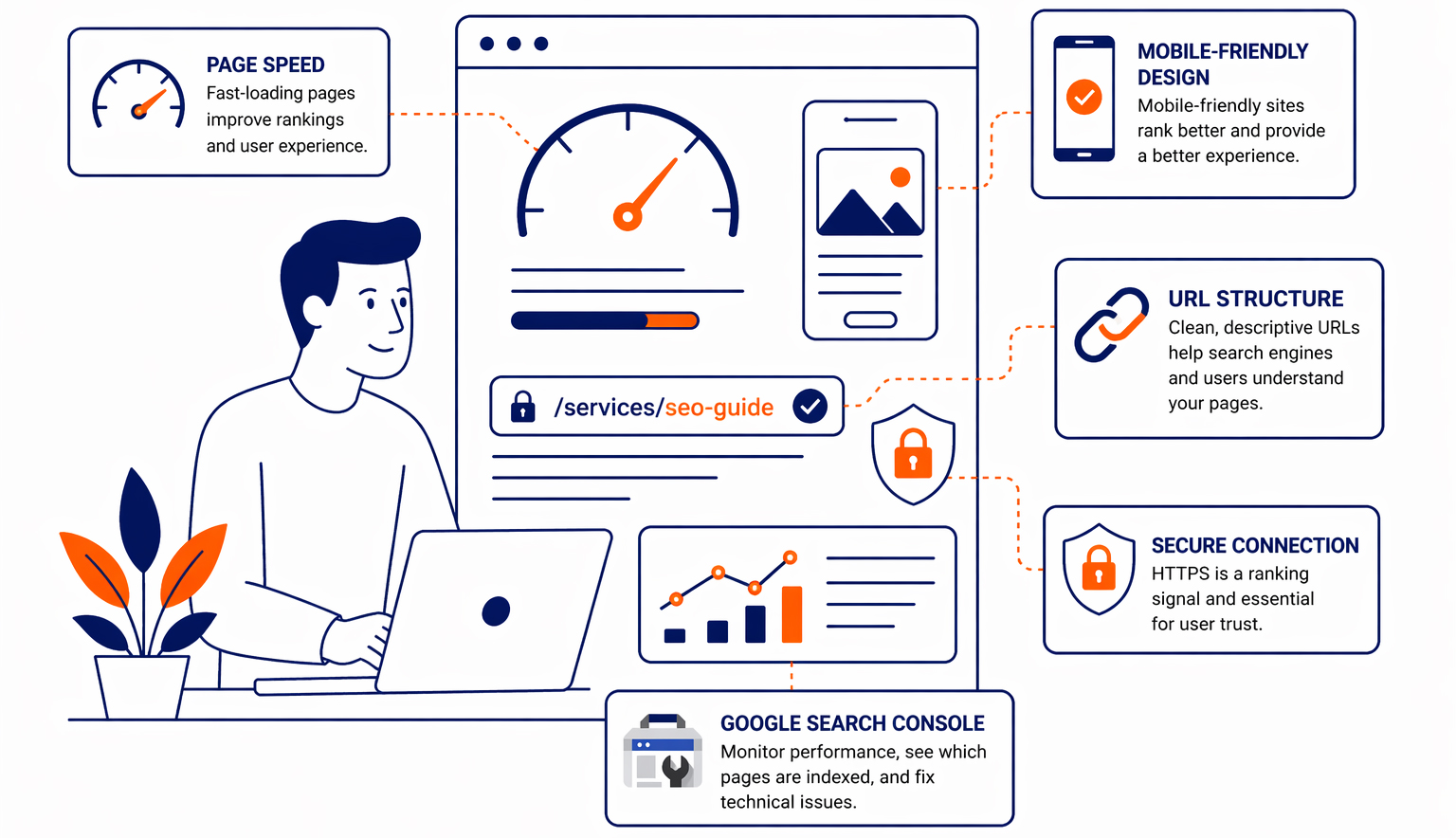
Technical SEO covers the behind-the-scenes factors that affect how search engines crawl and index your website. Content and links attract most of the attention. However, technical issues can prevent a well-written page from ranking at all.
Here’s the thing: when a search engine visits your site, it reads these technical signals before it even evaluates your content. Most business owners address this last. It should be first. Technical health is one of the most important foundations you can build, and one of the most frequently skipped.
Page speed. Google treats page speed as a ranking signal. Slow pages frustrate users and signal low quality. Uncompressed images and bloated code are the most common culprits. The correlation between slow load times and high bounce rates shows up consistently in analytics. A fast-loading site improves both search engine performance and user experience. Compress your images before uploading and minimize code where possible.
Mobile-friendly design. Over half of all web traffic comes from mobile devices. Google indexes the mobile version of your site first. A site that doesn’t function well on smartphones won’t rank as well as a mobile-friendly one. Test with Google’s mobile usability tools and fix what it flags.
URL structure. Clean, descriptive URLs contain real words that reflect the content of the page. These URLs perform better in search results than addresses full of numbers and query parameters. Short, descriptive URLs also help users understand what a page covers before they click. Audit your URLs periodically to confirm they follow a consistent pattern across your website. Each page should have one canonical URL. Avoid duplicate content, where the same page is accessible under multiple different addresses, as search engines find this confusing. Duplicate URLs split the ranking signals your site earns for a given topic, which weakens your position in search results.
Secure connection. Sites running on HTTPS rank better than HTTP. It’s a basic technical requirement now. Not optional.
Google Search Console. This is Google’s free tool for monitoring how your site performs in search. It shows which queries are bringing visitors to your pages, which pages are indexed, and whether Google has flagged any technical problems. Set it up before you do anything else and check it regularly.
Step 5: Link Building and Off-Page SEO
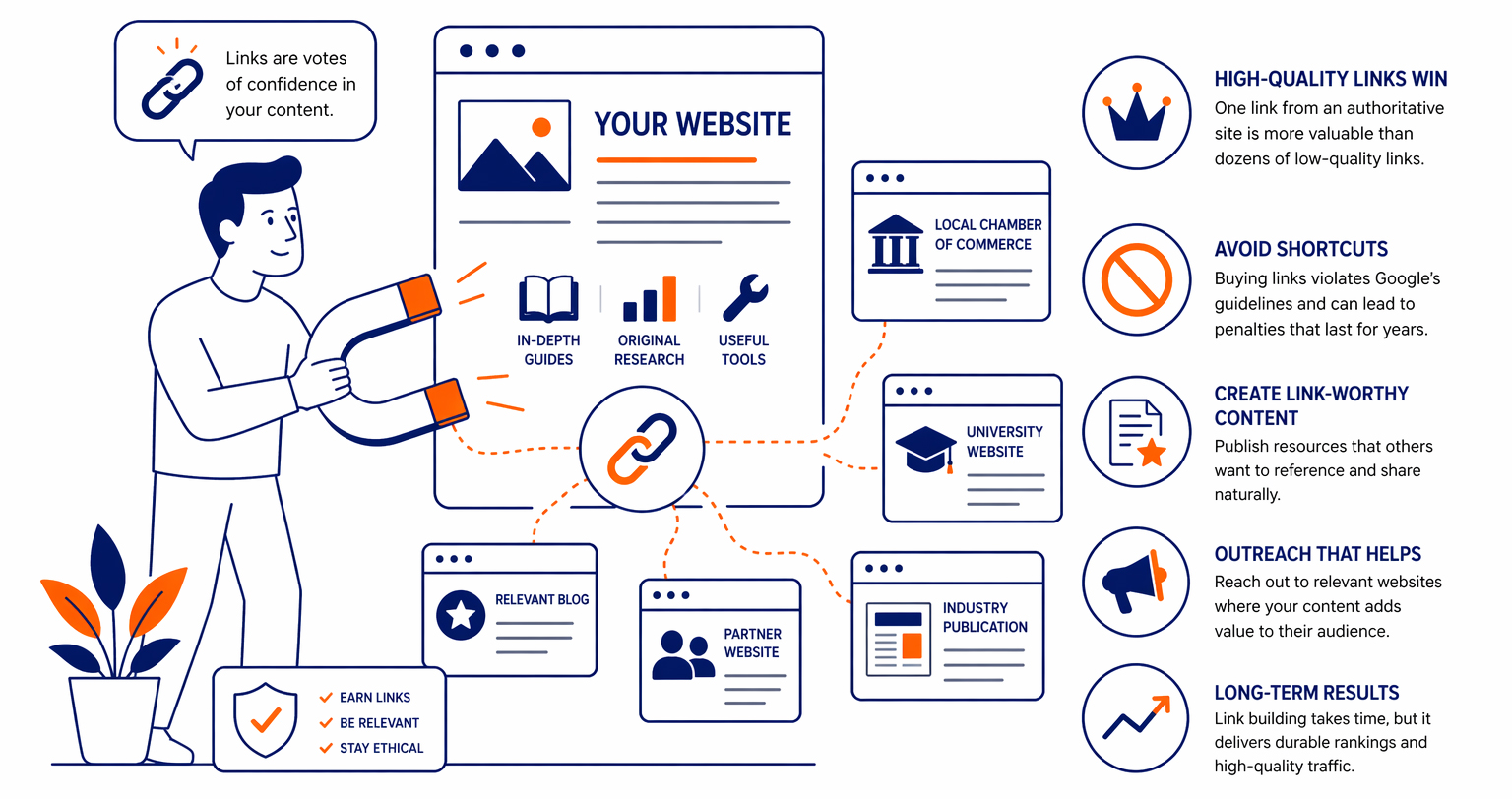
Links from other websites are one of the most important ranking signals in search engine optimization. Google interprets a link as a vote of confidence. The more authoritative the site linking to your content, the more weight it carries in search results.
Off-page SEO is primarily about building that link profile organically and ethically. One high-quality backlink from a reputable source, a local chamber of commerce, a university, a well-known industry publication, does more for your rankings than dozens of links from low-quality directories or purchased link farms. Buying backlinks violates Google’s guidelines and can result in penalties that are difficult to recover from. Many businesses have learned this the hard way. The penalty can stick for years.
Earn links by creating content that other sites genuinely want to reference: thorough guides, original research, useful tools, or local resources. Reach out to relevant websites where a link to your content helps their readers. Link building is slow work, and a dedicated link building strategy requires consistent effort over months before results compound. Most businesses underestimate how long this takes. Still, the results are durable. Organic traffic from a well-built link profile tends to be high-quality, because visitors arriving through reputable backlinks are already interested in what your site offers.
Step 6: Tracking Your Results
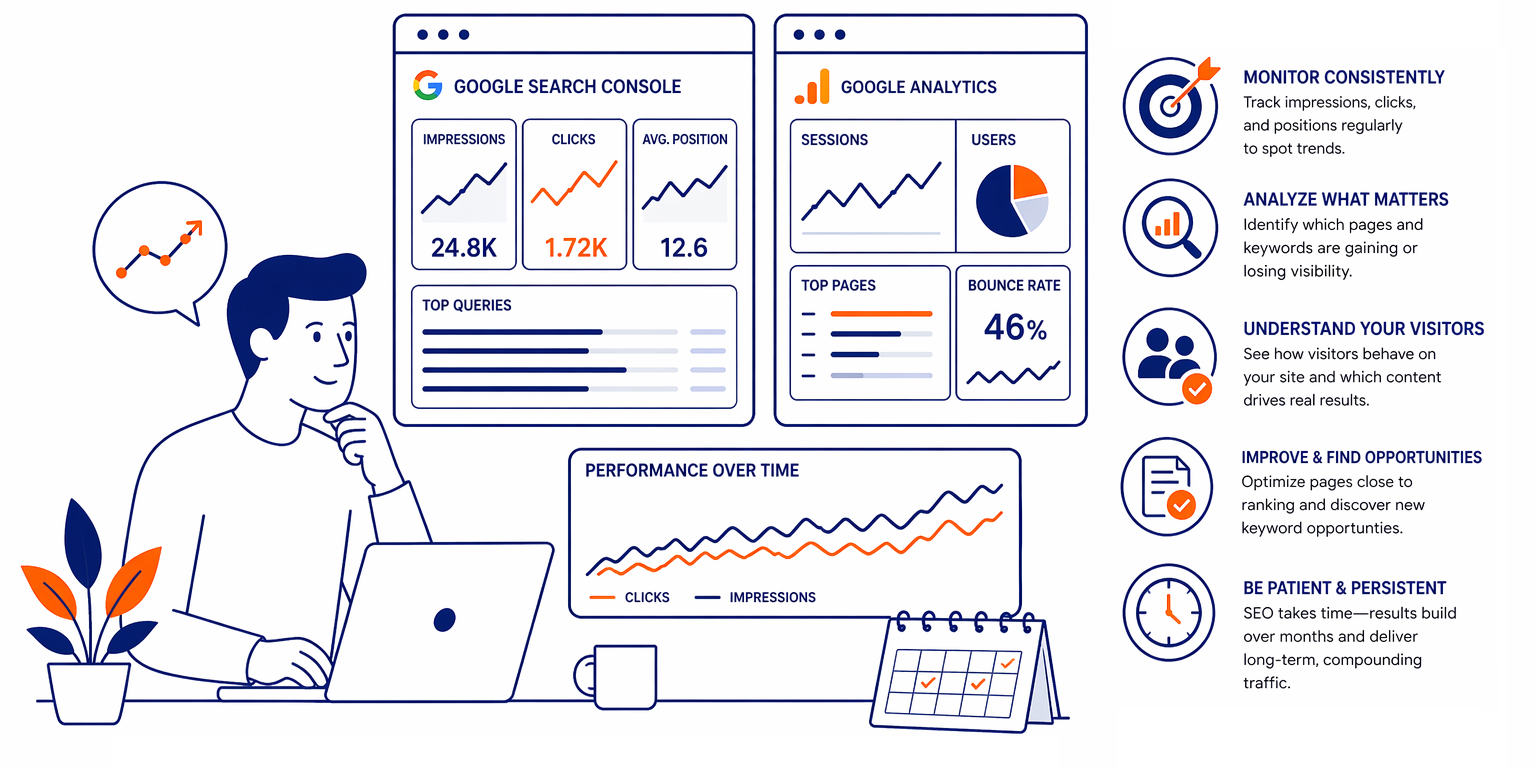
SEO isn’t set-and-forget. Results take months to appear, and ongoing improvement requires consistent monitoring of your site’s performance.
Use Google Search Console to track impressions, clicks, and keyword positions. Google Analytics then shows how visitors interact with your site after arriving from search. Look at which pages are gaining and which are losing visibility over time. Notice which content drives traffic, which keywords are attracting the wrong visitors, and which pages have high bounce rates. Furthermore, use these reports to help you improve specific pages that are close to ranking but not quite there. You can also find new keyword opportunities you hadn’t considered when you first built the site.
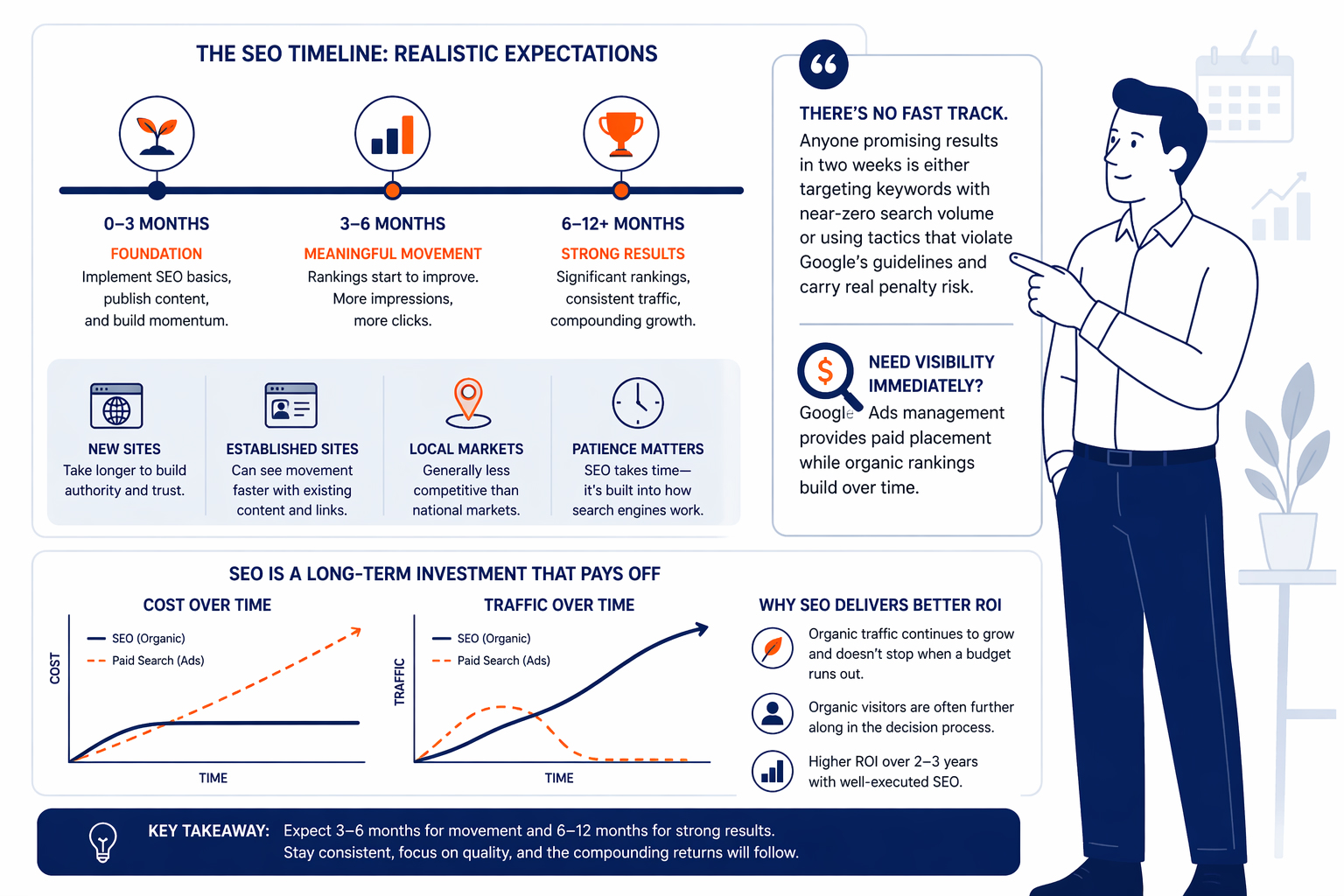
Expect to wait. A well-optimized page may take three to six months to see meaningful movement in search results. Competitive keywords in established markets can take longer. Nevertheless, once achieved, the results are durable: unlike paid ads, which stop the moment the budget runs out, organic search traffic continues to arrive.
How Long Does SEO Take?
Three to six months before meaningful movement. Six to twelve months before strong results. That’s the realistic timeline, and it depends on the competitiveness of your keywords and the current state of your site.
New sites with no existing authority take longer. Established sites with some existing content and links can see movement faster. Local markets are generally less competitive than national ones, which shortens the timeline. Patience isn’t optional here: it’s built into how search engines work.
There’s no fast track. Anyone promising results in two weeks is either targeting keywords with near-zero search volume or using tactics that violate Google’s guidelines and carry real penalty risk. If you need visibility immediately, Google Ads management delivers paid placement while organic rankings build over time.
SEO is a long-term investment. As a result, most businesses find the ROI on well-executed SEO significantly higher than paid search over a two-to-three year horizon, because the organic traffic it generates doesn’t stop when a budget runs out. Organic traffic also tends to create more consistent revenue than paid traffic for many types of businesses, since searchers arriving through organic results are often further along in the decision process.
How to Improve Your Website’s SEO Over Time
SEO isn’t a project with a finish line. The businesses that see the strongest long-term results treat search engine optimization as an ongoing discipline. Here are the most important ways to improve your website’s performance in search over time.
Audit your site regularly. Search engines find and index your site based on its technical health. Regular audits catch problems before they affect your rankings: broken links, slow-loading pages, duplicate content, or pages indexed incorrectly. Check the meta description on each page too: a missing or duplicate description is among the most common issues we find. Tools like Google Search Console and Screaming Frog help you find and fix these issues. Checking your website every few months keeps small problems from becoming large ones, and helps your site maintain the technical health search engines expect.
Create new content consistently. Every page you add to your website is a new opportunity to appear in search results. People searching for information related to your business have different questions at different stages of the buying process. Create pages that answer those questions directly: service pages, location pages, FAQ pages, how-to guides. Each page you create gives search engines more of your website to index, which can help expand your search visibility significantly. Create your pages around specific keywords, and you expand the number of queries your site can appear for. More indexed pages means more opportunities to reach users who are looking for what you offer.
Improve existing pages. Not all SEO gains come from new content. Significant results often come from improving what your website already has. Adding useful information to weak pages is one of the most reliable ways to improve your content’s performance without starting from scratch. People searching for related topics often find these pages first, since search engines tend to favour recently improved content. Search engines favour sites where the content stays fresh and relevant across all pages, not just new ones. We’ve seen pages recover strong positions after a single targeted update.
Build relevant links. Off-page search engine optimization still comes down primarily to links. Examine the quality and relevance of the backlinks pointing to your site: these tell search engines whether your pages are worth ranking. Focus on earning links from sites relevant to your industry or your local market. Keep track of which domains are linking to your website: a Calgary business directory, a regional news publication, an industry association, a supplier with a well-established website. Each relevant link pointing to your site improves its authority in Google’s eyes.
Track keyword positions monthly. Keywords your pages rank for shift over time. Some improve as your site gains authority. Others drop as competition increases or as Google updates its algorithms. Monthly position tracking shows you which pages need work and which content is performing. New keyword opportunities show up in these reports too, terms your site could realistically rank for that you hadn’t originally targeted. It also shows which pages are closest to ranking, so you know exactly where to focus efforts to improve positions first. Position reports are a standard part of search engine optimization done professionally: they show whether your keywords are moving and whether your website is gaining ground.
DIY SEO vs. Hiring an SEO Expert
You can do SEO yourself. The tools exist, the information is available, and covering the basics is within reach of any business owner willing to invest the time. Google’s own documentation is thorough and free.
But here’s the realistic constraint: time. SEO done well requires consistent attention: keyword research, content creation, technical audits, link outreach, and ongoing tracking. For a business owner already running daily operations, maintaining that level of consistent effort is genuinely difficult. Most try it for a while, see limited results from their site, and then let it slide. That’s understandable, but it’s also why they don’t find the growth they were looking for.
Hiring an SEO consultant shifts that burden. A good specialist brings tools, experience, and the ability to identify technical issues that most business owners would miss entirely. Specialists know which tactics produce durable results and which produce short-term movement followed by penalties. Local SEO knowledge matters too. A specialist understands how users search in your target markets, which local directories carry real link value, and how to optimize your website for the cities your customers are actually in.
What to look for when hiring: demonstrated results on actual client websites, a clear explanation of methods, honest timelines, and no promises of specific rankings. Anyone guaranteeing a position on Google for a specific keyword is either misinformed or planning tactics you don’t want your site associated with.
For Calgary and Alberta businesses, SEO services from a specialist with local knowledge offer an additional advantage: understanding of regional search behaviour, local competition, and how to optimize your site for the markets your customers are actually searching from.
SEO Company To-The-TOP! has been doing this work since 2007. White Hat SEO only. Every client works directly with the same specialist: no junior handoffs, no account managers between you and the person doing the work. Verified references available from Petro Management Group Ltd. and Career-Holdings. Monthly position reporting included. If you want to talk through what SEO could look like for your site, call (403) 308-5949.
Frequently Asked Questions
How do I use SEO on my website?
Keyword research comes first. Before you write a word of content, you need to know what people are actually searching for and how competitive those terms are.
Then optimize each page individually: title tag, meta description, headings, and body copy all aligned to one primary keyword. Create a keyword map so each page on your site targets a different term. Submit your site to Google Search Console so Google knows it exists. Build links from relevant external websites over time. Track your positions monthly and revise pages that aren’t climbing.
Using SEO on your website isn’t a task you complete once. It’s ongoing. The improvements compound: search engines find, understand, and rank your pages better as the work accumulates. We’ve worked with businesses that do everything right in month one and then stop. The results eventually decay. Sites that maintain strong search performance are the ones someone keeps working on.
Can I do SEO myself for free?
Yes. Google Search Console, Google Analytics, and Google Keyword Planner are all free. Screaming Frog has a free tier useful for technical audits. The foundational work, on-page optimization, content creation, basic link outreach, costs time rather than money.
Paid tools and specialist experience matter most in competitive markets. That’s where the difference between ranking and not ranking comes down to technical precision and link authority. That gap is real. Even small technical improvements to your site can make a measurable difference in how well your pages perform in search results. Knowing which improvements matter most is one of the most important things a specialist can help you identify.
What is the most important part of SEO?
Content and links. These are the most important factors in a site’s ability to rank in search results. Content gives search engines something to index and rank. Links signal that other sites find your content credible and useful. Technical SEO removes obstacles that prevent search engines from accessing and indexing your content properly.
All three matter. But if resources are limited, content and links produce the most visible results first. Technically perfect sites sometimes struggle because the content is thin. We’ve also seen sites with strong, well-linked content rank despite minor technical issues. Knowing where to focus your content and your keywords in each section is what separates consistent growth from scattered effort.
How do I do SEO optimization for my website?
Build each page around one keyword. Put that keyword in the title tag, the H1 heading, the meta description, the URL, and naturally throughout the body text. Title tags and meta descriptions are what searchers see before they ever reach your site. Write them for the reader. Include the target keyword near the front.
Compress images and add alt text to every one. Ensure the page loads quickly and functions on mobile. Submit the page to Google Search Console so your site gets indexed promptly. Earn links that point to the page from external sites. Monitor the page’s ranking position over the following months, and revise any page that isn’t climbing in search results.
What is the difference between on-page and off-page SEO?
On-page SEO covers everything you control directly on your website: title tags, meta descriptions, headings, content, URL structure, images, internal links, and technical factors like page speed and mobile design. Off-page SEO refers to signals that come from outside your site, primarily backlinks from other websites. Both matter for search engine optimization.
On-page SEO tells search engines what your pages are about and ensures they can be indexed properly. Off-page SEO tells search engines that your site is credible and worth ranking. Search engine optimization done well addresses both: there’s no shortcut that lets you rank without attending to each side.
If you have any other questions, or would like to push your website To The TOP of Google Search results, feel free to reach me by email or phone number on the top right corner of this page (403-308-5949 Greg).
Contact Calgary SEO Company To-The-TOP!
Questions about anything in this article, or about your own rankings? Talk to a Calgary SEO specialist directly.
Phone: (403) 308-5949
Address: 1509 14 Ave SW, Calgary, AB T3C 0W4
Hours:
Monday to Friday: 10:00 am – 7:00 pm
Saturday: 12:00 pm – 4:00 pm
Sunday: closed